
Key Takeaways
AI is transforming loan management by automating processes and improving decision-making.
AI-powered platforms reduce manual work, operational costs, and approval time
Advanced features like predictive analytics and automated underwriting improve risk management.
Choosing the right tech stack ensures scalability, security, and performance
Development costs vary based on complexity, AI capabilities, and integrations.
AI-powered loan management software typically costs between $10,000 to $90,000+, depending on features and scale
Trends like embedded lending and real-time approvals are shaping the future of fintech
Businesses investing in AI lending platforms gain a competitive edge in digital finance.
Financial institutions are rapidly adopting artificial intelligence to modernize lending operations. Traditional loan management processes often involve manual verification, long approval cycles, and high operational costs.
With digital transformation accelerating in the fintech industry, businesses are now investing in AI-powered loan management software development to streamline lending workflows and improve decision-making.
AI-driven platforms allow banks, fintech startups, and lending institutions to automate credit evaluation, reduce risks, and improve customer experience. From automated underwriting to predictive analytics, AI technologies are reshaping how loans are processed and managed.
This guide explains everything you need to know about AI loan management software development, including features, development process, technology stack, cost, and future trends in fintech lending.
AI-powered loan management software is a digital platform designed to automate and manage the entire lending lifecycle using artificial intelligence technologies. It helps financial institutions handle loan applications, credit risk analysis, approvals, repayments, and reporting through a centralized system.
Unlike traditional lending systems, loan management system development with AI integrates machine learning algorithms and data analytics to make faster and more accurate lending decisions.
An AI fintech loan management platform typically includes modules for:
Loan origination
Credit assessment
Risk analysis
Repayment management
Reporting and analytics
By automating these tasks, lenders can reduce manual work, improve accuracy, and process loan applications faster.
Below are some key industry statistics that highlight the growing importance of AI-powered loan management software development and digital lending platforms.
The global AI in lending market is expected to grow from $11.63 billion in 2025 to $14.71 billion in 2026, showing a strong annual growth rate of around 26.5%. This growth is driven by increasing adoption of automated loan origination, real-time risk analysis, and digital lending platforms.
The global digital lending platform market is projected to reach approximately $20.5 billion by 2026, fueled by rising demand for faster loan approvals and improved customer experiences.
The AI in the fintech market is expected to reach around $26.67 billion in 2026, with many fintech companies using AI for underwriting, fraud detection, and automated lending decisions.
The global loan management software market was valued at about $6.9 billion in 2024 and is projected to reach $14.74 billion by 2033, as banks and fintech companies adopt AI-driven platforms to automate loan processing and credit risk assessment.
Nearly 88% of fintech startups are already using AI technologies for functions such as credit scoring, fraud detection, and automated lending operations, showing how AI is becoming a core component of financial technology platforms.
Artificial intelligence has introduced major improvements in how lending systems operate.
Manual loan approval processes often take days or even weeks. AI systems can analyze borrower data instantly and provide recommendations within seconds.
AI algorithms analyze large datasets, including credit history, financial behavior, and transaction patterns, to identify potential risks more accurately.
AI can detect unusual patterns in applications and flag suspicious activities, helping reduce fraud in lending operations.
Borrowers expect quick and seamless loan approvals. AI-powered systems allow lenders to offer faster responses and personalized loan options.
Because of these benefits, many financial institutions are investing in AI-based lending software development to modernize their lending infrastructure.
Successful platforms combine automation, analytics, and user-friendly interfaces.
Below are some essential features commonly included in modern systems
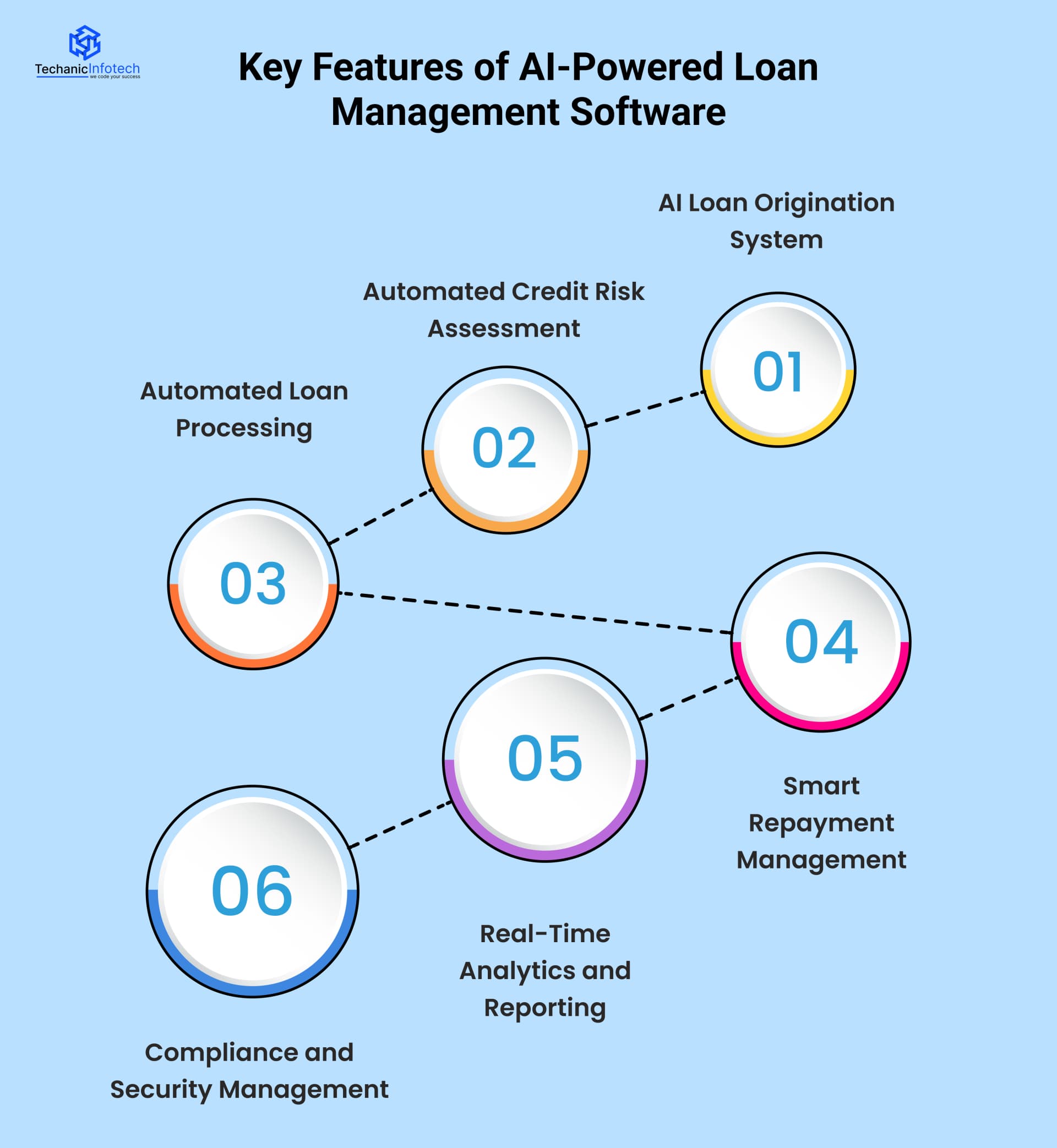
The loan origination module handles application intake and evaluation. AI analyzes borrower data such as credit history, income patterns, and transaction behavior to determine eligibility.
This capability is often referred to as AI loan origination system development, which allows lenders to automate approvals while reducing human bias.
AI models analyze multiple data points to evaluate borrower risk.
Features include:
Credit score analysis
Behavioral risk assessment
Financial history evaluation
Predictive default analysis
These tools form the foundation of AI-driven credit risk management software, enabling lenders to minimize bad debt and improve lending decisions.
Automation significantly reduces manual work in loan processing.
In automated loan processing software development, systems handle tasks such as:
Document verification
Loan approval workflows
Payment scheduling
Status tracking
Automation helps financial institutions process thousands of applications efficiently.
AI-powered platforms track repayment schedules and send automated reminders to borrowers.
They also detect early warning signals for potential defaults by analyzing payment behavior and financial trends.
Loan management platforms generate insights about:
Loan performance
Portfolio risk
Repayment trends
Customer behavior
These analytics help financial institutions optimize lending strategies.
Fintech platforms must follow strict regulatory requirements.
Modern AI loan systems include:
KYC and AML verification
Data encryption
Compliance monitoring
Audit logs
This ensures the platform remains secure and compliant with financial regulations.
Artificial intelligence is transforming how financial institutions evaluate borrower risk and make lending decisions. Traditional credit risk assessment methods rely heavily on historical credit scores and manual analysis.
In contrast, AI uses data-driven models to analyze large datasets and predict potential risks more accurately. Below are some key ways AI improves credit risk management.
AI systems can analyze large volumes of structured and unstructured data, including transaction history, spending behavior, employment patterns, and financial activities.
This broader analysis helps lenders gain deeper insights into a borrower’s financial stability and improves decision-making accuracy.
Machine learning algorithms can identify patterns in borrower behavior and predict the probability of loan defaults.
By using predictive models, lenders can evaluate risks more effectively before approving loans. This capability is a major component of AI-driven credit risk management software, which helps reduce financial losses.
AI platforms continuously monitor borrower activity and repayment behavior after a loan is approved. If the system detects unusual patterns or delayed payments, it can alert lenders early. This proactive monitoring helps financial institutions take preventive actions before risks increase.
Traditional loan approval processes may sometimes involve human bias or inconsistent evaluations. AI models rely on data-driven analysis, which helps create more consistent and objective credit decisions.
AI-powered systems can process loan applications and evaluate risk in seconds instead of hours or days. This speeds up the lending process while maintaining accurate risk assessments, improving both operational efficiency and customer experience.
Building a modern lending platform requires more than just coding a loan application system. Financial software must handle sensitive data, follow strict regulations, process large volumes of transactions, and deliver accurate AI predictions.
Because of this complexity, AI-powered loan management software development follows a structured mobile app development process that ensures scalability, security, and compliance.
Below is a detailed breakdown of the key stages involved in building a reliable AI-based lending software platform.
The first stage focuses on understanding the business objectives, regulatory environment, and technical requirements of the lending platform. Financial software must meet both operational and legal standards, which makes this phase critical.
During this stage, development teams work closely with business stakeholders to define the scope of the project.
Key areas analyzed include:
Type of lending services – personal loans, microloans, SME lending, BNPL, or peer-to-peer lending
Target users – banks, fintech startups, digital lenders, or financial institutions
Compliance requirements – KYC, AML, GDPR, and financial regulations
Integration needs – credit bureaus, payment gateways, banking APIs
Loan lifecycle workflows – application, approval, disbursement, repayment, and reporting
This stage also defines the roadmap for custom loan management software development, ensuring the platform aligns with the lender’s business model.
Proper planning reduces development risks and helps create a scalable architecture for future growth.
Once requirements are finalized, developers design the system architecture. The architecture determines how different components of the platform interact with each other.
A modern AI fintech loan management platform typically uses a modular or microservices architecture, which allows different services to scale independently.
Key architectural components include:
This is the user-facing application where customers submit loan applications, upload documents, track loan status, and manage repayments.
Features usually include:
Loan application forms
Document uploads
Loan calculators
Repayment tracking
Financial institutions require dashboards to manage loan applications, monitor portfolios, and track repayment performance.
These dashboards provide insights into:
Loan approvals and rejections
Risk analysis reports
Borrower profiles
Financial performance metrics
The AI engine analyzes borrower data and predicts credit risk.
It processes multiple data points including:
Credit history
Income patterns
Transaction behavior
Debt-to-income ratio
This engine forms the core of AI-driven credit risk management software.
Backend systems manage the core lending workflows such as loan origination, payment processing, and account management.
Financial systems require strong encryption and secure databases to protect borrower information and transaction data.
A well-designed architecture ensures the system can support high volumes of loan applications while maintaining performance and security.
Artificial intelligence is the most critical component of AI loan management software development. AI models enable lenders to automate credit evaluation and improve risk prediction accuracy.
During this phase, an AI development company builds machine learning models using historical loan datasets.
Training AI models requires large datasets that include:
Borrower credit histories
Repayment records
Financial behavior patterns
Default history
Data preprocessing is necessary to clean and structure the data before training.
Machine learning algorithms are trained to identify patterns that indicate borrower risk.
Common algorithms used include:
Decision trees
Random forests
Gradient boosting
Neural networks
After training, models are tested using validation datasets to measure accuracy and reliability.
Developers optimize models to reduce bias and improve predictive performance.
Accurate models are essential because they determine how effectively the platform evaluates borrower risk.
After the architecture and AI models are ready, developers begin building an AI platform.
This stage includes creating both the frontend user interfaces and backend services that support lending workflows.
Core development components include:
Loan application management
Automated approval workflows
Repayment tracking systems
Notifications and alerts
Reporting and analytics dashboards
For automated loan processing software development, developers integrate several third-party services.
Common integrations include:
Payment gateways for loan disbursement and repayment
Credit bureau APIs for credit scoring
Identity verification systems for KYC checks
Banking APIs for account validation
These integrations allow the system to automate complex lending processes and reduce manual work.
Testing is a critical step in financial software development. Because loan management systems handle sensitive financial data, they must undergo extensive testing before launch.
The app testing process typically includes:
Ensures that all system features work correctly, including loan application workflows, AI predictions, and repayment processing.
Security tests verify that the platform protects sensitive data through encryption and secure authentication.
Loan platforms must support high traffic and large transaction volumes. Performance tests simulate thousands of users to evaluate system stability.
Financial regulations require strict compliance. Developers verify that the platform follows regulatory requirements such as KYC, AML, and GDPR.
Testing ensures the system is secure, reliable, and ready for real-world financial operations.
After successful testing, the platform is deployed to production environments.
Most modern lending platforms are hosted on cloud infrastructure to ensure scalability and reliability.
Deployment activities include:
Cloud server configuration
Database deployment
API management
Monitoring setup
Once deployed, the system requires continuous monitoring and updates.
App maintenance activities include:
AI model updates and retraining
Security patch updates
Performance optimizationFeature enhancements
Continuous maintenance ensures the AI fintech loan management platform remains secure and efficient as user demand grows.
Choosing the right ewallet app technology stack is essential for building a scalable and reliable loan management system. The tech stack determines the platform’s performance, security, and ability to process large volumes of financial data.
Below are the commonly used technologies in AI-based lending software development.
Frontend technologies power the user interface for both borrowers and lenders.
Common frontend frameworks include:
React.js – widely used for dynamic web applications
Angular – ideal for enterprise-level financial platforms
Flutter – used for cross-platform mobile applications
These technologies enable responsive user interfaces and smooth user experiences.
The backend manages core business logic, APIs, and data processing.
Popular backend frameworks include the following:
Node.js – ideal for scalable financial applications
Python (Django / FastAPI) – commonly used for AI-driven platforms
Java Spring Boot – widely used in enterprise banking systems
Backend systems handle loan workflows, payment processing, and integration with financial services.
Artificial intelligence models power the decision-making capabilities of the platform.
Common tools include:
TensorFlow – widely used for deep learning models
PyTorch – popular for building AI prediction systems
Scikit-learn – used for machine learning algorithms
These tools help create models that analyze borrower behavior and predict credit risks.
Financial platforms must manage large datasets efficiently.
Common database solutions include:
PostgreSQL – secure relational database for financial systems
MongoDB – NoSQL database suitable for flexible data structures
Databases store loan records, borrower information, and financial transactions.
Cloud platforms provide scalability, reliability, and security.
Popular cloud providers include:
Amazon Web Services (AWS)
Microsoft Azure
Google Cloud Platform
Cloud infrastructure allows the platform to handle high transaction volumes while maintaining performance and uptime.
The loan management software development cost varies depending on the complexity of the system, AI capabilities, and integrations required.
Below is a typical cost estimate:
|
Platform Type |
Estimated Cost |
|
Basic Loan Management System |
$10,000 – $50,000 |
|
AI-Integrated Lending Platform |
$50,000 – $70,000 |
|
Enterprise AI Lending Platform |
$70,000 – $90,000+ |
Factors influencing mobile app development cost include:
AI model complexity
Number of integrations
Security and compliance requirements
Cloud infrastructure
Development team size
Businesses planning custom loan management software development should also budget for app maintenance strategies and AI model improvements.
The fintech lending ecosystem is evolving rapidly as financial institutions adopt advanced technologies to improve efficiency, reduce risk, and deliver better customer experiences.
Several innovations are shaping the future of AI-powered loan management software development, making digital lending faster, smarter, and more accessible.
Traditional credit scoring models rely on limited financial history, which can exclude many potential borrowers.
Modern AI systems analyze alternative data sources such as transaction behavior, spending patterns, employment history, and digital activity. This allows lenders to make more accurate credit decisions and expand lending to previously underserved customers.
Embedded finance is becoming a major trend in fintech.
Businesses such as e-commerce platforms, payment apps, and marketplaces are integrating lending services directly into their platforms. This allows customers to access credit instantly during purchases or transactions.
AI-driven systems can process large volumes of financial data in seconds, allowing lenders to approve loans almost instantly. Real-time approvals significantly improve the borrower experience and reduce operational delays.
Blockchain technology is being explored to improve transparency, security, and trust in lending systems. It helps create tamper-proof records of loan agreements and transactions.
AI analytics enable lenders to design customized loan offers based on borrower behavior, financial history, and risk profiles, creating more flexible lending solutions.
These AI-related mobile app development trends in 2026 are expected to accelerate innovation across digital lending platforms.
At Techanic Infotech, we focus on helping fintech businesses build scalable and intelligent lending solutions. Our mobile app development company specializes in AI-powered loan management software development, creating platforms that automate loan processing, improve credit risk analysis, and streamline lending operations.
We work closely with banks, fintech startups, and financial institutions to design secure and scalable systems tailored to their business models. From AI loan origination system development and automated credit assessment to real-time analytics and compliance-ready infrastructure, our solutions help organizations modernize their lending processes.
Artificial intelligence is transforming the lending industry by making loan processing faster, smarter, and more efficient. From automated approvals to predictive risk analysis, AI-driven systems enable financial institutions to manage lending operations with greater accuracy and scalability.
Businesses investing in AI-powered loan management software development can streamline loan workflows, reduce operational costs, and improve customer experiences. As fintech continues to evolve, platforms that integrate AI technologies will play a crucial role in shaping the future of digital lending.
Organizations planning to build advanced lending platforms should carefully evaluate features, development processes, and long-term scalability to create systems that meet modern financial demands.
It is a digital system that uses AI to automate loan processing, credit evaluation, approvals, and repayment tracking.
AI analyzes borrower data, automates decisions, reduces risks, and speeds up loan approvals.
Core features include loan origination, credit scoring, document verification, repayment tracking, and analytics dashboards.
Costs typically range from $10,000 to $90,000+, depending on features, AI complexity, and integrations.
Banks, fintech startups, microfinance institutions, and digital lenders benefit from AI-powered lending systems.
Yes, with encryption, compliance protocols, and fraud detection systems, it ensures high-level data security.
Development usually takes 3 to 6 months, depending on features and AI integration.
Yes, AI predicts borrower behavior and identifies risks early, helping reduce default rates.
Technologies include Python, TensorFlow, cloud platforms, APIs, and secure databases.
Yes, they can integrate with banking systems, payment gateways, and third-party financial services
AI evaluates alternative data like spending behavior and transaction history for more accurate credit decisions.
Yes, cloud-based architecture allows the system to scale easily as users and transactions grow.


Bharat Sharma is the CTO of Techanic Infotech, bringing deep technical expertise in software architecture, mobile app development, and scalable system design. He leads the engineering team with a strong focus on innovation, performance, and security.