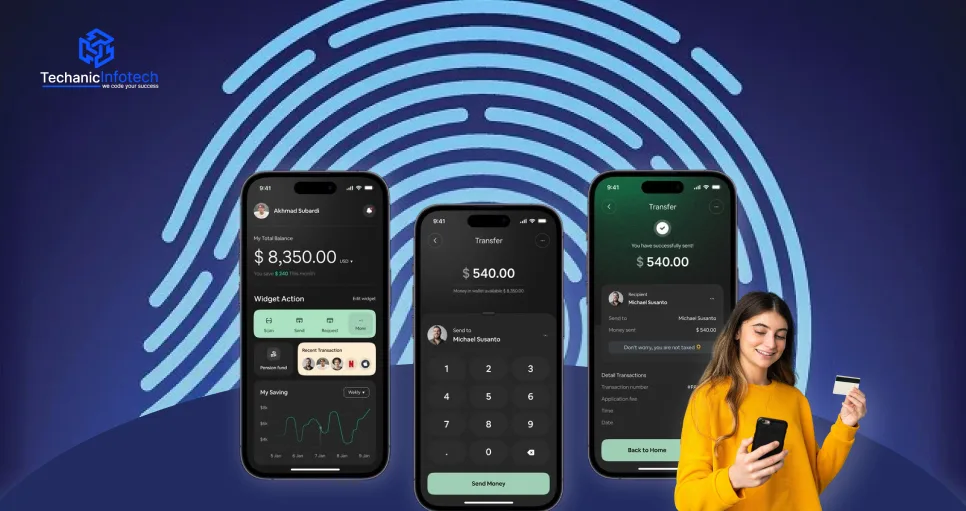
EWallet App Development
Biometric Authentication in eWallet Apps: Process, Types, Benefits & More
December 1, 2025
December 1, 2025
In this digital world, transactions, traditional password-based security systems are becoming increasingly vulnerable to violations. This change makes biometrics an important thing, especially in universities and corporate sectors that use fingerprint authentication, facial recognition, and iris scans; that's an attractive alternative.
For eWallet users, biometric authentication becomes important, especially for security concerns, which delivers faster or frictionless access by adding an extra layer of protection against fraud and unauthorized access.
With the rapid growth of digital payments, mastering ewallet app marketing is crucial for app developers and businesses aiming to thrive in a competitive market.
Incorporating biometric authentication in eWallet apps not only strengthens security but also supports effective eWallet app marketing, helping enhance user acquisition, retention, and overall revenue by offering personalized, seamless, and trustworthy user experiences.
In terms of eWallet app security, biometric identification is considered the best option for eWallet applications because of its ability to identify the user by using their unique biological characteristics.
For enhancing the user experience and application security, these biometric authentications deliver a secure and simple way to access eWallets.
Usually, biometric authentication delivers three identifiers that are used in eWallet applications for authentication, including iris scanning, fingerprint authentication in eWallet with facial recognition.
It is difficult for unauthorized people to unlock the eWallet because these methods usually rely on physical characteristics to keep the eWallet secure from any misuse.
Biometric authentication in eWallet apps has become a key security feature in modern eWallet systems by offering users a faster and more secure way to access their digital payments.
This advanced technology enhances protection against unauthorized access and also improves the overall convenience of digital transactions.
Due to the growth in mobile payments, biometric authentication plays a crucial role in building trust and ensuring a seamless user experience.
Enrollment: During the initial setup of the eWallet app, users are reminded to register their biometric data with their fingerprint or face.
This data is stored securely in the device's hardware or in a secure biometric processor to ensure that it will never be transmitted over the internet.
Verification: When the user attempts to access the eWallet, here users need to authenticate their identity by providing a biometric input.
Authentication can be completed by placing a finger on the fingerprint scanner or looking at the camera for facial recognition.
Authentication Outcome: If the biometric data matches the stored template, the user will get access to their eWallet.
In case of any mismatch with the denied, the user may be prompted to try again or use an alternative authentication method like PIN or password.
Using biometric authentication in eWallet apps to reduce the risk of fraud and unauthorized access while offering users a quick and secure way to manage their digital transactions.
This technology aligns with the growing need for stronger eWallet app security in mobile financial applications.
Biometric technology for eWallet, such as fingerprint scanning, facial recognition, iris detection, and voice verification, offers a unique blend of security and convenience that traditional methods often lack.
Their integration into the best eWallet apps not only boosts protection but also enhances user trust and adoption.
Unlike passwords or PINs, biometric identifiers are difficult to replicate or steal because they are unique to every individual.
This minimizes the risk of fraudulent logins and unauthorized transactions. Even if a fraudulent person gains access to a device then they will fail in terms of opening the eWallet with the biometric lock that creates a strong barrier, prevents access to the app.
Additionally, biometric data is typically encrypted and stored in secure hardware components such as a device’s secure enclave, making it resistant to hacking attempts.
This ensures a higher level of protection for sensitive financial data and reduces common vulnerabilities associated with traditional authentication methods.
Biometric authentication enhances user convenience by eliminating the requirement to remember or manually enter passwords and PINs.
With eWallet app features like fingerprint scans or facial recognition, users can access their eWallets instantly, ensuring a smooth experience.
This not only speeds up login times but also simplifies everyday transactions, especially for users who frequently make mobile payments.
The quick and intuitive nature of biometrics contributes to a seamless digital payment journey, encouraging more users to rely on eWallets over traditional payment methods.
Biometrics play a crucial role in strengthening Multi-Factor Authentication (MFA) systems.
When combined with other authentication layers such as passwords, device verification, or OTPs, biometrics add an extra level of protection that enhances overall system security.
This layered approach ensures that unauthorized access becomes significantly more difficult and reduces the chances of identity theft, account takeovers, or fraudulent transactions.
Integrating MFA (Multi-factor authentication ) to develop an ewallet app with a robust defense mechanism helps make it highly secure in terms of transferring money with proper identification.
Trust is essential in digital payment platforms, and biometric authentication plays a vital role in building user confidence.
When users know their financial data is protected by advanced biometric technology, they feel more secure using eWallets for daily transactions.
This perception of safety encourages more people to adopt digital payments, contributing to the overall growth of the industry.
Businesses that integrate biometrics into their eWallet systems can differentiate themselves by offering enhanced security and modern user experiences, which positively impact customer satisfaction and retention.
Many countries and regulatory bodies emphasize strict security standards for digital payment systems.
Biometric authentication helps eWallet providers comply with these regulations, such as Know Your Customer (KYC) requirements and data protection laws.
The strong identity verification offered by biometrics aligns with guidelines aimed at preventing fraud, money laundering, and unauthorized access.
By meeting these compliance standards, eWallet companies can operate more confidently within regulated markets while ensuring user data privacy and security.
Passwords and PINs are often vulnerable to phishing, shoulder surfing, and data breaches.
Biometric authentication reduces dependence on these traditional credentials, which are easy to forget, guess, or steal.
Users no longer need to manage multiple passwords or rely on easily compromised information.
This shift toward biometric-based security provides a stronger, more user-friendly alternative and lowers the risks associated with weak or reused passwords.
Modern smartphones and tablets come equipped with built-in biometric sensors, making integration considered as one of the best eWallet app ideas.
Device-level support ensures smooth performance, faster authentication, and secure data handling.
Because the biometric data never leaves the device, it enhances privacy while maintaining strong security.
This deep integration also ensures compatibility across different platforms, allowing users to enjoy a consistent and secure experience regardless of their device type.
Overall, biometric authentication plays a transformative role in securing eWallet payments.
Its unique combination of advanced security, user convenience, trust-building, and regulatory alignment makes it an essential tool for the future of digital finance.
Continuous behavioral monitoring involves tracking user activity to create a baseline profile of normal behavior, including tracking of typing speed, mouse movements, device usage, and more.
By analyzing these patterns in real time, the system can detect anomalies that might indicate suspicious activity, such as fraud, identity theft, or unauthorized access. If an unusual behavior is detected, security teams are alerted immediately to take action.
This approach enhances security by identifying threats early, improving the effectiveness of fraud prevention, and minimizing the risk of breaches. It is especially useful in industries with sensitive data or high-risk transactions.
Protection against device theft uses a combination of technologies to safeguard devices from any kind of theft and misuse.
Key features include GPS tracking, helpful in locating a device, remote locking to prevent any unauthorized access, and remote data wiping that deletes sensitive information from the device.
Biometric authentication, such as fingerprint or face recognition, provides an added layer of security, ensuring that a thief doesn’t have any physical access to the device, or is considered one of the top reasons digital wallet fails to open.
This approach ensures that personal or corporate data remains protected, minimizing the risk of information exposure or misuse.
Faster transaction authorization focuses on improving the speed and efficiency of validating transactions while maintaining security.
Technologies like biometric authentication, including fingerprint, facial recognition, and also tokenization, like substituting sensitive information with a secure identifier, are generally used for streamlining the verification process.
These methods enhance security by ensuring that only authorized users can complete transactions and also directly reduce friction in the transaction flow.
By minimizing delays, this role is helpful in improving the user experience for some environments where speed and security are both essential to customer satisfaction.
Meanwhile, eWallet apps generally use biometric authentication to enhance security and also provide a fast and seamless user experience. The following are some common biometric technologies used by eWallet app development companies for safeguarding digital payments and ensuring trustworthiness with user-friendly authentication.
Fingerprint recognition works by scanning the unique ridges and patterns on a user’s fingertip to verify identity.
It is fast, highly accurate, and widely available on smartphones. eWallet apps use it to enable quick login and secure transaction approvals, reducing the risk of unauthorized access.
Facial recognition analyzes distinct facial features such as the distance between eyes, jaw structure, and contours by analyzing them properly.
Using a smartphone camera or maybe laptop that verifies the user before granting access. This authentication type usually delivers multiple offers, like hands-free operation and strong security for e-wallet logins and payment validation.
Voice recognition works by identifying users based on vocal characteristics like tone, pitch, and speech patterns. eWallet apps use it to authenticate users through spoken commands.
It provides a convenient, contactless authentication option while relying on unique voiceprints to prevent impersonation.
Iris scanning captures the complex patterns of the colored ring around the pupil, which are unique and stable over time.
This highly secure biometric method is difficult to replicate, and usually gives authority for the wallet app to authenticate users with exceptional accuracy, typically in advanced security environments.
Palm vein recognition uses near-infrared light to figure out the unique vein patterns inside a user’s palm.
Because these patterns are internal and nearly impossible to copy, this method offers extremely high security. eWallet apps may use it for sensitive transactions requiring robust verification.
Signature recognition authenticates users by analyzing the way they sign their name, including speed, pressure, and stroke order.
It also focuses on behavioral instead of static images, where eWallet apps use this method for users who generally prefer being familiar, handwriting-based authentication for specific tasks.
This biometric authentication type identifies users according to their own patterns in their actions, such as typing rhythm, swiping style, or how they hold their phone.
E-wallet apps use it passively in the background to detect unusual behavior by providing an extra layer of security without interrupting the user experience.
Integrating biometric authentication into eWallets works by enhancing the security and also the user experience by allowing seamless access with high-assurance identity verification.
Below is a detailed guide on how to integrate biometric authentication in e-wallet apps by covering essential components from enrollment to continuous authentication.
This was one of the most secure methods to integrate biometrics in e-wallet by using native operating system APIs. iOS provides the LocalAuthentication framework, enabling face ID for eWallet apps and Touch ID, while Android offers the Biometric Prompt API for fingerprint, face, and iris recognition.
These eWallet API integrations ensure biometric data never leaves the device and is processed within secure hardware by handling the UI prompts, error messages, and fallback logic.
Leveraging these APIs ensures compliance with security standards, reduces the overall complexity for secure e-wallet development, and delivers consistent, user-friendly biometric authentication across diverse mobile devices.
A secure enrollment process is important for enabling biometrics in an eWallet. First of all, the application needs to be verified by ensuring that the device supports biometric hardware.
Not only this, but it's also important to verify whether the user has already enrolled biometric data in system settings. If not, the app should guide them to enable it.
During enrollment, the e-wallet binds a cryptographic key or secure token to the biometric authenticator. This key is stored locally in secure hardware and is used to verify future authentication attempts.
A smooth, guided enrollment process helps users understand the benefits and reduces friction in adopting biometric authentication.
Biometrics can deliver a strong factor in an MFA system for protecting the e-wallet against unauthorized access for the users.
Pairing biometrics with device PINs, passwords, or one-time passcodes adds layers of defense. MFA can be triggered during high-risk scenarios such as logging in from a new device or performing sensitive account changes.
Biometrics can also act as secondary verification for password-based logins. By combining something the user knows, their PIN, device, and biometrics where e-wallets achieve a high-security standard by maintaining ease of use.
Biometric authentication is not only used for logging into the application, but also supports securing the monetary transactions.
Sometimes, e-wallets require fingerprint and face recognition for identification and to save it from unauthorized login.
This approach allows users to easily unlock their e-wallet app for making transactions, greatly reduces fraud risks, and enhances user confidence.
Here, the biometric works as the app with a digital signature by confirming the identity of the person by initiating the transactions.
Certain non-transactional but sensitive operations require additional protection where biometric authentication plays a significant role.
These include viewing saved cards, accessing transaction history, modifying security settings, or exporting financial statements.
By requiring biometric verification specifically for these actions, e-wallets add a targeted security layer without inconveniencing the user during regular navigation.
This protects personal and financial information from anyone who might temporarily access the device.
Ensuring biometrics guard these sensitive functions strengthens the overall security posture of the application and mitigates internal privacy risks.
User trust is critical for implementing biometrics, so clear communication and consent are necessary.
Meanwhile, e-wallet must explain why biometrics are used, how the data is handled, and emphasize that biometric information never leaves the device.
The app should provide intuitive options for enabling or disabling biometric login at any time.
Transparent privacy settings and consent prompts help the user stay in control of their security preferences.
Compliance with privacy regulations also becomes easier when users are fully informed and empowered to manage their authentication settings.
Biometric systems can fail due to hardware damage, environmental factors, or recognition issues.
Providing fallback authentication methods like PIN, password, or pattern ensures users can always access their e-wallet.
These backup methods must be secure and should be required during the initial setup of biometric authentication.
Additionally, fallback options are useful when users temporarily disable biometrics or lend their device to trusted individuals.
A balanced authentication framework ensures reliability and accessibility without compromising overall security.
Continuous authentication enhances security during prolonged user sessions. Instead of a one-time login, the e-wallet can periodically check for biometric verification based on user inactivity, transaction behavior, or real-time risk signals.
These methods in the e-wallet help strengthen protection against session hacking and unauthorized access while maintaining user convenience.
It ensures the identity of the active user remains trusted throughout the session, reducing fraud and enhancing overall app integrity.
Biometric technology is transforming e-wallet security by offering stronger, faster, and more user-friendly authentication methods.
This advanced approach enhances security while maintaining convenience, making digital transactions safer and more efficient. Consider the following benefits that one should get with biometric authentication in eWallet apps.
Biometric authentication in digital apps enhances e-wallet security by relying on unique physical characteristics like fingerprints or facial patterns, which are extremely difficult to replicate. This makes unauthorized access far less likely compared to passwords or PINs.
By ensuring only the legitimate user can unlock the app, biometrics provide a stronger, more reliable layer of protection.
Biometrics in e-wallets enable faster authentication by allowing users to access their wallets instantly with a quick fingerprint or facial scan.
This eliminates the requirement for inputting the passwords by speeding up the login and transaction process.
The seamless, near-instant verification improves user experience while maintaining high security, especially during frequent or instant payments.
Biometric login makes e-wallet apps more convenient and user-friendly by removing the hassle of remembering complex credentials. Users simply tap or glance at their device to authenticate.
This easy, intuitive process encourages consistent security habits without adding friction, ensuring that strong protection does not compromise the overall usability of the e-wallet.
Using biometric authentication in digital apps helps significantly reduce fraud risk because biological traits cannot be easily stolen, guessed, or shared like passwords.
Only the rightful owner can authenticate transactions, reducing unauthorized access attempts.
This added security makes it much harder for spammers to exploit account weaknesses, creating a safer environment for digital payments and personal data.
Biometric data in modern e-wallets is stored securely at the device level, often within encrypted hardware like Secure Enclave or Trusted Execution Environment.
This ensures that sensitive information never leaves the device or travels over networks. Localized storage minimizes exposure to cyberattacks, providing stronger protection for both authentication data and user accounts.
Biometrics strengthen multi-factor authentication in e-wallet apps by adding a highly secure factor.
When combined with passwords, PINs, or device-based verification, they create a layered defense that is far harder for attackers to bypass.
This comprehensive security approach enhances protection for financial transactions and sensitive digital identities.
Biometric authentication, which uses unique physical characteristics such as fingerprints, facial recognition, iris patterns, and voice recognition to verify identity, has become increasingly popular due to its convenience and perceived security.
However, despite its growing adoption, biometric authentication in digital app systems faces several challenges and limitations that one should consider.
Biometric data is highly sensitive, where its misuse or unauthorized access to an e-wallet can have serious consequences. Unlike passwords, biometric traits cannot be changed with proper authentication.
Ensuring secure storage, encrypted transmission, and strict access controls is essential, but even with safeguards, users may worry about surveillance, tracking, or data breaches, making privacy a major challenge.
Biometric authentication in digital apps systems usually depends on specialized sensors or scanners, which may not function optimally in all conditions.
Poor lighting, dirt, moisture, or device wear can reduce reliability, where malfunctioning hardware or low-quality sensors can prevent accurate recognition, limiting usability.
These environmental and hardware constraints usually make biometric authentication in digital authentication more challenging to provide consistent, seamless authentication for all users.
No biometric system in e-wallet is 100% accurate or delivers true results, as false positives allow unauthorized access, while false negatives deny legitimate users from logging in to the e-wallet.
Therefore, numerous variations in fingerprints, facial changes, or voice modulation work to reduce the reliability of the system.
Such errors frustrate users and can undermine trust by highlighting the requirement for continuous calibration, high-quality sensors, and complementary security measures.
Integrating biometric authentication in digital apps requires investment in sensors, cameras, secure storage, and encryption technologies. Additionally, ongoing maintenance, software updates, and staff training add to expenses, making the initial and long-term deployment of biometric systems a significant financial consideration.
Advanced integration of biometric authentication features, such as fingerprint scanning or facial recognition, can influence the overall eWallet app development cost, as these technologies require higher security standards and specialized implementation.
Despite being secure, biometrics can be tricked using photos, masks, synthetic fingerprints, or voice recordings.
Attackers may exploit system vulnerabilities, bypassing authentication. Implementing anti-spoofing measures like liveness detection adds complexity and cost.
This limitation shows that biometrics are not infallible and must be combined with other security layers.
Techanic Infotech, a leading eWallet app development company, specializes in creating secure, user-friendly payment solutions integrated with advanced biometric authentication in digital apps.
By leveraging fingerprints, facial recognition, and other biometric technologies, the company ensures that only authorized users can access accounts and authorize transactions.
Their expertise in device-level encryption, multi-factor authentication, and secure data storage helps minimize fraud risks and password vulnerabilities.
With a focus on seamless user experience, Techanic Infotech designs e-wallet apps that are fast, convenient, and reliable, ensuring smooth onboarding and transaction processes.
The company also addresses compliance with global privacy and data protection regulations, safeguarding sensitive financial information.
Biometric authentication in eWallet apps offers the best combination of enhanced security, user convenience, and fraud prevention.
Leveraging these identifications, such as fingerprints, facial features, or voice patterns, allows e-wallets to reduce the risks associated with passwords by providing a seamless user experience.
Demand for secure and convenient digital transactions increases as integrating biometrics into e-wallet apps is a trend, also a necessary step toward ensuring trust, compliance, and long-term user adoption.
However, developers must consider challenges, such as privacy concerns and hardware limitations, to ensure that biometric systems are both secure and accessible.
Biometric authentication in eWallets verifies a user’s identity using unique physical traits such as fingerprints, facial recognition, or iris scans, ensuring secure access and protecting sensitive financial transactions from unauthorized use.
Yes, biometrics are generally safer than passwords because they rely on unique, hard-to-replicate physical traits, reducing risks of theft, guessing, or phishing attacks, and providing stronger protection for e-wallet accounts.
If biometric authentication fails, users are usually prompted to use alternative methods such as passwords, PINs, or security questions to access their eWallet, ensuring continued account access without compromising security.
Yes, biometrics can be combined with multi-factor authentication (MFA) to add an extra layer of security, pairing lines like “something you are” with “something you know” or “something you have” for stronger protection.
Biometric data is stored securely on the device using encrypted hardware modules like Secure Enclaves or Trusted Execution Environments, ensuring it never leaves the device and is protected from hacking or unauthorized access.


Abhishek Jangid is the CEO of Techanic Infotech, with extensive experience in mobile app and web development. He specializes in helping businesses turn innovative ideas into scalable digital solutions through strategic planning and modern technology.