Key Takeaways
The cost to build a taxi app in the USA ranges from $20,000 to $120,000, depending on the app’s features and complexity.
Basic apps with core functionalities like ride booking and GPS start around $20,000, while mid-level apps with advanced features cost between $30,000 and $60,000.
High-end apps, including AI-based features and real-time tracking, can go up to $150,000 or more.
Key factors affecting costs include the platform choice (native vs. cross-platform), tech stack, and design quality.
To reduce costs, strategies like launching an MVP, outsourcing development, and using white-label solutions can be highly effective.
Techanic Infotech offers tailored, cost-efficient solutions, focusing on MVP development, scalable cloud hosting, and post-launch maintenance to ensure your taxi app meets your goals within budget.
The demand for taxi app booking services and the ride-hailing industry is growing, especially in urban areas of the USA.
The cost to build a taxi app in USA usually depends on several factors, such as the features of the application, the complexity of its design, and the development team’s location.
Making basic taxi apps with core features such as ride booking, GPS integration, and payment gateway can start from $20,000, whereas more advanced apps with real-time tracking, AI-based route optimization, and multi-language support can go up to $150,000 or more.
This price usually contains the cost of the development of the app for both drivers and passengers, including maintenance and updates.
Understanding the taxi app market and specific business requirements will help to build the app to fit your needs, whether you're a startup or a larger company in the taxi industry.
The taxi and ride-hailing market in the USA has seen a remarkable transformation from 2014 to 2024, growing as digital mobility becomes the preferred mode of transportation.
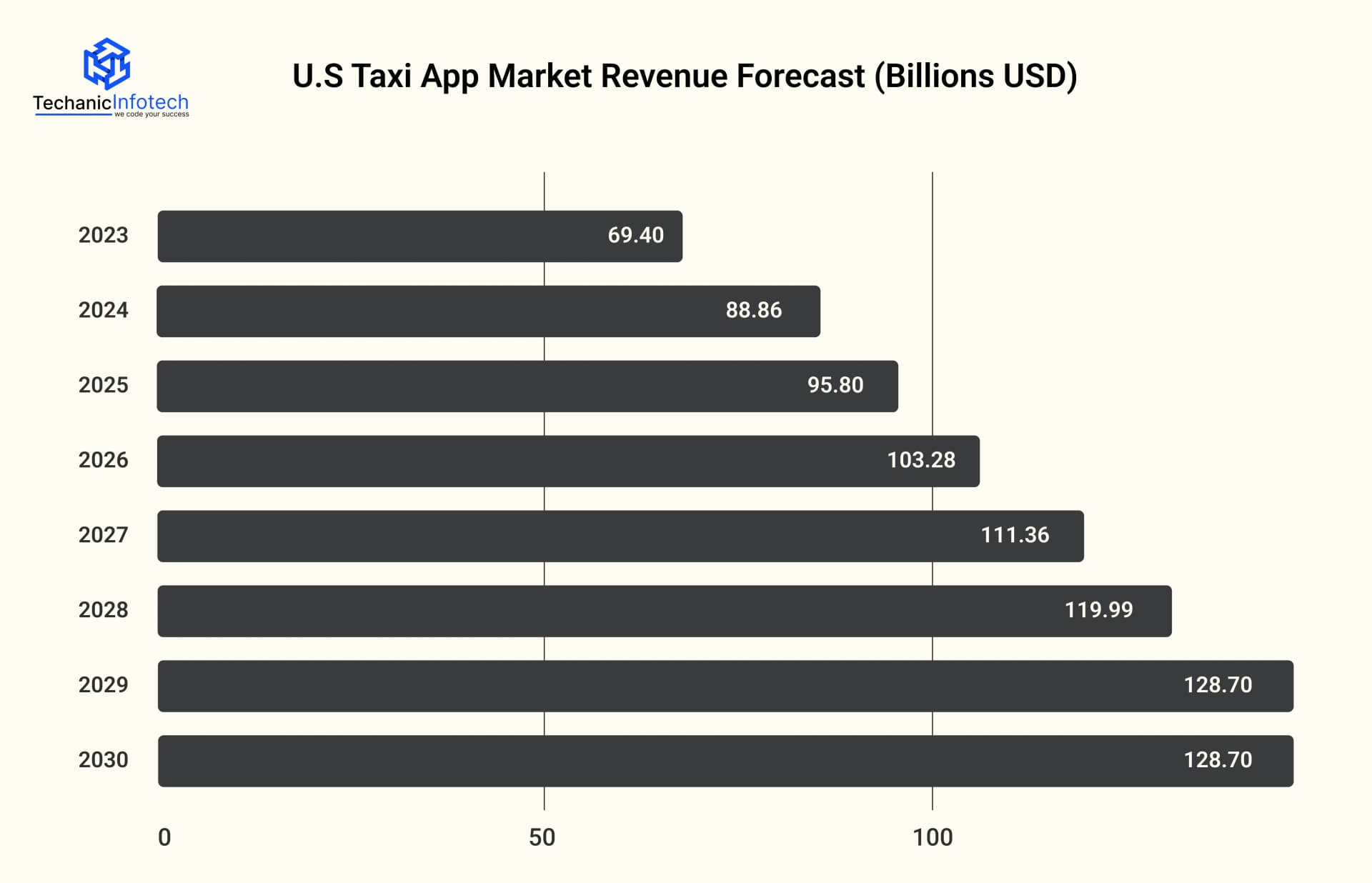
Industry estimates suggest the USA ride-hailing market expanded from around $25 billion in 2015 to nearly $60 billion in 2024, marking an approximate 140% growth within nine years.
Over 78% of riders now prefer features like one-tap booking, 72% use digital payments, and nearly 65% rely on ride history and real-time tracking before booking a ride.
Source: [Statista, Grand View Research, or other relevant market reports]
Best taxi apps in the USA, like Uber and Lyft, have set performance benchmarks. Uber alone handled an estimated 7.6 billion trips globally in 2023, while Lyft captured nearly 29% of the American market share by the end of 2024. These standards have encouraged businesses to explore innovative models such as:
Shared rides (growing at 12% annually),
Corporate travel solutions (adopted by 40% of mid-sized businesses),
Subscription-based mobility (projected to grow 18% by 2026), and
Eco-friendly taxi fleets, where electric ride-hailing saw a growth of 25% between 2021–2024.
Technology is also reshaping the industry. AI advancements have boosted ETA prediction accuracy by nearly 30% since 2020, while IoT-based vehicle monitoring has improved tracking efficiency by 40%.
With this diversification, the Western taxi app industry remains a ground for innovation for businesses exploring new taxi app ideas and revenue models.
Building a taxi app is a significant investment, with costs varying based on the app’s features, complexity, and the development approach. Understanding the price range for different types of taxi apps is essential for anyone looking to create an app.
The cost to develop a taxi app in the USA can range from basic to high-end solutions, with additional factors like tech stack and post-launch maintenance further influencing the total expenditure.
A basic taxi app includes essential features like ride booking, fare estimation, GPS navigation, and payment integration. These apps are perfect for small businesses or startups that usually have a limited budget.
The design of these applications is simple and doesn’t include any advanced features such as real-time traffic updates or a robust driver-rating system. The development process for these apps usually takes less time and involves fewer resources, which keeps costs down.
However, even a basic app requires skilled developers to ensure functionality and a user-friendly experience, which will still result in significant upfront investment.
A mid-level taxi app usually contains advanced or a wide range of features, such as ride management, in-app messaging, multiple payment methods, driver and rider ratings, and fare splitting.
It may also support multiple types of rides, such as economy, premium, and shared rides. The design and user interface (UI) are more sophisticated than a basic app, ensuring a better user experience. Due to its features, these applications usually range between $50,000- $80,000.
Development may take longer due to the added functionality, and more resources are required. A mid-level app could be a good choice for a growing taxi business or those looking to enter competitive markets.
High-end taxi apps are usually designed for large companies or industries that are looking to scale their taxi business more quickly.
These apps come with features like real-time vehicle tracking, sophisticated driver dispatch systems, advanced analytics, and integrated AI or machine learning for route optimization are common in these apps.
The development process is long and resource-intensive, requiring skilled developers, UI/UX designers, and system architects. Advanced taxi app features of these applications make their pricing range from $80,000-$1,50,000.
Additionally, high-end apps often support multiple languages and currencies for international markets. These apps are ideal for businesses aiming to compete with industry giants like Uber or Lyft.
In addition to the core taxi app development cost in the US, several other factors influence the total price of a taxi app.
These can include costs for app design, cloud services, third-party APIs, security measures, and legal compliance. Cloud hosting fees also play a significant role, especially if the app experiences high traffic.
Marketing, app store fees, and customer support infrastructure are additional ongoing expenses that businesses must factor in when budgeting for app development.
The choice of tech stack significantly impacts the development cost of the taxi booking applications.
For a taxi app, selecting the right combination of front-end and back-end technologies is crucial to ensure performance, scalability, and security.
The architecture of the app also matters, whether it’s a monolithic or microservices-based architecture.
Microservices allow for easier scalability and better performance, but increase development complexity and costs.
The tech stack of taxi apps affects the overall cost, time-to-market, and long-term maintenance.
Once a taxi app is launched, it requires ongoing maintenance to ensure it continues to function well and stays up to date with OS updates, security patches, and bug fixes.
Maintenance costs can range between $5,000- $20,000 annually, depending on the complexity and scale of the app.
This includes fixing any bugs that arise, updating the app to comply with changing regulations, and adding minor feature updates.
Additionally, if the app experiences high traffic, server optimizations and infrastructure scaling will be necessary. The post-launch phase also includes customer support, which can further increase operational costs.
When planning to build a taxi app, it's crucial to understand the factors that affect its development cost. These factors can vary from the app's complexity to the choice of platform and design of taxi app.
By understanding these variables, you can make more informed decisions to ensure your project stays within budget while meeting business goals.
The number and complexity of features in a taxi app directly influence its development cost.
Basic features like ride booking, GPS navigation, and payment integration are relatively simple, but advanced features such as real-time tracking, AI-based route optimization, in-app chat, and multiple payment options require more development time and resources.
The more features and complexity your app has, the higher the development cost. Customization and unique functionalities, like integrating with other apps or offering real-time traffic information, can push the cost higher.
|
Feature |
Average Development Cost |
Description |
|
Basic Features |
$1000-$3000 |
Includes essential features like ride booking, GPS navigation, and payment integration. |
|
Intermediate Features |
$3000 - $6000 |
Includes features like ride history and multiple payment options. |
|
Advanced Features |
$6000 - $8000 |
Includes real-time tracking, AI-based route optimization, and in-app chat. |
|
Customization & Unique Features |
$8000+ |
Includes integration with other apps, real-time traffic info, and unique custom features. |
Choosing the platforms for your taxi app, whether iOS, Android, or both, will significantly impact the development cost.
Developing an app for both platforms means you’ll need to either develop two separate native apps or use cross-platform technology.
Cross-platform frameworks like Flutter or React Native can lower costs, but they may not provide the same performance as native apps.
Therefore, if you need an app to work seamlessly across all devices with minimal bugs, native development may be worth the additional cost.
|
Feature |
Description |
Cost Estimate |
|
iOS Development (Native) |
Developing a dedicated iOS app tailored to Apple devices (iPhones, iPads, etc.). |
$4000 - $6000 |
|
Android Development (Native) |
Developing a dedicated Android app tailored to Android devices (smartphones, tablets, etc.). |
$4000 - $6000 |
|
Cross-Platform Development (Flutter/React Native) |
Developing a single app for both iOS and Android using a cross-platform framework. |
$3000 - $6000 |
The quality of the app’s design, including UI/UX, plays a vital role in its success and user retention.
A premium UI/UX designer will ensure the app stands out in a competitive market, improving usability and engagement.
Simple designs with limited user interaction, however, are cheaper but may not provide the best experience.
Balancing design aesthetics and functionality is key to controlling costs while creating a competitive product.
The location of your development team can significantly impact the overall cost of building a taxi app.
Development costs are higher in North America and Western Europe due to higher labor rates compared to regions like Eastern Europe, India, and Southeast Asia.
Choosing the right development team involves weighing these factors and selecting a team with the right skills and experience, whether domestic or offshore, to ensure a successful outcome.
Taxi apps often rely on third-party services such as maps, payment gateways, and SMS notifications. These services come with licensing or subscription fees that can add up quickly.
These external services may offer valuable functionality, but they add an ongoing cost to create a taxi app in the USA under budget.
It’s important to factor these expenses into your overall app development cost for accurate financial planning.
Integrating AI-powered features such as predictive algorithms for ride matching, dynamic pricing, or route optimization can substantially increase development costs.
AI requires significant data processing, machine learning models, and advanced algorithms, all of which demand highly skilled developers and data scientists. Additionally, AI solutions need continuous updates and improvements to remain accurate and effective.
While AI in taxi app development can improve app performance and user experience, it’s essential to assess whether these features align with your business goals and if the added cost is justified.
|
Feature |
Description |
Cost Estimate |
|
AI Model Training & Data |
Ongoing AI Model Maintenance |
$2000 - $5000 (initial training and data setup) |
|
Machine Learning Specialist |
To properly implement AI, from skilled developers and data scientists |
$1000 - $2000 per year (for hiring specialists) |
|
Ongoing AI Model Maintenance |
AI systems require regular updates and maintenance to adapt to new data and trends. |
$2000 - $4000 annually |
Taxi app development in the USA has become an essential part of urban transportation, with demand for ride-sharing services continuously rising.
The development of the best taxi apps varies based on their complexity, features, and business model. Here’s a breakdown of the costs associated with building different types of taxi apps.
Creating an Uber-like app requires advanced features such as real-time tracking, payment integration, driver and rider profiles, rating systems, and route optimization.
The cost can range from $30,000 to $150,000 or more, depending on the app’s complexity and technology stack.
Additionally, features like surge pricing and GPS integration can further increase development costs. Customization and scalability are key factors in the price.
A Lyft-like app is similar to Uber but with minor differences, such as unique branding and interface preferences. The cost typically falls between $100,000 and $140,000.
Key features such as ride-hailing, driver verification, user ratings, and seamless payment systems contribute to the overall expense.
Advanced functionalities like ride-sharing and carpooling options might increase the budget, but the app is still relatively less expensive than an Uber-like app.
A Via-like app focuses on shared rides, allowing multiple users to book a ride together. This reduces the cost per ride and makes the app appealing to budget-conscious riders. The cost to build a taxi app in USA typically ranges from $80,000 to $120,000.
The app requires features like ride-pooling algorithms, route optimization, and scheduling, making it less expensive than individual ride-hailing apps but still complex due to coordination needs.
Local taxi apps targeting specific regions or communities typically have fewer features and simpler interfaces than larger services. Development costs for these apps range from $50,000 to $100,000.
While the scope of functionality is more limited, key features such as GPS, payment integration, and basic ride-booking still need to be implemented.
Local competitors often focus on affordability and localized needs, reducing overall development costs.
Luxury or corporate taxi apps cater to high-end clients, providing premium features such as luxury vehicle options, priority booking, and enhanced customer service.
The cost of developing such apps can range from $60,000 to $100,000+, depending on the desired features.
Integration of real-time customer support, high-end vehicle tracking, and multiple payment options can increase the cost to build a taxi app in the US.
Developing a taxi app can be a costly venture. However, several strategies can help you lower the overall cost of development while maintaining essential features.
These tips focus on smart decisions in app design, outsourcing, and gradual rollout, ultimately saving you both time and money.
Building a Minimum Viable Product (MVP) allows you to focus on the core functionalities necessary for your taxi app, such as booking and payment systems.
The cost to build an MVP is significantly lower than developing a full-fledged app with all the bells and whistles.
An MVP can reduce development time by 30-50%, depending on the complexity of the app, potentially saving you anywhere from $10,000 to $50,000 in the early stages of development.
Outsourcing the development of your taxi app to a reliable team of experts, particularly from regions with lower labor costs, can significantly reduce your expenses.
Outsourcing to regions like Eastern Europe, India, or Southeast Asia can reduce your development costs by up to 40-60% compared to hiring in-house developers in the USA or Western Europe.
For instance, if the development cost in the USA is $100,000, outsourcing could bring that down to $40,000 to $60,000.
White-label solutions provide a pre-built, customizable platform that can be branded according to your needs. These solutions save time and money as they don’t require building the app from scratch.
By using a white-label solution, you can save 60-70% of the cost compared to developing a custom-built app from scratch.
A white-label taxi app may cost between $10,000 to $40,000, depending on the features and customizations you require. In contrast, a fully custom taxi app can cost $50,000 to $120,000 or more.
Using cloud hosting services for your taxi app helps lower infrastructure costs. Cloud providers offer scalable resources, which means you only pay for the services you use.
Cloud hosting can reduce infrastructure costs by as much as 30-50%. Instead of paying for servers, hardware, and maintenance, you can pay a monthly or pay-as-you-go fee, which is typically between $200 to $2,000 per month, depending on the scale of your app.
Cloud services also offer better scalability, so your costs increase only as your app grows, rather than requiring significant upfront investments.
Instead of adding all possible features right away, prioritize essential functionalities and leave out non-critical options.
By avoiding non-essential features, you could save $5,000 to $20,000 during the initial development phase.
Features like advanced analytics or AI-based algorithms can significantly increase your budget, so it’s wise to prioritize only the core functionalities first, such as ride booking, payment, and driver management.

Techanic Infotech is called the best taxi app development company, with expertise in providing cost-effective app development services that are customized for meeting the specific requirements of clients based in the USA.
The team of our company usually works by following a flexible development model, offering more custom solutions to save extra time by reducing the overall cost to build a taxi app in the US.
By focusing on building a solid MVP first, they help businesses launch quickly and economically. Techanic Infotech also leverages outsourcing and cloud-based technologies to lower operational costs.
Their expertise in phased development ensures businesses can start with essential features and scale up as demand grows, ensuring an affordable yet feature-rich taxi app.
The cost to build a taxi app in USA usually depends on multiple features, complexity, and tech stack.
Basic applications development starts from $20,000, high-end solutions with advanced features cross $120,000.
Understanding the factors affecting the overall cost of development is important to reduce it, whether it's about choosing the platform or getting extra services. These approaches help budget the taxi app development process.
Choosing the best strategy for app development also plays a significant role in boosting permanence and saving extra money.
The cost ranges from $20,000 to $120,000 depending on app type, features, platforms, design, and technology stack. Advanced apps with AI and analytics cost significantly more than basic MVP versions.
Development time varies from 2 to 8 months based on features, platform count, complexity, and testing requirements. MVPs take 2–3 months, while full-scale apps like Uber require multiple iterations.
Core features include ride booking, GPS tracking, payments, driver ratings, notifications, an admin dashboard, and fare estimation. Additional features like AI routing, loyalty programs, and ride-sharing enhance the customer experience.
Yes, by creating an MVP first, avoiding complex features initially, and using white-label or outsourced development options, you can build a functional Uber-like app at a lower budget.
Server usage, new feature additions, security updates, bug fixes, and platform updates impact maintenance costs. Typically, businesses spend $5,000 to $20,000 annually on upkeep.


Abhishek Jangid is the CEO of Techanic Infotech, with extensive experience in mobile app and web development. He specializes in helping businesses turn innovative ideas into scalable digital solutions through strategic planning and modern technology.