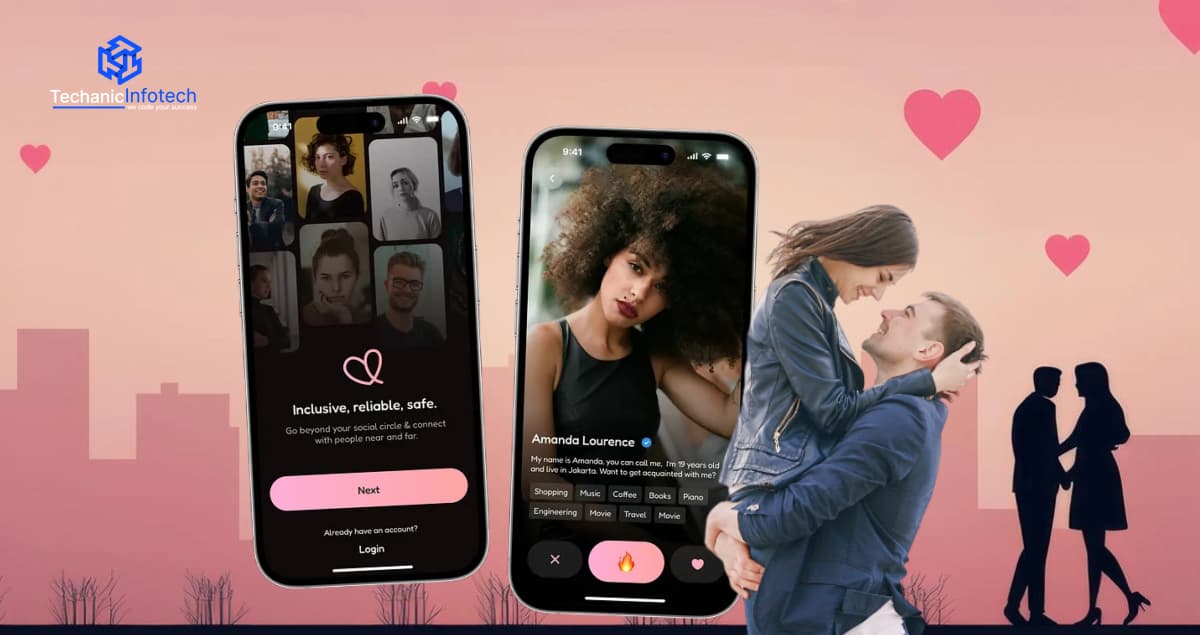
The global dating app industry continues to grow rapidly, driven by changing social behaviors, mobile-first users, and increasing acceptance of online matchmaking.
However, building a successful dating app is far more complex than launching a basic mobile product.
It requires deep market understanding, technical expertise, user psychology insights, compliance awareness, and a sustainable monetization strategy.
Dating app consulting helps entrepreneurs, startups, and enterprises transform raw ideas into scalable, market-ready platforms.
From validating concepts and identifying niche opportunities to defining monetization models and planning go-to-market strategies, consultants guide founders through every stage of development.
With intense competition and high user expectations, expert guidance minimizes risks, shortens time-to-market, and increases long-term success.
A well-structured consulting approach ensures your dating app is not just launched but adopted, trusted, and profitable.
The dating app market is highly competitive, dominated by global players like Tinder, Bumble, and Hinge, while niche platforms continue to emerge.
Users increasingly prefer niche-based dating apps focusing on religion, profession, lifestyle, or shared values rather than generic matchmaking.
AI-powered matchmaking, behavioral analytics, and preference-based algorithms are shaping user expectations.
Privacy, data security, and user safety have become critical decision factors due to growing awareness and regulations.
Freemium models dominate, but users are willing to pay for premium features that improve match quality and visibility.
Mobile-first design is mandatory, with seamless UX and minimal onboarding friction.
Social discovery features such as video profiles, live streaming, and icebreakers are gaining popularity.
Idea validation transforms a dating app concept into a viable business by testing demand, defining the audience, minimizing risk, and ensuring the idea can scale profitably before development begins.
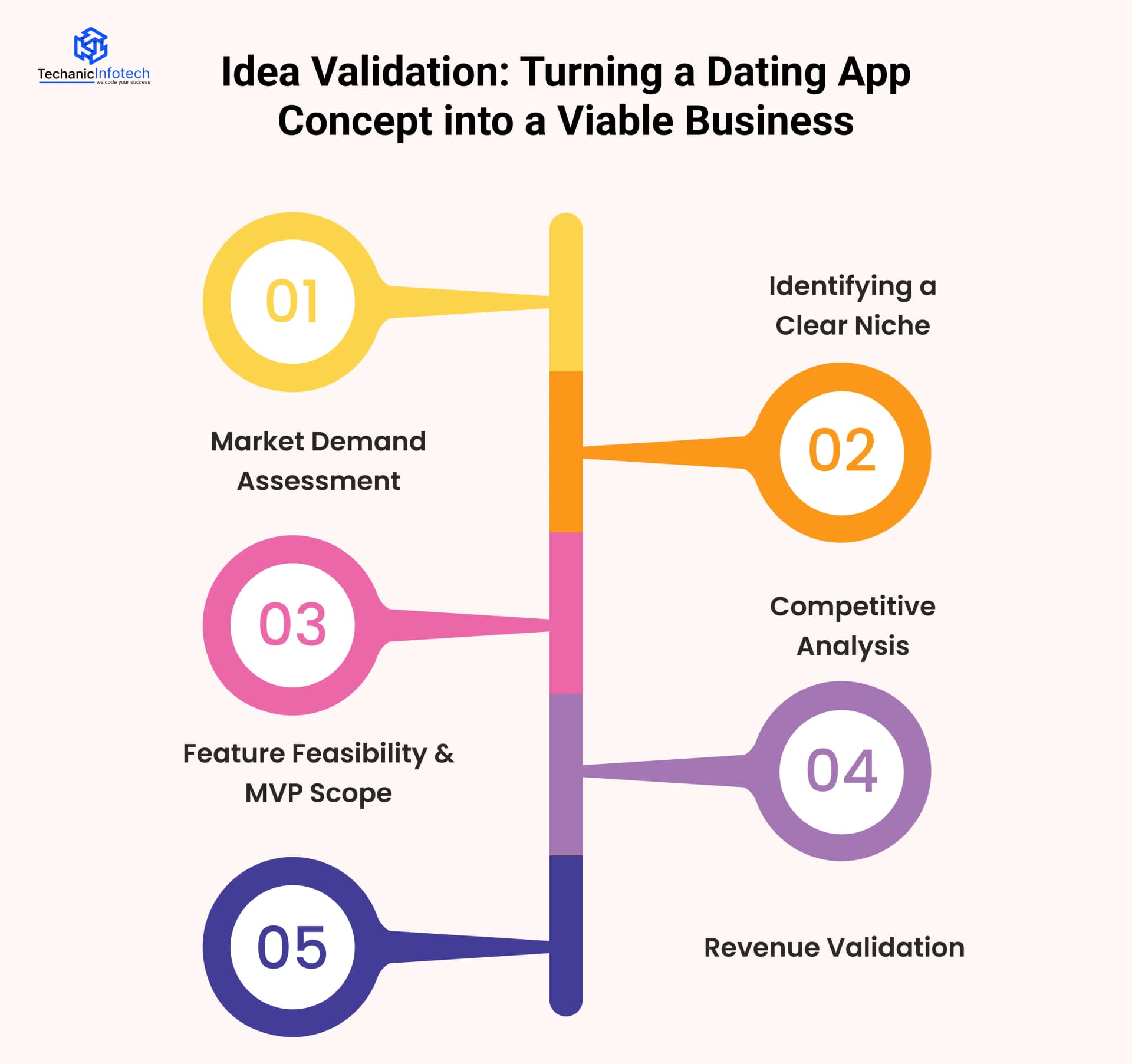
Successful dating apps solve a specific problem for a defined audience.
Consultants help analyze market gaps, audience demographics, behavioral patterns, and unmet needs.
Instead of building a generic app, validation focuses on identifying a niche such as serious relationships, professionals, or community-based dating.
Idea validation includes analyzing market size, growth potential, and user willingness to adopt a new platform.
Consultants use surveys, competitor benchmarking, keyword research, and trend analysis to validate demand.
This step ensures the idea is commercially viable before investing in development.
Consultants evaluate existing apps to understand their strengths, weaknesses, user feedback, and dating app business models.
This helps founders identify differentiation opportunities and avoid feature redundancy. Competitive insights shape the unique value proposition and positioning strategy.4. Feature Feasibility & MVP Scope
Not all ideas are technically or financially feasible.
Consultants prioritize features based on impact, cost, and scalability, defining a Minimum Viable Product (MVP) that validates assumptions while minimizing risk.
A viable idea must generate revenue. Consultants assess monetization potential early, ensuring the concept supports premium subscriptions, in-app purchases, or alternative revenue streams.
A dating app consulting framework provides a structured, step-by-step approach to transform ideas into successful products by aligning strategy, design, technology, and growth for long-term market success.
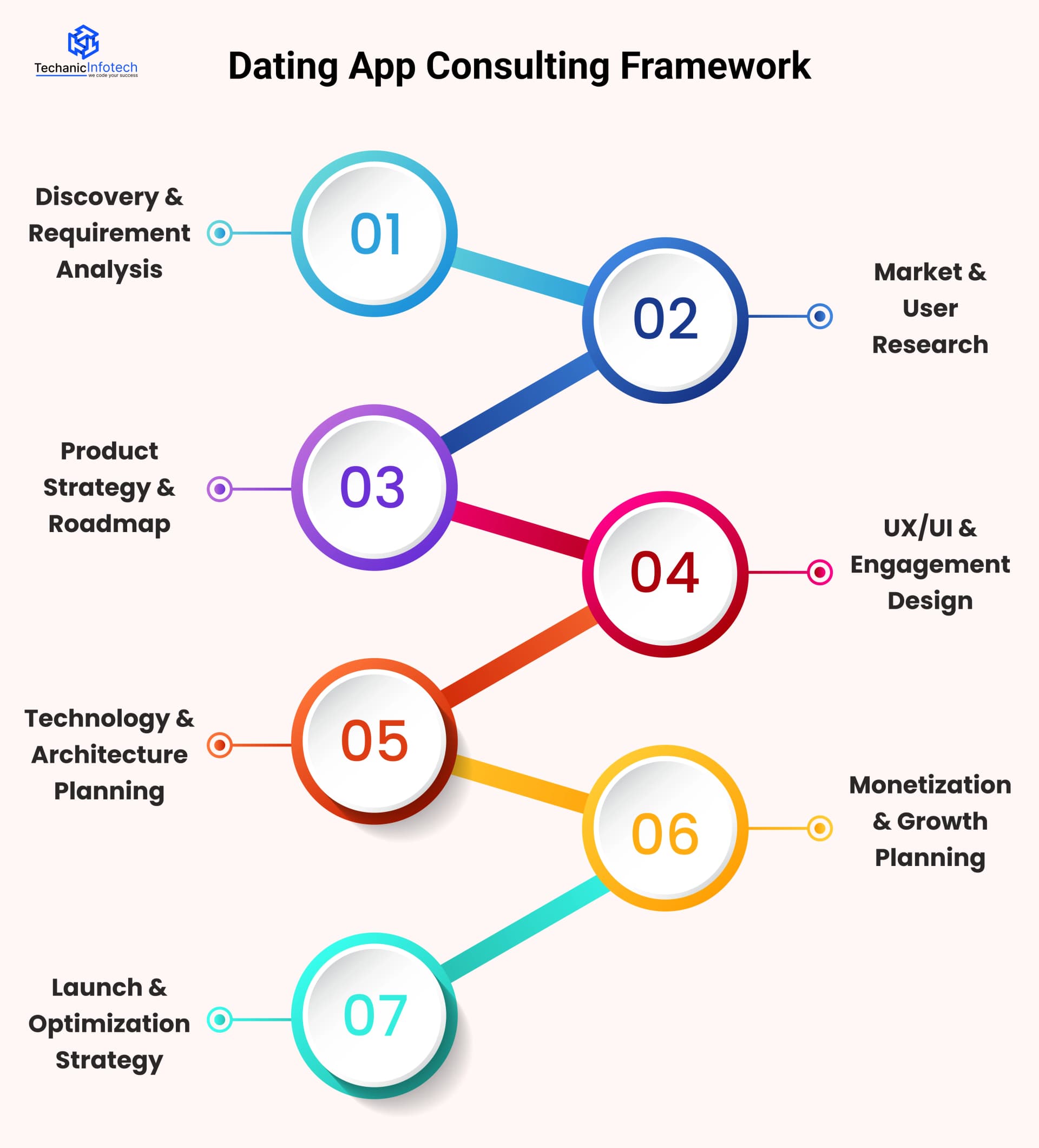
This phase focuses on understanding business goals, target audience, market positioning, and long-term vision.
Consultants collaborate with stakeholders to document functional, technical, and compliance requirements, laying a strong foundation.
In-depth research is conducted to understand user psychology, dating behavior, expectations, and pain points.
This ensures the app aligns with real-world usage patterns and emotional triggers.
A clear product roadmap is created, defining MVP features, future enhancements, timelines, and milestones.
This prevents scope creep and aligns development with business objectives.
Consultants guide user experience design to ensure intuitive navigation, trust-building interfaces, and engaging interactions.
Dating apps rely heavily on emotional comfort and ease of use.
Choosing the right tech stack, infrastructure, and third-party integrations ensures scalability, performance, and security.
Consultants ensure compliance with data protection regulations.
Dating app monetization strategies and growth channels are planned early, aligning pricing models, revenue streams, and user acquisition tactics to support long-term sustainability and profitability.
Launch planning includes beta testing, performance tracking, and KPI analysis, enabling continuous optimization, improved retention, and data-driven enhancements after the app goes live.
Effective dating app monetization combines multiple revenue strategies to balance user experience and profitability, leveraging subscriptions, purchases, partnerships, and data-driven insights to maximize long-term growth and lifetime value.
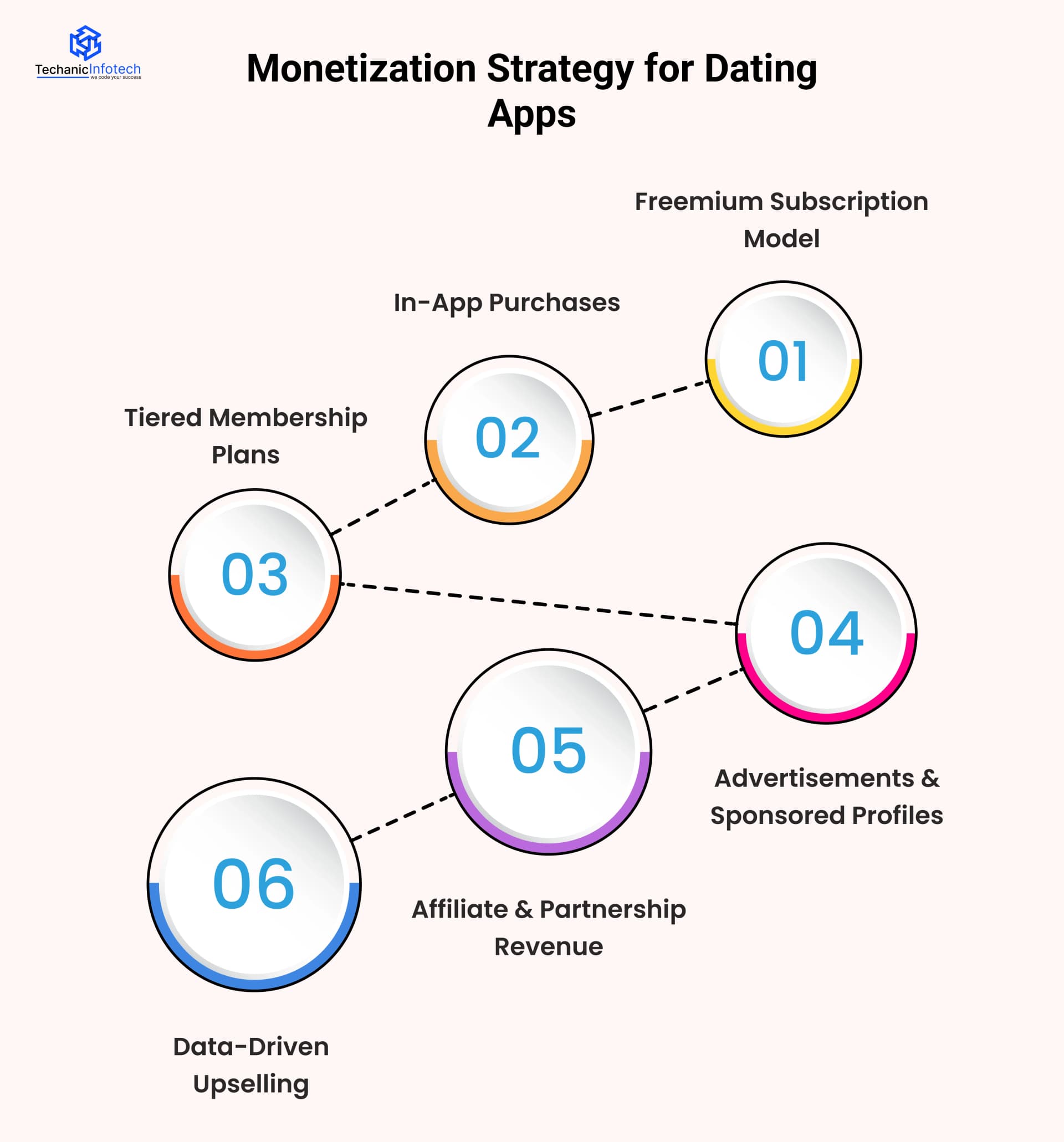
Core features remain free to attract users, while premium subscriptions unlock advanced filters, unlimited interactions, and boosted visibility.
This approach drives mass adoption while converting engaged users into recurring, predictable revenue.
One-time purchases such as boosts, super likes, profile highlights, or read receipts allow users to enhance visibility and engagement instantly.
These low-commitment microtransactions generate steady revenue without requiring long-term subscriptions.
Multiple membership tiers cater to different budgets and usage levels, offering increasing benefits at higher price points.
This strategy improves accessibility, maximizes conversions, and captures value from diverse user segments.
Carefully integrated native ads, sponsored matches, or promoted profiles create additional revenue streams while preserving user experience.
When executed thoughtfully, ads remain relevant, non-intrusive, and aligned with user interests.
Strategic partnerships with event organizers, gift services, travel brands, or lifestyle platforms enable contextual promotions.
These collaborations generate commission-based income while enhancing user experience through value-added offers.
User behavior analytics identify intent, preferences, and engagement patterns, enabling personalized upgrade prompts and offers.
This targeted upselling increases conversion rates, average revenue per user, and overall lifetime value.

Launching a successful dating app requires more than building features; it demands a disciplined go-to-market strategy that balances trust, liquidity, and user psychology.
The following points outline a structured approach to launching, acquiring users, and scaling a dating app sustainably in a highly competitive market.
A dating app must start with a narrowly defined audience and problem.
Focusing on one city, one demographic, and one core need creates liquidity, clearer messaging, faster product-market fit, and stronger word-of-mouth growth before expanding.
Before launch, build demand and trust through waitlists, scarcity, and community seeding.
Prioritize acquiring the harder side of the marketplace, create anticipation, and ensure a healthy gender ratio so early users experience immediate value.
Launch softly in one city with limited users and features. Focus on onboarding quality, fast matches, and engagement rather than growth.
Early retention and match success validate product-market fit and prevent churn from poor first experiences.
Early growth should rely on high-trust channels like referrals, micro-influencers, and offline events.
These drive higher-quality users than ads. Paid acquisition should only begin once retention, engagement, and unit economics are proven.
Monetization must align with user value and timing. Focus on power users and premium features that enhance the experience, not block it.
Early aggressive paywalls reduce trust and retention, damaging long-term growth and brand perception.
Success is measured by engagement, not downloads. Track matches, conversations, retention, and progression toward real-world dates.
These metrics indicate liquidity, satisfaction, and product health more accurately than vanity metrics like installs.
Many dating apps fail by expanding too fast, ignoring imbalance, scaling ads prematurely, or underinvesting in onboarding and trust.
These mistakes reduce liquidity, increase churn, and burn capital before product-market fit is achieved.
After validating one niche and city, expansion should follow a repeatable local playbook.
Use ambassadors, partnerships, and controlled launches to recreate early liquidity and trust rather than relying solely on global marketing.
A 90-day GTM focuses first on validation, then retention, then growth.
Month one builds demand, month two refines experience, and month three introduces referrals, influencers, and early monetization experiments to scale responsibly.
It's such a common thing where most people make mistakes while choosing the best dating app consultants.
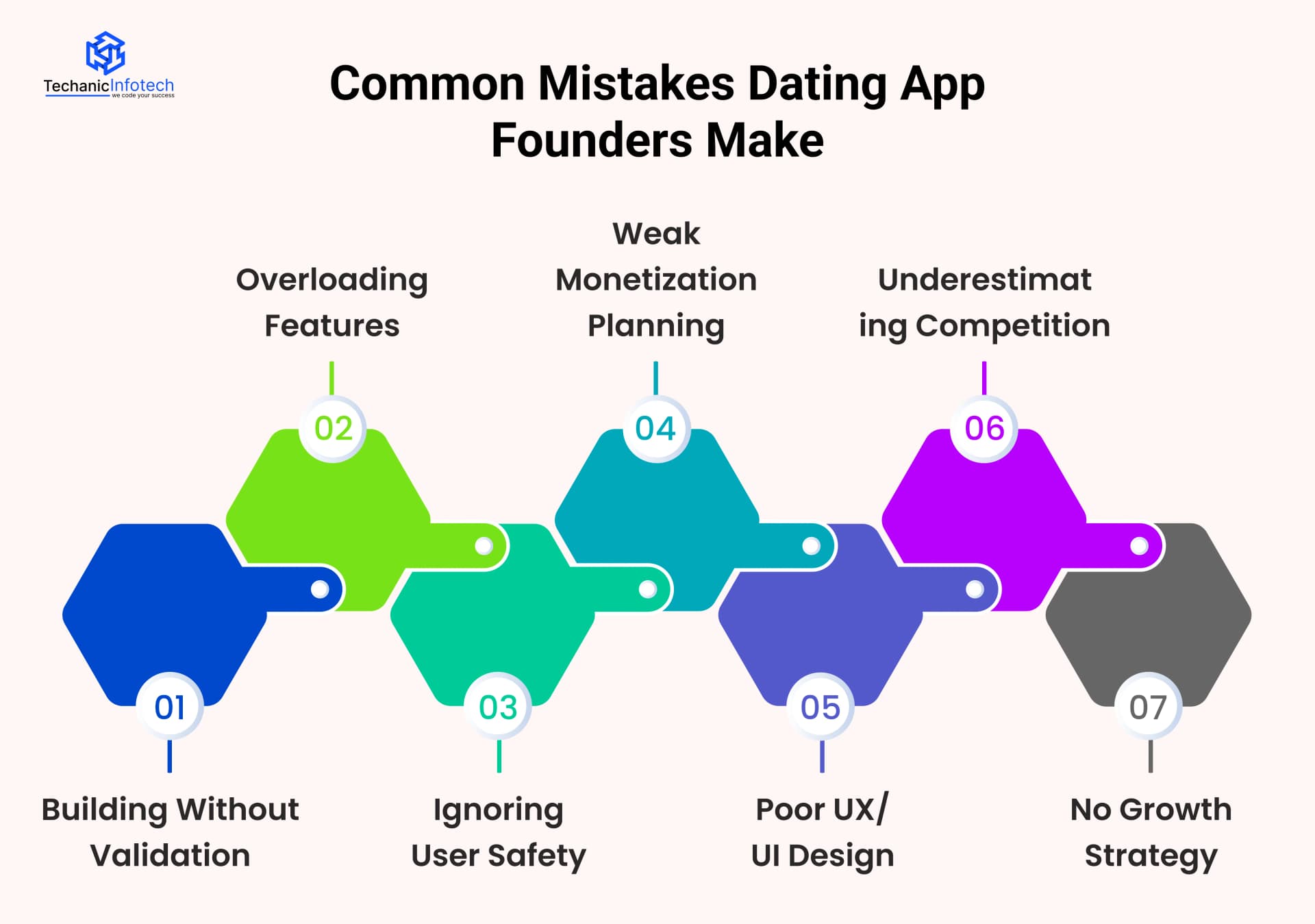
The following are the common dating app development mistakes to avoid in the process of choosing the best one.
Launching without validating market demand leads to low adoption, wasted investment, and misaligned features that fail to solve real user problems.
Adding too many features at launch confuses users, increases dating app development cost, and weakens the core value, negatively impacting engagement and retention.
Neglecting moderation, privacy, and security features erodes trust, damages brand reputation, and exposes the platform to legal and ethical risks.
Delaying or poorly planning monetization limits revenue potential, affects scalability, and reduces long-term business sustainability.
Complex navigation and unattractive dating app design frustrate users, lowering engagement, increasing churn, and harming overall app credibility.
Ignoring competitor strengths and market positioning leads to weak differentiation and difficulty attracting users in a crowded market.
Launching without a clear acquisition and retention plan restricts user growth, limits visibility, and slows overall business expansion.
Choosing the right dating app consultant is such a time-consuming task, where following proper ways helps save lots of time and effort.
Given are the ways that support choosing the best dating app consultant.
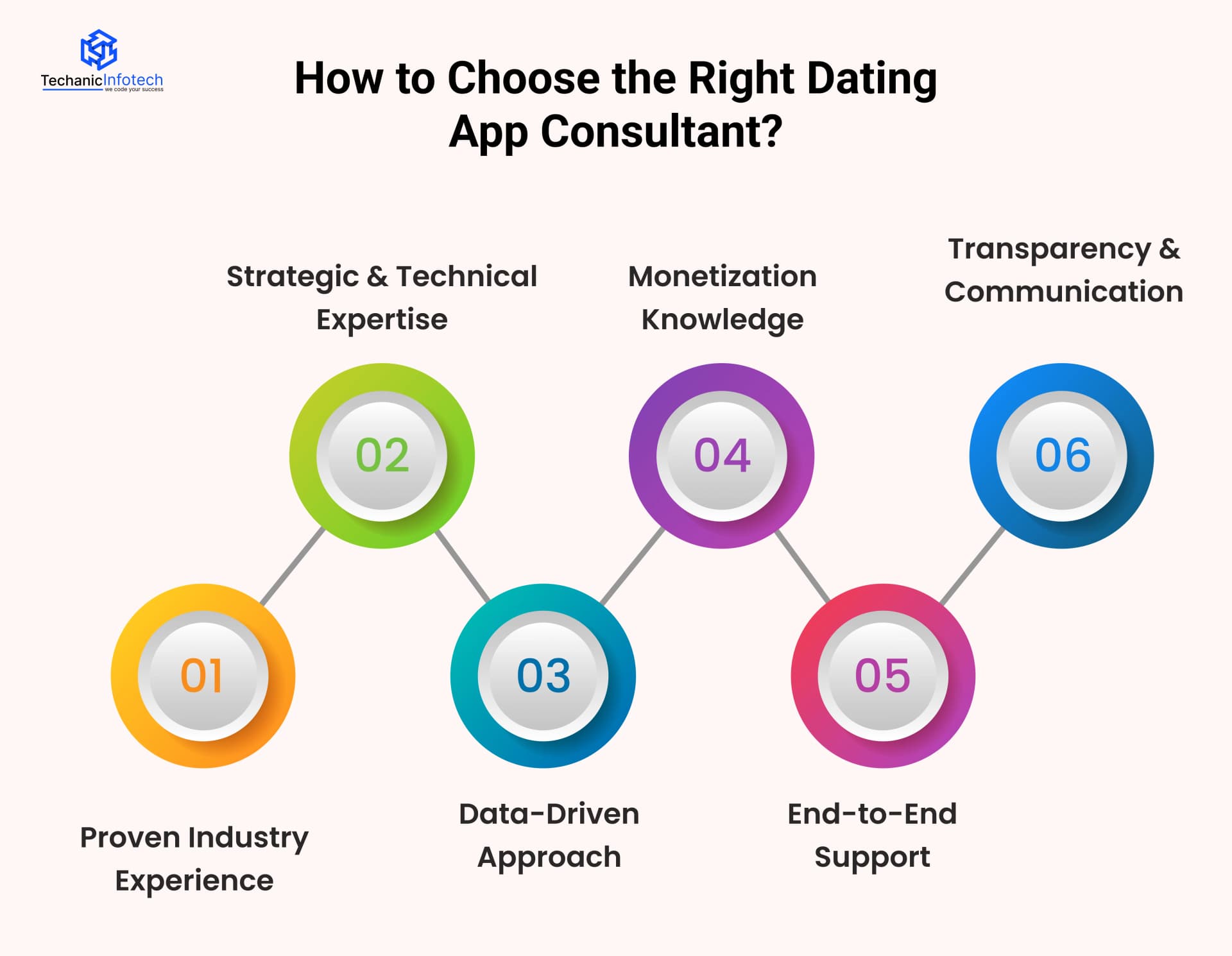
A consultant with proven industry experience understands the unique dating app development challenges and scaling dating apps.
They have firsthand knowledge of user behavior, matchmaking psychology, retention challenges, and competitive dynamics.
Their experience helps avoid common pitfalls, apply best practices, and make informed decisions faster.
Dating app success requires a balance between business strategy and technical execution.
A consultant with strategic and technical expertise can translate business goals into scalable technical solutions.
This dual expertise ensures that your app is not only innovative but also stable, secure, and future-ready, reducing rework and ensuring smooth collaboration between business and development teams.
A data-driven consultant bases decisions on research, analytics, and measurable insights rather than assumptions.
They analyze user behavior, market trends, conversion metrics, and engagement data to validate ideas and optimize performance.
This approach helps refine best dating app features, improve user experience, and enhance retention.
Strong monetization knowledge ensures your dating app is financially sustainable.
A skilled consultant understands various revenue models, including subscriptions, in-app purchases, ads, and premium features.
They align monetization strategies with user expectations, ensuring revenue generation without harming user experience.
End-to-end support means guiding you through every stage of the dating app journey from idea validation and market research to development, launch, and post-launch optimization.
Consultants offering full-cycle support ensure consistency in strategy and execution.
This holistic approach reduces coordination gaps, accelerates time-to-market, and allows continuous improvement.
Transparency and clear communication are critical for a successful consulting partnership.
A reliable consultant provides honest feedback, realistic timelines, and clear deliverables.
They keep stakeholders informed at every stage, ensuring alignment and trust. Open communication allows quick issue resolution, better collaboration, and informed decision-making.
Techanic Infotech stands out as a trusted dating app development company with proven expertise in building scalable, secure, and engaging matchmaking platforms.
With a deep understanding of user psychology, market trends, and modern technologies, we deliver end-to-end solutions from idea validation and UX design to development, launch, and growth optimization.
Their team follows industry best practices, ensures data privacy compliance, and integrates advanced features like AI matchmaking, real-time chat, and moderation tools.
What truly differentiates Techanic Infotech is its consultative approach, which focuses not just on development but also on long-term business success.
By aligning technology with monetization and growth strategies, they help founders build competitive dating apps that users trust and love.
Dating app success requires more than a good idea; it demands strategic planning, market insight, and expert execution.
Dating app consulting bridges the gap between concept and commercialization, helping founders avoid costly mistakes and build sustainable platforms.
From validating demand and defining niches to designing engaging experiences and monetizing effectively, expert guidance significantly increases the chances of success.
In a crowded and evolving market, consulting ensures your app stands out, builds trust, and scales efficiently.
Whether you’re a startup founder or an enterprise exploring social discovery platforms, investing in professional dating app consulting is a smart, growth-focused decision.
A dating app consultant helps with idea validation, market research, feature planning, UX strategy, user psychology, growth tactics, monetization models, and launch guidance.
Dating app consulting isn’t mandatory, but it reduces risk, avoids costly mistakes, validates demand, improves product-market fit, and accelerates growth for early-stage startups.
Idea validation usually takes two to four weeks, including market research, competitor analysis, target audience interviews, feature validation, and initial business feasibility assessment.
Yes, consultants design monetization strategies such as subscriptions, freemium models, in-app purchases, ads, and premium features based on user behavior and market trends.
Hire a dating app consultant before development, during ideation, or early growth stages to validate ideas, refine strategy, reduce risks, and improve chances of success.
Abhishek Jangid is the CEO of Techanic Infotech, with extensive experience in mobile app and web development. He specializes in helping businesses turn innovative ideas into scalable digital solutions through strategic planning and modern technology.