
Mobile App Development
Dedicated Developers vs In-House Team: Which One Is Best for Your Business?
February 12, 2026
February 12, 2026
Choosing between dedicated developers and an in-house team is one of the most important decisions for businesses planning software development.
Both models offer unique advantages depending on project scope, budget, timeline, and long-term goals.
While an in-house team works exclusively within your organization, dedicated developers operate remotely but focus solely on your project through a service provider.
Companies must evaluate factors such as control, cost, scalability, and expertise before deciding.
Startups often seek flexibility and affordability, whereas enterprises may prioritize direct oversight and cultural alignment.
Understanding the strengths and limitations of each approach helps organizations make informed decisions that align with their operational strategy, technical requirements, and growth plans in an increasingly competitive digital landscape.
Dedicated developers and in-house teams represent two distinct hiring models in software development.
A dedicated development team is an outsourced group of professionals who work exclusively on your project while being managed either by you or a service provider.
In contrast, an in-house team consists of employees hired directly by your company, working from your office or internal environment.
The primary difference lies in the mobile app development cost structure, flexibility, and management style.
Dedicated developers are often more cost-efficient and scalable, making them ideal for short- to mid-term projects or rapidly growing companies.
In-house teams offer stronger cultural alignment, easier communication, and greater operational control, which suits long-term or highly confidential projects.
The right choice depends on business goals, budget constraints, and technical complexity.

A dedicated development team is a group of remote software professionals hired through an outsourcing company to work exclusively on a client’s project.
They function as an extension of the client’s internal team while remaining officially employed by the service provider.
This model ensures focused, minimum viable product development support without full-time hiring responsibilities.
Businesses partner with a software development company that provides skilled developers based on project requirements.
The client selects team members, defines goals, and manages workflows directly or through a project manager.
The service provider handles recruitment, payroll, infrastructure, and HR tasks, allowing the client to concentrate on product development.
Companies usually choose dedicated developers when they need specialized expertise, faster team setup, or cost-efficient scaling.
It is ideal for startups, short-term projects, MVP development, or businesses expanding into new technologies.
This model also suits organizations lacking internal technical resources or those aiming to reduce operational overhead.
Dedicated teams provide flexibility, reduced hiring costs, and access to global talent.
However, time zone differences and limited face-to-face interaction can create communication challenges.
While operational costs are lower, businesses may experience slightly reduced direct control compared to in-house teams.

An in-house development team consists of full-time employees hired directly by a company to handle software development internally.
They work within the organization’s infrastructure and follow its policies and culture.
This model provides greater control, collaboration, and alignment with long-term business objectives.
An in-house team typically includes developers, project managers, mobile app design experts, QA engineers, and system administrators.
They manage product development, testing, maintenance, and updates.
The team collaborates closely with other departments, ensuring alignment with company goals, security standards, and internal workflows.
Organizations prefer in-house teams for long-term projects requiring high confidentiality, continuous product evolution, and close collaboration.
It suits enterprises with stable budgets and a consistent mobile app development processneeds. Businesses that value cultural alignment and direct supervision often select this model.
In-house teams offer direct communication, stronger cultural alignment, and better control over processes.
However, recruitment costs, employee benefits, and infrastructure expenses can be high. Scaling quickly may also be challenging compared to outsourcing models.
Choosing between dedicated developers and in-house teams is a critical decision for businesses, as each model differs in cost, flexibility, management, and long-term strategic impact.
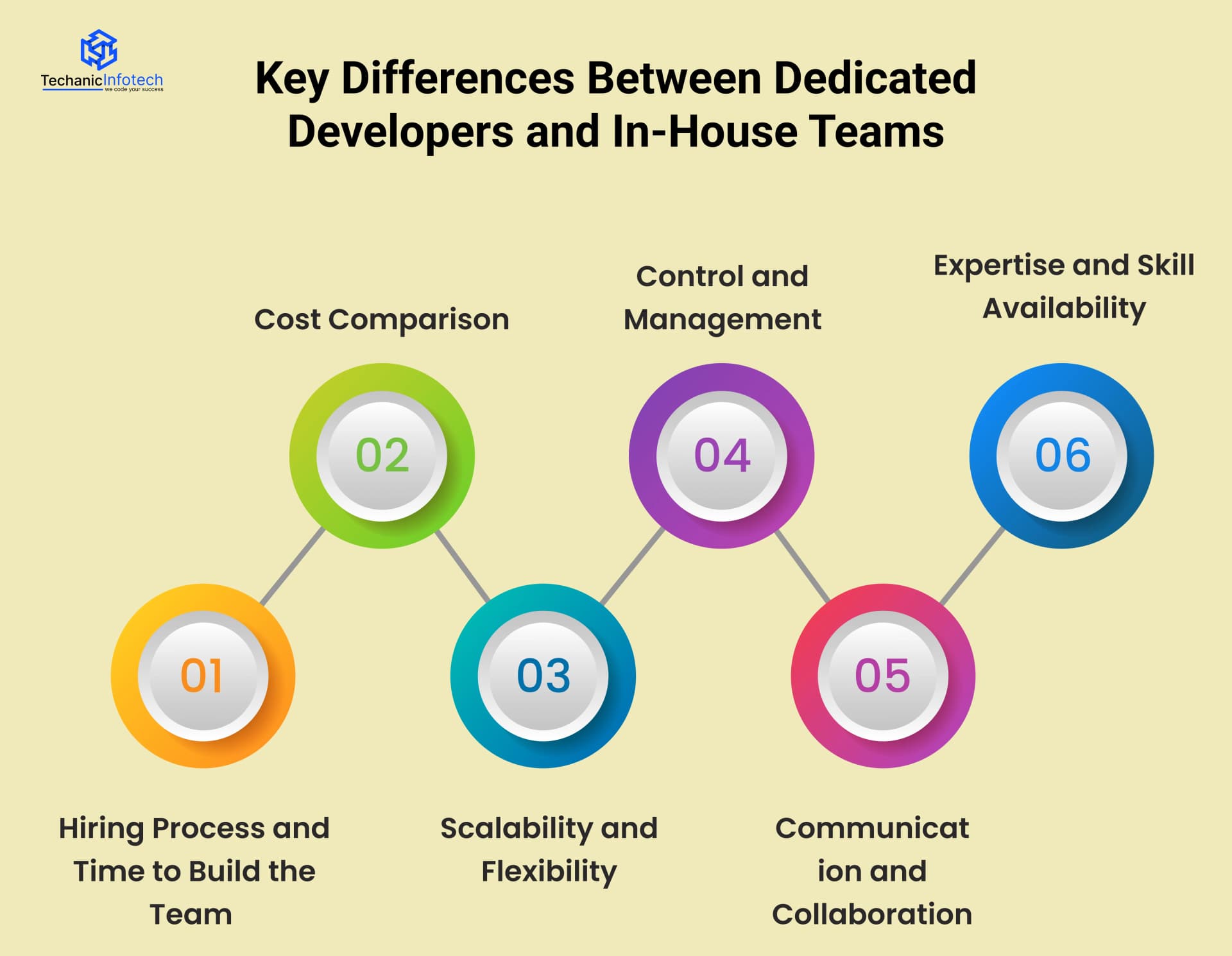
Dedicated developers can be hired quickly through outsourcing partners, often within weeks.
In-house hiring requires lengthy recruitment, interviews, onboarding, and training.
Building an internal team may take months, making outsourcing a faster solution for urgent projects.
Dedicated developers reduce costs related to office space, equipment, insurance, and benefits.
In-house teams involve salaries, recruitment fees, infrastructure, and long-term employee benefits.
While outsourcing offers predictable monthly pricing, internal teams demand significant upfront and ongoing investments.
Dedicated teams allow easy scaling based on project requirements. Businesses can add or remove developers as needed.
In-house teams are less flexible due to contractual obligations and hiring a mobile app development timeline. Outsourcing offers better adaptability for dynamic market demands.
In-house teams provide direct supervision and stronger organizational control.
Managers can monitor progress physically and adjust workflows instantly.
Dedicated teams offer control as well, but remote coordination and communication tools are necessary for effective management.
In-house teams benefit from face-to-face meetings and real-time discussions.
Dedicated developers rely on digital tools such as Slack, Zoom, and project management platforms.
While technology bridges gaps, time zone differences may impact collaboration efficiency.
Dedicated developers provide access to global talent pools and niche expertise.
In-house teams rely on local hiring markets, which may limit access to specialized skills.
Outsourcing enables companies to integrate experts in emerging technologies without extensive recruitment efforts.

When comparing the cost of dedicated developers versus an in-house team in 2026, businesses must consider both direct and indirect expenses.
Hiring an in-house team involves high overhead costs, including recruitment, onboarding, salaries, benefits, office space, infrastructure, training, and long-term employment commitments.
Companies pay a fixed monthly or project-based rate without worrying about additional overhead, administrative expenses, or employee benefits.
Comparing dedicated developers with in-house teams reveals major cost differences in salaries, operational expenses, hiring investments, scalability, infrastructure, and overall budget predictability for growing businesses.
Dedicated Developers: Typically cost between $25,000–$60,000+ per year, depending on expertise, seniority, and mobile app tech stack. This pricing usually covers full-time commitment and focused project involvement.
In-House Team: Costs can range from $5,000–$8,000 per month, including salaries and multiple operational expenses, making the total annual investment significantly higher.
|
Aspect |
Dedicated Developers |
In-House Team |
|
Price Range |
Typically $25,000–$60,000 per year based on skills and tech stack |
Generally $5,000–$8,000 per month, including payroll and operational overhead |
|
Yearly Cost Impact |
Predictable mid-range annual pricing |
Monthly costs scale into a much higher yearly expenditure |
|
Financial Commitment |
Contract-based and adjustable |
Fixed payroll with long-term obligations |
Dedicated Developers: Recruitment, screening, and onboarding are generally managed by the service provider, eliminating additional hiring expenses and reducing time-to-hire.
In-House Team: Businesses must invest in job postings, HR management, recruitment agencies, background verification, and onboarding processes, increasing both upfront and ongoing hiring costs.
|
Aspect |
Dedicated Developers |
In-House Team |
|
Hiring Price |
Recruitment included within a $10,000–$35,000 yearly package |
Additional hiring costs beyond $4,000–$8,000 monthly salary |
|
Extra Expenses |
No separate agency or HR fees |
Job boards, recruiter commissions, onboarding, training |
|
Cost Efficiency |
Lower upfront hiring investment |
Higher initial and recurring recruitment spending |
Dedicated Developers: No need to spend on office space, hardware, software licenses, utilities, or IT mobile app maintenance, as developers work remotely under their provider’s infrastructure.
In-House Team: Requires investment in office rent, equipment, workstations, internet, security systems, and software subscriptions, significantly increasing operational costs.
|
Aspect |
Dedicated Developers |
In-House Team |
|
Infrastructure Price |
Covered within the $12,000–$35,000 annual engagement cost |
Added expenses beyond $3,000–$10,000 monthly payroll |
|
Office & Utilities |
No office rent or equipment investment required |
Office space, utilities, hardware, and software increase total monthly cost |
|
Operational Burden |
Minimal |
Significant recurring operational spending |
Dedicated Developers: Benefits, insurance, payroll taxes, and legal compliance are handled by the outsourcing company, reducing administrative burden and hidden costs.
In-House Team: Employers must provide health insurance, paid leave, bonuses, retirement contributions, and comply with local labor laws, which substantially raise overall employment expenses.
|
Aspect |
Dedicated Developers |
In-House Team |
|
Benefits Price |
Included in the $15,000–$40,000 yearly cost structure |
Additional expenses on top of a $5,000–$10,000 monthly salary |
|
Insurance & Bonuses |
Managed by an outsourcing provider |
Employer-funded health insurance, bonuses, paid leave |
|
Compliance Cost |
Handled externally |
Employer is responsible for legal and tax compliance |
Dedicated Developers: Scaling up or down is simple and cost-efficient, allowing businesses to adjust resources without long-term financial obligations or severance concerns.
In-House Team: Expanding or downsizing often involves lengthy hiring processes, notice periods, severance packages, and potential legal complexities.
|
Aspect |
Dedicated Developers |
In-House Team |
|
Scaling Price |
Flexible within a $20,000–$35,000 annual range, depending on role and experience |
Expanding team increases payroll from $8,000 to $15,000 per month per hire |
|
Downsizing Cost |
No severance liabilities |
Severance pay and contractual exit costs |
|
Financial Flexibility |
High and adjustable |
Limited and risk-prone |
Dedicated Developers: With a predictable annual cost of $25,000–$60,000+, businesses can plan budgets accurately and avoid unexpected financial surprises.
In-House Team: Monthly costs of $10,000–$25,000+ can fluctuate due to operational overhead, benefits, and administrative expenses, making long-term budgeting more challenging.
|
Aspect |
Dedicated Developers |
In-House Team |
|
Budget Stability |
Controlled annual investment between $25,000–$60,000+ |
Monthly expenses ranging $10,000–$25,000+, often fluctuating |
|
Hidden Costs |
Minimal and predefined |
High due to benefits, infrastructure, and admin overhead |
|
Long-Term Financial Risk |
Lower overall cost exposure |
Higher cumulative operational expenses |
Before choosing between dedicated developers and in-house teams, it’s essential to evaluate key factors such as budget, project scope, timeline, required expertise, scalability needs, and long-term business goals to ensure the best strategic fit.
Assess both immediate and future financial capacity before choosing a team model.
Dedicated developers typically lower operational and overhead costs, while in-house teams demand higher salaries, benefits, infrastructure, and training expenses.
Careful budgeting should account for hidden costs to ensure sustainable, informed decisions.
For short-term, pilot, or experimental projects, dedicated developers offer flexibility and quick onboarding without long-term commitments.
However, long-term or continuously evolving products may benefit from an in-house team that ensures stability, deeper product understanding, and stronger alignment with strategic business goals.
Projects involving niche, advanced, or emerging technologies often require specialized expertise that dedicated developers can provide immediately.
Building an in-house team with similar capabilities may take significant recruitment time and training investment, potentially delaying project timelines and increasing overall development costs.
Companies anticipating rapid growth or fluctuating workloads need adaptable team structures.
Dedicated green app development teams allow quick scaling up or down based on project demands.
In contrast, expanding or downsizing in-house teams involves lengthy hiring processes, contractual obligations, and complex human resource management challenges.
Organizations handling sensitive data or confidential operations may prefer in-house teams for greater control and direct oversight.
However, reliable outsourcing partners implement strict security standards, compliance measures, and nondisclosure agreements, ensuring data protection while still delivering professional development services.
Evaluate whether your company possesses experienced technical leadership and project management resources.
Dedicated teams often require structured communication, clear documentation, and remote coordination practices.
In-house teams, meanwhile, demand strong internal leadership to maintain productivity, collaboration, and consistent strategic direction.
Techanic Infotech is the best mobile app development company that assists businesses in evaluating their project scope, technical needs, budget, and long-term vision before recommending the most suitable development model.
The company provides both dedicated developers and complete development teams tailored to client requirements.
With expertise across multiple technologies, Techanic Infotech ensures seamless onboarding, transparent pricing, and scalable solutions.
Their consultation process analyzes project complexity, timeline, and growth potential to determine whether outsourcing or building an internal team will deliver better ROI.
By offering flexible engagement models and experienced professionals, Techanic Infotech helps startups, SMEs, and enterprises confidently choose a strategy that aligns with operational efficiency, innovation goals, and sustainable business growth.
There is no universal answer to whether dedicated developers or an in-house team is better.
The ideal choice depends on business priorities, financial resources, project complexity, and long-term strategy.
Dedicated developers are cost-effective, scalable, and ideal for dynamic or short-term needs.
In-house teams offer stronger control, collaboration, and organizational alignment for stable, ongoing development.
Startups and growing businesses often benefit from the flexibility of dedicated teams, while established enterprises may prefer internal control.
Ultimately, evaluating your goals, technical requirements, and management capacity will guide the right decision.
A balanced approach, combining both models when necessary, can also maximize efficiency and innovation.
Dedicated developers are generally more cost-effective due to lower operational and infrastructure expenses. However, for very long-term stable projects, in-house teams may offer better continuity despite higher upfront costs.
It is ideal when businesses need quick scalability, specialized skills, lower costs, or support for short-term or experimental projects without long-term hiring commitments.
An in-house team works best for highly confidential, long-term projects requiring direct supervision, cultural alignment, and continuous internal collaboration.
Dedicated developers provide greater scalability. Companies can easily expand or reduce team size based on project requirements without complex HR processes.
Analyze your budget, project duration, scalability needs, required expertise, and management capacity. Consulting with experienced IT service providers can also help evaluate the most suitable approach.


Bharat Sharma is the CTO of Techanic Infotech, bringing deep technical expertise in software architecture, mobile app development, and scalable system design. He leads the engineering team with a strong focus on innovation, performance, and security.