EWallet App Development
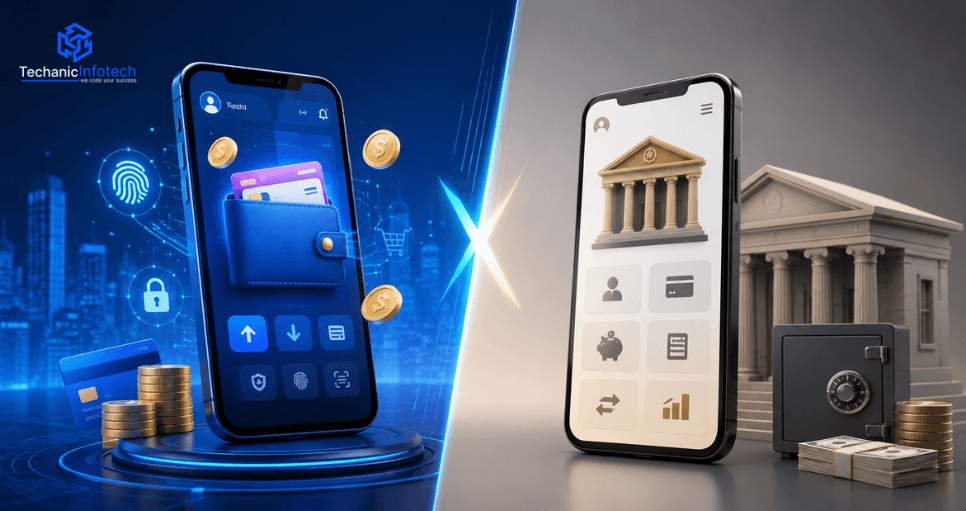
eWallet Apps vs Traditional Banking Apps: The Future of Digital Payments
June 6, 2026
June 6, 2026
eWallet app development is attracting more investor attention than ever before, and honestly, the reason is easy to see. People no longer want to wait in lines, visit branches, or deal with slow payment processes. They expect money to move instantly. A quick scan, a tap, and the transaction is done. That shift in behavior has quietly changed the direction of the fintech industry.
Something interesting over the last few years. Traditional banking apps still hold a strong place in lending, savings, and financial security, but digital wallet platforms are winning the battle for everyday transactions. From peer-to-peer payments and online shopping to cross-border transfers and mobile payments, users increasingly prefer speed and convenience over complexity.
In this blog, we'll explore the key differences between eWallets and traditional banking apps, examine real-world user preferences, discuss why fintech startups are investing heavily in mobile wallet solutions, and help investors understand which model offers stronger growth opportunities in today's evolving digital finance landscape.
A few years ago, checking out with a banking app felt modern. Today? Expectations have changed. People want payments to happen almost instantly, without extra screens, passwords, or unnecessary steps slowing them down.
Mobile wallets have evolved beyond payments into complete digital finance and lifestyle ecosystems.
Users can pay bills, transfer money, shop, and manage rewards from one app.
QR payments and contactless transactions have become everyday habits, not premium features.
Customers abandon apps simply because onboarding took a few minutes longer.
Convenience often drives adoption faster than product features or marketing campaigns.
Younger consumers expect financial services to work like social media apps, fast and intuitive.
Traditional banking apps still excel in savings, lending, and regulated financial services.
Yet many banking platforms struggle to match modern mobile-first user experiences.
Real-time payments have reshaped expectations across fintech products and payment platforms.
Cross-border transactions are becoming simpler through modern digital wallet solutions.
Consumers increasingly prefer financial tools that fit naturally into daily routines.
Investors closely watch payment behavior because consumer habits often predict market direction.
High engagement rates make mobile wallet platforms attractive long-term investment opportunities.
The growing demand to create an eWallet App reflects changing customer expectations worldwide.
Businesses want faster user acquisition, stronger retention, and higher transaction frequency.
Mobile wallets are leading that shift, one tap, scan, and payment at a time.
Banking apps function like a reliable friend who is always punctual yet never delivers surprises.
Mobile wallets? The mobile wallet user is the spontaneous friend who covers your expenses with a quick tap and generously offers cashback afterward.
So what really sets them apart? A lot, actually.
Digital wallets for daily transactions outperform most mobile-first financial solutions in terms of user experience, speed, and flexibility.
Best eWallet apps are rapidly advancing by connecting with our daily lives beyond traditional banking methods, while banks progress at a slower pace.
Let’s understand the difference between eWallet and traditional banking:
|
Feature |
eWallet Apps |
Traditional Banking Apps |
|
UX & Onboarding |
Fast, sleek, and intuitive—ideal for Gen Z financial preferences |
Often clunky, with more steps and slower KYC processes |
|
Transaction Speed |
Instant, real-time payments with tap, QR, or NFC |
Transfers can take hours or even days, especially cross-bank transfers |
|
Cross-border Capabilities |
Great for global use—many support currency conversion and borderless payments |
Limited—often requires extra fees, forms, or in-person visits |
|
Lifestyle Integration |
Syncs with food delivery, ride-share, shopping, travel, and more |
Mostly focused on bills and transfers—mobile banking limitations apply |
|
Personalization & Gamification |
Cashback rewards, spending insights, challenges, and other mobile wallet benefits |
Very little gamification and rarely personalized experiences |
|
Crypto & Loyalty Support |
Many offer crypto wallets and loyalty rewards, creating strong eWallet investment opportunities |
Usually unavailable or limited through third-party partnerships |
With this out of the way, it is time to know what users prefer at the current time.
Feature lists can look impressive on a website. Real life is where products get judged. I've seen users ignore ten advanced features simply because paying for coffee took longer than expected. That's why comparing eWallets and banking apps through everyday situations tells a much clearer story.
Buying groceries, splitting lunch bills, or paying a local vendor shouldn't feel like a banking task. Mobile wallets remove friction with QR payments, one-tap transfers, and instant confirmations. This everyday convenience is one reason businesses increasingly partner with an eWallet app development Company to build payment experiences users actually enjoy.
Gig workers require rapid payment processing combined with minimal transfer fees.
A wallet app allows for immediate client deposits while providing superior currency conversion services and built-in invoice tools.
Traditional banking apps require 1–3 business days for payments to become visible. That delay matters.
The difference between eWallet and traditional banking is huge when your cash flow depends on speed.
This development stands among the primary ewallet wallet trends that investors monitor with great attention.
Looking for a way to transfer cash between countries?
Digital wallets provide more cost-effective and convenient financial transactions compared to traditional banks.
Numerous services provide multi-currency wallets that operate without hidden fees and enable faster delivery times.
Traditional banking apps suffer from slow processing times and high transfer fees.
Digital wallet platforms enjoy an evident benefit over other payment systems.
eWallet app adoption faces some regular ewallet app challenges, but technological advancement continues to accelerate.
Millennials and members of Gen Z demand both attractive design and immediate outcomes.
Young consumers choose wallet apps that offer gamified saving tools along with financial rewards and tracking features.
People who save money prefer traditional banking apps because they value stability and want to see their detailed financial statements.
The competition between eWallets and traditional banking apps primarily centers on which platform better aligns with users' lifestyles rather than technological features.
The swipe-and-go generation hears the benefits of eWallet apps more clearly, while older users prefer traditional banking solutions.
Do you need to obtain a personal loan, or do you require assistance with EMI management?
Traditional banking applications maintain their dominance in the credit market because they offer structured loan options alongside regulatory backing.
The development of microloans and buy-now-pay-later services in wallet apps remains an unfinished project.
Developing full lending ecosystems represents a key challenge for eWallet app growth.
The fast progress of fintech may soon change the landscape by reestablishing the distinction between e-wallet services and traditional banking institutions.
Your wallet app works seamlessly alongside your daily activities, whether you are booking rides or ordering dinner online.
Digital wallet trends indicate a movement toward smooth payment methods for various services, including food delivery and streaming subscriptions.
Traditional banking apps typically do not have plug-and-play integrations built into their systems.
Digital wallet platforms excel by making payments become a natural component of everyday routines instead of a burdensome task.
The advantages of digital wallets over traditional banking apps lie in their ability to turn payments into part of your daily rhythm, not a chore.
Have you attempted to divide a payment with your bank application? Painful.
A wallet app permits immediate money transfers accompanied by notes or GIFs along with emojis.
The greatest advantage of eWallet apps for social expenses is their simplicity and user-friendly experience.
A traditional banking application provides a formal experience that operates at a slower pace.
The difference between eWallet and traditional banking apps becomes particularly evident when analyzing younger users' preferences.
Fintech startups, ranging from solo founders to billion-dollar unicorns, invest their resources heavily into developing eWallet apps.
Why? The future of finance is moving toward palm-sized technology because the financial outlook appears extremely promising.
This section explores five key factors that make digital wallets more prominent than conventional banking services.
Launching a full-service traditional banking app? That’s a long, expensive road.
Building a slick e-wallet app features? Much faster, leaner, and cheaper.
Early-stage startups pursue eWallet investment possibilities because they require lower initial spending and enable quicker MVP production.
The rising need for digital wallets to manage everyday payments creates an established market opportunity.
The difference between eWallet and traditional banking here is all about speed and scale.
Fintech founders seek products that achieve rapid growth while crossing industry limits.
A well-built wallet app serves as a payment solution and functions as a platform for integrating shopping, travel, food services, and cryptocurrency transactions.
One of the primary benefits of digital wallet systems comes from their ability to enable cross-industry integration.
Traditional banking apps lack this flexibility because they operate within a single ecosystem.
Startups have the ability to achieve rapid growth while serving international markets and adapting their business models swiftly.
During the initial stages of building eWallet apps, user trust emerged as a fundamental difficulty.
But now? Security measures have advanced significantly to meet modern standards.
Today’s secure mobile wallet apps incorporate encryption technologies as well as biometric authentication methods, along with fraud detection capabilities similar to those used by traditional banking institutions.
Startups can integrate these digital wallet security features directly into their applications without having to deal with decades of accumulated technical debt.
Developing an eWallet app takes weeks rather than years, meaning less development time.
Startups achieve rapid MVP launches by using pre-built APIs alongside fintech SDKs and cloud infrastructure solutions.
They gain significant advantages because banks continue to struggle with updating their obsolete systems.
Being the first to reach the market or explore a new niche represents a significant strategic advantage.
Startups know their target: the swipe-savvy, crypto-curious, impatient Gen Z crowd.
These users demand services that are quick to access through mobile devices and highly customized to their needs.
A wallet app provides users with cashback rewards and gamified savings while enabling one-tap access to all features.
Traditional banking apps offer a rigid experience, which makes the benefits of a wallet app clear to everyone.
eWallet apps align perfectly with this generation's lifestyle needs and represent the market with the potential to create one billion new users.
The next chapter explores the decision between creating a mobile wallet application versus a banking app.
Every fintech founder reaches this point sooner or later. The idea feels solid, the market looks promising, and then comes the harder question: should you build a mobile wallet or a banking app? I've seen businesses spend months debating features when the real answer usually comes down to users, revenue, and long-term growth strategy.
If your business depends on frequent transactions, daily engagement, and recurring user activity, a mobile wallet often makes more sense. Peer-to-peer payments, online shopping, subscriptions, and merchant payments naturally fit the wallet model. Many businesses work with an eWallet app development Company because wallet platforms can generate revenue through transaction fees, partnerships, rewards programs, and value-added financial services.
People rarely think about security until something goes wrong. Traditional banks benefit from decades of trust, regulatory frameworks, and established compliance systems. At the same time, modern eWallet App security standards have improved dramatically through biometric authentication, tokenization, encryption, and real-time fraud monitoring. Today, users expect both convenience and protection, not one or the other.
Consumer habits are changing faster than many businesses expected. Most users now prefer quick payments, QR scans, contactless transactions, and financial tools that fit naturally into everyday life. Digital wallets serve those needs exceptionally well. Banking apps still remain essential for loans, fixed deposits, and wealth management, but mobile wallets often win when speed, accessibility, and daily usage become the deciding factors.
The debate around eWallets and traditional banking apps isn't really about which one survives. It's about which one fits modern user behavior better. I've seen people tolerate complex banking processes for loans and savings, but when it comes to everyday payments, speed usually wins. That's where digital wallets continue pulling ahead.
Traditional banking apps still offer trust, regulatory strength, and mature lending ecosystems. Yet mobile wallets are shaping how people pay, transfer money, shop, and interact with financial services every day. For investors, the opportunity lies in platforms that combine security with convenience. The future of fintech may not belong entirely to banks or wallets it will likely belong to businesses that successfully bring both worlds together.
Modern eWallets use encryption, biometrics, and fraud detection. Security now depends more on implementation than app type.
They often deliver higher engagement, faster growth, and recurring transaction-based revenue opportunities.
Not completely. Wallets handle daily payments well, while banks still dominate lending, savings, and investments.
A basic eWallet can take 3–6 months, depending on features, compliance needs, and integrations.
Fast payments, rewards, seamless UX, and mobile-first experiences align with how younger users manage money.
Many eWallets offer multi-currency support and faster cross-border transfers with fewer fees than banks.
Balancing security, compliance, user trust, and scalability remains the biggest challenge for most businesses.
Startups focused on payments usually choose wallets, while lending-focused businesses often prefer banking platforms.


Abhishek Jangid is the CEO of Techanic Infotech, with extensive experience in mobile app and web development. He specializes in helping businesses turn innovative ideas into scalable digital solutions through strategic planning and modern technology.