EWallet App Development
eWallet App Security: Key Features to Protect User Data & Transactions
January 27, 2026
January 27, 2026
As digital payments become part of everyday life, security has become a top concern for both users and businesses.
A single breach can damage trust, lead to financial loss, and impact brand reputation. That’s why eWallet app security is not optional, it’s essential. A secure eWallet app must protect sensitive information while ensuring smooth and reliable transactions.
Strong digital wallet security features help prevent fraud, unauthorized access, and data leaks. From user authentication to transaction protection, every layer plays a role in keeping payments safe. Businesses building mobile wallets must focus on eWallet payment security to protect user data and maintain trust.
In this blog, we’ll explore the key security features in eWallet applications and explain how eWallet apps protect transactions in real-world scenarios.
eWallet app security refers to the set of technologies, practices, and controls used to protect digital wallets from fraud, data breaches, and unauthorized access.
Since eWallets store sensitive information such as personal details, payment data, and transaction history, security becomes the backbone of the entire application.
A secure eWallet app ensures that users can send, receive, and store money without worrying about data misuse or financial loss.
Digital wallet security focuses on protecting both user data and financial transactions at every stage. This includes securing login credentials, encrypting transaction data, validating user identity, and monitoring suspicious activity. Unlike regular apps, eWallets deal directly with money, which makes them a prime target for cyber threats.
Strong eWallet app security features work behind the scenes to ensure that data is encrypted during transmission, stored safely on servers, and accessed only by authorized users.
Mobile wallet app security also covers backend systems, APIs, and third-party integrations to prevent loopholes that attackers can exploit. When built correctly, digital wallet security creates a safe environment where users can trust the app with their financial information.
Trust is the foundation of any successful eWallet application. Users will only continue using a financial app if they feel confident that their money and data are protected.
Users share sensitive financial data: eWallet apps store bank details, cards, and transaction history, making trust essential.
Security directly affects user adoption: Even one security incident can lead to app uninstalls and negative reviews.
Financial loss damages brand reputation: Fraud or data breaches can cause long-term damage to business credibility.
Regulatory compliance builds confidence: Following security standards reassures users that the app is professionally built.
Trust leads to long-term usage: Secure apps retain users and encourage repeat transactions.
In short, strong eWallet app security is not just about the app technology stack, it’s about earning and maintaining user trust in every transaction.
eWallet applications handle sensitive financial and personal data, making them attractive targets for cybercriminals. Understanding the most common security risks helps eWallet businesses take the right preventive measures early.
Below are major security risks that eWallet apps commonly face.
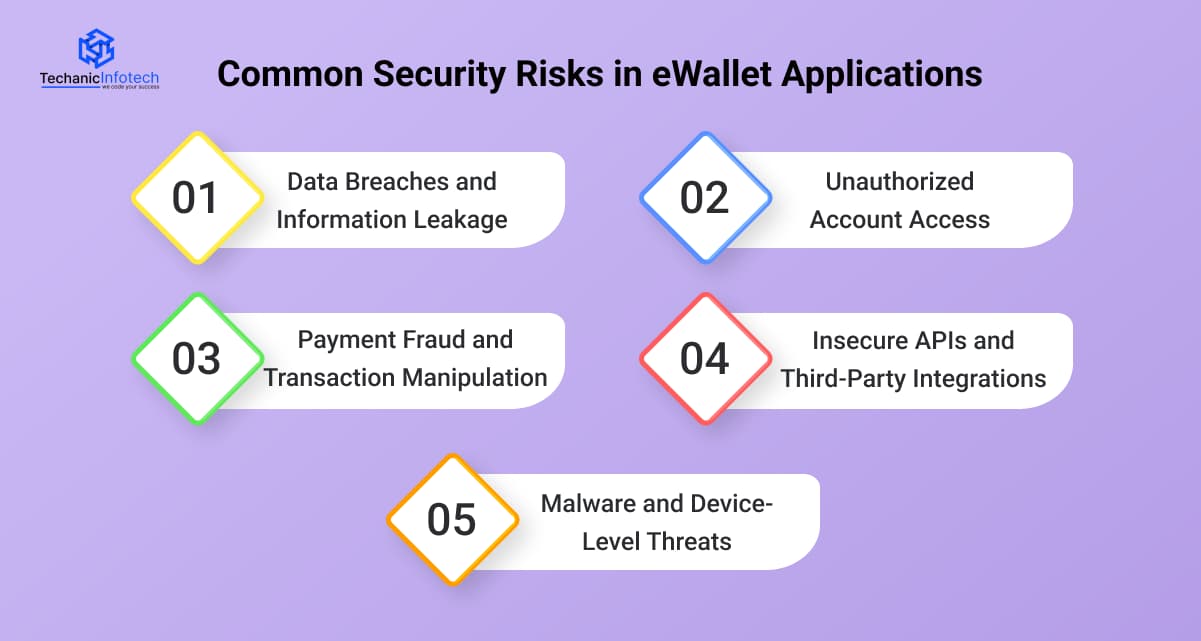
One of the biggest risks in eWallet applications is unauthorized access to user data. Weak encryption, poor server security, or misconfigured databases can expose personal and financial information. A data breach not only leads to financial loss but also damages user trust and brand reputation.
If authentication mechanisms are weak, attackers can gain access to user accounts through stolen credentials or brute-force attacks. Once inside, they can perform unauthorized transactions or steal stored payment information. Poor password policies and lack of multi-factor authentication increase this risk.
Fraudulent transactions are a serious threat to eWallet apps. Attackers may intercept or manipulate transactions if proper validation and encryption are missing. This can result in direct financial losses for both users and the platform.
Top eWallet apps rely heavily on APIs for payments, notifications, and third-party services. Poorly secured APIs can become entry points for attackers. If integrations are not properly monitored or validated, they can expose sensitive data and system access.
Malicious apps, phishing attacks, or compromised devices can steal login credentials or session data. If the eWallet app does not implement strong session management or device verification, attackers can exploit these vulnerabilities easily.
Building a secure eWallet app requires more than basic login protection. Since digital wallets handle sensitive user data and real money, security must be built into every layer of the application.
Below are the most important security features every eWallet app should include, along with the key benefits of each feature.
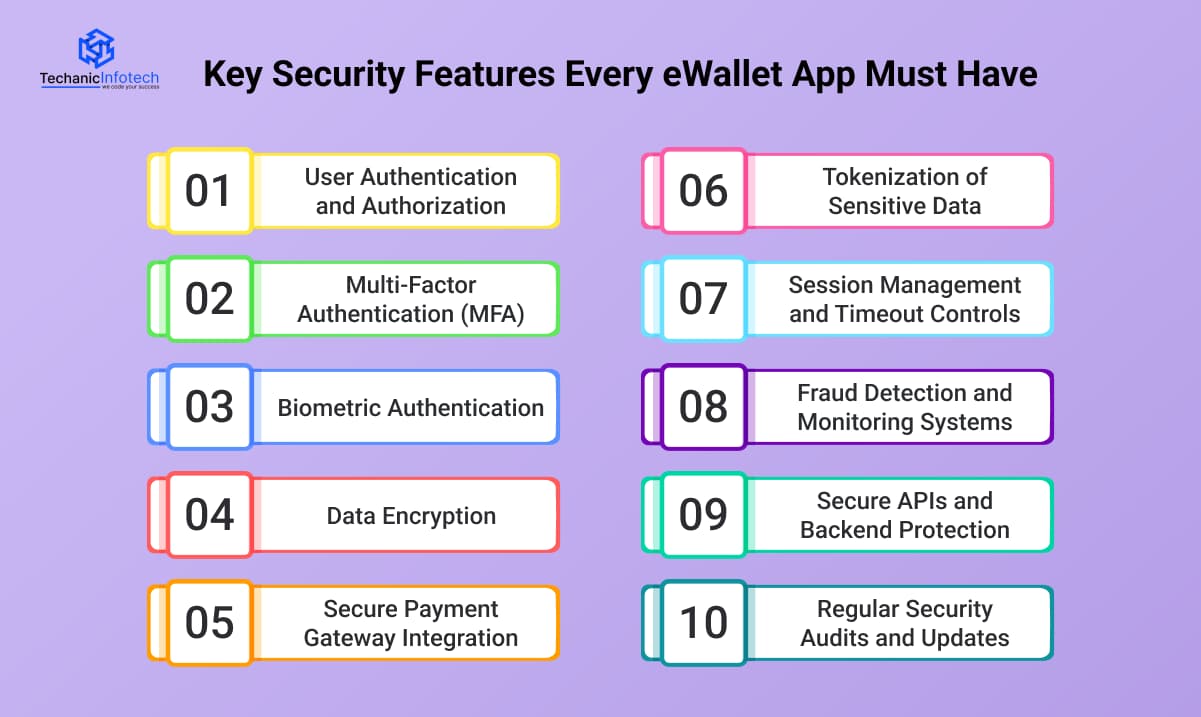
User authentication is the first line of defense in an eWallet app. It verifies user identity during login, while authorization controls what actions different users can perform inside the app. This includes defining access levels for users, admins, and merchants. Strong authentication prevents unauthorized access and limits system misuse.
Benefits:
Prevents unauthorized account access
Protects user funds and personal data
Reduces the risk of account takeover attacks
Multi-factor authentication adds an extra verification step beyond passwords. This may include OTPs, email verification, or authenticator apps. MFA is especially important for actions like logins from new devices, large transactions, or profile changes. Even if credentials are stolen, MFA helps block attackers.
Benefits:
Blocks access even if passwords are compromised
Improves overall account security
Builds user trust in the app
Biometric authentication in eWallet apps uses fingerprint scanning or facial recognition to verify users. Since biometric data is unique to each person, it provides a strong balance of security and convenience. Many users also prefer biometrics because they remove the need to remember passwords.
Benefits:
Faster and safer login experience
Difficult for attackers to replicate
Enhances user convenience without sacrificing security
Encryption protects sensitive data by converting it into unreadable formats. Data must be encrypted both while stored on servers and while being transmitted between the app and backend systems. This ensures that even if data is intercepted, it cannot be misused.
Benefits:
Protects user data from breaches
Secures transactions and personal information
Helps meet regulatory and compliance standards
Payment gateways act as the bridge between users, banks, and financial networks. Integrating trusted and secure gateways ensures transactions are processed safely. Secure gateways also include fraud checks, transaction validation, and encryption layers.
Benefits:
Prevents transaction tampering
Reduces fraud and payment failures
Ensures smooth and reliable payment processing
Tokenization replaces sensitive payment data such as card numbers with random tokens. These tokens have no real value outside the system, making them useless if exposed. Tokenization significantly reduces the risk associated with storing payment information.
Benefits:
Minimizes risk of data theft
Protects sensitive payment information
Limits damage even if systems are compromised
Session management ensures that users remain logged in only while actively using the app. Automatic session timeouts log users out after inactivity, reducing the risk of misuse on lost or shared devices. Secure session handling is essential for financial apps.
Benefits:
Prevents unauthorized access from idle sessions
Reduces risks on shared or lost devices
Improves overall app security
Fraud detection systems monitor user behavior and transactions in real time. By analyzing patterns, these systems can identify suspicious activity such as unusual spending or login attempts. Alerts can trigger verification steps or block transactions instantly.
Benefits:
Detects unusual transaction patterns early
Prevents financial fraud
Protects both users and businesses from losses
APIs connect the eWallet app to payment services, databases, and third-party tools. If APIs are not secured, attackers can exploit them to access data or disrupt services. Proper validation, authentication, and rate limiting are essential.
Benefits:
Prevents unauthorized system access
Protects data flow between services
Reduces vulnerabilities from third-party integrations
Security threats evolve constantly, which means eWallet apps must be updated regularly. Security audits help identify vulnerabilities, while updates fix bugs and strengthen defenses. Ongoing monitoring ensures long-term protection.
Benefits:
Keeps the app secure against new threats
Maintains compliance with security standards
Improves long-term app reliability
Beyond basic eWallet app security features, advanced security measures help eWallet apps stay ahead of evolving cyber threats. These measures focus on deeper monitoring, smarter prevention, and stronger system control.
Below are advanced security measures that enhance eWallet protection and are not covered in the core features section.
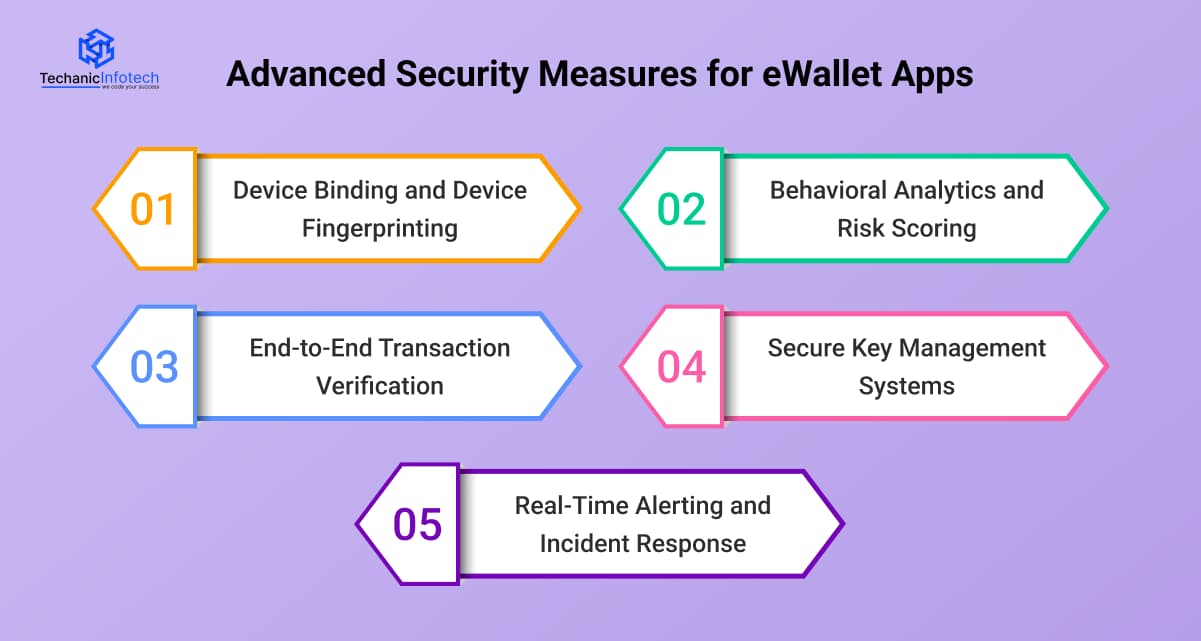
Device binding links a user account to specific trusted devices. Each device is identified using unique parameters such as hardware details, OS version, and device behavior. If a login attempt comes from an unknown device, additional verification is required.
This reduces the risk of unauthorized access, even if login credentials are compromised.
Behavioral analytics track how users normally interact with the app, including transaction patterns, login times, and usage frequency. A risk score is generated based on deviations from normal behavior.
High-risk actions can trigger security checks or transaction blocks, preventing fraud before it happens.
End-to-end verification ensures that transactions are validated at multiple checkpoints. This includes user confirmation, backend validation, and final authorization before completion.
This layered verification reduces the chances of transaction manipulation and unauthorized transfers.
Secure key management controls how encryption keys are generated, stored, and rotated. Keys are kept in protected environments to prevent unauthorized access.
Strong key management ensures encryption remains effective and prevents data exposure through stolen keys.
Real-time alert systems notify users and administrators instantly when suspicious activity occurs. These alerts allow quick action, such as blocking accounts or reversing transactions.
An effective incident response system helps limit damage and restore security quickly.
Implementing these advanced security measures adds an extra layer of protection, making eWallet apps more resilient, trustworthy, and prepared for modern security threats.
Compliance is not optional for eWallet apps. Since these applications handle sensitive financial and personal data, they must follow strict security and privacy regulations. Meeting compliance standards not only avoids legal penalties but also builds long-term user trust.
PCI DSS (Payment Card Industry Data Security Standard) is mandatory for any app that processes card payments. It ensures that cardholder data is stored, processed, and transmitted securely.
Key requirements include:
Secure storage of card data
Encrypted payment transactions
Restricted access to sensitive information
Regular security testing and audits
Following PCI DSS reduces fraud risk and protects payment information from breaches.
GDPR focuses on protecting user privacy and personal data. eWallet apps that serve users in regulated regions must follow strict data handling rules.
Key GDPR principles for eWallet apps:
User consent for data collection
Transparency about data usage
Right to access, modify, or delete personal data
Secure storage of user information
GDPR compliance ensures ethical data usage and improves user confidence in the app.
Apart from global standards, eWallet apps must also comply with country-specific financial regulations. These may include KYC (Know Your Customer), AML (Anti-Money Laundering), and reporting requirements.
Why local compliance matters:
Prevents illegal financial activities
Ensures legal operation across regions
Builds credibility with regulators and partners
Ignoring compliance can result in fines, app suspension, or loss of user trust.
The backend and APIs are the core of an eWallet app. Even if the front end looks secure, weak backend protection can expose the entire system. Strong backend and API security is essential to protect transactions and user data.
APIs connect the eWallet app to payment gateways, databases, and third-party services. These APIs must be protected against unauthorized access.
Secure API practices include:
Authentication tokens
Encrypted data transmission
Limited API access permissions
Securing APIs prevents attackers from exploiting system vulnerabilities.
Rate limiting restricts how many requests a user or system can make within a set time. This helps prevent brute-force attacks and system overloads.
Request validation ensures:
Only valid data reaches the backend
Malicious requests are blocked early
System stability during high traffic
Together, these controls protect the app from abuse and downtime.
RBAC ensures users and admins only access what they’re authorized to use. Different roles are assigned specific permissions based on responsibilities.
Benefits of RBAC:
Reduces insider threats
Limits data exposure
Improves system control and accountability
Strong backend and API security ensures the eWallet app remains reliable, scalable, and protected against modern cyber threats.
A secure architecture ensures that eWallet app security is built into the system from the ground up.
Instead of relying on a single security layer, it protects user data and transactions across servers, networks, and cloud infrastructure. Below is a clear, point-wise explanation.
Hardened servers are used to store sensitive user and transaction data, reducing exposure to attacks.
Strict access controls ensure that only authorized systems and personnel can access critical data.
Firewalls and intrusion detection systems help block unauthorized access attempts and malicious traffic.
Regular security patches and updates fix vulnerabilities before they can be exploited.
Load balancing and redundancy protect secure digital wallet transactions by preventing downtime during traffic spikes or attacks.
These measures together strengthen mobile wallet app security and protect backend systems from breaches.
Data encryption at rest and in transit ensures strong eWallet app data protection, even in cloud environments.
Isolated cloud environments prevent cross-application data exposure.
Identity and access management (IAM) controls who can access cloud resources and data.
Regular backups and disaster recovery plans ensure data can be restored without transaction loss.
Continuous monitoring and alerts detect suspicious activity early, improving eWallet payment security.
Even well-planned eWallet applications can become vulnerable if security is not handled correctly. Many security issues are caused by avoidable mistakes during ewallet app development or after launch.
Understanding these pitfalls helps businesses build a secure eWallet app and protect both users and transactions.
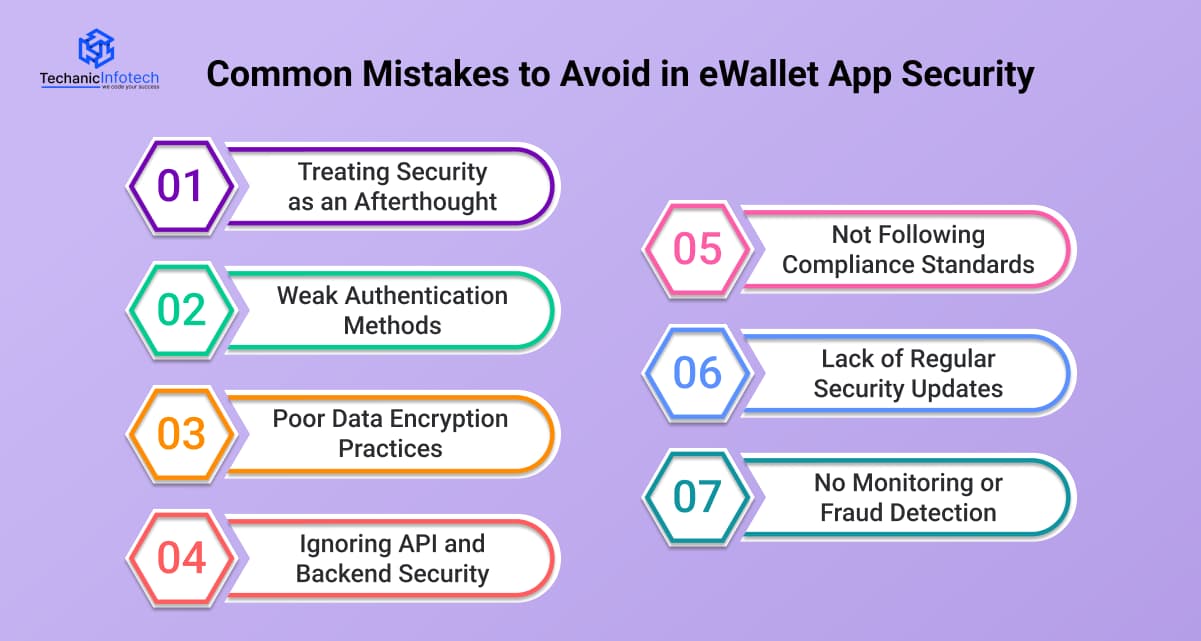
One of the most common mistakes is adding ewallet app security features at the end of mobile app development. eWallet app security must be planned from the beginning, not patched later. Delayed security implementation often leads to weak architecture and costly fixes.
Relying only on basic passwords puts mobile wallet app security at risk. Without strong authentication, attackers can easily gain access to user accounts and perform unauthorized transactions.
Failing to encrypt sensitive data properly is a major risk. Without encryption at rest and in transit, user data and payment information can be intercepted or exposed, weakening eWallet app data protection.
Many developers focus on front-end security and overlook backend systems. Insecure APIs can expose transaction data and user information, making secure digital wallet transactions vulnerable.
Ignoring regulations like PCI DSS or data protection laws can lead to legal issues and security gaps. Compliance plays a key role in eWallet payment security and user trust.
Security threats evolve constantly. Apps that are not updated regularly become easy targets. Missing updates can weaken digital wallet security features over time.
Without real-time monitoring, suspicious activities go unnoticed. This increases the risk of fraud and unauthorized transactions.
At Techanic Infotech, security is a core part of how we build eWallet applications, not an afterthought. We start by designing a secure architecture that protects user data and transactions from day one.
Our eWallet app development company follows proven eWallet app security practices, including strong authentication, data encryption, secure payment gateway integration, and backend protection. We also ensure compliance with industry standards and apply regular security testing to identify risks early.
By combining smart technology choices with continuous monitoring and updates, we help businesses launch secure eWallet apps that users can trust for safe and reliable digital transactions.
Security is the foundation of a successful eWallet application. From protecting user data to ensuring safe transactions, every layer of the app must be designed with strong security measures in place.
By implementing essential and advanced eWallet app security features, following compliance standards, and avoiding common security mistakes, businesses can significantly reduce risks.
A secure architecture not only prevents fraud and data breaches but also builds long-term user trust. Investing in the right security practices from the start helps create a reliable, scalable, and secure eWallet app that users feel confident using for everyday digital payments.
eWallet app security refers to the technologies and practices used to protect user data, payment information, and transactions from fraud, unauthorized access, and data breaches.
eWallet apps handle sensitive financial data. Strong security helps prevent fraud, protects user information, and builds trust, which is essential for long-term user adoption.
Key security features include user authentication, data encryption, secure payment gateway integration, tokenization, session management, and fraud detection systems.
eWallet apps protect transactions using encrypted data transmission, secure payment gateways, transaction verification, and real-time monitoring to detect suspicious activity.
Most eWallet apps must follow PCI DSS for payment security, data protection laws like GDPR, and local financial regulations to ensure safe and legal operations.
Yes. Biometric authentication such as fingerprint or facial recognition adds a strong security layer and reduces the risk of unauthorized access.
Security updates should be done regularly. Continuous monitoring and timely updates help protect against new threats and vulnerabilities.
Absolutely. Modern security features are designed to protect users while keeping the app fast, simple, and user-friendly.


Abhishek Jangid is the CEO of Techanic Infotech, with extensive experience in mobile app and web development. He specializes in helping businesses turn innovative ideas into scalable digital solutions through strategic planning and modern technology.