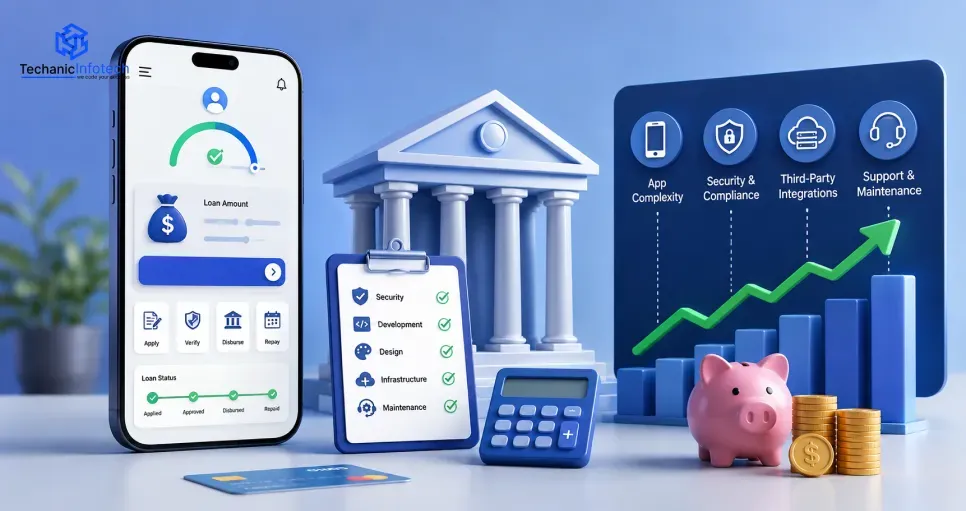
Key Takeaways
Loan lending app development cost usually ranges from $10,000 to $100,000+ based on app scope.
MVP development helps startups test lending ideas before bigger investments.
Features like KYC, AI credit scoring, and fraud detection raise development expenses.
Security, compliance, and integrations shape the final app development budget.
A proper cost plan reduces unexpected maintenance and operational costs.
Most founders think building a loan-lending app is just about coding screens and adding a loan form. It feels simple at first. But the moment you go deeper, things start to shift. Costs, compliance, AI scoring – all of it quietly stacks up.
In 2026, a lending app is not just “an app” anymore. It’s a full financial system sitting inside a phone. In this guide, I’ll break down what it really costs to build a loan lending app, from MVP level to enterprise scale. You’ll also see what drives those numbers up and where startups usually get surprised (yes, that happens more often than people admit).
If you’re planning to build a fintech product or pitching it to investors, this will give you a clear, realistic picture before you spend a single dollar.
A loan lending app is basically a digital setup where people apply for loans, get verified, and receive approval without walking into a bank. Think of it like a middle layer sitting between a borrower and a lender… but everything runs on code, data, and decision systems.
In simple terms, it connects users, credit data, and lenders in one place. Apps like this usually include KYC checks, credit scoring, loan offers, and repayment tracking. I remember when I first worked on a small lending prototype. The tricky part wasn’t the UI. It was the approval logic. That’s where everything either feels smooth or completely breaks.
Now let’s break down how it actually works in real flow, not textbook style, just how it behaves in real systems:
The first step is identity verification. User uploads PAN, Aadhaar, or SSN (in U.S. systems).And honestly… This step decides everything. If KYC fails, nothing moves forward.
Next, the app checks credit history through bureaus or internal AI scoring models.Sometimes I’ve seen apps delay here because data sources don’t match cleanly. It happens more than people expect.
Based on income, credit score, and risk model, the app shows the approval amount.It feels instant to users, but behind the scenes, multiple APIs are talking to each other in milliseconds.
User selects the offer, agrees to the terms, and signs digitally.This is where trust matters; if the flow feels confusing, users drop off fast.
Finally, funds are transferred, and EMI tracking begins inside the app.And this part never really “ends”. It keeps running in the background every month until closure.
Loan lending apps are important in 2026 because digital lending is rapidly replacing traditional banking processes with faster, AI-driven financial services. Users now expect instant approvals, transparent EMI structures, and mobile-first experiences.
According to the Grand View Research Report, the digital lending market is growing really fast in India and globally, backed by strong fintech demand and investor interest. The market is expected to expand at a high CAGR of around 28.8% from 2025 to 2030.
In 2024, the global lending analytics and digital lending platform market was valued at around USD 799.8 million, and it may reach nearly USD 3.5 billion by 2030 as more banks and fintech apps move online.
For example, a small business owner can now apply for working capital loans and receive approval within minutes instead of waiting days or weeks.
Building a loan lending app is not just about creating screens and adding buttons. The real cost comes from the decisions behind the platform. How smart the system is, how secure it needs to be, and how many moving parts it has.
During lending app projects, we found that adding advanced verification, banking integrations, and automation can significantly change the development budget.
The complexity of your lending platform directly impacts the loan-lending app development cost.
A basic loan calculator or simple personal loan application may need fewer workflows, while a complete digital lending ecosystem requires borrower dashboards, lender dashboards, automated underwriting, credit score checking, and real-time loan tracking.
A simple app usually focuses on the loan application process, document upload, and repayment schedule. But a full credit platform or loan marketplace connects borrowers, lenders, banks, and financial institutions through advanced API integration and secure workflows.
Cost difference:
Basic loan calculator / simple MVP: $10,000 – $30,000
Medium lending platform with dashboards and workflows: $30,000 – $60,000
Advanced lending ecosystem with AI, automation, and integrations: $70,000 – $100,000+
Choosing the right platform changes your development expenses because every platform has its own design, testing, and technical requirements.
Native iOS app development and Android app development can deliver strong performance, but building separate apps increases the app development budget.
Many businesses now choose cross-platform development using frameworks like React Native or Flutter to reduce early costs and launch faster.
A good loan lending app development company usually evaluates the user base, scalability, and future plans before selecting the approach.
Cost difference:
Single platform app (iOS or Android): $10,000 – $35,000
Cross-platform development using React Native or Flutter: $20,000 – $50,000
Native iOS + Android development: $40,000 – $80,000+
The features in mobile apps decide how much time and effort go into development. A simple lending app may only need user registration, a loan application, and payment options.
A modern FinTech solution often requires KYC verification, identity verification, fraud detection, AI credit scoring, and automated approval.
Features like digital wallets, API integration, payment gateway connections, and card processing improve user convenience but require secure backend development.
These additions also affect testing, compliance, and maintenance costs.
Cost difference:
Basic features (registration, loan application, loan calculator): $10,000 – $25,000
Advanced features (KYC, payment gateway, dashboards, tracking): $30,000 – $60,000
AI-powered lending features, fraud detection, automated underwriting: $70,000 – $100,000+
The technology stack creates the foundation of your loan lending software development. A scalable architecture helps manage growing users, transactions, and financial data without rebuilding the system later.
|
Technology Layer |
Common Technologies |
Estimated Cost Impact |
|
Frontend Development |
React Native, Flutter, Swift, Kotlin |
$4,000 – $15,000 |
|
Backend Development |
Node.js, Python, Java, Microservices Architecture |
$5,000 – $20,000 |
|
Database Setup |
PostgreSQL, MongoDB, Data Management Systems |
$3,000 – $15,000 |
|
Cloud Infrastructure |
AWS, Google Cloud, Azure |
$10,000 – $50,000+ |
|
AI & Analytics Layer |
AI, ML models, predictive analytics, Big Data Analytics |
$30,000 – $100,000+ |
The best tech stack for loan lending app development includes scalable backend systems, secure databases, and AI-ready frameworks.
A modern fintech stack typically includes React for the frontend, Node.js or Python for the backend, and AWS or Firebase for cloud infrastructure.
For example, Python is widely used for AI credit scoring models due to its strong machine learning libraries.
Financial apps work with sensitive user data, so compliance is a major cost factor. Lending platforms must follow financial regulations related to data privacy, AML (anti-money laundering), GDPR, PCI DSS, and regional lending rules.
Compliance requirements affect the design, backend development, reporting system, and security process. A serious lending platform needs proper audit trails, secure data handling, and transparent loan operations.
For businesses working with NBFCs, credit unions, or other financial institutions, compliance planning should start early. It avoids expensive changes after development.
Cost difference:
Basic compliance setup: $5,000 – $15,000
KYC, AML, GDPR, PCI DSS, reporting workflows: $15,000 – $40,000
Advanced compliance monitoring for large platforms: $40,000 – $80,000+
Third-party integration often becomes one of the biggest cost drivers in lending app development. Your app may need connections with banks, payment providers, credit bureaus, identity verification services, and financial APIs.
Payment processing, ACH, UPI, digital wallet, and e-wallet API integration improve the borrower experience but require careful backend work. Every external service has different documentation, testing requirements, and security rules.
Cost difference:
Basic integrations (notifications, simple APIs): $5,000 – $15,000
Payment gateway, credit checks, KYC, banking APIs: $20,000 – $50,000
Multiple banking APIs, advanced financial connections: $50,000 – $90,000+
Security is not an optional feature in a loan platform. Users share financial details, identity documents, and payment information, so the system needs strong protection from day one.
Modern lending apps use encryption, two-factor authentication, biometric authentication, secure login systems, and fraud detection systems. AI-powered monitoring can also identify unusual transactions and improve risk management.
A small security mistake can damage user trust quickly. That is why security planning is built into the development process, not added at the end.
Cost difference:
Basic security setup (authentication, encryption): $5,000 – $15,000
Advanced security (2FA, biometric authentication, fraud detection): $20,000 – $50,000
Enterprise security with AI monitoring and risk management: $50,000 – $100,000+
Launching the app is only the beginning. A lending platform needs regular updates, bug fixes, security checks, server monitoring, and feature improvements after release.
Maintenance cost depends on app complexity, user growth, integrations, and support requirements. AI models also need monitoring because lending patterns change over time.
A reliable loan lending app development company usually provides ongoing support to keep the platform stable and ready for scaling.
Cost difference:
Basic maintenance and updates: $5,000 – $15,000/year
Regular improvements, monitoring, bug fixes: $15,000 – $40,000/year
Enterprise support with scaling and security updates: $40,000 – $80,000+/year
The loan lending app development cost in 2026 usually ranges from $10,000 to $100,000+, depending on app complexity, features, security needs, integrations, and scalability requirements. A basic MVP may need a smaller budget, while an advanced FinTech platform with AI, automation, and banking connections requires a bigger investment.
The fintech app development cost is not only about building screens. The real budget comes from backend development, compliance, third-party integration, cloud infrastructure, and future growth planning. A lending app is a complete financial system where every layer affects the final pricing. .
|
App Stage |
Estimated Cost (USD) |
Features Included |
Timeline |
|
MVP Lending App |
$10,000 – $25,000 |
Basic KYC, loan application form, EMI calculator |
4–8 weeks |
|
Starter Growth App |
$25,000 – $40,000 |
User dashboard, credit scoring basics, notifications |
6–10 weeks |
|
Mid-Level Fintech App |
$40,000 – $60,000 |
Payment gateway, admin panel, and loan tracking system |
8–14 weeks |
|
Advanced Lending Platform |
$60,000 – $80,000 |
Fraud detection, automated approvals, analytics |
12–18 weeks |
|
Enterprise AI Lending System |
$80,000 – $90,000+ |
AI underwriting, real-time risk engine, full automation |
16–24 weeks |
The features you add to a lending platform directly affect the digital lending app development cost. A basic app may handle simple loan requests, but advanced features bring automation, security, and a better user experience.
During lending app projects, we found that features connected with verification, AI, and financial integrations create the biggest budget changes.
AI credit scoring is one of the most advanced features in modern lending apps. It uses artificial intelligence (AI), machine learning (ML), and predictive analytics to review borrower data and support faster credit decisions.
Instead of only depending on manual checks, AI-powered lending systems analyse spending patterns, repayment history, and risk signals.
This feature improves automated underwriting but needs data models, backend development, and continuous monitoring.
KYC verification plays a major role in the loan application process. Borrowers need to submit identity documents, income details, and personal information before approval.
Adding identity verification, document verification, and AML (Anti-Money Laundering) checks requires third-party integration with verification providers.
It improves trust but adds development expenses due to API setup and security testing.
A fraud detection system protects lenders and users from suspicious activities. It monitors transactions, login behaviour, and application patterns to identify possible risks.
For a serious credit platform or loan marketplace, real-time fraud monitoring is not optional. It uses risk management tools, analytics, and secure workflows to reduce financial losses.
A loan calculator looks simple, but it improves user experience by helping borrowers understand interest rates, monthly payments, and repayment schedules before applying.
This feature supports transparency in personal loan and business loan applications. It connects with loan rules, interest calculations, and repayment logic, which affect backend development.
Users often have questions during the borrowing process. A chat feature helps them get answers about loan status, payments, and application updates without waiting.
Modern apps use AI chatbots to handle common requests and reduce support pressure. Adding AI assistance requires chatbot integration, natural language processing, and backend connection.
A document management feature allows users to upload, store, and manage important files like ID proof, income documents, and bank statements.
This feature needs secure file handling, cloud storage, encryption, and access control. It becomes more important for lenders handling large numbers of borrowers.
Payment features are a core part of AI-powered loan management software development. Borrowers expect smooth repayment options through cards, UPI, ACH, and Digital Wallet solutions.
Payment gateway integration and payment processing workflows require secure API development and testing. These integrations can quickly change the cost to develop a mobile app.
Auto debit makes loan repayment easier by allowing automatic EMI deductions from user accounts. It helps reduce missed payments and improves cash flow for lenders.
This feature requires banking connections, secure authorisation, and repayment tracking. It is commonly used in consumer lending and FinTech platforms.
Separate borrower dashboards and lender dashboards to improve control over the lending process. Borrowers can check loan status, payments, and repayment schedules, while lenders manage approvals and reports.
These dashboards require UI/UX design, data visualisation, role-based access, and real-time updates.
Analytics helps lenders understand loan performance, repayments, user activity, and business growth. Admin teams use these insights to improve lending decisions.
Big data analytics and reporting tools become important as the platform grows. More advanced reports require stronger cloud infrastructure and database planning.
Cloud infrastructure supports secure storage, faster performance, and scalability. Loan apps handle sensitive financial records, so protection cannot be treated as an afterthought.
Features like encryption, two-factor authentication, biometric authentication, and secure cloud storage improve safety for users and financial institutions.
Blockchain can improve transparency and record management in advanced lending platforms. It helps maintain secure transaction histories and supports trust between borrowers and lenders.
This feature is mainly used in larger FinTech solutions where data integrity and verification are critical.
Many businesses plan their loan lending app development cost around design and development only. But the real budget often changes after launch. Things like cloud infrastructure, compliance, security updates, and third-party services quietly add up over time.
For FinTech products, these hidden expenses matter because lending apps handle sensitive financial data, payments, and user records. A smart app development budget includes these operational costs from the beginning, not after problems appear.
|
Hidden Cost Area |
What It Includes |
Estimated Cost Impact |
|
Cloud Hosting & Infrastructure Scaling |
Server upgrades, database expansion, bandwidth, storage, and performance optimisation as users increase. A growing digital lending platform may need stronger cloud infrastructure over time. |
$500 – $20,000+/month |
|
API Subscription & Usage Fees |
Ongoing fees for external API usage, including banking data, credit checks, notifications, and other third-party services. |
$1,000 – $15,000+/year |
|
Customer Support & CRM Tools |
Support systems, ticket management, chatbot tools, and CRM platforms are used to handle borrower queries after launch. |
$500 – $5,000/month |
|
App Monitoring & Performance Tools |
Error tracking, uptime monitoring, analytics, and performance reporting to identify and resolve issues proactively. |
$200 – $3,000/month |
|
Software Updates & Compatibility |
Mobile OS updates, device compatibility fixes, bug patches, security updates, and minor feature improvements to keep the app stable. |
15–25% of annual development cost |
|
Data Backup & Disaster Recovery |
Backup systems and recovery mechanisms to protect borrower records, transaction history, and business data from unexpected failures. |
$1,000 – $10,000/year |
|
Team Training & Process Setup |
Internal training, administrator onboarding, process documentation, and workflow improvements for smooth operations. |
$2,000 – $15,000+ |
Many startups overspend by creating a full system before knowing what users actually need. A smarter approach is to start small, test the idea, and improve based on real feedback.
An MVP helps startups control the loan-lending app development cost by focusing on core functions first. Start with features like user registration, KYC verification, loan application, repayment tracking, and basic dashboards.
Once users respond well, advanced features like AI credit scoring, automated underwriting, fraud detection systems, and advanced analytics can be added.
Cost impact: MVP-first development can reduce initial expenses by around 40–60% compared to building a complete lending platform from the beginning.
A flexible architecture helps avoid expensive rebuilds later. Using modular development, API integration, and cloud infrastructure allows startups to add new features without changing the entire system.
A strong foundation also supports future growth in digital lending, personal loans, business loans, and peer-to-peer lending platforms.
Cost impact: Smart architecture may slightly increase early investment but reduce long-term maintenance costs and operational expenses.
Not every feature needs to launch together. Startups should identify what solves the biggest user problem first.
For example, a new credit platform may begin with a borrower dashboard, loan tracking, payment processing, and document verification before adding complex AI-powered lending tools.
Cost impact: Removing unnecessary early features can lower the app development budget and speed up market launch.
A clear budget plan helps startups understand the real loan lending software development cost. Include development, third-party services, cloud hosting, security updates, and future improvements.
During lending app projects, we found that businesses that plan scaling early avoid sudden cost jumps when user traffic increases.
Cost impact: Early planning helps control development expenses and creates room for future upgrades without financial pressure.
A lending app can generate revenue in different ways beyond interest. The right monetisation model depends on your users, lending model, and platform strategy.
Interest-Based Lending Model: Earn through interest charges on personal loans, business loans, or short-term credit products offered through the platform.
Late Payment Charges: Generate additional revenue through penalties applied to delayed repayment schedules and missed payments.
Subscription Plans: Offer premium plans with benefits like faster approvals, financial insights, or advanced borrower tools.
Marketplace Commission: A loan marketplace can earn by connecting borrowers with multiple lenders and taking a commission per successful deal.
Partner Revenue Model: Create partnerships with banks, credit unions, or financial institutions and earn referral-based income.
Premium Financial Services: Provide paid services such as credit score checking, financial reports, or personalised money management tools.
API Monetization: Offer your lending infrastructure or API development services to other FinTech companies for recurring revenue.
Advertisement Revenue: Display relevant financial offers, insurance products, or business services inside the platform.
Developing a loan lending app starts with more than just coding. Each stage, from planning to launch, affects the final cost to build a loan lending app in 2026. The budget changes based on features, security, integrations, and platform needs.
Before development begins, decide what type of platform you need — a personal loan, a business loan, peer-to-peer lending, or a complete credit platform. This choice decides the workflows, features, and overall digital lending app development cost.
Cost: $2,000 – $8,000 (planning, research, business analysis)
A simple and clear design helps borrowers complete the loan application process easily. The design stage includes the borrower dashboard, the lender dashboard, a loan calculator, and user journey planning.
Cost: $3,000 – $12,000
Frontend development creates the user-facing app, while backend development manages accounts, loan data, transactions, and APIs. A strong backend supports future scaling without rebuilding the system.
Cost: $4,000 – $20,000
The main features in mobile apps decide the development effort. This stage includes KYC, document verification, repayment schedule, credit score checking, loan tracking, and automated approval workflows.
Cost: $15,000 – $50,000
Payment gateway, banking connections, ACH, UPI, digital wallet, and API integration improve the user experience but add development complexity.
Cost: $10,000 – $40,000
Loan apps handle sensitive financial data, so security layers like encryption, two-factor authentication, biometric authentication, AML, and fraud detection are important.
Cost: $10,000 – $40,000
AI-powered lending features use artificial intelligence (AI), machine learning (ML), and predictive analytics for smarter decisions. These features increase investment but improve risk management.
Cost: $15,000 – $45,000+
Before release, the app needs testing, bug fixing, performance checks, and ongoing improvements. Maintenance cost depends on user growth, integrations, and updates.
Cost: $5,000 – $30,000+
Building a successful lending platform is not only about creating an app. It is about combining secure technology, smooth user experience, compliance, and smart financial workflows into one system.
The cost to build a loan-lending app in 2026 depends on your app's complexity, required features, technology stack, integrations, and long-term goals. A simple MVP may fit a smaller app development budget, while a full-scale digital lending solution with automation, analytics, and advanced security needs more investment.
From UI UX design and backend development to KYC, payment processing, and AI-powered lending features, every decision changes the final development expenses. Planning early helps businesses control the loan lending app development cost and avoid unexpected changes later.
A strong lending product is built step by step. Start with the right foundation, validate your idea, and scale features as users grow. That approach creates a reliable platform instead of just another app in the market.
A loan lending app can cost around $10,000 to $100,000+, depending on features, integrations, security needs, and platform complexity.
A loan lending app can cost around $10,000 to $100,000+, depending on features, integrations, security needs, and platform complexity.
The average cost usually ranges between $40,000 and $60,000 for a mid-level lending platform with essential fintech features.
The average cost usually ranges between $40,000 and $60,000 for a mid-level lending platform with essential fintech features.
Features, AI credit scoring, KYC, payment processing, backend complexity, security, and third-party API integration impact the final pricing.
Features, AI credit scoring, KYC, payment processing, backend complexity, security, and third-party API integration impact the final pricing.
Yes. Startups can launch an MVP with basic features like loan applications, document verification, and repayment tracking at a lower cost.
Yes. Startups can launch an MVP with basic features like loan applications, document verification, and repayment tracking at a lower cost.
A basic app may take 2–3 months, while advanced digital lending platforms can take 6+ months to develop.
A basic app may take 2–3 months, while advanced digital lending platforms can take 6+ months to develop.
AI underwriting, fraud detection, automated approval, dashboards, analytics, and banking integrations usually increase development costs.
AI underwriting, fraud detection, automated approval, dashboards, analytics, and banking integrations usually increase development costs.
AI is not mandatory, but AI-powered lending improves risk assessment, credit decisions, and fraud detection capabilities.
AI is not mandatory, but AI-powered lending improves risk assessment, credit decisions, and fraud detection capabilities.
Common expenses include maintenance, cloud hosting, security updates, API fees, compliance checks, and operational support.
Common expenses include maintenance, cloud hosting, security updates, API fees, compliance checks, and operational support.
Yes. MVP development helps test the market, collect user feedback, and reduce unnecessary early investment.
Yes. MVP development helps test the market, collect user feedback, and reduce unnecessary early investment.
Businesses can control costs through phased development, reusable frameworks, outsourcing, and focusing on core lending workflows first.
Businesses can control costs through phased development, reusable frameworks, outsourcing, and focusing on core lending workflows first.


Abhishek Jangid is the CEO of Techanic Infotech, with extensive experience in mobile app and web development. He specializes in helping businesses turn innovative ideas into scalable digital solutions through strategic planning and modern technology.