Salon App Development
How Voice Assistants in Salon Apps Are Transforming Customer Experience
June 11, 2026
June 11, 2026
Imagine this: It's Tuesday at 7 PM. Sarah's just remembered she has a hair appointment needed for the big presentation on Friday.
She's cooking dinner, children are crying in the distance, and the last thing she's got time for is messing around on a booking app.
So she just says, "Book me with Lisa for Friday afternoon, just a trim and blowout." Done. Appointment booked in 15 seconds.
This is no longer science fiction.
Salon owners everywhere are facing the tough reality that missed calls translate to lost income, no-shows blow through schedules, and customers cancel online bookings quicker than it takes to say "processing".
Manual scheduling systems become relics of the past when everyone wants Amazon-level ease.
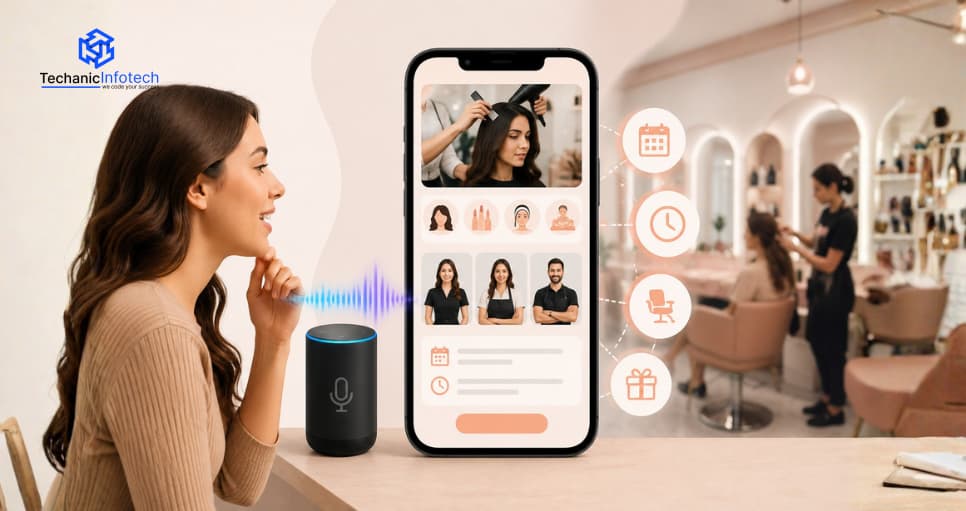
That's where voice assistants in salon apps come in, making annoying booking experiences as easy as a conversation.
Sophisticated salon owners understand that staying in the game involves partnering with a company that understands salon app development.
The future of salons is about making it easy to book, and voice technology is at the helm.
Imagine voice assistants in salon apps like having an extra-intelligent receptionist who is always awake, never gets stressed, and can recall precisely what each customer prefers.
Compared to Siri or Alexa, which do everything from providing weather forecasts to keeping shopping lists, these are trained especially for the beauty industry.
When someone asks Alexa about balayage, she might read a Wikipedia article.
But a salon-focused voice assistant? She knows your colorist's availability, can explain the difference between balayage and highlights, and books the appointment while factoring in processing time and your hair history.
The actual magic occurs because these systems communicate in "salon language."
They know that "just a touch-up" is one thing to a person with highlights and another to one with grey roots. They realize that scheduling a "quick trim" on Saturday afternoon of prom season isn't actually possible.
When comparing salon management software vs salon app, the addition of voice assistants clearly shows how apps deliver smarter, more personalized client experiences.
Nonetheless, here's what makes a salon app with voice assistant technology so potent:
Intelligent Booking That Really Delivers: These programs take care of the tricky business, such as double-checking to ensure your colorist has sufficient time for a full highlight treatment or recommending a better time slot when they notice you're attempting to fit in a chemical treatment during lunchtime.
Memory That Matters: Remember when Lisa mentioned she was going blonde for the summer? The voice assistant does too, and it'll suggest a toner appointment when it notices she hasn't been in for maintenance.
Always-On Service: That midnight panic booking when you remember tomorrow's wedding? Voice assistants handle it, checking real-time availability and sending confirmation while you sleep.
Hassle-Free Payment: "Add a 20% tip to my regular card" is as simple as expressing thanks. No juggling payment displays or doing percentages.
Shattering Language Barriers: If your customer uses Spanish, Mandarin, or has a Boston growl, new voice systems adjust and comprehend, making all feel welcome.
Multi-Platform Magic: Customers can book through their smart speakers at home, their car's voice system during commute, or their phone's assistant while multitasking.
Those who want to create a salon app should include such functionalities to stand out from the crowd.
Let's get real about what's actually going on in salons today. Phone rings during a color service? That request too book goes to voicemail.
Customer attempts booking online but is overwhelmed by the service description. They book somewhere else. Person needs to reschedule, but calls during closing time? Missed opportunity.
The statistics paint a grim picture. Industry reports indicate that salons miss out on approximately 30% of possible bookings because of timing problems, convoluted systems, or plain old human mistakes. That's not merely inconvenient – that's money leaving the building every single day.
Voice-enabled salon apps turn this equation on its head. Rather than your customers changing to fit your booking system, your booking system changes to fit the way people naturally interact.
Here's what happens when you welcome the role of voice assistants in salon apps:
Actual Conversion-Speed Booking: Classic online booking is 3-5 minutes when all goes well. Voice booking? Twenty seconds maximum. Customers who may have been about to give up after viewing a daunting form now get bookings done with ease.
Never Miss Another After-Hours Opportunity: Your voice assistant never goes home. When a person has a booking idea at 10 PM on Sunday, the system records it rather than letting your competitor who checks their phone Monday morning get it.
Natural-Sounding Personalization: Rather than mass-marketing emails, customers receive voice calls such as "Hi Jessica, 8 weeks have passed since your previous highlight touch-up, and we have a slot Thursday afternoon with Sarah." That's not a marketing ploy – that's customer service.
Loyalty Programs That Really Pay Off: "You're just 2 visits from a complimentary deep conditioning treatment" resonates more strongly when communicated via organic conversation rather than hidden behind an app notification.
Access for All: All top salon apps have this in common. That is, visually impaired customers with arthritis, or anyone who has trouble with tiny screens, can now engage in your services as easily as tech-savvy customers.
Staff Freedom to Do What They Do Best: When voice assistants handle routine bookings and questions, your team can focus on delivering amazing services instead of playing phone tag.
Real Customer Insights: Voice interactions reveal what customers actually want – not just what they book, but how they think about services, what concerns them, and what would make them come back more often.
Appointment Scheduling That Actually Makes Sense. Scheduling appointments with voice isn't merely about ease – it's about smarts. If Maria utters "I need a root touch-up, but I can only come after soccer practice," the system doesn't simply look at a schedule.
It takes into account that root touch-ups require particular timing, that after-school time slots book up quickly, and that Maria's hair grows rapidly according to her history.
The actually intelligent voice assistants in salon apps learn trends. They understand that wedding season translates to longer appointments, that some clients always show up late, and that some services simply cannot be hurried.
This isn't scheduling; it's strategic resource management that occurs in real dialogue.
No one enjoys automated reminder calls, but everyone enjoys friendly ones.
Today's voice assistants send reminders that sound personal: "Hi Tom, just to remind you of tomorrow's beard trim with Mike at 3 PM. Looks like good weather, so parking will be simple."
Those small flourishes indicate to customers that you're considering their entire experience, not just scheduling appointment slots.
The system becomes smarter with time as well. If Sarah habitually cancels Tuesday appointments due to her yoga class, upcoming reminders could suggest Wednesday time slots instead.
When looking at various challenges, one of the most significant is making automated communication personal.
Here's where voice assistants in beauty apps really come into their own.
Rather than promoting pricey treatments randomly, they suggest based on real customer needs and history. "Your color looks great, but I can see your ends are starting to get a bit dry.
Do you want to throw a treatment in today, or would you like us to schedule for next week when you can take more time?".
These discussions occur organically at the time of booking, not as irritating upsells.
The AI takes into account such things as service intervals, seasonal requirements, special events noted on prior visits, and even local weather patterns that could impact hair and skin.
Point tracking is effortless when embedded in everyday conversation.
"That puts you at 8 visits this year – you've qualified for a free aromatherapy upgrade." Would you like to apply it today or save it for your next visit?"
No app navigation, no lost rewards, just easy value recognition.
Processing payments via voice commands is risky-sounding, yet it's more secure than much of what's done in traditional ways.
"Charge my normal card and throw in an 18% tip" initiates several security checks in the background while sounding entirely natural to consumers.
Split payments for group treatments, gift certificate use, and loyalty point redemption all occur via ordinary conversation.
Voice assistants dismantle communication barriers that could otherwise lose you customers.
Beyond general multilingual capabilities, sophisticated systems handle code-switching (where bilingual speakers switch back and forth between languages naturally) and learn to accommodate diverse cultural patterns of communication.
This is not merely pleasant to do – it's it's business-wisee in multicultural markets.
No matter whether Amazon Alexa, Google Assistant, or Apple's Siri is your preferred voice assistant, your salon's voice assistant is compatible with all platforms.
A customer can initiate a booking conversation over their phone at lunchtime and complete it using their vehicle's system on the drive home.
That ensures that no booking falls through the cracks.
It's not convenience that separates voice assistant use from old-fashioned booking techniques – it's the difference between being heard and being processed.
When clients can communicate their needs in a natural manner, salon appointments become conversations instead of transactional experiences.
Consider how annoying it is to try to explain precisely what you're looking for using a booking form. "Medium length" is different for each person.
But when you can say, "I'd like to maintain the length but add some movement – you know, like the actress on the show I mentioned last time," an intelligent voice assistant makes those pieces fit together and books you with the appropriate stylist who specializes in textured cuts.
Voice technology removes the guesswork and frustration that accumulate in conventional booking systems.
Customers don't have to memorize service names or wade through infinite options. They simply speak as they would to a wise friend, and the system converts that to precisely the right appointment.
Actual enhancements customers immediately appreciate:
Instead of choosing between "Partial Highlights," "Full Highlights," or "Color Touch-up," customers explain what they want and the system figures out the technical details. "I need my roots done, but want to brighten things up a bit" gets interpreted correctly.
Voice assistants recall not only service history but also preferences, issues, and objectives stated in conversations. When a person states that they're letting a pixie cut grow out, subsequent interactions retain that in mind.
When there's a conflict, voice assistants provide actual solutions: "Your regular time is not available, but I can arrange for you 30 minutes ahead with Lisa, or there is a Thursday at the same time slot available with your regular stylist."
Voice assistants serve useful reminders based on booked services: "Since you're having a chemical treatment, don't forget not to wash your hair the day before your appointment."
Post-appointments, voice assistants follow up with customized messages: "How did your color turn out? If you need any touch-ups or have home care questions, just let me know."
Customers of varying abilities are able to access the same quality booking experience regardless of whether they are visually impaired, mobility-impaired, or just prefer communication by ear.
The effect on customers emotionally can't be exaggerated.
When customers feel valued and understood instead of channeled through a system, they form true loyalty that becomes profitable over the long term in the form of long-term business relationships.
The investment return on voice technology in salons extends far beyond booking additional appointments. It fundamentally shifts the way salons function, producing efficiencies that multiply over time while establishing more loyal customer relationships.
Actual salons are experiencing remarkable growth. Consider Rebecca's salon in Austin – six months after adopting voice assistants, her booking completion rate increased from 45% to 72%. But the actual prize was retention: clients who booked via voice were 40% more likely to rebook within 30 days than the standard bookings.
These aren't just feel-good metrics. When customers have positive booking experiences, they're more likely to try additional services, refer friends, and remain loyal during competitive pressure.
The cost to build a salon app with voice capabilities pays for itself through these compounding benefits.
Check out the business impact of voice assistants in salon apps here:
Salons see 35-45% more completed bookings when customers can use voice rather than forms. The contrast is particularly striking for mobile users who tend to drop off on multistep booking flows.
Voice assistants naturally recommend complementary services while booking conversations, growing average ticket sizes by 18-25% without coming across as pushy or sales-oriented.
Personalized voice reminders with updates on weather, parking, and preparation cut no-shows by as much as 40% over text reminders.
With voice assistants taking care of procedural bookings, confirmations, and basic inquiries, staff can prioritize revenue-generating services instead of administrative tasks.
The one-of-a-kind experience voice assistants deliver drives retention levels noticeably higher, with a lot of salons registering 30%+ repeat visit frequency enhancements.
Lower demand for front desk personnel during peak times, fewer booking error that needs to be corrected, and automated responses for routine questions can reduce operating costs by 15-20%.
A chain of mid-sized salons in California installed voice booking in three locations. Eight months later, they measured outstanding results: overall bookings were up 42%, customer satisfaction scores climbed from 3.8 to 4.6 out of 5, and revenue per store rose 28%.
Perhaps most importantly, staff turnover was reduced because team members were able to concentrate on creative efforts rather than answering repetitive booking queries.
Ready to revolutionize your booking process? Let's see how voice technology can particularly help your salon's specific scenario..
The beauty and wellness industry is rapidly adopting AI-powered solutions to improve customer experiences and streamline operations. Voice-enabled booking systems help salons reduce missed appointments, improve customer engagement, and provide 24/7 booking support without increasing operational costs.
Businesses planning to launch an AI-powered beauty platform should partner with an experienced salon app development company that understands voice technology, customer behavior, and salon workflow automation. Integrating voice assistants into salon applications can significantly improve booking efficiency, customer retention, and overall business growth.
Let’s get to know the technical side. Here, we will learn how to build voice-enabled salon apps:
Before putting pen to paper for a single line of code, successful voice assistant projects begin with extensive discovery.
This's not about selecting the hippest technology – it's about learning how your particular customers talk, what annoys them about existing booking practices, and what will get them to book at your salon versus other salons.
The analysis stage is spent learning from real customer conversations, recognizing typical booking situations, and diagramming the decision process individuals use in selecting services.
Various salon formats call for varying styles: a high-end spa demands more consultative discussions, while a quick-service unit requires speedy, streamlined exchanges.
Platform choice dictates all aspects of user experience and ultimate success.
Google's Dialogflow is very good at natural language understanding and plays nicely with existing Google ecosystems.
Amazon's Alexa Skills Kit gives access to millions of smart speaker users but demands certain development methods. Apple's SiriKit features easy iOS integration but more limiting guidelines.
The solution is aligning platform strengths with customer behavior trends.
If your clients are mainly iPhone owners who book on the way to work, SiriKit integration is appropriate.
If you have families that engage with smart speakers in the home, Alexa skills are a more effective reach.
Being aware of the latest salon app trends assists these strategic technology choices.
The largest technical hurdle isn't developing voice recognition – it's getting new tech to get along with current salon management software, payment gateways, and scheduling software.
Old systems tend not to have contemporary APIs, so middleware needs to be developed to fill gaps.
Successful integration keeps data synchronized on all systems, while voice interactions are able to access real-time data. What this implies is that appointment availability, customer preferences, and payment information remain consistent whether a person schedules through voice, web, or in-person.
Voice user experience design is guided by totally different rules than visual interfaces. Dialogue should sound natural while successfully retrieving necessary information.
That implies knowing how individuals actually explain services and not necessarily as salons technically group them.
Designing involves scripting conversations for dozens of situations: initial reservations, regular appointments, urgent requests, complaint resolution, and opportunities to upsell.
Every path needs to be thoughtfully developed so as not to sound helpful but rather clinical while getting results for the business.
Voice assistant testing extends well beyond verifying whether words are being correctly recognized by the system.
It's about testing under various accents, levels of background noise, speaking rates, and emotional states. Beta testing with real customers uncovers edge cases that developers never think of.
Through and through testing covers accuracy verification, security validation, and integration stress testing. The system must be able to handle interruptions, misunderstandings, and technical failures elegantly while sustaining customer trust and data integrity.
Effective voice assistant launches include employee training, customer education, and phased rollouts. Employees must learn how the system operates so they can assist customers with questions or problems.
Customer adoption is best achieved through gradual introduction via current communication channels, illustrating real benefits without insisting on immediate adoption.
Many salons often achieve success by framing voice booking as an extra convenience option instead of a substitute for their most preferred approaches.
After launching, ensure you invest in ongoing salon app maintenance to keep performance seamless and features up-to-date.
As much as it sounds amazing to use voice assistants in the salon app. It is important to know about those salon app development challenges that an investor faces while integrating voice assistants in a salon app:
Beauty vocabulary presents special challenges for voice recognition systems.
Terms such as "ombré," "balayage," "microneedling," and product names tend to be confused by generic voice systems.
Even basic terminology can be problematic – "highlights" and "lowlights" are easy to confuse but imply very different services and timing.
Developing industry-specific lexicon takes a lot of training data from actual salon discussions.
The program must learn not only technical jargon but the way customers really define what they need: "I want to go lighter" vs. "I need a touch-up" vs. "Can you repair this disaster that I got from another salon?"
Voice data carries intensely personal data – not only booking information but discussions on appearance issues, life milestones, and financial circumstances.
Customers are naturally concerned about how such data is stored, to whom it is available, and potentially how it can be used.
Effective implementations depend on open privacy policies, strong data encryption, and explicit customer control over their data.
This is not about compliance with the law – it's about establishing confidence that leads customers to make frequent use of voice features.
Regional dialects, rates of speech, and patterns of communication based on culture all add richness that defies straightforward translation of language.
There are cultures that prize indirectness, but others are extremely direct. Voice assistants must be able to adjust to these differences without leading customers to feel misunderstood or judged.
The difficulty increases in multilingual markets where the customer may switch languages during conversation or employ culturally specific vocabulary for beauty ideas. Designing inclusive voice systems involves significant testing across varied user populations and continuous iteration based on real-world usage patterns.
Integrating voice assistants with current salon systems tends to expose technical debt and compatibility problems that weren't known previously. Legacy scheduling software may lack APIs for checking availability in real time.
Payment systems may not accommodate voice-initiated transactions. Customer databases may not organize information in a way that will support personalized voice interaction.
These integration challenges can significantly impact project timelines and budgets. Many salons underestimate the complexity of making all systems work together seamlessly, leading to compromised functionality or unexpected costs during development.
The future wave of voice technology in salon apps will render existing systems ancient.
We're headed towards genuinely intelligent assistants that not only schedule appointments but also become discreet beauty advisors who know client needs at a molecular level.
Picture voice assistants that scan variations in your voice patterns to identify stress levels and automatically recommend relaxation therapies.
Or systems that integrate with your fitness band to recommend hair treatments based on your workout routine and perspiration patterns. This is not science fiction yet – the technology is available now, and early adopters are already trying these features.
Game-changing features coming your way:
Your voice assistants will get to know your routines so well they'll book appointments before you know you need them.
"Your roots tend to irritate you around week 6, and you've got that company presentation – can I schedule a touch-up for next Tuesday?"
Customers will tell AI what they want with their hair or skin in everyday language, and AI will suggest certain products, read reviews in your voice assistant's voice, and make purchases without ever touching a screen.
Learning about how salon apps generate revenue, product sales through voice will become the primary source of revenue.
Sophisticated systems will identify mood cues in voice patterns and adjust service recommendations accordingly.
Stressed-out customers may receive proposals for additional longer massages, while enthusiastic customers organizing special occasions are guided towards dramatic transformation procedures.
Voice commands will drive augmented reality experiences where clients are able to experiment with various looks virtually.
"Show me what I'd look like with layers" is an interactive experience that's driven completely by natural conversation.
If you plan to start an online salon business, it’s high time to consider such trends to have in your app.
Voice assistants will integrate with health apps to recommend beauty treatments that align with overall well-being objectives.
Detox program in planning? Your voice assistant may recommend scalp treatments that aid healthy hair growth during nutritional transitions.
Those salons that begin to play with voice technology today will be in the best position to leverage these higher-order capabilities as they emerge. Early adoption generates learning opportunities and customer comfort that snowball over time.
Voice assistants in salon apps are more than a tech upgrade; they're an inherent move toward more human, intuitive business engagement.
When it's as easy as chatting with a friend to book an appointment at the salon, everyone is a winner.
Customers enjoy the convenience they desire, salons increase bookings, and employees can focus on providing incredible services rather than wrangling scheduling headaches.
The function of voice assistants in salon apps will only grow as the technology advances and the consumer is more accustomed to voice communication. Salons that adopt this technology early are positioning themselves as cutting-edge companies committed to customer experience and business efficiency.
The issue isn't whether voice technology will revolutionize the salon business it's whether your company will drive that revolution or play catch-up later on. Early movers benefit greatly: increased booking conversion, better customer retention, and efficiencies that build over time.
Revolutionize your salon's booking experience now. Get in touch with us to learn how voice assistant technology can address your particular pain points and fuel your company's growth.
Voice assistants allow customers to book appointments, make inquiries, and manage salon services using voice commands.
They simplify booking by enabling customers to schedule appointments naturally without navigating complex forms.
Yes, personalized voice reminders and automated follow-ups help reduce missed appointments and cancellations.
Modern salon apps use encryption, authentication, and secure payment systems to protect customer data and transactions.
Voice assistants improve customer convenience, increase bookings, enhance engagement, and streamline salon operations.


Neha Sharma is a tech expert at heart who loves exploring new technologies and turning complex ideas into easy-to-understand content. With a passion for learning and writing, she enjoys sharing insights on emerging tech, digital products, and innovation that help businesses stay ahead.