
Ecommerce App Development
AI in eCommerce App Development: Everything You Should Know
February 20, 2026
February 20, 2026
Artificial Intelligence (AI) is redefining how online businesses operate, engage customers, and drive revenue.
In eCommerce, AI enables smarter automation, real-time personalization, predictive insights, and seamless customer interactions.
From product recommendations to fraud detection, AI-powered systems analyze vast amounts of data to deliver highly relevant shopping experiences.
Businesses leveraging AI in their eCommerce apps gain deeper customer insights, improve operational efficiency, and increase conversion rates.
As digital commerce continues to expand globally, AI-driven innovation ensures scalability, smarter decision-making, and long-term business growth in an increasingly competitive marketplace.
Artificial intelligence is revolutionizing eCommerce in 2026, enabling hyper-personalized shopping, smarter automation, predictive analytics, and seamless customer experiences that drive growth and competitive advantage.
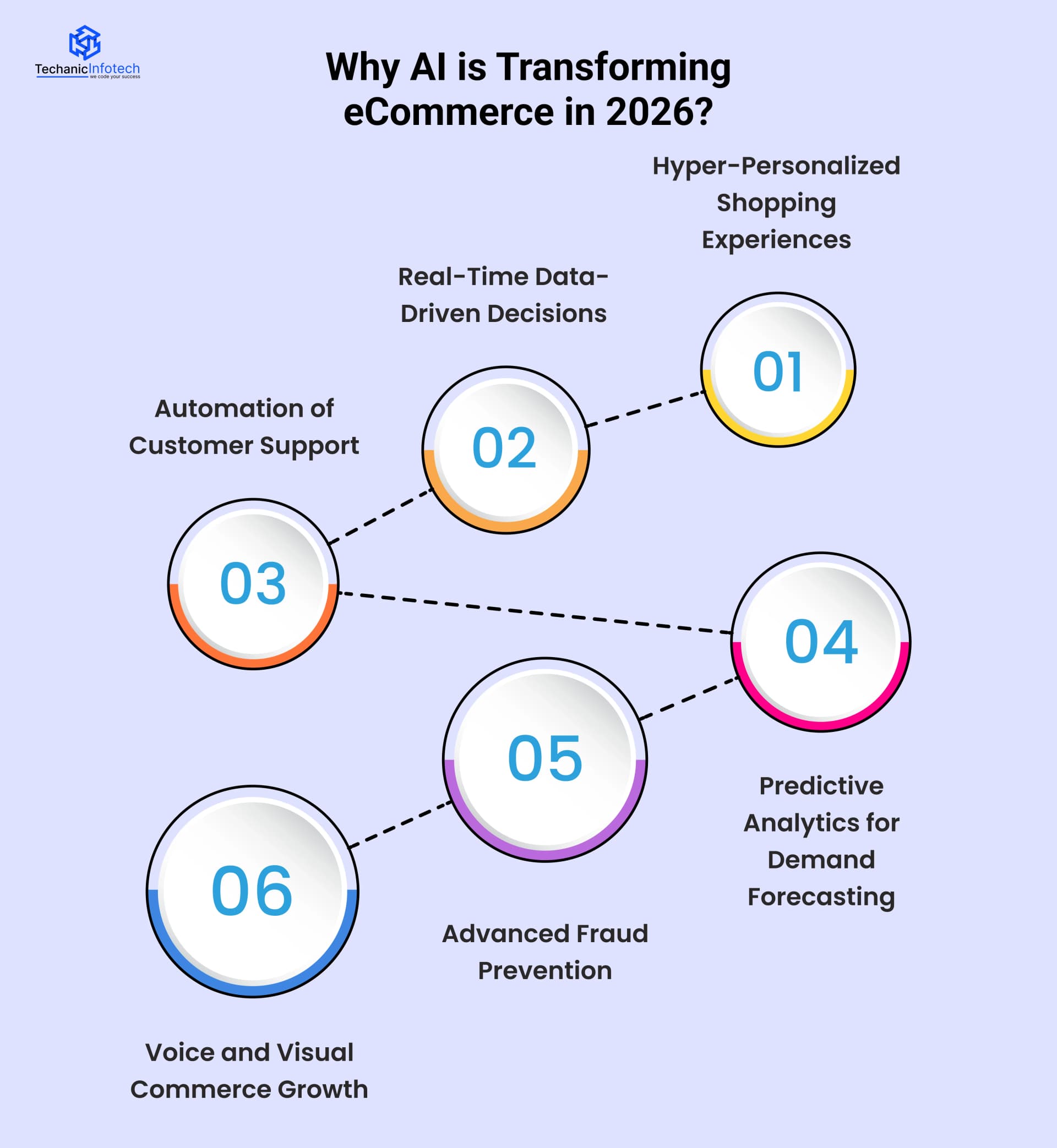
AI analyzes browsing behavior, purchase history, and user preferences to deliver tailored product recommendations and dynamic content.
In 2026, customers expect personalized interactions, making AI crucial for improving engagement, boosting conversions, and increasing average order value.
AI processes massive datasets instantly, enabling businesses to adjust pricing, promotions, and inventory strategies in real time.
This responsiveness helps brands stay competitive, reduce losses, and maximize profitability in fast-changing online markets.
AI-powered chatbots and virtual assistants provide instant, 24/7 customer support.
They reduce operational and AI chatbot development costs, improve response times, and enhance customer satisfaction by resolving queries without human intervention.
AI predicts buying trends and seasonal demand patterns that seem very helpful.
This helps businesses optimize inventory levels, prevent stockouts, and reduce overstock situations, improving overall supply chain efficiency.
AI detects unusual patterns and suspicious transactions in real time.
Machine learning and ecommerce business models continuously evolve, improving fraud detection accuracy and strengthening security in online payment systems.
With voice assistants and image recognition technologies gaining popularity, AI enables hands-free shopping and visual search capabilities, creating more convenient and interactive shopping experiences.
AI is transforming eCommerce apps by using machine learning, NLP, computer vision, and predictive analytics.
These technologies enable smarter, faster, and highly personalized shopping experiences.
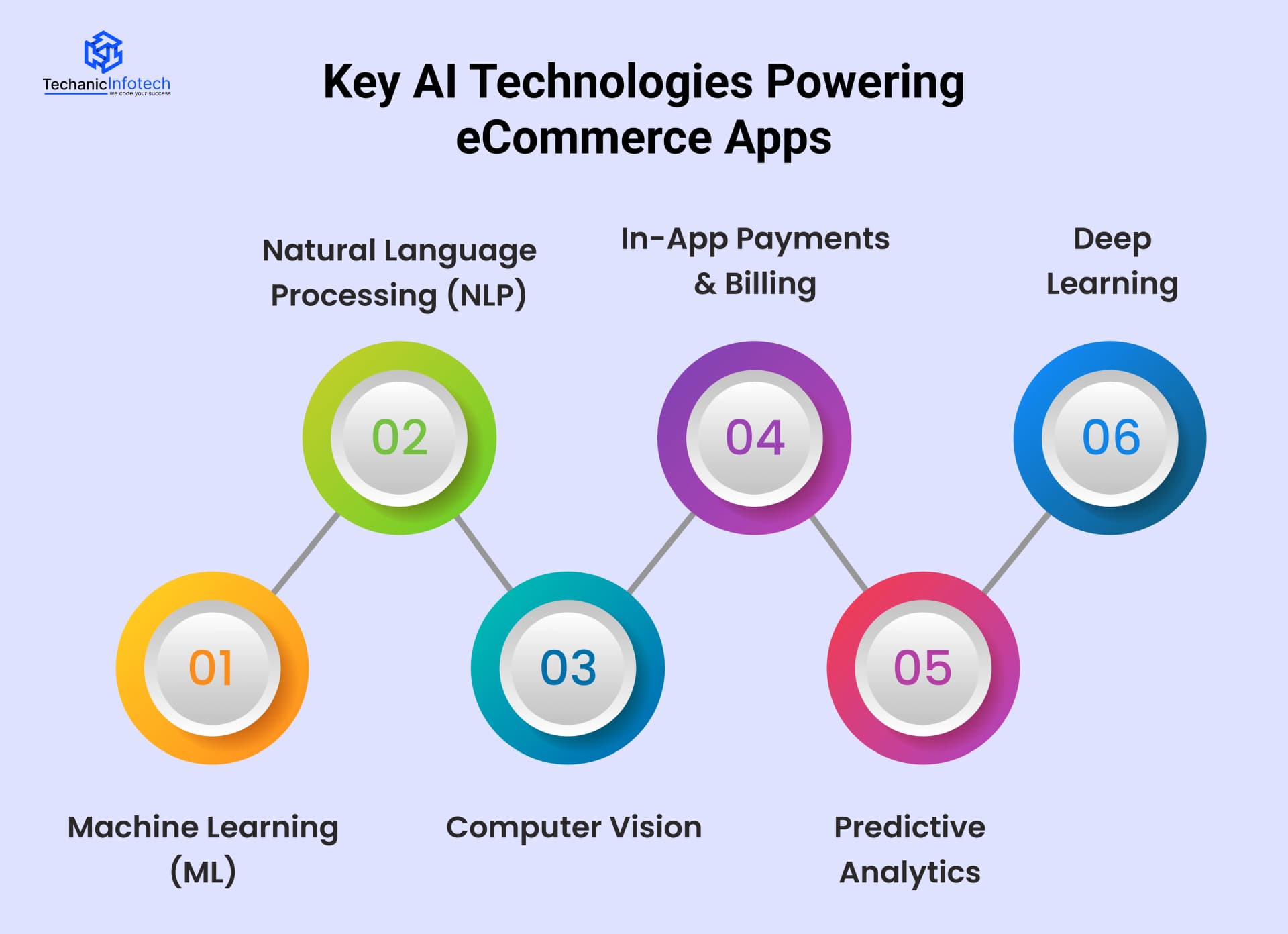
Machine Learning algorithms leverage vast amounts of user data to accurately predict behavior, deliver highly personalized product recommendations, and optimize marketing performance.
Natural Language Processing empowers chatbots, virtual assistants, and intelligent search engines to understand, interpret, and respond to human language naturally.
By enabling conversational commerce, enhancing search accuracy, and supporting multilingual interactions, NLP creates seamless and engaging customer experiences across digital platforms.
Computer Vision technology enables advanced visual search and real-time image recognition capabilities.
Customers can upload images to instantly discover similar products, streamlining product discovery and significantly increasing purchase intent.
Predictive Analytics combines historical insights with real-time data to forecast demand, anticipate customer churn, and identify emerging sales trends.
By transforming raw data into actionable intelligence, it empowers businesses to make proactive decisions, minimize risks, and seize growth opportunities with confidence.
Deep Learning utilizes sophisticated neural networks to process complex data patterns and uncover deeper insights.
From fraud detection and recommendation engines to advanced behavioral analysis, deep learning enhances precision, automates complex processes, and drives intelligent decision-making at scale.
Robotic Process Automation streamlines repetitive and rule-based backend tasks such as order processing, data entry, and inventory management.
When integrated with AI technologies, RPA boosts operational efficiency, reduces human error, lowers Magento development cost, and allows teams to focus on strategic, high-value initiatives.
Modern eCommerce apps use AI to offer personalized product recommendations, intelligent chatbots, and visual search.
The following are the key AI ecommerce app features that also leverage dynamic pricing and predictive inventory management to enhance user experience and boost sales.
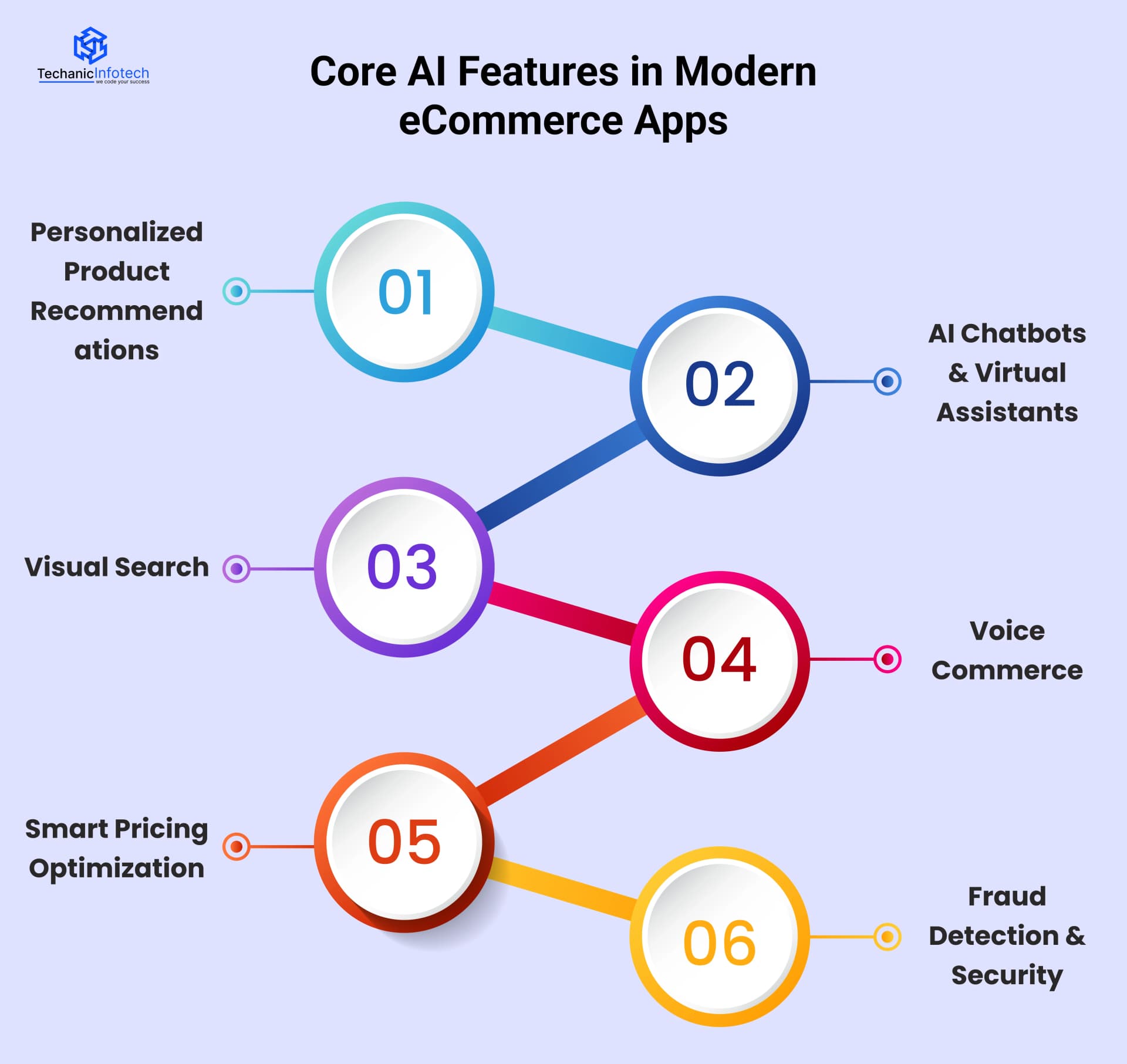
AI-driven recommendation engines analyze customer behavior, browsing patterns, purchase history, and preferences to deliver highly relevant product suggestions in real time.
This level of personalization increases engagement, enhances the shopping experience, and significantly boosts cross-selling, upselling, and overall revenue growth.
Intelligent AI-powered chatbots and virtual assistants provide instant responses to customer inquiries, assist with product selection, track orders, and resolve common issues.
Operating 24/7, they improve customer satisfaction, reduce response times, lower operational costs, and free up human teams to focus on complex tasks.
AI-powered visual search enables customers to upload images and instantly discover similar or matching products.
By simplifying product discovery and bridging inspiration with purchase intent, visual search enhances user convenience and significantly improves conversion rates.
Voice-enabled AI technology allows customers to browse, add items to carts, and complete purchases using simple voice commands.
By enabling hands-free, frictionless shopping experiences, voice commerce increases accessibility, speeds up decision-making, and enhances customer convenience.
AI continuously analyzes competitor pricing, market demand, customer behavior, and seasonal mobile app development trends to dynamically adjust product prices in real time.
This data-driven pricing strategy maximizes profitability while maintaining competitiveness and customer trust.
Advanced AI systems monitor transactions in real time to identify unusual patterns and suspicious activities.
By proactively preventing payment fraud and security breaches, AI protects both businesses and customers, reduces financial losses, and strengthens brand credibility.
AI in eCommerce app development brings numerous benefits, including enhanced personalization and more.
These advantages help businesses increase sales, efficiency, and customer satisfaction.
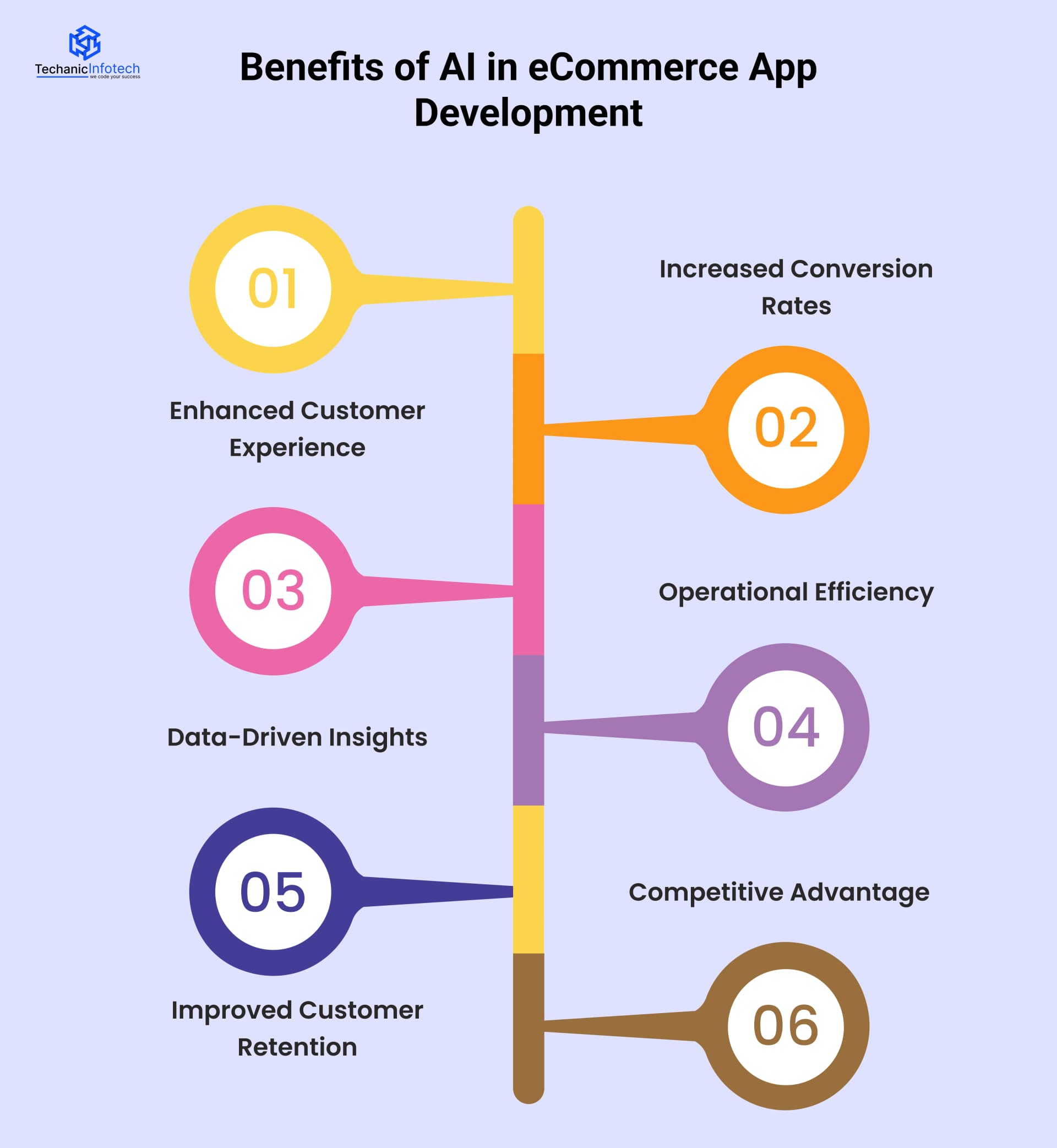
AI-powered personalization ensures that customers see the most relevant products, offers, and content based on their behavior and preferences.
By delivering the right message at the right time, businesses can significantly improve engagement, accelerate purchase decisions, and achieve higher conversion rates and stronger sales performance.
Create an ecommerce app with seamless, intuitive, and highly personalized shopping journeys through intelligent search, tailored recommendations, and instant support.
By reducing friction and simplifying decision-making, AI elevates customer satisfaction and builds meaningful brand interactions.
Through intelligent automation, AI streamlines repetitive tasks, optimizes workflows, and minimizes human error.
This reduces operational costs, accelerates processes, and allows teams to focus on strategic initiatives that drive growth and innovation.
AI transforms vast amounts of customer data into actionable insights.
By uncovering patterns, predicting trends, and identifying opportunities, businesses can make informed decisions, refine marketing strategies, and maximize return on investment.
Organizations that leverage AI gain a strategic edge by offering smarter features, faster services, and more personalized experiences.
This innovation-driven approach helps businesses differentiate themselves in competitive markets and adapt quickly to changing customer expectations.
AI enables proactive engagement through personalized communication, targeted offers, and predictive recommendations.
By consistently delivering value and relevance, businesses can strengthen customer loyalty, increase repeat purchases, and build long-term relationships.
In 2026, developing AI-powered eCommerce apps involves varying costs, influenced by features, complexity, and advanced personalization requirements.
The following is the table and description of the mobile app development cost incurred for developing an AI ecommerce application.
|
Tier |
Key Features |
Estimated Cost (USD) |
|
Basic AI Integration |
Simple recommendation engines, chatbots, and basic analytics |
$25,000 – $40,000 |
|
Mid-Level AI Applications |
Predictive analytics, dynamic pricing, enhanced personalization, and smarter segmentation |
$40,000 – $65,000 |
|
Advanced AI Solutions |
Deep learning models, voice commerce, visual search, fraud detection, enterprise automation |
$65,000 – $90,000+ |
|
Custom Enterprise Platforms |
End-to-end AI, multi-platform integration, highly customized architecture |
$90,000+ |
|
Maintenance & Optimization |
Model retraining, performance monitoring, cloud management, security updates |
15–25% of the initial investment per year |
Basic AI integration typically ranges between $25,000 and $40,000, depending on platform complexity and feature requirements.
This level includes foundational capabilities such as simple recommendation engines, chatbot integration, and basic analytics dashboards.
It is well-suited for startups and small businesses entering AI-powered eCommerce, offering improved customer engagement and automation without significant infrastructure costs.
Mid-level AI solutions generally cost between $40,000 and $65,000, reflecting the addition of more advanced capabilities.
These may include predictive analytics, dynamic pricing optimization, enhanced personalization engines, and smarter customer segmentation.
Designed for growing businesses, this investment supports data-driven decision-making and measurable revenue growth.
Advanced AI implementations typically start at $65,000 and can exceed $90,000, depending on customization and scalability requirements.
These solutions often include deep learning models, voice commerce integration, visual search functionality, fraud detection systems, and enterprise-grade automation.
They are ideal for businesses aiming to deliver cutting-edge digital experiences and leverage sophisticated AI-driven insights at scale.
Custom enterprise AI platforms usually begin at $90,000 and may increase significantly based on system complexity, integrations, scalability demands, and compliance requirements.
These large-scale solutions are built for enterprises seeking end-to-end AI transformation, multi-platform integration, and highly customized architectures.
Ongoing maintenance and optimization costs generally account for 15–25% of the initial development investment per year.
This includes AI model retraining, performance monitoring, cloud infrastructure management, security updates, and continuous improvements to ensure accuracy, scalability, and long-term return on investment.
Implementing AI in eCommerce apps faces challenges like high costs, data privacy concerns, integration complexity, and maintaining accurate, personalized experiences.
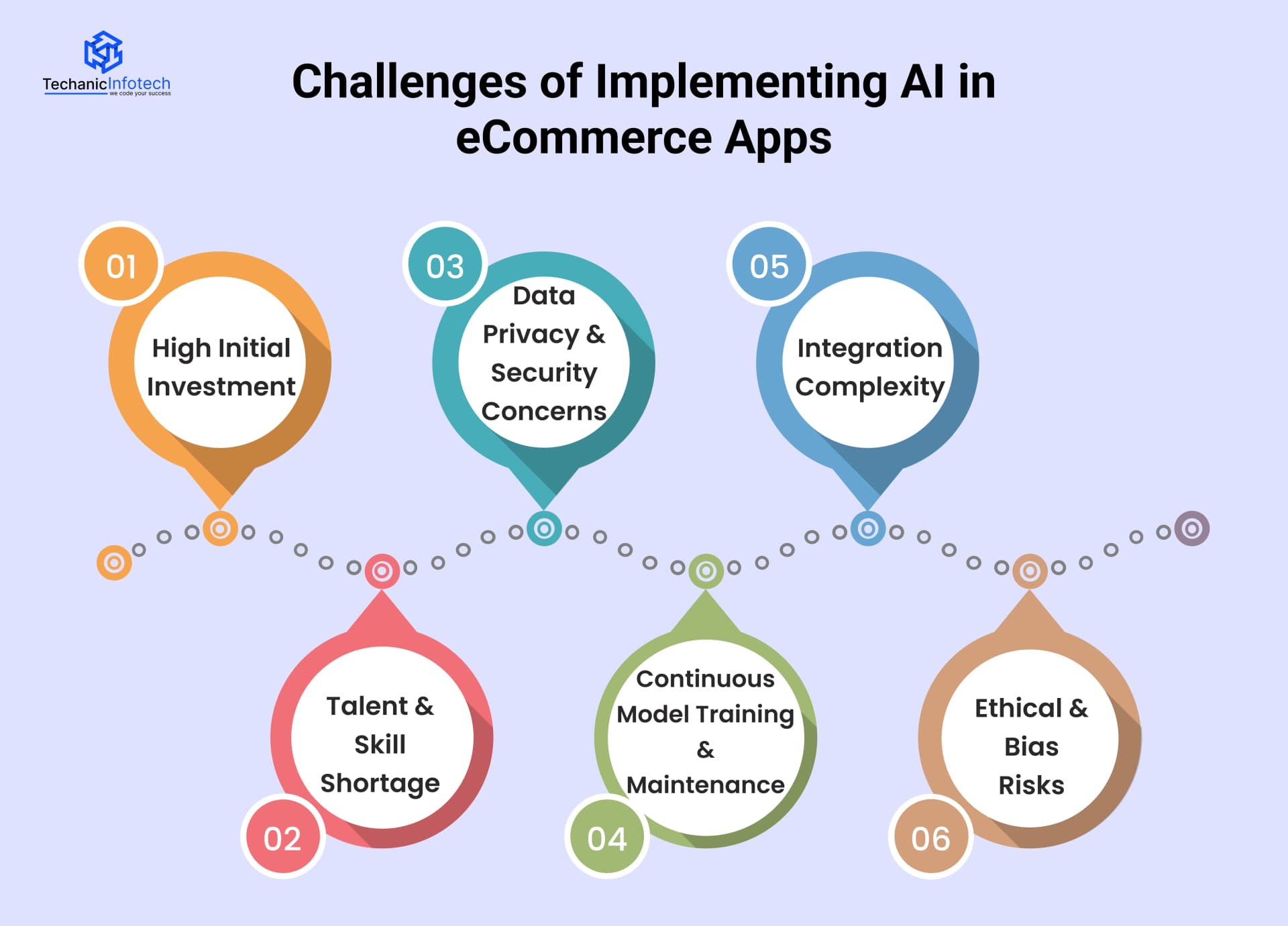
Implementing AI solutions requires significant upfront investment in specialized expertise, advanced infrastructure, high-quality datasets, and development resources.
These initial ecommerce app development costs can be substantial, particularly for businesses building custom AI architectures or enterprise-scale systems.
AI systems rely heavily on customer data, including behavioral and transactional information.
Ensuring strict compliance with data protection regulations and maintaining robust cybersecurity frameworks is critical to protect sensitive information and maintain customer trust.
Integrating AI technologies into existing legacy systems, databases, and third-party platforms can be technically complex and resource-intensive.
It often requires system restructuring, API development, and infrastructure upgrades to ensure seamless functionality and scalability.
AI engineers, machine learning specialists, and data scientists are in high demand globally.
Recruiting and retaining qualified professionals can be costly and competitive, particularly for organizations without established technical teams.
AI models require ongoing monitoring, retraining with updated datasets, performance tuning, and optimization to maintain accuracy, adapt to changing customer behavior, and prevent model drift over time.
AI systems trained on incomplete or biased datasets may generate unfair recommendations, discriminatory pricing strategies, or inaccurate predictions.
Organizations must implement ethical AI frameworks, transparent algorithms, and regular audits to ensure fairness, accountability, and responsible AI deployment.
Techanic Infotech is the best eCommerce app development company specializing in developing scalable, secure, and feature-rich eCommerce applications integrated with advanced AI technologies.
By combining modern frameworks, cloud infrastructure, and AI-driven automation, Techanic Infotech ensures seamless performance and future scalability.
Their team follows agile development practices, transparent communication, and data-driven strategies to deliver high-performing applications tailored to business needs.
Whether you’re a startup or an enterprise, partnering with experienced developers ensures your app remains competitive in 2026’s AI-driven digital marketplace while delivering exceptional shopping experiences.
AI is transforming eCommerce in 2026 by enabling intelligent automation, predictive insights, and hyper-personalized customer experiences.
From product recommendations to fraud detection and smart pricing, AI-powered features drive higher conversions, operational efficiency, and customer loyalty.
Partnering with an experienced AI development company ensures seamless integration, regulatory compliance, and continuous optimization.
Ultimately, AI is not just enhancing eCommerce apps; it is redefining how digital commerce operates, grows, and competes in a rapidly evolving global marketplace.
AI boosts sales through personalized recommendations, dynamic pricing, and predictive analytics that increase engagement and conversion rates.
Development typically ranges from $25,000 to $90,000+, depending on features, complexity, and scalability requirements.
Yes, startups can implement basic AI tools like chatbots and recommendation engines to improve efficiency and customer experience.
AI integration can take 3–6 months, depending on app complexity and customization needs.
Yes, AI enhances security by detecting fraud patterns and preventing suspicious transactions in real time.


Abhishek Jangid is the CEO of Techanic Infotech, with extensive experience in mobile app and web development. He specializes in helping businesses turn innovative ideas into scalable digital solutions through strategic planning and modern technology.