Healthcare App Development
AI in Healthcare: Benefits, Use Cases & Real-World Examples (2026)
April 1, 2026
April 1, 2026
Artificial Intelligence (AI) is transforming modern healthcare by improving diagnostic accuracy, optimizing workflows, and enabling personalized treatment plans.
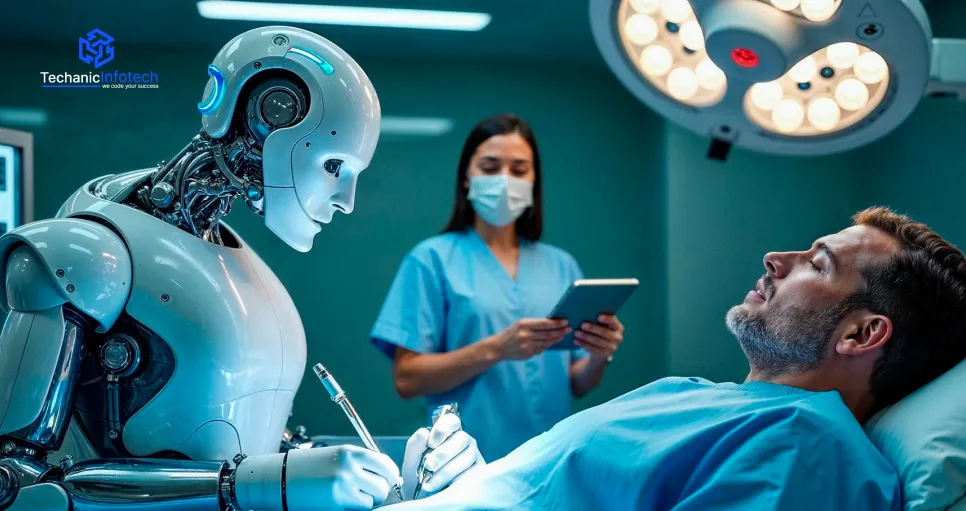
From predictive analytics to robotic surgeries, AI-driven systems help healthcare providers deliver faster, safer, and more cost-effective care.
Technologies such as machine learning, natural language processing, and computer vision are reshaping patient engagement, drug discovery, and clinical decision-making.
By combining human expertise with intelligent automation, AI is not replacing clinicians but empowering them to make better, evidence-based decisions in an increasingly complex healthcare ecosystem.
The global AI in healthcare market was valued at USD 36.67 billion in 2025, reflecting strong adoption across the industry.
The market is projected to reach USD 505.59 billion by 2033, indicating substantial expansion potential.
The industry is expected to grow at a robust CAGR of 38.90% during 2026–2033, driven by rapid technological advancements and increasing healthcare demand.
North America continued to lead as the largest regional market in 2025, supported by advanced infrastructure and early adoption of AI technologies.
Artificial Intelligence is revolutionizing modern medicine by enhancing diagnostic accuracy, personalizing treatment plans, and streamlining operations.
The following are the key reasons that explain why AI matters in modern healthcare.
AI-powered systems analyze complex medical imaging, laboratory reports, and comprehensive patient histories with exceptional precision.
For example, Aidoc provides real-time CT scan analysis, enabling radiologists to detect acute, life-threatening abnormalities earlier and more reliably.
Artificial intelligence rapidly processes vast volumes of patient data within seconds, delivering actionable, real-time clinical insights.
In emergency care settings, AI-assisted triage enhances decision speed, prioritizes critical cases, and significantly improves patient survival outcomes.
Machine learning algorithms evaluate genetic profiles, lifestyle factors, and detailed medical histories to design individualized treatment strategies.
Mobile app development company for healthcare apps like Tempus integrates clinical and molecular data to personalize oncology therapies, improving effectiveness and reducing adverse reactions.
AI streamlines time-consuming administrative functions such as appointment scheduling, billing management, and clinical documentation.
By automating routine workflows, healthcare organizations reduce clinician burnout, improve productivity, and enhance overall operational performance.
Advanced predictive models analyze historical and real-time health data to identify high-risk patients and prevent hospital readmissions.
It also forecasts potential disease outbreaks, enabling proactive interventions and more strategic healthcare resource allocation.
By minimizing unnecessary diagnostic tests, reducing medical errors, and optimizing evidence-based treatment pathways.
AI-driven systems lower overall healthcare expenditures while following the mobile app maintenance strategy for high-quality patient care and improving long-term financial sustainability.
Artificial intelligence is revolutionizing healthcare by enhancing diagnostic accuracy, personalizing treatment plans, and streamlining administrative workflows.
By processing vast data sets, AI improves patient outcomes, reduces mobile app development costs, and empowers providers.
Advanced AI algorithms identify subtle abnormalities in medical imaging at the earliest stages of disease progression.
Zebra Medical Vision leverages deep learning technology to detect liver, lung, and cardiovascular conditions from radiology scans with high accuracy.
AI-driven clinical decision support systems systematically analyze patient records and cross-reference them with extensive medical research databases.
It is helpful for them in reducing diagnostic errors, minimizing oversight, and improving overall clinical accuracy and patient safety.
AI-powered wearable devices and remote monitoring systems enable continuous real-time health tracking.
It helps in allowing the early detection of complications, improved chronic disease management, and timely medical interventions that enhance patient outcomes.
Artificial intelligence significantly shortens the pharmaceutical research and mobile app development timeline by analyzing complex biological data.
PathAI enhances pathology diagnostics and supports drug development initiatives through machine learning-driven insights and data precision.
Advanced computer vision technologies improve the interpretation of X-rays, MRIs, and CT scans by providing automated anomaly detection, image enhancement, and reliable second-opinion support for more confident clinical decision-making.
AI-powered virtual assistants and intelligent chatbots efficiently manage appointment scheduling, patient inquiries, and documentation processes, strengthening communication, increasing patient engagement, and optimizing overall healthcare operational productivity.
AI is transforming healthcare in 2026 by enabling faster, more accurate diagnoses, personalized treatment plans, and streamlined administrative workflows, ultimately improving patient outcomes and reducing operational costs.
Following is the list of applications that were made with the help of AI in the healthcare field.
AI-powered imaging systems such as Aidoc analyze CT scans, MRIs, and X-rays to detect abnormalities like strokes, tumors, and fractures.
These tools assist radiologists by prioritizing urgent cases, improving diagnostic speed, reducing oversight, and enhancing overall accuracy in clinical interpretation and reporting workflows.
AI models evaluate electronic health records to predict disease risks, hospital readmissions, and complications.
By analyzing historical and real-time data, healthcare providers can proactively intervene, allocate resources efficiently, and implement preventive care strategies that improve patient outcomes and reduce long-term healthcare costs.
Companies like Tempus use AI to combine genomic sequencing with clinical data, enabling customized oncology treatments.
Algorithms analyze genetic mutations and therapy responses to recommend targeted treatment plans that maximize effectiveness while minimizing adverse drug reactions for individual patients.
AI accelerates pharmaceutical research by analyzing molecular structures and predicting drug interactions.
Organizations such as PathAI enhance pathology insights, enabling researchers to identify potential compounds faster, reduce clinical trial failures, and shorten time-to-market for innovative medications and life-saving therapies, which was covered in the EHR software development.
AI-driven chatbots assist patients with symptom checks, appointment scheduling, and medication reminders.
These tools enhance accessibility, provide 24/7 support, reduce administrative burdens, and improve patient engagement while ensuring healthcare providers can focus more on direct clinical care activities.
Robotic platforms like the da Vinci Surgical System integrate AI to support minimally invasive procedures.
Surgeons gain enhanced precision, visualization, and control, resulting in reduced complications, shorter hospital stays, faster recovery times, and improved surgical outcomes across multiple specialties.
AI-enabled wearable devices continuously track vital signs such as heart rate, oxygen levels, and glucose levels.
Real-time analytics alert clinicians to early warning signs, enabling timely interventions, improved chronic disease management, and reduced emergency hospital admissions.
AI-powered decision support tools analyze patient data and medical literature to provide evidence-based recommendations.
These systems assist clinicians in diagnosis and treatment planning, reduce human error, and ensure alignment with updated clinical guidelines and best practice standards.
Real-world examples and case studies bridge theory and practice by illustrating how concepts work in action.
The following examples provide practical insights, measurable outcomes, and valuable lessons drawn from real challenges and successes.
Aidoc has helped hospitals detect intracranial hemorrhages within minutes.
By flagging urgent CT scan abnormalities automatically, emergency teams respond faster, significantly improving survival rates and reducing long-term neurological damage in acute stroke patients.
Tempus collaborates with cancer centers to analyze molecular and clinical datasets.
Its AI platform identifies targeted therapies based on tumor genetics, helping oncologists personalize treatments and improve patient survival outcomes.
PathAI uses machine learning to improve diagnostic accuracy in pathology labs.
Pharmaceutical companies leverage their insights to enhance mental health app development processes, reduce trial failures, and accelerate therapeutic innovations for complex diseases.
Hospitals worldwide utilize the da Vinci Surgical System for minimally invasive surgeries.
AI-assisted precision reduces blood loss, lowers complication rates, shortens recovery periods, and improves surgical consistency across cardiac, urology, and gynecological procedures.
Several hospitals deploy predictive analytics tools to identify early signs of sepsis.
AI algorithms analyze vital signs and lab data in real time, enabling rapid intervention and significantly reducing mortality rates in critical care units.
AI-enabled wearable technology supports diabetes and cardiac patients through continuous monitoring.
Alerts notify physicians of irregularities, preventing severe complications and reducing hospital readmissions through proactive and personalized disease management.
Challenges and ethical concerns play an important role in developing an AI app, where they highlight the complexities and responsibilities involved in applying ideas to real-world situations.
Following challenges address potential risks, moral dilemmas, and unintended consequences, encouraging thoughtful decision-making and sustainable, responsible practices.
Healthcare AI systems depend on highly sensitive patient information. Safeguarding electronic health records against cyber threats and ensuring strict regulatory compliance.
It is also helpful in preserving patient confidentiality and remains a fundamental challenge in the widespread adoption of AI across healthcare organizations.
AI models trained on incomplete or non-representative datasets may generate biased or inequitable outcomes.
Ensuring diverse, high-quality training data is critical to minimizing disparities in diagnosis, treatment recommendations, and healthcare delivery across different demographic populations.
Many AI systems function as “black boxes,” offering limited visibility into their decision-making processes.
This lack of explainability can undermine clinician trust, hinder regulatory approval, and complicate accountability within clinical settings.
Healthcare AI solutions must adhere to rigorous regulatory frameworks and evolving compliance standards.
Navigating approval pathways, addressing liability concerns, and meeting legal requirements can significantly slow innovation and large-scale implementation.
Numerous healthcare institutions rely on outdated IT infrastructures. Integrating advanced
AI technologies with existing electronic health record systems and clinical workflows can be technically challenging, costly, and resource-intensive.
Deploying AI solutions requires substantial upfront investment in infrastructure, workforce training, cybersecurity, and system modernization.
Smaller healthcare providers, in particular, may face financial constraints that limit adoption despite the potential for long-term operational efficiencies.
Artificial Intelligence is revolutionizing healthcare by enhancing diagnostic precision, enabling personalized medicine, streamlining operations, and accelerating research innovation.
By transforming complex medical data into meaningful insights, AI empowers clinicians to make faster, more informed decisions while reducing costs and improving patient safety.
Although challenges such as data privacy, bias, and regulatory barriers remain, continuous advancements in ethical AI frameworks and governance models are strengthening trust and adoption.
The future of healthcare lies in collaborative intelligence, where human expertise and AI-driven technologies work together to deliver proactive, predictive, and patient-centered care.
AI improves diagnostic accuracy, enhances patient outcomes, reduces operational costs, enables personalized treatment, and streamlines administrative workflows.
The most common applications include medical imaging, predictive analytics, personalized medicine, virtual health assistants, robotic surgery, and remote patient monitoring.
AI analyzes complex medical data such as imaging scans and lab reports to detect early signs of diseases, reducing errors and supporting faster, more accurate diagnoses.
Real-world use cases include stroke detection through imaging, AI-powered cancer treatment planning, robotic-assisted surgeries, and predictive analytics for sepsis detection.
AI enables continuous patient monitoring through wearable devices, provides real-time alerts, and supports personalized care plans for chronic disease management.
AI analyzes genetic, clinical, and lifestyle data to create tailored treatment plans, improving effectiveness and minimizing adverse reactions.
AI automates tasks like appointment scheduling, billing, documentation, and patient communication, improving efficiency and reducing clinician workload.
AI accelerates drug discovery by analyzing molecular data, predicting drug interactions, and reducing the time and cost of clinical trials.
Challenges include data privacy concerns, algorithmic bias, lack of transparency, regulatory hurdles, and integration with existing healthcare systems.
The future includes advanced predictive care, AI-driven diagnostics, smarter virtual assistants, improved global health monitoring, and deeper integration into clinical decision-making.


Neha Sharma is a tech expert at heart who loves exploring new technologies and turning complex ideas into easy-to-understand content. With a passion for learning and writing, she enjoys sharing insights on emerging tech, digital products, and innovation that help businesses stay ahead.