Key Takeaways
Cloud kitchen management software centralizes multi-platform orders, inventory, CRM, analytics, and kitchen operations into one scalable digital ecosystem.
AI-powered features such as demand forecasting, predictive inventory, and dynamic pricing significantly improve profitability and reduce food waste.
Seamless integration with third-party delivery platforms and POS systems ensures real-time synchronization and operational efficiency.
Development costs vary by scope, ranging from $10,000 for an MVP to $90,000+ for enterprise-grade, AI-enabled multi-location platforms, with ongoing annual maintenance of 15–20%.
Choosing the right tech stack, including cloud infrastructure, scalable backend frameworks, and secure API,s is critical for long-term performance and growth.
Partnering with an experienced development company that offers transparent pricing, strong industry expertise, and reliable post-launch support ensures sustainable success in the competitive cloud kitchen market.
Cloud kitchen management software has become a critical enabler for modern food businesses operating without dine-in infrastructure.
As delivery-first models continue to expand globally, virtual restaurants require centralized digital systems to manage orders, inventory, staff, analytics, and customer engagement.
In 2026, competition in the online food delivery market is driven by speed, automation, and data intelligence.
Cloud-based platforms help kitchen operators streamline multi-brand operations, integrate third-party delivery apps, and optimize profitability through real-time insights.
Unlike traditional restaurant software, cloud kitchen systems are built specifically for high-volume, multi-channel order processing.
With scalable architecture, AI-driven forecasting, and seamless integrations, these solutions empower entrepreneurs, restaurant chains, and food startups to launch and scale efficiently.
From receiving orders through platforms like Uber Eats and DoorDash to dispatching deliveries and analyzing sales trends, every touchpoint depends on technology.
Without integrated systems, managing multi-platform orders can become chaotic and error-prone.
Technology ensures automation, real-time synchronization, and centralized control across brands and locations.
Cloud-based systems also enable remote monitoring, performance tracking, and seamless scalability. In a highly competitive delivery ecosystem, operational efficiency directly impacts profitability.
Cloud Kitchen Management Software is designed to simplify and optimize the operations of delivery-only restaurants.
These core mobile app features centralise the orders, inventory, analytics, and delivery integrations to improve efficiency, reduce costs, and support scalable growth.
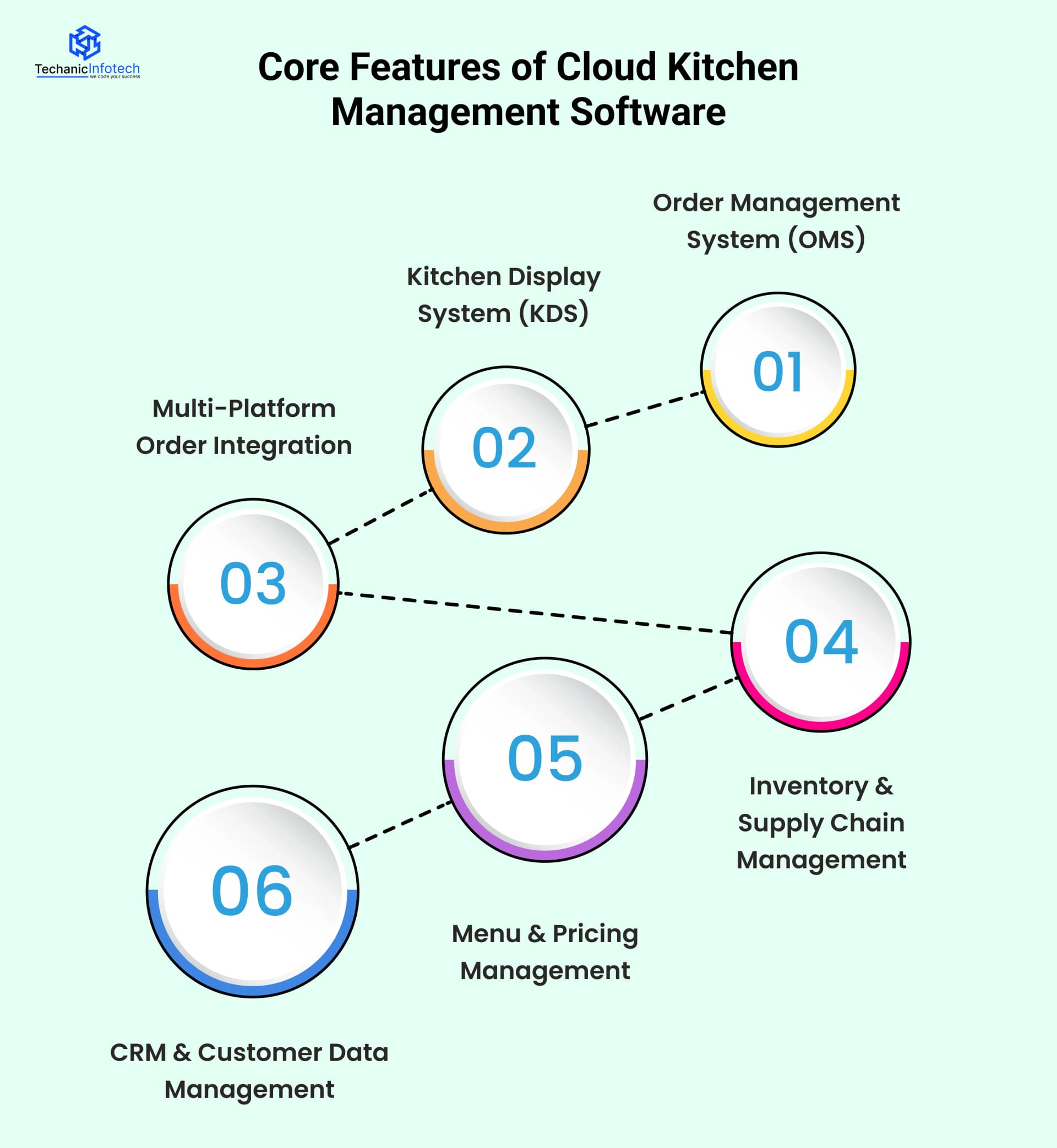
An OMS centralizes orders from websites, mobile applications, and third-party platforms into one unified dashboard.
It automates confirmations, status notifications, billing processes, and refund handling while significantly reducing manual errors.
A KDS strengthens communication between front-end systems and kitchen teams, automatically prioritizes preparation queues, minimizes cooking mistakes, and streamlines workflows efficiently, especially during peak service hours.
Integration with platforms eliminates multiple device dependency, reduces missed orders, synchronizes menus automatically, and maintains consistent pricing and availability across every connected sales channel.
This module monitors ingredient consumption in real time, tracks stock movement accurately, and generates automated low-inventory alerts.
Smart purchase planning prevents over-ordering, reduces food waste, controls operational costs, and maintains uninterrupted kitchen productivity through coordinated supplier management systems.
Centralized menu controls allow instant updates to items, pricing structures, availability status, and promotional campaigns across platforms.
It supports dynamic pricing models, bundled combo creation, demand-based adjustments, and brand-specific customization to maximize profitability and adapt quickly to market fluctuations.
CRM tools enable personalized campaigns, structured loyalty programs, targeted promotional messaging, and retention strategies designed to increase customer lifetime value and strengthen long-term brand engagement.
Advanced Cloud Kitchen Management Software enhances operational efficiency by integrating intelligent automation, real-time analytics, and many more.
These advanced features empower multi-brand management, accurate forecasting, and data-driven decision-making to maximize profitability and scalability.
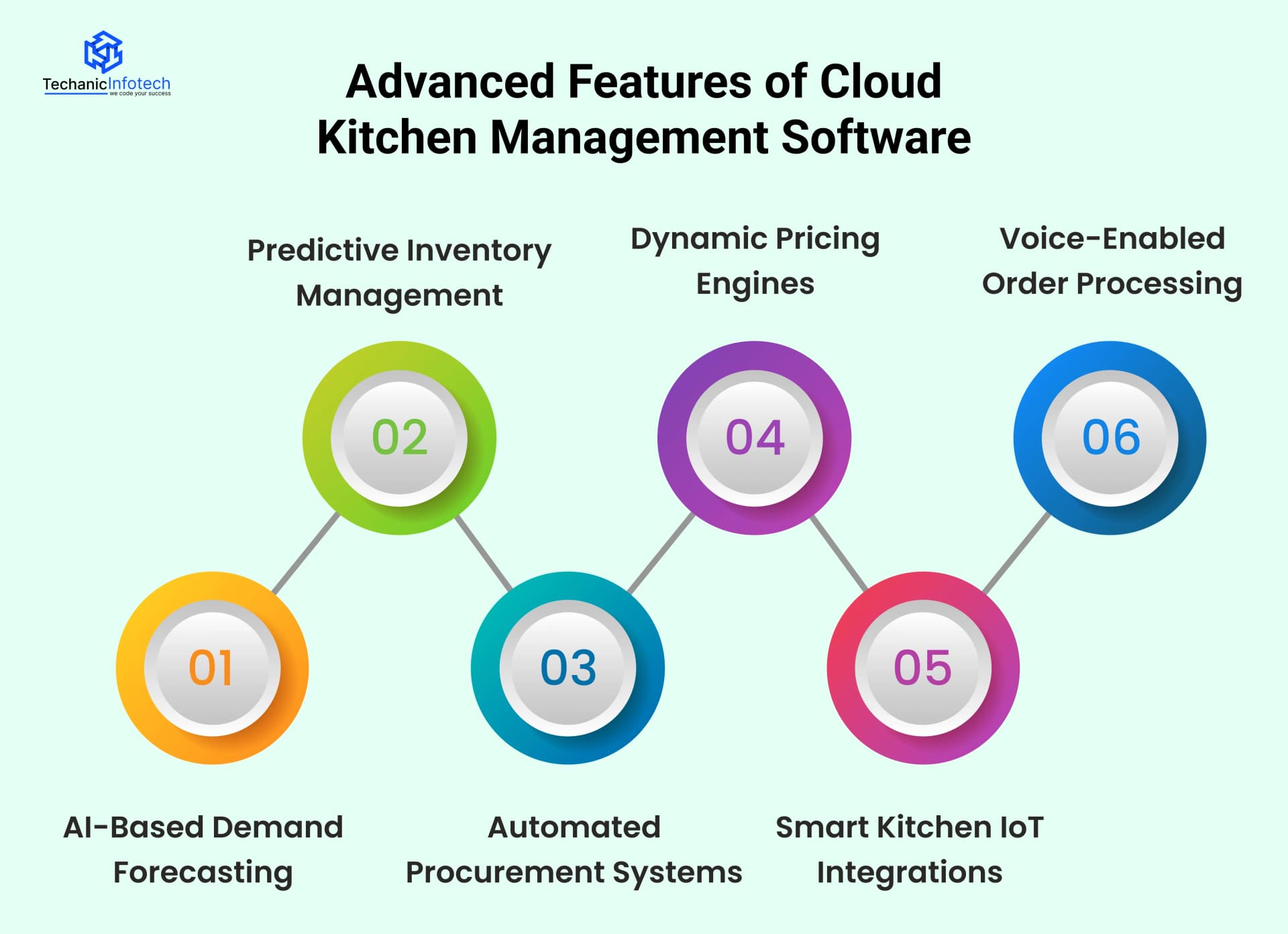
AI algorithms analyze historical sales, seasonal patterns, and local trends to predict future demand.
This helps kitchens prepare in advance, reduce food waste, and optimize staffing requirements for maximum profitability.
Predictive systems automatically calculate ingredient consumption patterns and forecast restocking needs.
By leveraging AI, kitchens avoid shortages and minimize excess inventory, improving cost control and operational continuity.
Automated procurement connects inventory data directly with suppliers.
When stock levels drop below predefined thresholds, purchase orders are generated automatically, streamlining vendor coordination and reducing administrative workload.
Dynamic pricing tools adjust menu prices based on demand, competition, and peak hours.
This data-driven strategy maximizes revenue during high-demand periods while remaining competitive during slow hours.
IoT-enabled devices monitor cooking equipment performance, temperature control, and energy usage.
Smart alerts prevent breakdowns, ensure food safety compliance, and reduce mobile app maintenance costs.
Voice recognition systems allow staff to update order statuses or check inventory hands-free.
This speeds up operations, improves multitasking, and enhances kitchen productivity.
Building a powerful cloud kitchen platform begins with selecting the right mobile app tech stack.
From scalable backend frameworks to cloud infrastructure and seamless integrations, the chosen technologies lay the foundation for performance, security, and long-term growth.
Modern frontend development uses frameworks like React, Angular, or Vue.js to create responsive dashboards and mobile-friendly interfaces.
These technologies ensure a seamless user experience across devices while enabling real-time updates and intuitive navigation.
Backend systems rely on Node.js, Django, or Laravel for scalable server-side processing.
These frameworks manage order workflows, integrations, and database interactions efficiently while ensuring high performance and security.
Cloud platforms such as Amazon Web Services, Microsoft Azure, and Google Cloud provide scalable hosting, data storage, and security solutions.
They ensure reliability, uptime, and global scalability.
Databases like PostgreSQL, MySQL, or MongoDB store transactional and customer data securely.
Scalable database architecture ensures high-speed query processing and data integrity.
Robust APIs enable seamless integration with payment gateways, delivery platforms, CRM tools, and accounting systems.
Well-documented APIs ensure flexibility and faster feature expansion.
AI components use machine learning models to power forecasting, personalization, and predictive analytics.
These systems improve automation, optimize pricing strategies, and enhance operational decision-making.
Developing a cloud kitchen platform requires a structured and strategic approach to ensure efficiency and scalability.
From planning and mobile app design to deployment and optimization, each phase plays a critical role in building a successful solution.
Detailed documentation, stakeholder interviews, and process mapping minimize scope creep, reduce development ambiguity, and create a structured, goal-oriented implementation roadmap.
This strategy lowers initial investment risk, accelerates mobile app development timeline, gathers real user feedback, and enables structured iterative enhancements based on measurable performance insights.
Agile methodology promotes incremental releases, adaptive planning, continuous feedback loops, and cross-functional collaboration, making it ideal for rapidly evolving cloud kitchen ecosystems.
Automated testing pipelines ensure consistent reliability, system scalability, data protection compliance, and seamless multi-platform interoperability before production deployment.
Continuous monitoring, proactive bug resolution, feature upgrades, performance optimization, and security patch management sustain long-term scalability while adapting to evolving industry demands and user expectations.
Understanding the mobile app development cost management software is essential for effective planning and budgeting.
Expenses vary based on features, technology stack, integrations, customization requirements, and long-term scalability goals.
|
Type |
Key Features |
Estimated Cost |
|
Basic MVP |
Order management, kitchen display, basic integrations |
$10,000 – $25,000 |
|
Mid-Level |
Analytics dashboards, CRM, inventory tracking, multi-platform orders |
$25,000 – $50,000 |
|
Enterprise |
AI forecasting, dynamic pricing, IoT kitchen automation, and multi-location management |
$50,000 – $90,000+ |
|
Custom Integrations |
ERP, payment gateways, logistics, third-party APIs |
$5,000 – $15,000 |
|
Maintenance |
Hosting, updates, support, security, feature enhancements |
15–20% of total budget annually |
An entry-level solution typically ranging between $10,000 and $25,000 covers essential modules such as order management, kitchen display systems, and basic third-party integrations.
This package is ideal for startups launching a single virtual brand, offering foundational automation, streamlined workflows, and rapid market entry without heavy infrastructure investment.
A mid-tier system priced between $25,000 and $50,000 includes advanced analytics dashboards, CRM capabilities, inventory tracking, and multi-platform order integration.
This investment level suits growing businesses managing multiple brands or higher order volumes, delivering improved operational visibility, marketing automation, and scalable performance management tools.
Enterprise-grade platforms typically cost $50,000 to $90,000+ or more, depending on customization depth and infrastructure complexity.
These solutions incorporate AI-driven demand forecasting, dynamic pricing engines, IoT-enabled kitchen automation, and multi-location management features designed for large-scale operations requiring robust scalability and real-time strategic intelligence.
Custom API development and third-party integrations generally add $5,000 to $15,000 to the overall project cost, depending on system complexity.
Integrating ERP platforms, accounting software, payment gateways, or logistics providers increases AI app development effort, testing requirements, and long-term system interconnectivity planning.
Annual maintenance and support services typically require 15–20% of the total development budget each year.
This recurring investment covers cloud hosting, performance monitoring, security updates, compliance management, technical support, and continuous feature enhancements to ensure system reliability, scalability, and long-term operational stability.
Developing cloud kitchen software involves navigating technical, operational, and integration complexities.
From real-time order synchronization to scalability, security, and multi-platform compatibility, businesses must overcome several challenges to ensure seamless performance and reliability.
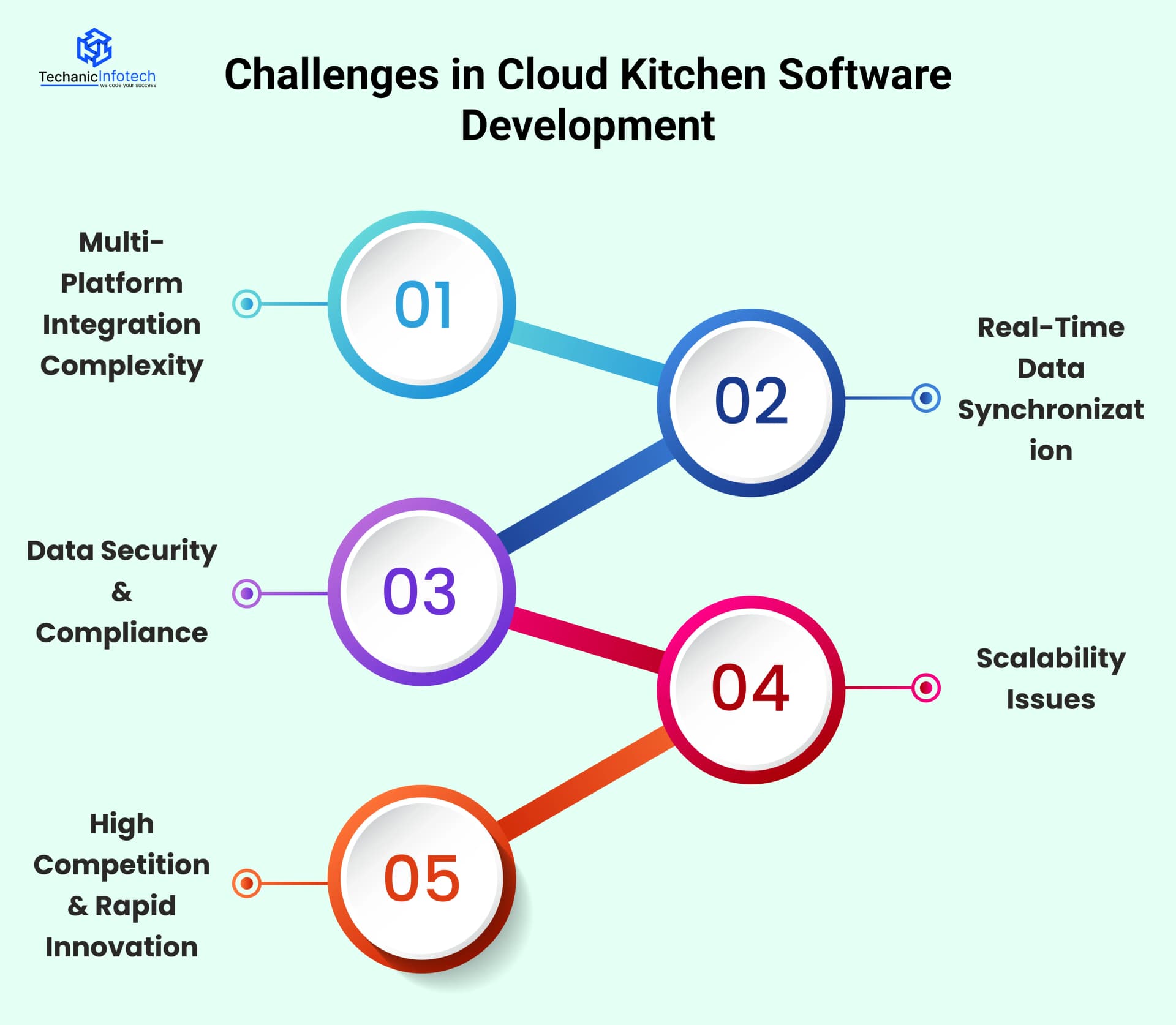
Integrating and managing APIs from multiple third-party delivery applications requires continuous monitoring, version updates, compatibility validation, and performance optimization.
Maintaining accurate, real-time synchronization across dashboards, mobile applications, POS systems, and kitchen environments is technically complex and infrastructure-intensive.
Processing payment transactions and storing customer information necessitates strict adherence to cybersecurity standards, encryption protocols, and regional data protection regulations.
Rapid business expansion, increasing order volumes, and multi-location growth can overwhelm systems lacking proper scalability planning.
The food technology market evolves rapidly, requiring continuous feature enhancements, user experience improvements, and technological upgrades to stay competitive.
Choosing the right cloud kitchen software development partner is crucial for long-term success.
The right company brings technical expertise, industry experience, scalability planning, and reliable support to turn your vision into a high-performing solution.
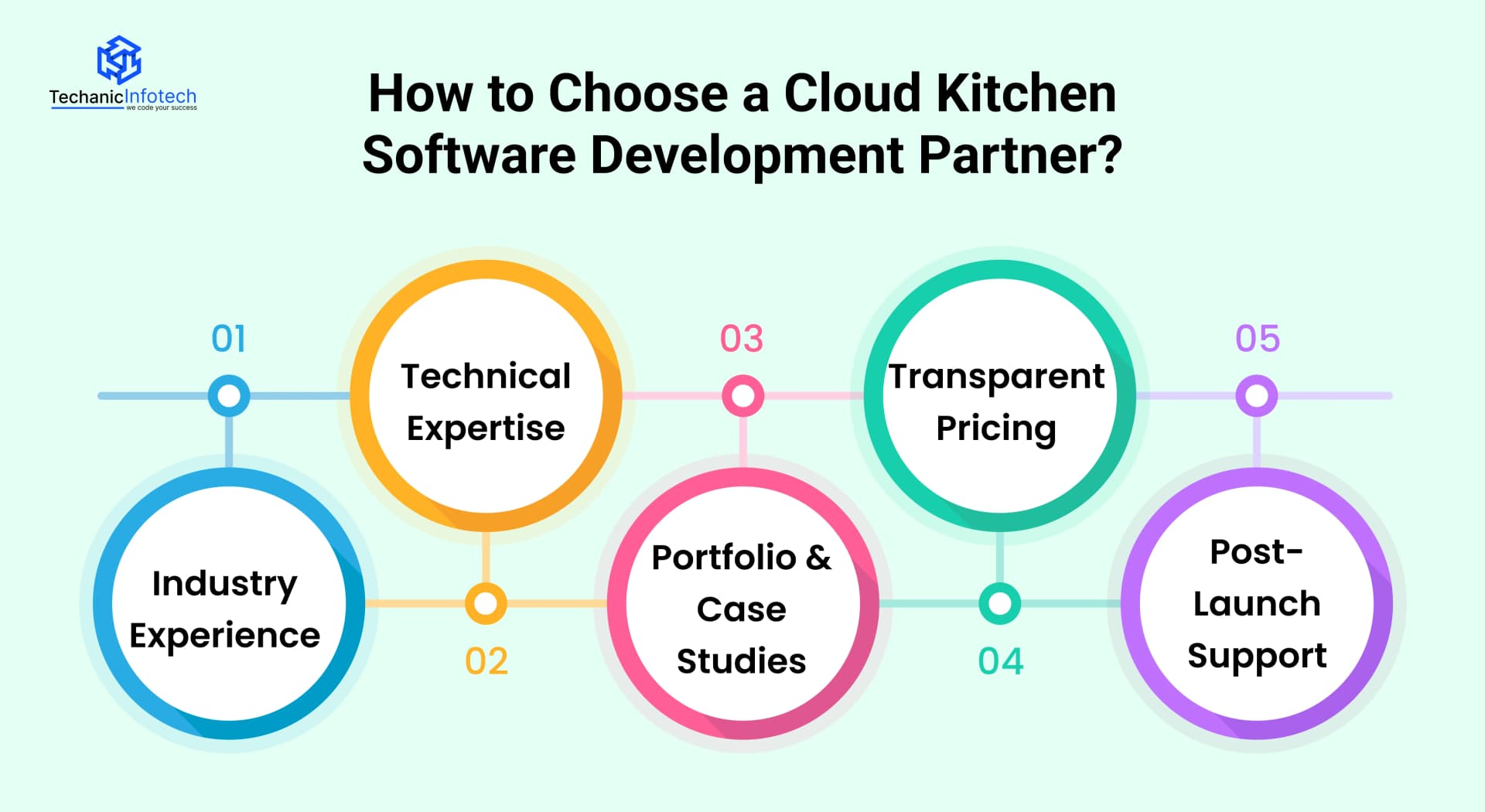
Choose a minimum viable product development partner with demonstrated expertise in food-tech platforms and SaaS-based product ecosystems.
Proven industry experience ensures familiarity with operational challenges, third-party integrations, compliance requirements, and scalable architecture design tailored specifically for cloud kitchen and multi-brand environments.
Verify strong proficiency in cloud-native architecture, AI-driven analytics integration, secure API development, and microservices-based system design.
A technically capable team can build scalable, high-performance platforms that maintain reliability, data security, and seamless multi-platform interoperability.
Carefully assess previous projects, detailed case studies, and live product deployments to evaluate scalability, UI/UX excellence, innovation depth, and technical execution quality.
Reviewing measurable outcomes and client success stories provides confidence in the delivery standards and problem-solving capabilities of the mobile app development company.
Select partners that provide clear cost structures, detailed project scope documentation, milestone-based billing, and flexible engagement models.
Transparent pricing minimizes hidden expenses, reduces financial uncertainty, and fosters trust through structured budgeting and predictable investment planning.
Ongoing maintenance, proactive monitoring, security updates, performance optimization, and responsive technical assistance are critical for sustained operational success.
A reliable support framework ensures system stability, continuous improvement, and adaptability to evolving market demands and technological advancements.
Cloud kitchen management software is transforming how virtual restaurants operate in 2026.
With increasing reliance on online ordering platforms and data-driven decision-making, robust digital infrastructure is essential for efficiency and profitability.
From order management and inventory tracking to AI-powered forecasting and dynamic pricing, advanced software solutions empower operators to scale seamlessly.
Choosing the right technology stack and development partner ensures long-term sustainability and competitive advantage.
Software that centralizes orders, inventory, and analytics for delivery-only restaurants, enabling automation, AI forecasting, and multi-platform integration.
MVP: $10k–$25k, mid-level: $25k–$50k, enterprise: $50k–$90k+, plus 15–20% annual maintenance.
Order management, kitchen display, inventory tracking, CRM, menu control, AI forecasting, dynamic pricing, IoT integration, and multi-platform syncing.
AI forecasts demand, optimizes inventory, automates procurement, adjusts pricing, reduces waste, and enhances staffing efficiency.
Pick partners with industry experience, AI expertise, strong portfolio, transparent pricing, and reliable post-launch support.


Bharat Sharma is the CTO of Techanic Infotech, bringing deep technical expertise in software architecture, mobile app development, and scalable system design. He leads the engineering team with a strong focus on innovation, performance, and security.