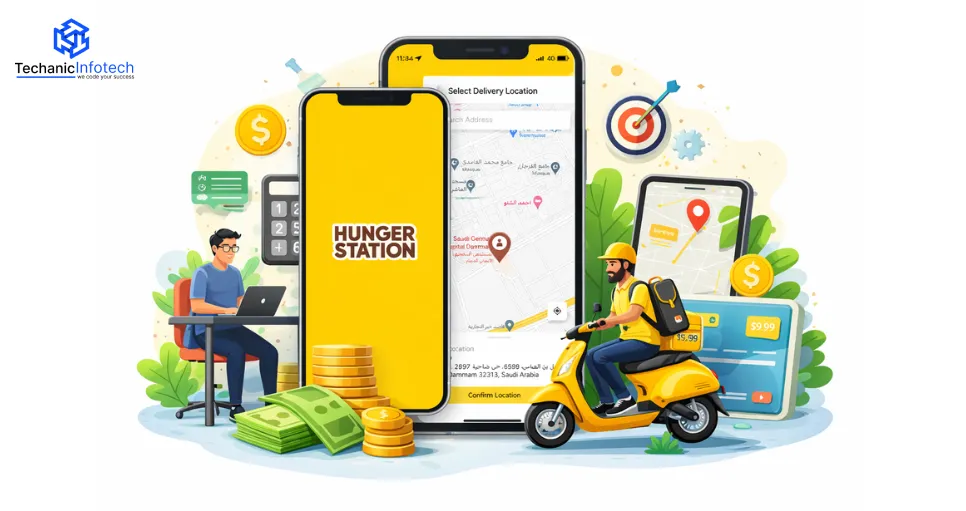
Building a food delivery app like HungerStation involves combining user-friendly design, real-time logistics, and scalable backend technology.
The total food delivery app development cost range from $8000 to $50,000+ can vary widely depending on features, platform choice (iOS, Android, or both), and development approach.
Basic apps with core functionalities like ordering, payment integration, and tracking may cost less, while advanced versions with AI recommendations, multi-vendor support, and robust admin panels significantly increase expenses.
Additionally, factors such as UI/UX design, third-party integrations, maintenance, and team location also influence pricing. Overall, creating a competitive food delivery app requires careful planning, investment, and a clear understanding of business goals.
Several critical factors influence the cost to build a mobile app, including design complexity, platform choice, features, development team location, and integrations required for seamless functionality.
Food delivery app costs depend on features, platform, design, team location, backend, and integrations. The table below highlights key factors and their estimated cost impact.
|
Factor |
Short Description |
Estimated Cost Impact |
|
App Features & Functionality |
Basic vs advanced features |
$3,000 – $7,000 |
|
Platform Selection |
Android, iOS, or cross-platform |
$4,000 – $5,000 |
|
UI/UX Design Complexity |
Simple vs custom design |
$4,000 – $6,000 |
|
Development Team Location |
Offshore vs US/Europe developers |
$2,500 – $5,000 |
|
Backend Infrastructure |
Servers, database, scalability |
$3,000 – $7,000 |
|
Third-Party Integrations |
Payments, maps, SMS, analytics |
$2,000 – $4,000 |
The number and complexity of features directly affect the food delivery app development cost.
Basic apps include ordering and login, while advanced features like AI recommendations, real-time tracking, and loyalty programs increase effort, bringing feature-related costs to approximately $3,000 to $15,000 overall.
Choosing between Android, iOS, or cross-platform development significantly impacts cost.
A single-platform app is more affordable, but targeting both platforms or using native development increases expenses, typically ranging between $5,000 and $20,000, depending on performance requirements and user reach.
Design plays a major role in user engagement and cost.
Simple layouts are budget-friendly, but custom animations, branding, and interactive elements require more effort and expertise, increasing design-related expenses to around $2,000–$10,000 within the total project budget.
The geographical location of your development team affects hourly rates.
Offshore teams offer cost-effective solutions, while developers in regions like the US or Europe charge higher rates, contributing approximately $5,000–$25,000 to the overall development cost, depending on expertise.
A strong backend ensures scalability, performance, and data handling.
Complex server architecture, cloud databases, and API integrations increase mobile app development timeline and cost, typically ranging from $3,000 to $15,000, depending on traffic expectations and system complexity.
Integrating services like payment gateways, maps, SMS notifications, and analytics tools adds functionality but increases cost.
Depending on the number and complexity of integrations, businesses can expect to spend around $2,000–$8,000 as part of the overall process of creating a minimal viable product.
A food delivery app consists of multiple components, each serving a unique role.
Understanding the cost breakdown helps businesses allocate budgets efficiently across essential modules and functionalities.
The customer app is the core interface where users browse menus, place orders, and make payments.
It requires intuitive design and seamless navigation, contributing approximately $3,000 to $7,000, depending on features, responsiveness, and overall user experience quality.
|
Feature |
Description |
Estimated Cost |
|
Menu browsing & search |
Users can view and search menus |
$1,000 – $3,000 |
|
Order placement & checkout |
Add items, confirm orders |
$1,000 – $4,000 |
|
Payment integration |
Cards, wallets, and online banking |
$500 – $2,000 |
|
User profiles & history |
Track past orders & preferences |
$500 – $2,000 |
|
Responsive UI/UX design |
Intuitive and mobile-friendly UI |
$500 – $3,000 |
The restaurant panel enables vendors to manage menus, update pricing, track orders, and monitor performance.
It requires dashboard features and real-time synchronization, typically costing between $2,000 and $8,000 depending on customization and operational complexity.
|
Feature |
Description |
Estimated Cost |
|
Menu & pricing management |
Add/update menu items and prices |
$500 – $2,000 |
|
Order management system |
Track incoming and completed orders |
$500 – $2,500 |
|
Dashboard & analytics |
View performance, reports |
$500 – $2,000 |
|
Real-time updates |
Sync with customer & delivery apps |
$500 – $1,500 |
|
Performance monitoring |
Monitor restaurant activity |
$500 – $2,000 |
The delivery app is used by drivers to accept orders, navigate routes, and update delivery status.
Features like GPS tracking, route optimization, and notifications increase development complexity, resulting in costs ranging from $3,000 to $10,000 overall.
|
Feature |
Description |
Estimated Cost |
|
Order acceptance |
Accept and manage delivery orders |
$500 – $2,000 |
|
Order management system |
Track incoming and completed orders |
$500 – $2,500 |
|
Dashboard & analytics |
View performance, reports |
$500 – $2,000 |
|
Real-time updates |
Sync with customer & delivery apps |
$500 – $1,500 |
|
Performance monitoring |
Monitor restaurant activity |
$500 – $2,000 |
The admin dashboard manages users, orders, payments, and analytics. It acts as the control center of the system.
Advanced reporting, insights, and management tools typically cost around $2,000 to $8,000, depending on the key features of a mobile app and data processing needs.
|
Feature |
Description |
Estimated Cost |
|
User & order management |
Manage users and monitor orders |
$500 – $2,500 |
|
Payment & transaction tracking |
Track payments and financial data |
$500 – $2,000 |
|
Reports & analytics |
Generate business insights |
$500 – $2,500 |
|
System control panel |
Control settings & app operations |
$500 – $1,500 |
|
Admin notifications |
Alerts and system updates |
$500 – $1,500 |
APIs connect all app components and ensure smooth communication between systems.
Backend services handle data storage, authentication, and processing, contributing approximately $3,000 to $10,000, depending on scalability, integrations, and performance optimization requirements.
|
Feature |
Description |
Estimated Cost |
|
Database & server setup |
Store and manage app data |
$1,500 – $5,000 |
|
API development |
Connect customer, restaurant, admin |
$2,000 – $4,000 |
|
Authentication & security |
Secure login & user data |
$1,000 – $3,000 |
|
Integrations & scalability |
Payment, maps, cloud infrastructure |
$800 – $3,000 |
|
Data processing & optimization |
Ensure smooth performance |
$500 – $3,000 |
Testing ensures the app is bug-free and performs smoothly across devices and platforms.
Deployment includes launching the app on stores. Combined, these processes typically cost around $1,000 to $5,000, depending on app size and testing depth.
|
Feature |
Description |
Estimated Cost |
|
Functional & performance testing |
Ensure the app works as intended |
$500 – $2,000 |
|
Bug fixing & optimization |
Resolve issues, improve speed |
$500 – $2,000 |
|
App store deployment |
Publish to Play Store & App Store |
$200 – $1,000 |
|
Cross-device testing |
Check responsiveness on devices |
$300 – $1,000 |
|
Quality assurance |
Overall verification & review |
$200 – $1,000 |
App complexity plays a major role in determining total food delivery app development cost, as more advanced features, integrations, and scalability requirements demand higher development time, expertise, and resources.
A basic MVP includes essential features like user registration, browsing, and ordering.
It is ideal for startups testing the market and usually costs between $8,000 and $15,000, offering a cost-effective way to launch quickly with minimal risk.
Mid-level apps include features like real-time tracking, payment integration, push notifications, and better UI/UX.
These enhancements improve user experience and functionality, increasing development costs to approximately $20,000–$35,000, depending on customization and performance optimization.
Advanced apps include AI-based recommendations, multi-language support, analytics dashboards, and high scalability.
These complex systems require more development time and expertise, pushing the total cost beyond $40,000 to $50,000+, depending on requirements and infrastructure.
Custom features such as loyalty programs, chat systems, or subscription models require additional mobile app development services effort.
Depending on complexity and integration needs, these features can add approximately $5,000 to $15,000 to the overall development cost.
Apps designed for large user bases must handle high traffic efficiently.
This requires robust cloud infrastructure and optimized backend systems, increasing development costs by around $5,000 to $20,000 depending on future growth expectations and performance requirements.
Implementing strong security measures, data encryption, and compliance with regulations ensures user data protection.
These features require specialized expertise and can add approximately $2,000 to $10,000 to the total food delivery app development cost, depending on the security standards required.
Each feature in a food delivery app contributes to the overall cost.
Understanding feature-wise pricing with a table helps businesses prioritize essential functionalities while managing budget effectively.
|
Feature |
Description |
Estimated Cost |
|
User Registration & Profiles |
Email login, OTP verification, social media login |
$500 – $2,000 |
|
Search & Filters |
Advanced search, sorting, and suggestions |
$1,000 – $3,000 |
|
Real-Time Order Tracking |
GPS tracking to monitor order status and location |
$2,000 – $6,000 |
|
Payment Integration |
Secure transactions via cards, wallets, and online banking |
$1,500 – $5,000 |
|
Push Notifications |
Real-time updates, offers, and personalized alerts |
$500 – $2,000 |
|
Ratings & Reviews |
User feedback, ratings, and moderation |
$800 – $2,500 |
User authentication systems, including email login, OTP verification, and social media integration, form the foundation of the app.
Depending on complexity and security measures, this feature typically costs between $500 and $2,000 within the overall development budget.
Advanced search functionality allows users to quickly find restaurants, cuisines, or dishes.
Features like filters, sorting, and suggestions improve usability but require additional development effort, costing approximately $1,000 to $3,000 depending on customization and performance optimization.
Real-time tracking allows users to monitor their order status and delivery location using GPS integration.
This feature enhances user experience but requires complex backend support, typically costing between $2,000 and $6,000, depending on accuracy and map services used.
Secure payment gateways enable transactions through cards, wallets, and online banking.
Ensuring compliance and security increases development complexity, resulting in costs ranging from $1,500 to $5,000, depending on the number of supported payment methods and regions.
Push notifications keep users informed about order updates, promotions, and offers.
Implementing real-time and personalized notifications requires backend logic and integration, typically costing around $500 to $2,000, depending on automation and targeting capabilities.
Ratings and reviews allow users to provide feedback on restaurants and services.
This feature improves trust and engagement but requires moderation and UI development, costing approximately $800 to $2,500 depending on design and functionality.
UI/UX design and backend development are core elements of a food delivery app, directly impacting usability, performance, and scalability, making them major contributors to the total food delivery app development cost.
UI research and wireframing define the app’s structure and user journey before development begins.
This phase ensures clarity and usability, reducing future errors. It typically costs between $1,000 and $3,000, depending on project complexity and level of detail required.
Visual design focuses on branding, colors, typography, and overall aesthetics of the app.
A highly engaging and modern interface improves user retention but requires more effort, increasing costs to approximately $2,000–$7,000 depending on customization and design quality.
Frontend development transforms design into a functional interface using frameworks and coding languages.
It ensures responsiveness across devices and platforms, contributing around $3,000 to $10,000 to the total cost, depending on platform choice and complexity of interactions.
Backend development manages server logic, databases, and application performance. It ensures smooth data flow and scalability.
Depending on app complexity, integrations, and expected user load, backend development can cost between $5,000 and $20,000 overall.
APIs enable communication between app components such as customer, restaurant, and admin panels.
Custom API development ensures flexibility and scalability, typically costing between $2,000 and $8,000 depending on the number of integrations and system architecture complexity.
Testing and optimization ensure the app performs efficiently across devices and scenarios.
This includes bug fixing, speed improvements, and usability testing, typically costing around $1,000 to $4,000 depending on the size and complexity of the application.
Third-party services and tech stack for mobile app development choices influence both functionality and cost, as they determine how efficiently the app operates and integrates with external systems.
Payment gateway integration allows secure transactions via cards, wallets, and online banking.
It requires compliance and encryption standards, adding approximately $1,000 to $4,000 to development costs, depending on supported payment methods and geographic coverage.
Map integration enables real-time tracking, route optimization, and location-based services.
Using APIs like GPS mapping increases functionality but adds food delivery app development cost, typically ranging from $1,000 to $3,000, depending on accuracy and usage frequency.
Cloud hosting ensures data storage, scalability, and app performance.
Costs vary based on traffic, storage, and server usage, typically ranging from $500 to $3,000 annually, forming a crucial part of ongoing infrastructure expenses.
SMS and push notification services keep users updated with OTPs, alerts, and promotions.
Integration and automation setup usually costs around $500 to $2,000, depending on messaging volume and personalization features required for user engagement.
Analytics tools help track user behavior, app performance, and business metrics.
Integration of advanced analytics systems costs approximately $1,000 to $3,000, enabling data-driven decision-making and continuous improvement of the application experience.
Choosing the right technology stack impacts development speed, scalability, and long-term maintenance.
Modern frameworks may require higher initial investment but improve efficiency, typically costing between $2,000 and $8,000 depending on project requirements and architecture.
Beyond initial development, businesses must consider hidden and ongoing costs required to maintain, scale, and market the app effectively over time.
Regular maintenance ensures the app remains functional, secure, and up-to-date.
This includes bug fixes, feature updates, and performance improvements, typically costing around 15–20% of the initial development cost annually, depending on app complexity and update frequency.
Server and hosting expenses are recurring costs required to keep the app running smoothly.
Depending on traffic and storage requirements, businesses may spend between $500 and $5,000 per year on reliable hosting infrastructure and cloud services.
Marketing is essential for attracting users and growing the platform with the support of a reliable food delivery app development company.
Expenses include ads, social media campaigns, and promotions, typically ranging from $2,000 to $20,000+, depending on target audience, competition, and overall marketing strategy.
Publishing apps on platforms like Google Play and Apple App Store involves fees and commissions.
These costs are relatively low but recurring, typically ranging from $100 to $1,000 annually, depending on subscriptions and revenue-sharing policies.
Providing customer support through chat, email, or call centers ensures user satisfaction and retention.
Depending on team size and tools used, support systems can cost between $1,000 and $5,000 annually as part of operational expenses.
As the business grows, adding new features becomes necessary to stay competitive.
Each upgrade cycle may cost between $2,000 and $10,000, depending on the complexity of features and integration with the existing system.
Reducing food delivery app development costs requires strategic planning, prioritizing essential features, and leveraging cost-effective development approaches without compromising app performance or user experience.
Launching with a Minimum Viable Product helps businesses test the market with essential features only.
This approach reduces initial investment to around $8,000–$15,000, allowing gradual scaling based on user feedback and business growth.
Cross-platform frameworks allow developers to build a single app for both Android and iOS.
This reduces development time and cost by approximately 20–40%, making it a cost-effective option for startups and small businesses.
Outsourcing to experienced offshore development teams can significantly reduce costs without compromising quality.
Businesses can save around 30–60% compared to hiring in-house or local developers, depending on location and expertise.
Using ready-made templates, APIs, and modules reduces development time and effort.
This approach can lower costs by approximately $3,000 to $10,000, making it ideal for businesses looking to launch quickly with limited budgets.
Avoiding unnecessary custom features in the initial phase helps control development costs.
By focusing only on essential functionalities, businesses can save approximately $5,000 to $15,000, ensuring efficient resource allocation and faster time to market.
Selecting efficient and scalable technologies reduces long-term development and maintenance costs.
A well-optimized tech stack can save approximately $2,000 to $8,000 while also improving app performance, scalability, and future upgrade flexibility.
Developing a food delivery app like HungerStation requires a well-planned budget and a clear understanding of features, complexity, and scalability needs.
The overall development cost typically ranges from $8,000 to $50,000+, depending on the app’s functionality and design.
A basic MVP is ideal for startups, while advanced apps with analytics, AI, and multi-city support demand higher investment.
By prioritizing essential features and adopting cost-effective strategies like cross-platform development or outsourcing, companies can build a high-performing app while staying within budget and ensuring long-term growth and success.
It typically costs between $8,000 and $50,000+, depending on features, complexity, platforms, and integrations required for the app.
A basic MVP version with essential features costs around $8,000–$15,000, suitable for startups testing the market.
Advanced apps include AI, analytics, and scalability features, increasing development time and cost to $40,000–$50,000+.
Development typically takes 2 to 6 months, depending on complexity, team size, and feature requirements.
Key cost drivers include features, design, backend complexity, integrations, and platform selection.
Yes, cross-platform development can reduce costs by 20–40% compared to building separate native apps.
Ongoing costs include maintenance, hosting, updates, and marketing, usually 15–25% annually of the initial development cost.
Yes, by starting with an MVP, outsourcing, and limiting features, you can significantly lower overall costs.
Third-party integrations typically cost between $2,000–$8,000, depending on services used.
Yes, with growing demand, a well-built app can generate a strong ROI if planned and executed effectively.


Abhishek Jangid is the CEO of Techanic Infotech, with extensive experience in mobile app and web development. He specializes in helping businesses turn innovative ideas into scalable digital solutions through strategic planning and modern technology.