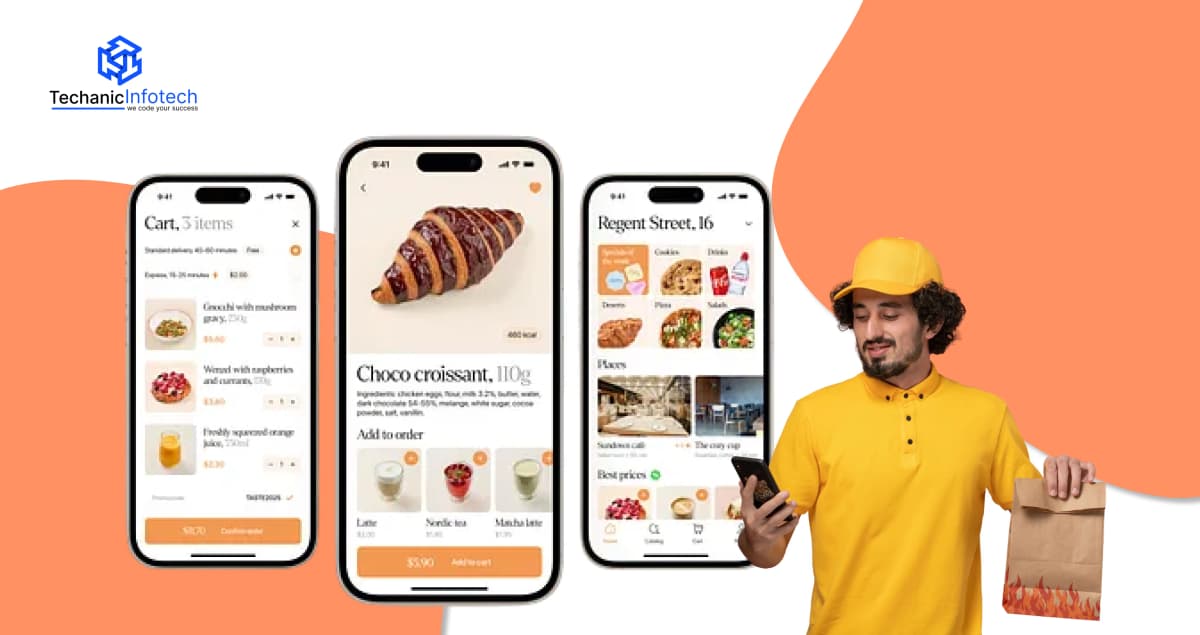
Food Delivery App Development
Food Delivery App Development Cost in 2026 ($5K–$150K Guide)
March 26, 2026
March 26, 2026
In 2026, the food delivery industry is expanding rapidly across the USA, UK, Middle East, Italy, and many other regions, creating significant opportunities for startups and businesses worldwide.
Businesses are investing in platforms similar to Uber Eats, Zomato, and Deliveroo, often partnering with a reliable food delivery app development company such as Techanic Infotech, Crinpro, & TCS to build scalable and feature-rich applications.
The most important question for businesses is: "How much does it cost to develop a food delivery app?"
The food delivery app development cost starts from $5,000 for a basic MVP and can go up to $150,000+ for a fully advanced solution.
Here are the latest market statistics shaping the food delivery app industry globally:
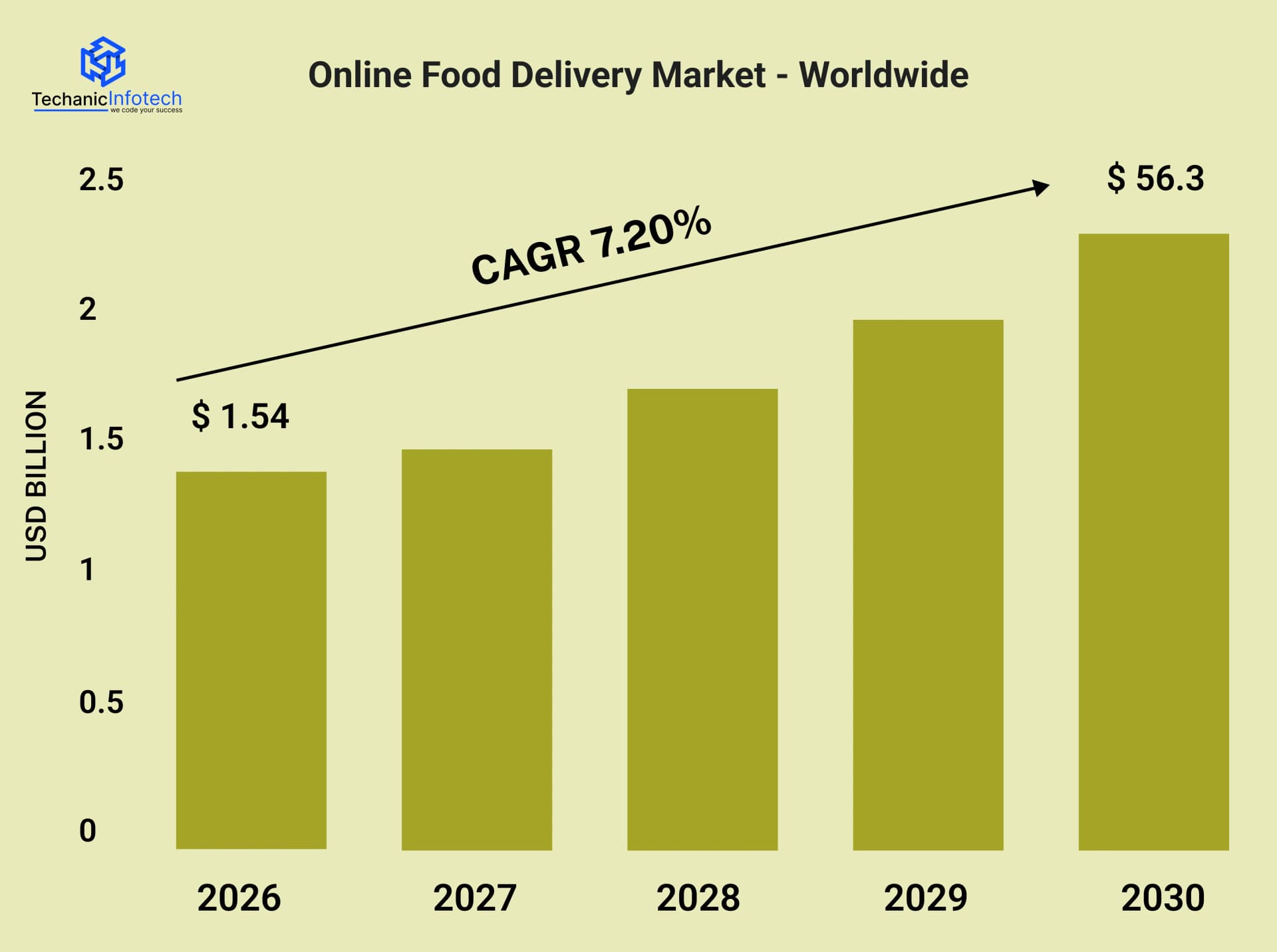
The global online food delivery market is projected to reach $400+ billion by 2030, driven by increasing digital adoption and convenience demand.
In the USA, the online food delivery segment is expected to generate over $150 billion in revenue, making it the largest market worldwide.
More than 60% of consumers prefer ordering food via mobile apps, highlighting the shift toward digital-first ordering behavior.
The Middle East food delivery market is growing rapidly, supported by high smartphone penetration and rising demand for on-demand services.
In Europe (including the UK & Italy), food delivery usage continues to increase, especially among urban users and younger demographics
A food delivery app is a digital platform that connects customers, restaurants, and delivery partners, allowing users to browse menus, place orders, and receive food at their doorstep with minimal effort.
It streamlines the entire ordering process by offering features like restaurant discovery, smart search filters, real-time order tracking, and secure payment options, ensuring a fast, convenient, and user-friendly experience.
Many businesses planning to build an app like Zomato start by understanding core features and development costs involved in creating a scalable platform.
Here are the main types of food delivery apps based on different business models and operational approaches used in the industry.
This model includes multiple restaurants in one app, giving users a wide variety of food choices and increasing platform scalability.
This model allows restaurants to manage their own orders and deliveries without third-party involvement, providing better control over operations.
This model focuses only on delivery services without dine-in facilities, reducing operational costs and increasing efficiency.
|
App Type |
Estimated Cost |
Timeline |
|
Basic MVP App |
Starts from $5,000 – $30,000 |
2–3 months |
|
Mid-Level App |
$30,000 – $80,000 |
4–6 months |
|
Advanced App |
$80,000 – $150,000+ |
6–12 months |
The cost to build a food delivery app depends on features, scalability, and development approach.
|
Region |
Hourly Rate |
Estimated Cost |
Description |
|
USA |
$20 – $49/hour |
$8,000 – $150,000+ |
High development cost due to expensive developers and advanced features. |
|
UK |
$60 – $120/hour |
$6,000 – $120,000 |
Moderate to high cost with strong UI/UX focus. |
|
Middle East (UAE, Saudi Arabia) |
$40 – $100/hour |
$10,000 – $100,000 |
Growing market with balanced cost and premium demand |
|
Italy |
$50 – $110/hour |
$12,000 – $110,000 |
Mid-range cost with increasing adoption. |
|
India (Outsourcing) |
$15 – $40/hour |
Starts from $5,000 – $50,000 |
Cost-effective option with MVP starting from $5,000. |
Here are the key factors that influence food delivery app development cost, including features, complexity, technology, and development approach.
Higher complexity requires advanced technologies, more development time, and skilled developers, which significantly increases the overall cost and project duration.
Each additional feature requires proper design, development, testing, and integration, which directly increases the development time, effort, and overall project budget.
Developing separate apps for Android and iOS platforms costs more compared to cross-platform solutions, as it requires different codebases and additional development resources.
High-quality UI/UX design improves user engagement, retention, and overall experience, but it requires more design effort, creativity, and increases development and design costs.
The overall cost varies depending on the location of the development team, as hourly rates differ significantly between regions like the USA, UK, Middle East, and India.
Integrating services like payment gateways, GPS tracking, push notifications, and analytics tools adds both development complexity and ongoing maintenance costs.
These are essential mobile app features that ensure smooth performance, better user engagement, and higher customer retention.
These features focus on providing a smooth and convenient ordering experience for customers.
User Registration & Login: Allows users to sign up quickly using email, phone, or social media for secure and easy access.
Profile Management: Enables users to manage personal details, addresses, and payment preferences in one place.
Search & Filters: Helps users find restaurants or dishes based on cuisine, location, ratings, and price range.
Restaurant Listings: Displays available restaurants with menus, ratings, delivery time, and pricing information.
Menu Browsing: Allows users to view food items with descriptions, images, and pricing details before ordering.
Add to Cart: Enables users to select multiple items and manage their order before checkout.
Order Placement: Provides a smooth checkout process with order confirmation and delivery details.
Multiple Payment Options: Supports payments via cards, wallets, UPI, and cash on delivery for user convenience.
Real-Time Order Tracking: Allows users to track their order status from preparation to delivery using GPS.
Push Notifications: Send updates about order status, offers, and promotions to keep users engaged.
Ratings & Reviews: Enables users to rate restaurants and share feedback, improving trust and transparency.
These features help restaurant owners manage their operations efficiently.
Restaurant Registration: Allows restaurants to onboard easily by submitting required details and documents.
Menu Management: Enables restaurants to add, edit, or remove food items and update pricing in real time.
Order Management Dashboard: Provides a centralized system to view and manage incoming orders efficiently.
Order Status Update: Allows restaurants to update order progress such as preparing, ready, or dispatched.
Inventory Management: Helps track ingredient availability and avoid order cancellations due to stock issues.
Analytics & Reports: Provides insights into sales, customer preferences, and performance metrics.
Offer & Discount Management: Enables restaurants to create promotional deals to attract more customers.
These features ensure efficient delivery management and improve delivery speed.
Delivery Partner Registration: Allows drivers to sign up and get verified before accepting orders.
Order Request Notifications: Sends instant alerts to delivery partners about new delivery tasks.
Accept/Reject Orders: Enables drivers to manage their availability and choose orders.
Route Optimization: Provides the fastest and most efficient route using GPS navigation.
Real-Time Tracking: Allows both admin and users to track delivery progress accurately.
Earnings Dashboard: Displays daily, weekly, and monthly earnings for delivery partners.
Delivery History: Keeps a record of completed deliveries for reference and tracking.
The admin panel controls the entire system and ensures smooth operations.
Dashboard Overview: Provides a complete view of orders, revenue, and user activity in one place.
User Management: Allows admin to manage customers, restaurants, and delivery partners efficiently.
Order Management: Enables admin to monitor and control all orders across the platform.
Commission Management: Allows setting and managing commission rates for each transaction.
Payment Management: Tracks all transactions and ensures secure financial operations.
Reports & Analytics: Provides detailed insights into business performance and growth trends.
Content Management System (CMS): Helps manage app content, banners, and promotional campaigns.
Notification Management: Allows admin to send alerts and updates to users and partners.
These features improve usability and enhance overall app performance.
Multi-Language Support: Allows users from different regions to use the app in their preferred language.
Multi-Currency Support: Enables seamless transactions across different countries.
In-App Chat Support: Allows communication between users, restaurants, and delivery partners.
Loyalty Programs: Rewards users with points and discounts to increase retention.
Order Scheduling: Allows users to schedule orders for a future date and time.
Choosing the right mobile app tech stack plays a crucial role in determining the app’s performance, scalability, and long-term success.
Here is the summary table for your refrences:
|
Layer |
Technology |
Usage |
Cost Impact |
Description |
|
Frontend |
Flutter |
Cross-platform app development |
Low |
Uses a single codebase for Android & iOS, reducing development cost. |
|
Frontend |
React Native |
Cross-platform apps |
Low |
Enables faster development with reusable components. |
|
Frontend |
Swift |
iOS app development |
High |
Required for high-performance native iOS apps with better security. |
|
Frontend |
Kotlin |
Android app development |
High |
Provides optimized performance for Android devices. |
|
Backend |
Node.js |
Server-side development |
Medium |
Handles real-time data and scalable app performance efficiently. |
|
Backend |
Laravel |
Backend framework |
Medium |
Offers secure and structured backend development. |
|
Database |
MongoDB |
NoSQL database |
Low |
Flexible and scalable database for handling large data. |
|
Database |
MySQL |
Relational database |
Low |
Reliable and widely used for structured data storage. |
|
APIs |
Google Maps API |
Location & tracking |
Medium |
Enables real-time GPS tracking but has usage-based costs. |
|
APIs |
Stripe / Razorpay |
Payment processing |
Medium |
Secure payment gateways with transaction fee |
|
Cloud |
AWS / Google Cloud |
Hosting & infrastructure |
High |
Scalable cloud services with ongoing usage costs. |
|
Notifications |
Firebase |
Push notifications |
Low |
Cost-effective solution for sending real-time alerts. |
Here are the main phases involved in the mobile app development timeline for a food delivery app, covering everything from initial planning to final deployment.
Defines project goals, target audience, and core requirements clearly to ensure smooth execution. It helps avoid confusion and reduces development risks.
Focuses on creating intuitive UI/UX with wireframes and prototypes for better user experience. A good design improves user engagement and retention.
Builds the core functionality, features, and backend systems required for the app to work efficiently. This is the most time-consuming stage.
Ensures the app is bug-free, secure, and performs well across devices and platforms. Proper mobile app testing improves app reliability and enhances overall user satisfaction.
Launches the app on app stores / PlayStore and servers after final checks and approvals. It ensures the app is ready for real users.
Total development time: 2 to 12 months, depending on app complexity
While planning your budget, it’s important to consider hidden costs that are often overlooked during initial development, as they can significantly impact the total investment and long-term sustainability of your food delivery app.
Here are the additional expenses involved in food delivery app development that are often overlooked but can impact the overall budget and long-term maintenance.
Regular updates, bug fixes, and performance improvements are required to keep the app running smoothly. This is an ongoing cost after launch.
Hosting and cloud infrastructure are needed to store data and manage traffic. These costs increase as your user base grows.
Services like payment gateways, maps, and notifications require recurring subscription or usage-based fees.
Promotions, ads, and campaigns are necessary to acquire users and grow your app. Marketing is essential for long-term success.
Platforms like Apple App Store and Google Play charge fees for publishing and in-app transactions.
Here are some effective strategies to reduce food delivery app development cost while maintaining quality, performance, and scalability for long-term business growth.
Focusing on a Minimum Viable Product (MVP) allows you to launch your food delivery app with only essential features, helping you reduce initial investment and development time.
This approach enables you to test your idea in the market and gradually add advanced features later based on real user feedback and business needs.
Building a single app for both Android and iOS using cross-platform technologies helps save significant time and mobile app development cost. This approach is especially beneficial for startups and businesses looking to reach a wider audience without investing in separate native apps.
Hiring developers or partnering with a development company from cost-effective regions helps reduce overall project expenses while maintaining quality standards. It also provides access to experienced teams and faster project execution.
Utilizing ready-made frameworks, templates, and tools can significantly speed up the development process and lower costs. These solutions reduce the need for building everything from scratch and help in faster time-to-market.
Modern on-demand app development services focus on building scalable, flexible, and cost-efficient applications using advanced technologies, ensuring long-term growth while keeping development expenses under control.
We provide cost-effective MVP development starting at $5,000, making it ideal for startups and businesses looking to launch quickly with minimal investment while ensuring scalability and long-term growth potential.
Essential features like user login, menu management, order system, and admin panel are included to launch a fully functional MVP that supports real-time operations and smooth user experience.
The MVP can be launched within a short time, helping you enter the market faster, validate your idea, and start generating revenue without long development delays.
The app is built with a scalable architecture that allows you to easily upgrade features, integrate new functionalities, and expand your platform as your business grows.
Our cost-effective development approach ensures high-quality output within a limited budget, making it suitable for startups and small businesses aiming to reduce initial investment.
You can add advanced features, third-party integrations, and custom functionalities anytime later based on your evolving business requirements and user demand
You get expert guidance and continuous technical support throughout the development process, ensuring smooth execution, timely delivery, and a successful app launch
Here are the key monetization models used by food delivery apps to generate consistent revenue and ensure long-term business growth.
Earn a percentage from each order processed through the platform, creating a consistent and scalable revenue stream as order volume increases.
Charge users a fixed or variable fee per delivery based on distance, location, or order value to generate steady income.
Offer premium memberships with benefits like free delivery, discounts, and exclusive offers to increase user retention and recurring revenue.
Promote restaurants and featured listings within the app to generate additional income through sponsored placements and paid promotions.
Choosing the right app development company is crucial for building a successful, scalable, and high-performing food delivery app that meets your business goals.
Review the company’s previous projects, especially food delivery or on-demand apps, to understand their expertise, design quality, and ability to deliver real-world solutions.
Ensure the company has strong knowledge of modern technologies like Flutter, React Native, Node.js, and cloud services to build a scalable and secure application.
Analyze different pricing structures such as fixed cost, hourly rate, or dedicated team to choose an option that fits your budget and project scope.
Go through client testimonials and third-party reviews to understand the company’s reliability, communication, and overall client satisfaction.
Confirm that the company provides ongoing maintenance, updates, and technical support to keep your app running smoothly after launch.
The food delivery app development cost varies based on factors like app complexity, features, technology stack, and development location. While a basic MVP can start from $5,000, a fully advanced and scalable solution can exceed $150,000+, depending on your business goals and requirements.
For businesses targeting markets such as the USA, UK, Middle East, Italy, and many other regions, it’s essential to choose the right development strategy, prioritize must-have features, and plan for long-term scalability. Starting with an MVP and gradually upgrading based on real user feedback remains the most cost-effective and low-risk approach.
By selecting the right technology stack and partnering with an experienced development company, you can build a high-performing food delivery app that drives strong ROI, enhances user experience, and supports long-term business growth.
Ready to build your food delivery app? Start with a cost-effective solution from $5,000, validate your idea quickly, and scale your platform as your business expands.
The average cost ranges between $5,000 and $150,000+, depending on app complexity, features, and scalability requirements.
A basic MVP with essential features like login, menu, and order management can cost around $5,000 to $30,000.
Key factors include advanced features, real-time tracking, multiple platforms, UI/UX design quality, and third-party integrations.
Development time typically ranges from 2 to 12 months, depending on the app’s complexity and feature set.
Cross-platform development is more cost-effective as it uses a single codebase for both Android and iOS, reducing development time and cost.
Building a similar app can cost between $20,000 and $150,000+, depending on customization, features, and scalability.
Yes, ongoing costs include maintenance, server hosting, API usage, updates, and marketing expenses.
Startups can reduce costs by building an MVP, using cross-platform frameworks, outsourcing development, and limiting initial features.
Popular technologies include Flutter or React Native for frontend, Node.js for backend, and MongoDB for database.
Yes, apps can be easily scaled by adding new features, upgrading infrastructure, and expanding to new markets as the business grows.


Abhishek Jangid is the CEO of Techanic Infotech, with extensive experience in mobile app and web development. He specializes in helping businesses turn innovative ideas into scalable digital solutions through strategic planning and modern technology.