Key Takeaways
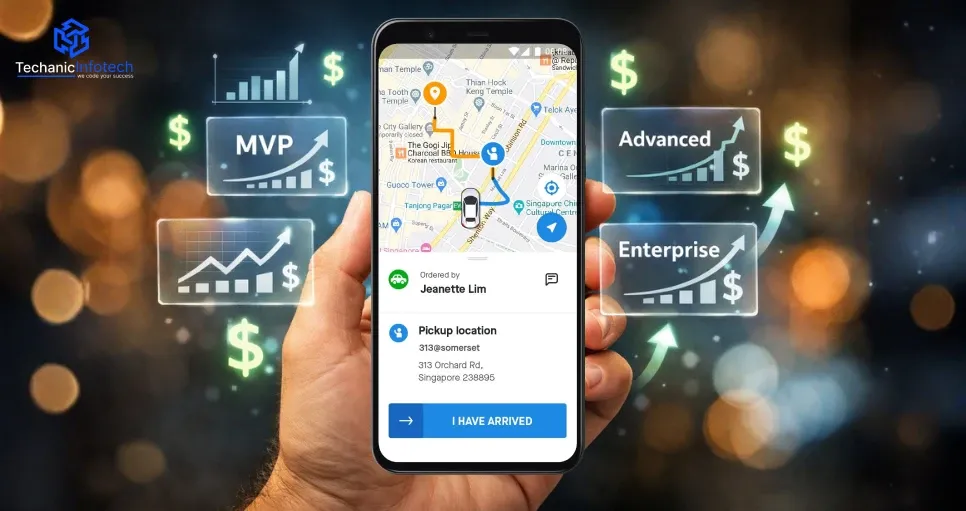
The Gojek-like app development cost typically ranges from $9,000 to $70,000+, depending on features and complexity.
The number of services (ride, delivery, payments) is the biggest factor affecting the cost.
Choosing cross-platform development can significantly reduce the cost to build an app like Gojek app.
Real-time features and third-party integrations increase both complexity and overall budget.
UI/UX design plays a key role in user experience and should not be ignored.
Development team location can reduce costs by up to 40–60% if chosen wisely.
Have you ever thought about how much it costs to build an app like Gojek that offers multiple services in one place?
From ride-hailing to food delivery and payments, super apps are becoming the future of digital platforms. But when it comes to planning, the biggest question is always the Gojek-like app development cost.
On average, the cost can range between $9,000 to $70,000, depending on the number of services, features, and technology used.
If you are a startup or an established business, understanding the development cost is essential before getting started.
In this guide, we’ll break down the cost to build an app like Gojek in a simple and practical way.
Gojek is a popular super app that offers multiple services on one platform. It started as a ride-hailing app but quickly expanded into food delivery, grocery delivery, digital payments, and more.
Today, it is one of the best examples of a multi-service platform, which is why many businesses are interested in knowing the cost and want to build similar apps.
Here are the key reasons behind Gojek’s popularity, along with real stats and facts:
Gojek has around 170 million users across Southeast Asia, making it one of the most widely used super apps. A large user base means higher engagement and strong network effects.
Gojek offers 20+ services including ride-hailing, food delivery, payments, and logistics, all in one app. This “everything in one place” model is a major reason users prefer it over multiple apps.
The platform has over 2.7 million driver partners, ensuring fast and reliable service availability.
A strong supply network helps maintain speed and efficiency.
Gojek has processed over 1.8 billion transactions with a gross transaction value of around $22 billion. High transactions show strong user trust and daily usage.
The company generates billions in revenue, with strong year-on-year growth and improving profitability. This makes it a highly scalable and profitable business model.
Gojek contributes significantly to the economy by supporting drivers, merchants, and small businesses across regions. This ecosystem approach helps in long-term growth and sustainability.
The demand for super apps like Gojek is growing rapidly as users prefer having multiple services in one place. This trend is creating huge opportunities for businesses investing in Gojek-like app development.
Here are some key insights that show how strong this market is:
The global super apps market is projected to reach around $155 billion in 2026, showing strong demand for multi-service platforms.
The market is growing at a high rate of 30% CAGR, making it one of the fastest-growing segments in the app industry.
By 2033, the super app market is expected to cross $838.3 billion, showing massive long-term potential for businesses building such platforms.
Users prefer apps that offer multiple services like payments, shopping, ride-hailing, and food delivery in one place. This convenience is a major reason behind the increasing adoption of super apps.
Regions like Asia-Pacific dominate the market with the highest adoption, driven by apps like Gojek, Grab, and WeChat. These platforms are becoming everyday tools for millions of users.
When planning a super app, the first thing most businesses want to understand is the cost to build an app like Gojek. Unlike simple apps, a Gojek-style platform combines multiple services like ride-hailing, delivery, and payments, which makes it more complex and expensive.
On average, the cost to develop an app like the Gojek app can range between $9,000 to $70,000+, depending on features, number of services, and scalability requirements.
A basic version with limited services may cost around $9,000 – $20,000
A mid-level app with multiple services and integrations can cost $20,000 – $50,000
An advanced super app with real-time features, AI, and full ecosystem can go beyond $70,000+
The cost increases as you add more services like food delivery, payments, and logistics. Each module requires separate development, backend systems, and integrations.
Another important factor is scalability. A Gojek-like app needs to handle thousands of users, real-time tracking, and transactions, which requires a strong backend and cloud infrastructure.
The best approach is to start with a focused version (MVP) with 1–2 services and then scale gradually. This helps you manage the Gojek-like super app development cost while validating your business model.
Features are the biggest factor that defines your budget. Since a super app includes multiple services, each feature adds to the complexity and overall cost.
Here’s a cost-oriented breakdown of key features:
User Registration & Profile ($1,000 – $3,000): Basic features like sign-up, login, and user profile management are essential.
Service Selection Module ($2,000 – $6,000): This allows users to choose between services like ride-hailing, food delivery, or payments.
Booking & Order Management ($3,000 – $10,000): Users should be able to book rides, place orders, and manage requests easily.
Real-Time Tracking ($5,000 – $15,000): Live tracking of rides or deliveries is a key feature in any super app. It requires GPS integration and real-time data processing.
Payment & Wallet Integration ($3,000 – $12,000): Features like digital wallets, multiple payment options, and transaction history.
Push Notifications ($1,000 – $3,000): Used for updates, offers, and alerts. This is a low-cost feature but important for user engagement.
Ratings & Reviews ($1,000 – $3,000): Allows users to rate services and providers. This helps maintain quality and trust on the platform.
Admin Panel ($3,000 – $10,000): The admin panel helps manage users, services, transactions, and analytics. A more advanced dashboard increases the cost.
When estimating the overall super app development cost, it’s important to understand that the final price depends on multiple factors.
These factors have the biggest impact on the cost to develop a super app like the Gojek app.
The number of services you include is one of the biggest cost drivers. A Gojek-like app can offer services like ride-hailing, food delivery, grocery delivery, payments, and more.
If you start with just one or two services, the app development cost stays lower. However, adding multiple services increases complexity because each service requires its own features, backend logic, and integrations. This significantly raises the super app development cost.
Starting with 1–2 services and expanding later is the most cost-effective approach.
The platform you choose directly affects the cost to build an app like the Gojek app. Developing for a single platform (either iOS or Android) is more budget-friendly.
However, if you want to target a larger audience, you may need to build for both platforms, which increases the cost. Adding a web panel or admin dashboard also adds to development time and budget.
UI/UX design plays a crucial role in user experience and retention. A Gojek-like app must be easy to navigate, fast, and visually appealing despite offering multiple services.
Basic designs cost less, but custom UI, animations, and smooth transitions increase the overall cost. Since users interact with multiple services in one app, designing a seamless experience requires more effort.
Investing in good design improves engagement and directly impacts the success of your app.
Gojek-like apps rely heavily on third-party services to function smoothly. These include payment gateways, maps and navigation (like Google Maps), push notifications, SMS services, and analytics tools.
Each integration adds development time and cost. For example, integrating payments and real-time tracking systems increases the budget significantly. The more services you integrate, the higher your Gojek clone super app development cost will be.
Real-time functionality is a core part of any super app. Features like live tracking, instant booking, order updates, and real-time notifications require strong backend systems and fast data processing.
These features increase server load and require technologies like WebSockets or real-time databases, which add to the cost to build a super app like Gojek. Apps with smooth real-time performance are more expensive but essential for user satisfaction.
The location of your mobile app development company plays a big role in the overall budget. Developers in the US or Western Europe charge higher hourly rates, while teams in India or Eastern Europe offer more cost-effective solutions.
Choosing the right team can reduce the cost by up to 40–60% without affecting quality. However, it’s important to balance cost with experience and communication.
Choosing the right technology stack is crucial because it directly impacts the cost, performance, and scalability. A super app requires a strong backend, real-time capabilities, and a smooth user experience.
Here’s a cost-oriented breakdown:
|
Component |
Technologies |
Avg Cost |
|
Frontend (Mobile App) |
Flutter, React Native, Swift, Kotlin |
$8,000 – $30,000 |
|
Backend Development |
Node.js, Python, Java (Spring Boot) |
$10,000 – $40,000 |
|
Database |
MongoDB, PostgreSQL, MySQL |
$3,000 – $12,000 |
|
Cloud & Hosting |
AWS, Google Cloud, Azure |
$3,000 – $15,000 |
|
Real-Time Technologies |
Firebase, WebSockets |
$5,000 – $20,000 |
|
APIs & Integrations |
Google Maps, Stripe, Twilio |
$5,000 – $25,000 |
|
Security Tools |
OAuth, SSL, JWT |
$4,000 – $15,000 |
|
Analytics & Tracking |
Firebase Analytics, Mixpanel |
$1,500 – $6,000 |
|
DevOps & Deployment |
Docker, Kubernetes, CI/CD Tools |
$3,000 – $10,000 |
Building a super app requires a structured approach.
Each stage of development contributes to the overall Gojek-like app development cost. Understanding this breakdown helps you plan your budget better and avoid unexpected expenses.
|
Stage |
Description |
Avg Cost |
|
Requirement Analysis & Planning |
Define business goals, services (ride, delivery, etc.), target audience, and app scope. Proper planning reduces future costs. |
$2,000 – $5,000 |
|
UI/UX Design |
Create wireframes, prototypes, and user-friendly designs for multiple services in one app. |
$3,000 – $15,000 |
|
Frontend Development |
Build user and service provider apps with smooth navigation and performance. |
$8,000 – $30,000 |
|
Backend Development |
Develop server-side logic, APIs, databases, and real-time functionalities. |
$10,000 – $40,000 |
|
Third-Party Integrations |
Integrate payments, maps, notifications, and communication systems. |
$5,000 – $25,000 |
|
Testing & Quality Assurance |
Test for bugs, performance issues, and security to ensure smooth functionality. |
$3,000 – $10,000 |
|
Launch & Deployment |
Deploy the app on app stores, set up servers, and optimize performance. |
$1,000 – $5,000 |
|
Maintenance & Updates |
Ongoing updates, bug fixes, and feature improvements after launch. |
15–20% of total cost/year |
Building a super app can be expensive, but with the right approach, you can control the Gojek-like app development budget without compromising on quality. From our experience, smart planning and expert development strategies make a huge difference.
Here’s how our developers help optimize the cost to develop an app like Gojek app:
Instead of building a full-scale super app from day one, we focus on creating a minimum viable product (MVP). This includes only essential features and 1–2 services.
This approach reduces the initial Gojek-like super app development cost and helps you launch faster. Once the app is validated in the market, additional features and services can be added gradually.
We use technologies like Flutter and React Native to build apps for both iOS and Android using a single codebase.
This significantly reduces development time and lowers the cost to build an app like Gojek compared to building separate native apps for each platform.
Our developers design the app with scalability in mind from the beginning. This ensures that your app can handle more users and services as it grows.
While scalable architecture may require a slightly higher initial investment, it helps avoid costly rebuilds later, ultimately reducing long-term development costs.
Instead of building every feature from scratch, we integrate reliable third-party services for payments, maps, and notifications.
This reduces app development time and lowers the Gojek clone app development cost while maintaining high performance and reliability.
We help you prioritize features based on business goals and user needs. Instead of adding everything at once, we focus on what truly matters in the early stage.
This prevents unnecessary spending and keeps the cost to develop an app like Gojek app under control.
Our team follows agile development practices, ensuring faster delivery and continuous improvements.
We also focus on early testing to catch issues before they become costly problems. This reduces rework and helps manage the overall Gojek-like super app development cost effectively.
Building a super app like Gojek is a powerful opportunity, but understanding the Gojek-like app development cost is key to making the right decisions. The cost can range from $9,000 to $70,000+, depending on the number of services, features, and overall complexity.
From our experience, the best approach is to start with a focused version, validate your idea, and then scale gradually. This helps you manage the cost to develop an app like Gojek app while building a strong and scalable platform.
With the right strategy, technology, and development team, you can create a successful super app that delivers value to users and drives long-term business growth
The Gojek-like app development cost typically ranges between $9,000 to $70,000+, depending on features, number of services, and complexity.
Key factors include number of services, platform choice, UI/UX design, real-time features, integrations, and development team location
It usually takes 3 to 8 months, depending on the scope, features, and number of services included.
Essential features include user registration, service selection, booking system, real-time tracking, payments, and admin dashboard.
Yes, by starting with an MVP, using cross-platform development, and focusing on essential features first.
Cross-platform is the most cost-effective option, while native apps offer better performance but higher cost.
Yes, each additional service (like food delivery or payments) increases the cost to develop an app like Gojek app.
Yes, with the rising demand for super apps, it can be a highly profitable and scalable business model.
Maintenance usually costs 15–20% of the total development cost per year.
Yes, integrations like payment gateways, maps, and notifications are essential for functionality.
Yes, starting small and scaling gradually is the best way to manage cost and reduce risk.


Bharat Sharma is the CTO of Techanic Infotech, bringing deep technical expertise in software architecture, mobile app development, and scalable system design. He leads the engineering team with a strong focus on innovation, performance, and security.