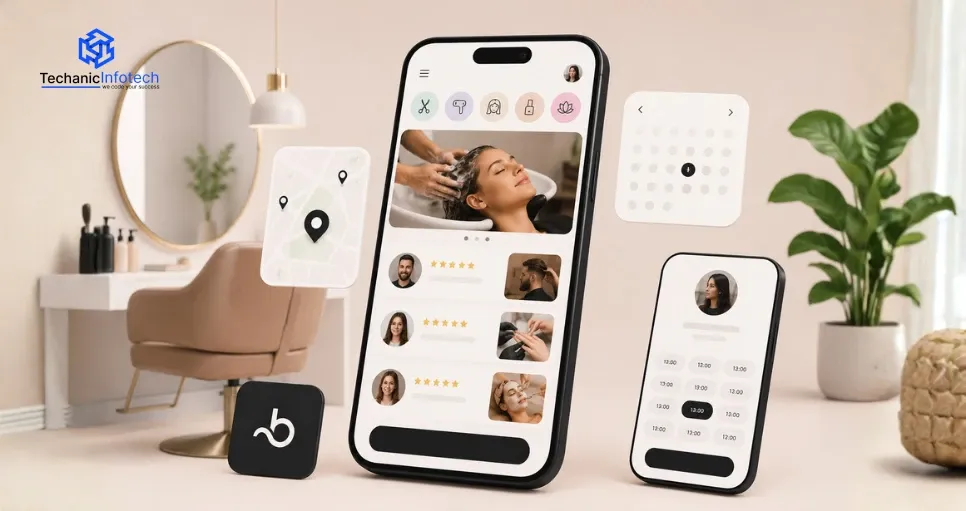
How to Create an App Like Booksy: Cost, Features & Development Guide
May 16, 2026
May 16, 2026
Planning to build an app like Booksy in 2026? One of the first questions that comes to mind is the development cost.
As the beauty and wellness industry continues to grow digitally, platforms like Booksy have transformed how customers book appointments, manage schedules, and connect with service providers. From salons and spas to barbershops and fitness studios, businesses now rely heavily on smart booking applications to streamline operations and improve customer experience.
Developing an app similar to Booksy in 2026 can be an exciting business opportunity, but the total cost depends on multiple factors. Features like AI-powered scheduling, real-time availability, online payments, customer management, push notifications, and multi-platform support all influence the final budget.
The overall development cost also varies based on app complexity, UI/UX design, technology stack, third-party integrations, development team location, and the time required to build and launch the platform.
In this guide, we’ll break down the complete process of developing an app like Booksy in 2026, explore must-have features, and provide a detailed estimate of the expected development cost so you can plan your project more effectively.
An app’s features play a major role in determining its success, usability, and overall customer experience. In 2026, users expect fast, AI-powered, and highly personalized booking solutions, especially in the beauty and wellness industry.
For a modern salon booking app like Booksy, the right set of features can simplify business operations, improve customer retention, and increase revenue growth. Choosing the right beauty salon app features is essential for delivering a seamless booking experience and staying ahead in the competitive beauty industry.
Below are the essential features every Booksy-like app should include in 2026 to stay competitive in the market.
Customers should be able to book appointments anytime using a smart scheduling system. AI-based booking suggestions, real-time availability, and instant confirmations help businesses reduce manual work and maximize appointment bookings.
Service providers need a powerful admin panel to manage appointments, staff schedules, working hours, customer data, and service availability from one centralized dashboard.
A modern booking app should support secure digital payment options, including credit/debit cards, Apple Pay, Google Pay, UPI, wallets, and Buy Now Pay Later services. Flexible payment methods improve customer convenience.
Verified reviews and ratings help salons and wellness businesses build trust online. Customers can share feedback after appointments, while businesses can respond directly to reviews to improve engagement.
Push notifications, SMS alerts, WhatsApp reminders, and email notifications help reduce no-shows and keep customers informed about upcoming appointments, offers, and schedule changes.
Businesses with multiple branches should be able to manage bookings, staff, and services across all locations from a single platform. This feature is especially important for salon chains and franchises in 2026.
Business owners should have full control over services, pricing, package offers, appointment duration, add-ons, and seasonal discounts. Dynamic pricing features can also help maximize profits during peak hours.
Loyalty rewards, referral bonuses, cashback points, and membership subscriptions encourage repeat bookings and improve long-term customer retention.
Advanced analytics tools provide valuable insights into customer behavior, peak booking times, revenue performance, staff productivity, and marketing campaign success. These reports help businesses make data-driven decisions.
The app should include marketing features such as promo codes, push campaigns, social media promotions, email marketing, and personalized offers to attract and retain customers.
Real-time messaging between customers and service providers improves communication. AI chatbots and live support features can also help answer customer queries instantly.
Integration with platforms like Instagram, Facebook, Google Calendar, and Apple Calendar allows users to book appointments directly and sync schedules automatically.
In 2026, voice-enabled booking and AI assistants are becoming more common. Virtual assistants in salon apps allow users to search services, schedule appointments, and manage bookings using voice commands for a faster and smoother customer experience.
Salon owners can monitor employee productivity, customer ratings, completed appointments, and sales performance using detailed reporting tools.
A modern Booksy-like app should use secure cloud infrastructure, end-to-end encryption, and scalable architecture to ensure smooth performance and strong customer data protection.
With these advanced features, businesses can build a highly competitive salon booking app in 2026 that delivers seamless customer experiences while improving operational efficiency and business growth.
Planning to build a modern salon booking platform like Booksy in 2026? With the beauty and wellness industry rapidly shifting toward digital solutions, Develop a salon app has become a profitable business opportunity for startups and enterprises alike.
From appointment scheduling and online payments to AI-powered recommendations and customer management, salon booking apps now require advanced functionality and seamless user experiences, making it important to partner with an experienced salon app development company for successful app development and long-term scalability.
Below is a complete step-by-step guide to help you understand how to develop a successful salon booking app like Booksy in 2026.
The first step in developing a salon booking app is understanding the market and identifying the problem your app will solve.
You should analyze customer behavior, study competitors, and understand the latest beauty industry trends. Researching the challenges of salon app development is equally important, as it helps businesses prepare for issues related to scalability, user retention, competition, and real-time appointment management.
Studying successful platforms and top salon apps can help you identify what customers expect from a modern booking experience.
The next step is selecting the right features for your application.
Your app should include essential functionalities such as online appointment booking, AI-based scheduling, secure payment gateways, push notifications, customer reviews, loyalty programs, business dashboards, and multi-location management.
If you also plan to create an app like Fresha, focusing on customer convenience and smooth booking experiences will help improve user engagement and retention.
A modern UI/UX design plays a huge role in the success of salon booking applications.
Your goal should be to create a clean, visually attractive, and easy-to-navigate interface that improves the overall customer journey. Simple layouts, fast-loading screens, intuitive navigation, and mobile-first designs can help your platform compete with leading salon applications in 2026.
A well-designed interface also improves customer trust and increases booking conversions.
Selecting the right salon app tech stack is one of the most critical decisions during development.
Businesses can choose between native and cross-platform technologies depending on their budget and project goals. For example, React Native and Flutter are popular options for cross-platform development, while Swift and Kotlin are ideal for native applications.
Your app infrastructure should also include scalable cloud solutions like AWS or Google Cloud to ensure strong performance, data security, and future scalability.
This is the stage where your concept transforms into a real application.
The development process generally includes frontend and backend development. The frontend focuses on the user interface and overall app experience, while the backend handles databases, APIs, payment systems, user authentication, and real-time appointment management.
Professional Android app development and iOS app development should be optimized for speed, responsiveness, and seamless performance across devices.
Testing is a crucial phase before launching the app.
Your development team should perform functional testing, performance testing, security testing, UI/UX testing, and device compatibility testing to identify bugs or user experience issues.
A thoroughly tested application ensures smooth functionality, minimizes crashes, and delivers a better customer experience after launch.
After testing is complete, it’s time to launch your salon booking app on platforms like the Google Play Store and Apple App Store. Businesses should also understand the process to publish an app on the App Store successfully to ensure smooth approval and maximum visibility.
A strong marketing strategy is essential for attracting users in a competitive market. Businesses should focus on app store optimization (ASO), influencer marketing, social media campaigns, paid advertising, and SEO strategies to increase visibility and downloads.
Collaborating with beauty influencers and local salon businesses can also help build trust and attract early users.
Launching the app is only the beginning of the journey.
Regular maintenance, performance optimization, bug fixing, and feature updates are necessary to keep users engaged and stay ahead of competitors. Businesses should continuously monitor user feedback and industry trends to improve the application over time. Investing in proper mobile app maintenance also helps ensure better app performance, security, and long-term scalability.
Most importantly, businesses should choose the right salon app development company to ensure long-term technical support, smooth upgrades, and scalable development solutions.
With the right strategy, modern technologies, and customer-focused features, businesses can successfully build a salon booking app like Booksy in 2026 and establish a strong presence in the growing beauty and wellness market.
The salon app development cost to create a salon booking app like Booksy can range between $8,000 to $70,000+, depending on the app features, complexity, platform selection (iOS, Android, or both), and the expertise of the development team.
If you plan to develop a salon booking app like Booksy, it will require proper planning, experienced developers, and a clear development strategy. Several factors can influence the total cost, including third-party integrations, UI/UX design quality, AI-powered features, cloud infrastructure, testing, and ongoing maintenance support.
Although the investment may vary based on project requirements, building a salon booking app can deliver long-term business value through improved customer experience, better operational efficiency, and multiple revenue opportunities.
Below is a breakdown of the estimated cost to develop a salon booking app based on key development factors.
|
Development Stage |
Estimated Cost Range |
|
Basic Salon Booking App with Essential Features |
$8,000 - $25,000 |
|
Advanced Features & AI Integrations |
$25,000 - $45,000 |
|
Enterprise-Level Salon Booking Solution |
$45,000 - $70,000+ |
|
Cross-Platform Development (iOS & Android) |
$10,000 - $40,000+ |
Apart from the core development stages, several additional factors can influence the overall cost of building a salon booking app like Booksy. Features such as custom branding, backend infrastructure, security systems, testing, and ongoing updates play a major role in the final project budget.
Businesses planning to build a scalable and high-performing salon app should also consider long-term maintenance, cloud setup, third-party integrations, and enterprise-level functionality while estimating the total development investment.
|
Additional Development Factors |
Estimated Cost Range |
|
Custom UI/UX Design & Branding |
$3,000 - $8,000 |
|
Admin Panel & Business Management System |
$4,000 - $9,000 |
|
Third-Party API & Payment Gateway Integrations |
$3,000 - $8,000 |
|
Cloud Infrastructure & Security Setup |
$2,000 - $8,000 |
|
App Testing & Quality Assurance |
$2,000 - $5,000 |
|
Ongoing Maintenance & Feature Updates |
$1,000 - $4,000 Annually |
The overall cost of developing a salon booking app like Booksy depends on multiple factors, including app complexity, feature requirements, platform selection, UI/UX design, third-party integrations, and development team expertise. Businesses looking to create a salon appointment booking app should carefully plan advanced functionalities such as AI-powered booking, real-time notifications, payment gateway integration, cloud infrastructure, and multi-location management, as these features can significantly impact the final development budget.
Additionally, factors like app maintenance, security implementation, scalability, and ongoing updates also play a major role in determining the total Booksy-like app development cost. Let’s explore the key factors that influence the overall investment required to build a salon booking app in 2026.
|
Factor |
Details |
Cost Impact |
|
App Features & Complexity |
Basic booking features vs. AI tools, loyalty programs, and advanced integrations |
Higher complexity increases development cost |
|
Platform Selection |
iOS, Android, cross-platform, or web app development |
Native apps usually cost more |
|
UI/UX Design |
Custom branding, modern layouts, and responsive design |
Premium design increases the overall budget |
|
Development Team |
In-house team or outsourcing based on region and expertise |
Experienced teams charge higher rates |
|
Backend & Cloud Setup |
Database, APIs, cloud hosting, and security systems |
Adds development and maintenance costs |
|
Payment Gateway Integration |
Stripe, PayPal, UPI, and secure payment systems |
Essential integration with additional setup cost |
|
App Maintenance |
Bug fixes, updates, and feature improvements |
Ongoing yearly expense |
|
Marketing & Launch |
SEO, paid ads, influencer marketing, and app promotions |
Impacts overall launch budget |
|
Testing & Quality Assurance |
Performance testing, security testing, and device compatibility |
Improves app quality but increases upfront cost |
|
App Store Fees |
Apple App Store and Google Play Store charges |
Small but necessary publishing cost |
Apps like Booksy are not just appointment booking platforms anymore. In 2026, salon booking applications generate revenue through multiple smart monetization strategies that help both businesses and platform owners grow together, while also following the latest salon app development trends in the beauty and wellness industry.
From commission-based earnings to premium subscriptions and advertising opportunities, these apps create several consistent revenue streams while improving customer convenience and salon operations.
Here are the most common ways Booksy-like apps make money in 2026:
One of the biggest revenue sources for salon booking apps is charging a commission on every successful booking.
Whenever a customer books a salon service through the app, the platform takes a small percentage of the transaction amount. As the number of bookings increases, the app generates higher recurring revenue.
This model benefits both salon businesses and platform owners by bringing more customers and increasing appointment conversions.
Many salon booking platforms offer monthly or yearly subscription plans to salons and beauty professionals.
Basic subscription packages may include appointment scheduling and customer management tools, while premium plans can provide advanced analytics, marketing tools, staff management, AI automation, and multi-location support.
Subscription-based revenue creates stable long-term income for the platform.
Modern salon apps also earn revenue by offering premium membership plans to users.
Customers can access exclusive benefits such as priority bookings, discounted services, loyalty rewards, VIP support, personalized recommendations, and special offers through paid memberships.
This monetization strategy improves customer retention while generating additional profits.
Salon businesses can pay to promote their services within the app.
Featured salon listings, sponsored ads, banner promotions, and top search placements help businesses gain more visibility and attract potential customers. This creates another profitable income stream for the app owner.
Many salon booking apps now include built-in marketplaces where customers can purchase beauty products, gift cards, skincare items, or wellness packages directly from the platform.
The app earns revenue by taking a commission on each product sale or marketplace transaction.
Apps can also generate income through secure online payment processing.
Whenever users pay through integrated payment gateways such as Stripe, PayPal, Apple Pay, Google Pay, or UPI, the platform may charge small transaction or convenience fees.
Booksy-like apps often collaborate with beauty brands, POS providers, CRM platforms, and payment solution companies.
These partnerships can generate additional income through affiliate commissions, referral programs, or revenue-sharing agreements.
Advanced salon booking platforms can offer premium analytics and business intelligence tools to salon owners.
Detailed reports related to customer behavior, sales performance, appointment trends, and marketing campaigns can be provided through paid dashboard subscriptions.
Referral systems and loyalty programs help apps attract new users while increasing repeat bookings.
Apps can partner with salons to run cashback campaigns, referral rewards, and membership offers that boost engagement and create extra revenue opportunities.
By combining multiple monetization models, salon booking apps like Booksy can build scalable and profitable business ecosystems while delivering a seamless experience for both salon owners and customers.
Building a salon booking app like Booksy in 2026 requires the right combination of market research, advanced features, modern UI/UX design, scalable technology, and a skilled development team. From appointment scheduling and secure payments to AI-powered automation and customer engagement tools, every element plays an important role in creating a successful salon app.
With growing demand for digital beauty and wellness solutions, investing in a salon booking application can help businesses improve customer experience, streamline operations, and generate long-term revenue.
Whether you want to launch a startup salon app or build a feature-rich platform for enterprise-level businesses, having the right development strategy and innovative features can help your app stand out in the competitive market.
A well-designed salon booking app not only simplifies appointment management but also helps businesses strengthen customer relationships, improve brand visibility, and increase overall profitability.
Let’s create a powerful and future-ready salon booking app that delivers exceptional user experiences and supports long-term business growth in 2026 and beyond.
The development cost usually ranges from $8,000 to $70,000 depending on features, design, and app complexity.
A basic salon booking app can take around 3–6 months, while advanced apps may require more time.
Online booking, payment integration, push notifications, reviews, loyalty programs, and admin dashboards are essential features.
Most businesses choose both Android and iOS platforms to reach a larger audience.
Yes, AI can be used for smart scheduling, recommendations, chatbots, and customer support.
They earn through subscriptions, booking commissions, advertisements, and premium features.
Yes, cross-platform frameworks like Flutter and React Native help reduce development costs and time.
A user-friendly design improves customer experience and increases appointment bookings.
Yes, regular updates, bug fixes, and security improvements are necessary for smooth performance.
Yes, advanced salon booking apps can easily manage appointments across multiple branches or locations.


Neha Sharma is a tech expert at heart who loves exploring new technologies and turning complex ideas into easy-to-understand content. With a passion for learning and writing, she enjoys sharing insights on emerging tech, digital products, and innovation that help businesses stay ahead.