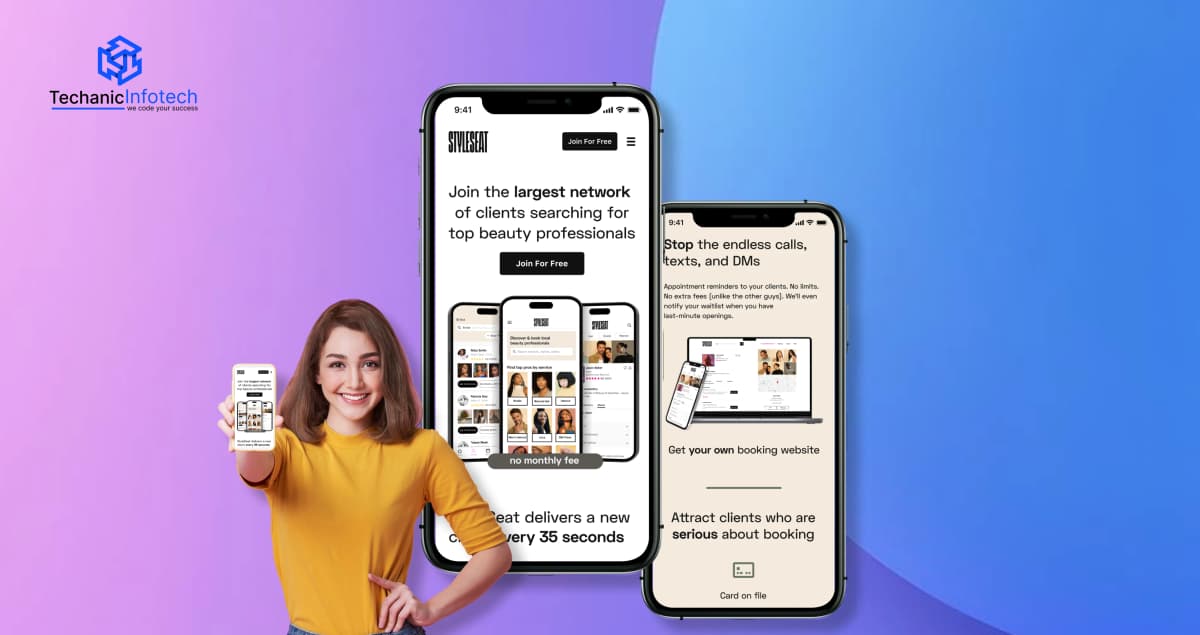
How to Develop an App Like Styleseat? A Complete Guide
December 11, 2025
December 11, 2025
Building a beauty booking app isn’t just a trend; it's a lucrative business model powered by real customer demand. Platforms like StyleSeat have changed how clients discover stylists, schedule appointments, and pay online, all from one place.
If you’re planning to develop an app like StyleSeat, the focus shouldn’t be only on design and coding. You need a smart feature mix, a solid revenue plan, and a smooth user experience that keeps both professionals and clients engaged.
From real-time scheduling to automated reminders, secure payments, and business management tools, every detail matters.
In this guide, we’ll break down the complete development process, timeline, cost, and tech choices to help you build a successful beauty booking app.
StyleSeat is one of the top salon apps in the beauty industry, designed to connect clients with hairstylists, nail artists, skincare experts, and other grooming professionals.
It removes the inconvenience of calls and walk-ins by allowing users to discover stylists, check pricing, browse portfolios, and book appointments instantly.
For pros, StyleSeat doubles as a business management tool with automated scheduling, reminders, payments, and revenue insights.
What makes it stand out is its ability to help beauty professionals grow without heavy marketing costs.
Anyone planning to build an app like StyleSeat must understand this balance of convenience, automation, and beauty-business support.
Clients search for beauty pros based on services, location, and ratings.
They view pricing, portfolio images, availability, and reviews.
The app lets users book appointments and pay securely online.
Automated alerts help reduce no-shows and boost retention.
Beauty pros manage bookings, payments, marketing, and client history from one dashboard.
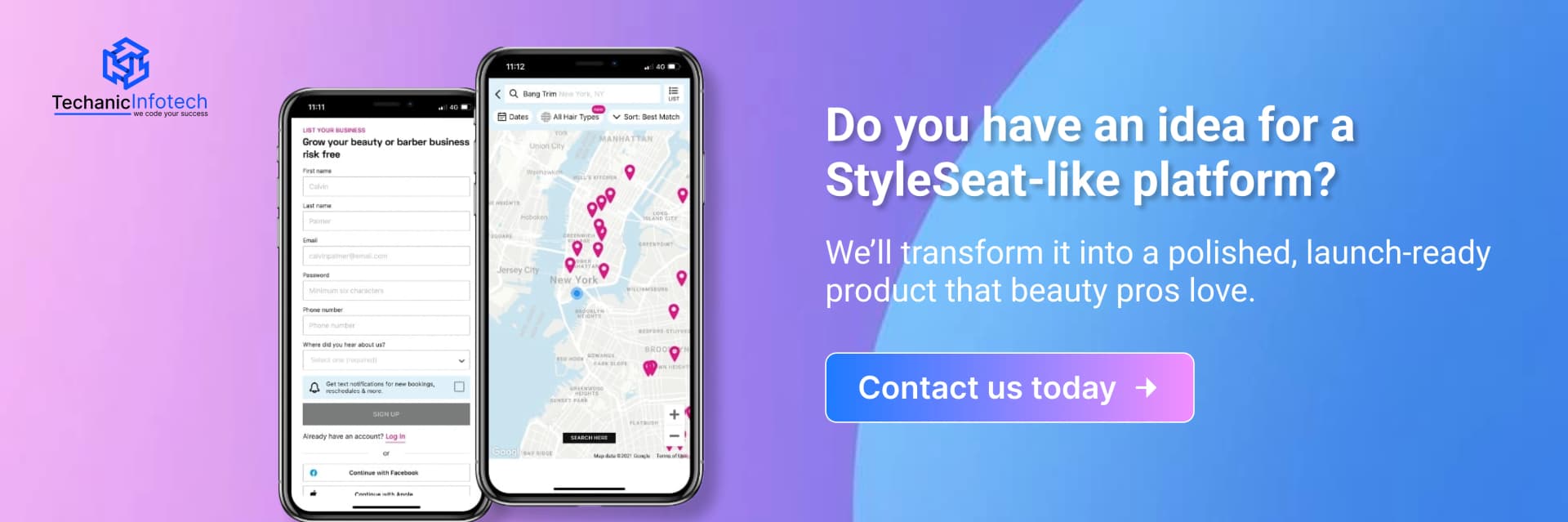
The beauty industry is shifting fast toward digital bookings, and more entrepreneurs are now exploring how to create an app like StyleSeat to tap into this growing demand.
Customers want quick appointments, transparency in pricing, and access to trusted stylists from their phones, and platforms like StyleSeat have already proven how powerful this model can be.
Consumer habits are shifting fast, and salon customers no longer want to rely on walk-ins or phone calls.
Around 79% of beauty clients now prefer booking services online, showing how strongly digital convenience influences decisions.
Meanwhile, the global beauty booking app market is projected to reach $7.5 billion by 2028, proving the rising demand for tech-driven salon platforms.
Users expect instant booking, digital payments, and verified stylist profiles with real reviews.
With trends like automated reminders and smart scheduling becoming the norm, both clients and beauty professionals benefit, and the adoption of digital salon apps continues to grow rapidly.
A marketplace model doesn’t depend only on service earnings like traditional salons.
Instead, it opens multiple revenue streams, commission on bookings, subscriptions for stylists, advertising placements, featured listings, and even product sales.
As more users join, revenue grows automatically. Since the platform isn’t tied to a physical location, it can scale city by city without the costs of opening new branches.
Building a StyleSeat-like app does not involve real estate, salon equipment, or full-time staff.
The business scales digitally, and stylists bring their services to the platform while customers drive demand.
This tech-driven growth approach significantly lowers financial risk and accelerates expansion compared to salon chains.
Beauty pros want more clients without managing calls, messages, cancellations, or reminders manually.
A booking app gives them automated scheduling, payments, reminders, marketing tools, and revenue tracking all in one place.
Because it directly boosts their income and saves time, most stylists are willing to pay monthly subscriptions or commissions to stay active on the platform.
Even with successful platforms like StyleSeat, there is still space to build winning products in the online salon business category.
Entrepreneurs can innovate with features such as AI-powered stylist matching, loyalty programs, virtual try-on filters, express checkout, or niche-focused platforms for barbers, nail artists, or home-service beauticians.
A fresh, well-targeted idea can stand out quickly in this fast-growing space.
To stand out in the beauty tech market, your platform must go beyond basic booking and payments.
A successful beauty marketplace is built on smart salon app features that simplify life for both clients and professionals while driving revenue and long-term retention.
The more seamless and intuitive the experience, the faster the platform grows.
User profiles are the core of a beauty booking marketplace.
Clients should be able to share personal details and service preferences, while professionals can highlight their expertise with service lists, pricing, photos, certification, and a professional bio.
Strong profile sections build trust and influence booking decisions.
Instant booking is the heart of the app. Clients must be able to view a stylist’s availability in real time and reserve a time slot instantly.
Pros should receive automatic updates and sync their schedules with digital calendars to avoid double booking and missed appointments.
A beauty marketplace thrives on visual proof. High-quality before and after photos, style albums, and service highlights help users compare professionals and decide confidently.
Visual work also attracts repeat clients and helps you make an app like StyleSeat feel more personalized and inspired.
Payments shouldn’t require cash or links. The app should support secure digital payments, multiple card options, a wallet, and Apple/Google Pay.
Additional features like auto-change for no-shows or deposits protest professionals and ensure smooth revenue flow.
Reputation is everything in the beauty industry. A transparent review and rating system increases trust, helps users pick the right stylist, and drives fairness in pricing.
For professionals, good reviews act as social proof and turn into predictable bookings.
Push notifications play a major role in reducing cancellations and improving user retention.
Appointment reminders, payment alerts, special offers, and booking confirmations keep clients engaged and help stylists stay organized without manual follow-ups.
Professionals need more than bookings; they need business support. Revenue tracking, analytics dashboards, client history, marketing tools, and inventory notes help stylists grow their business without extra staff or software. These features make the platform indispensable.
Every scalable platform needs a strong admin panel. It helps monitor users, bookings, payments, commissions, disputes, and promotions in real time. A powerful dashboard enables you to develop an app similar to StyleSeat that runs smoothly, stays secure, and provides a positive experience for every user.
Creating a beauty booking marketplace takes more than just design and coding. To succeed, you need the right mix of strategy, features, technology, and branding.
If you’re researching how to develop an app like StyleSeat, the journey starts with understanding what customers want, how stylists run their business, and what makes a digital platform truly scalable.
The steps below will guide you through the full development cycle, from idea validation to post-launch growth, including how to launch an app on Playstore successfully and start attracting your first users.
Before building the app, first define who you’re targeting.
Are you focusing on hairstylists, nail technicians, estheticians, barbers, bridal makeup pros, or a mix? Research your competitors, pricing strategies, and user expectations.
Look for industry gaps, maybe home-service beauticians, men’s grooming, or luxury beauty services are underserved in your market.
Clear positioning helps your app stand out and grow faster.
There are multiple revenue sources you can integrate: commissions, subscriptions for professionals, featured listings, ads, and product sales.
But before implementation, finalize your earning structure and policies for both clients and stylists. Also, plan refund rules, cancellation charges, deposits, and customer support workflows.
A strong business model paired with consistent salon app maintenance prevents confusion and keeps your marketplace profitable long-term.
Now list all the features for clients, beauty professionals, and admins. Map out how users sign up, discover services, book appointments, make payments, and manage schedules.
Also, to decide which additional features will differentiate your app AI recommendations, loyalty programs, virtual try-ons, or memberships. The clearer the flow, the smoother your development phase becomes.
Once features are finalized, select the right mobile and backend technologies.
To support scalability, security, and fast performance, developers must choose a reliable salon app tech stack.
Popular choices include Flutter or React Native for mobile, Node.js or Laravel for backend, and AWS or Google Cloud for hosting.
Picking the correct stack early saves development time and reduces future upgrade costs.
A beauty booking platform must feel modern, polished, and effortless to use. Focus on minimal navigation, soft aesthetics, smooth animations, and visually driven pages.
Portfolios, ratings, pricing, and real-time availability should be extremely easy to browse. The goal is to help users make decisions quickly and book within a few clicks.
Begin by developing the MVP (Minimum Viable Product), the essential features needed to launch.
This includes scheduling, payments, profiles, notifications, reviews, and admin control.
Once the MVP is live, collect feedback and add improvements based on real user behavior rather than guesswork. This approach reduces risk and keeps development cost-efficient.
A seamless platform requires more than core features. Now integrate payment gateways, automated reminders, SMS/email services, fraud protection tools, and calendar syncing.
For stylists, business analytics and client history modules create real value. The more automated the operations, the more professionals will stay active and engaged.
Before going live, run extensive QA tests, performance testing, security testing, and device compatibility checks across Android and iOS.
Fix bugs, optimize speed, and refine navigation. After that, plan a beta release to gather real feedback from stylists and clients. Proper testing ensures you build a salon app that users trust from day one.
Once the app is polished, launch it across the App Store and Play Store with a strong marketing strategy.
Onboarding campaigns, referral rewards, social media promotions, Google Ads, and influencer partnerships in the beauty niche can speed up adoption.
Also, create video portfolios and style success stories to attract more professionals organically.
After launch, monitor performance through analytics, bookings per stylist, repeat users, cancellation rates, churn, and revenue patterns.
Add new features based on feedback and evolving beauty trends. Expanding into new cities, new categories (like massage or wellness), and B2B partnerships can unlock the next stage of salon app business growth.
Continue improving the product, releasing updates, and enhancing user experience to stay competitive in the market.
Understanding the salon app development cost, which typically ranges from $25,000 to $150,000+ depending on features and complexity, is crucial before creating a StyleSeat-like platform, as your investment directly impacts performance, user experience, and scalability.
|
Cost Component |
Estimated Cost Range |
What It Includes |
|
UI/UX Design |
$3,000 – $15,000 |
Wireframes, screen layouts, visual design, and user flow optimization |
|
Core app Features development |
$10,000 – $60,000 |
Registration/login, stylist marketplace, booking system, payments, reviews, chat, push notifications |
|
Admin Dashboard |
$3,000 – $12,000 |
User management, bookings control, analytics, promotions, commission handling |
|
Technology Stack & Integrations |
$6,000 – $30,000 |
Backend setup, APIs, database, cloud hosting, payment gateway, SMS, and analytics tools |
|
iOS & Android app development |
$12,000 – $80,000 |
Native or cross-platform development with optimized performance & scalability |
|
QA Testing |
$2,000 – $15,000 |
Manual & automation testing, bug fixing, performance tuning, device & OS compatibility |
|
Deployment & Launch |
$1,000 – $5,000 |
App Store & Play Store submission, hosting configuration, compliance & analytics setup |
|
Maintenance & Support |
$1,500 – $8,000 per month |
Updates, bug fixing, new features, server scaling, security upgrades |
A StyleSeat-like beauty booking platform can unlock multiple income sources when salon app monetization is planned strategically from the beginning.
Since the app serves both beauty professionals and clients, there are opportunities to generate revenue from commissions, subscriptions, promotions, product sales, and value-added services.
Below are five profitable and scalable monetization strategies for long-term growth.
Charging a commission on each completed booking is the most consistent and predictable revenue model.
Stylists pay a small percentage to the platform for every service they complete through the app.
The commission may vary by stylist category, location, peak hours, or service type.
As bookings increase, the earnings scale automatically, making this a strong foundation for sustainable revenue.
Another high-performing option is offering membership packages to beauty professionals who want more visibility and business tools.
When you develop a salon app like StyleSeat, subscription tiers can include benefits such as priority search ranking, analytics dashboards, unlimited booking slots, and advanced profile customization.
Stylists who want to grow their income are willing to invest in plans that support their business expansion.
Stylists and beauty service providers can pay to appear in featured sections of the app, such as category highlights, homepage banners, or top search placements.
This boosts visibility and drives more appointments without altering the customer experience.
Promotion credits and time-bound spotlight placements create recurring revenue while giving professionals a competitive edge.
Many stylists already sell cosmetic, grooming, and self-care products to their clients. When you build a beauty salon app, integrating an in-app marketplace empowers them to list and sell products directly to users.
The platform earns a commission on every sale, increasing revenue opportunities beyond appointment bookings while improving user engagement and retention.
User-side micro-payments can also boost profit margins without feeling intrusive. Small fees for faster scheduling, same-day appointments, or booking guarantees can lift overall earnings.
Cancellation and no-show penalties protect the professional’s time and add revenue for the platform.
When positioned transparently, this model works well in StyleSeat app development and enhances service reliability.
The next generation of beauty booking platforms is rapidly evolving, and brands aiming to create a salon management app like StyleSeat must align with the upcoming technology shifts to stay competitive.
The industry is moving beyond simple appointment scheduling toward highly personalized, automated, and immersive digital beauty experiences.
Below are the top future trends shaping the beauty and salon tech landscape.
Artificial intelligence will analyze factors like service history, hair type, skin type, reviews, budget, and seasonal preferences to recommend the most suitable stylist and services.
The more personalized the experience, the higher the user loyalty and booking rate.
Augmented Reality (AR) will dominate the best salon app ideas, enabling users to digitally preview different hairstyles, makeup looks, and hair colors before booking.
This reduces uncertainty and increases trust, especially for first-time transformations.
Advanced scheduling systems will predict the best available time slots automatically based on stylist availability, peak booking hours, estimated service duration, travel time (for home services), and customer demand patterns.
This improves efficiency and reduces cancellations.
Creating an app like StyleSeat, offering built-in paid and free micro-courses for stylists, will become a major trend.
Courses on hairstyling, makeup, client handling, branding, and social media will help professionals grow while creating an added revenue channel for the platform.
The demand for on-site grooming services continues to rise. Apps will increasingly support mobile stylists, allowing users to schedule beauty and wellness services wherever they are, from home visits to hotel appointments.
Platforms that create an app like StyleSeat will integrate salon management functions such as accounting dashboards, inventory tracking, automated customer reminders, CRM, payroll, and reporting. This turns apps into complete business ecosystems rather than just booking tools.
The future of salon booking platforms includes BNPL (Buy Now Pay Later), digital wallets, instant payouts for stylists, subscription checkout, and cryptocurrency payments, making financial transactions seamless and flexible.
Social discovery will play a major role. To optimize salon app design, apps will feature influencer portfolios, social ratings, video transformations, client testimonials, and brand collaborations, helping clients choose stylists based on trust and community recommendations.
Techanic Infotech stands out as the leading choice for beauty salon app development because we understand both the technology side and the real business needs of salons, stylists, and customers.
As a beauty salon app development company, we focus on creating platforms that are visually appealing, user-friendly, and built to scale.
Our apps support online booking, smart scheduling, payments, CRM, stylist management, and marketing features, everything needed to run and grow a salon app business.
We follow industry trends like AI personalization, AR try-ons, mobile beauty services, and automated business tools to ensure clients always stay ahead of the market.
With a transparent process, competitive pricing, and end-to-end support, Techanic Infotech delivers apps that drive results, not just downloads.
Building a beauty booking platform has become one of the most profitable business ideas in the digital salon industry.
Whether you want to digitize salon operations or empower independent stylists, the opportunity is huge.
With the right features, technology stack, monetization model, and user-focused design, you can develop an app like StyleSeat that attracts both beauty professionals and clients.
The key is understanding customer needs, offering a seamless booking experience, and staying aligned with future trends like AI personalization, AR try-ons, mobile beauty services, and automated business tools.
Partnering with an experienced development team ensures faster launch, lower risk, and long-term scalability. The next big beauty platform could be yours; all it needs is execution
The cost typically ranges from $25,000 to $150,000, depending on features, platform (iOS/Android), UI complexity, and development location.
Must-have features include provider profile, appointment scheduling, in-app payments, reviews, push notifications, and salon management tools.
On average, it takes 4 to 9 months, depending on the features list, tech stack, and whether you choose MVP or full-scale development.
Yes, an admin dashboard helps manage users, bookings, payments, commissions, services, and promotions.
Popular choices include react native or Flutter for mobile, Node.js or Laravel for backend, and AWS or Google Cloud for hosting.


Neha Sharma is a tech expert at heart who loves exploring new technologies and turning complex ideas into easy-to-understand content. With a passion for learning and writing, she enjoys sharing insights on emerging tech, digital products, and innovation that help businesses stay ahead.