
Job Portal App Development
Job Portal Business Model: How Job Platforms Make Money in 2026
January 21, 2026
January 21, 2026
Finding the right job or the right candidate has never been simple. Job seekers often struggle with endless applications and little response, while recruiters deal with unqualified resumes and high hiring costs. This gap is exactly where job portals step in. Over the years, job platforms have evolved from basic listing websites into powerful hiring ecosystems that connect talent with opportunity at scale.
But behind every successful job portal is a smart business model that keeps the platform running, growing, and profitable. In this blog, we’ll break down the job portal business model in simple terms. You’ll learn how job platforms earn revenue, what monetization strategies work best today, and how different job portals structure their income streams to stay competitive in a crowded market.
At its core, a job portal works as a two-sided marketplace. On one side are job seekers looking for opportunities. On the other side are employers and recruiters searching for the right talent. The platform’s role is to make this connection smooth, fast, and valuable for both parties.
Most job portals offer basic services for free to attract users. Once traffic and engagement grow, they introduce paid services that solve specific problems for employers or premium needs of job seekers. This balance between free access and paid value is the foundation of an effective online job portal business model.
Before understanding the job portal development process, it’s important to understand value. Job portals don’t just list jobs. They offer:
Access to a large pool of candidates
Tools to filter, shortlist, and manage applications
Employer branding opportunities
Data insights for better hiring decisions
Faster and more efficient recruitment processes
When a platform consistently delivers these benefits, users are willing to pay for convenience, speed, and better results.
Selecting the right business model is one of the most important decisions when building a job portal. There is no one-size-fits-all approach. The best model depends on your audience, market, and long-term goals. Below are key points to help you choose wisely.
Understand Your Target Users: Decide whether your platform mainly serves job seekers, employers, or recruitment agencies, and create a job portal design accordingly. General job portals, niche platforms, and enterprise-focused portals all require different monetization approaches.
Start Simple and Scalable: In the early stage, focus on free listings or basic job portal features to attract users. Once traffic and engagement grow, introduce paid features gradually without disrupting the user experience.
Choose Employer-Focused Revenue First: Paid job postings, featured listings, and recruiter subscriptions are usually the easiest ways to generate early revenue, especially if your platform attracts quality candidates.
Add Job Seeker Monetization Carefully; Premium profiles, resume services, and skill tests work best in competitive job markets. These features should always be optional and value-driven.
Use Multiple Revenue Streams: Relying on a single income source is risky. Combine subscriptions, advertising, database access, and partnerships to create steady and diversified revenue.
Consider Your Market and Region: Pricing and features should match local hiring trends. What works in one region may not work in another, so adapt your model accordingly.
Focus on Long-Term Value, Not Quick Profits: A sustainable job portal grows by solving real hiring problems. Prioritize trust, transparency, and quality over aggressive monetization.
Use Data to Improve Decisions: AI in job portals helps to track user behavior, conversions, and drop-offs. Data insights help refine pricing, features, and overall business strategy.
Choosing the right business model is about balance, between user needs, market demand, and revenue goals. When done right, it sets the foundation for long-term success.
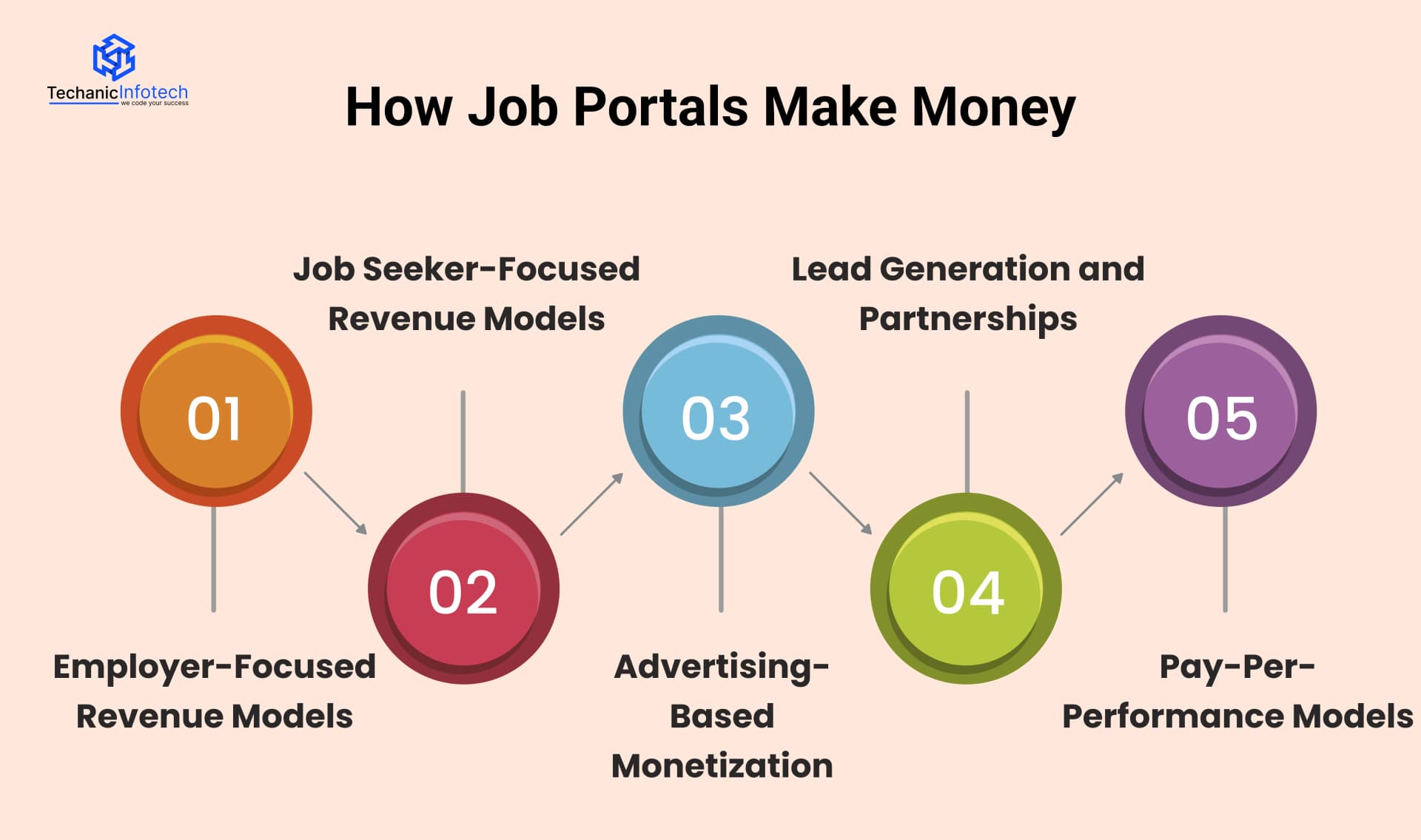
If you’re wondering how job portals make money, the answer is not through one single method. Most successful platforms use multiple revenue streams together. This reduces dependency on one source and creates steady income even during market fluctuations.
The most common approaches that job portal development companies apply include subscriptions, job postings, advertisements, database access, and premium features. Let’s break each one down in detail.
Employers and recruiters are the primary revenue drivers for most job portals. These models are designed to help companies hire faster, reach the right candidates, and improve visibility, while allowing the platform to generate consistent and scalable income.
This is one of the most common job portal revenue streams. Employers pay to post job openings on the platform for a fixed duration, such as 15, 30, or 60 days.
Pricing usually depends on:
Job visibility
Duration of listing
Category or industry
Location targeting
Some portals offer free postings with limited reach, while paid listings get priority placement and higher visibility.
To stand out in a competitive market, employers often choose featured job postings. These listings appear at the top of search results or are highlighted visually.
This approach fits well into the job portal advertising model, where visibility itself becomes a product. Employers pay extra to attract more applicants in less time.
Many platforms use a job portal subscription model for recruiters. Instead of paying per job, employers subscribe monthly or annually to access a bundle of services.
These plans may include:
A fixed number of job postings
Resume database access
Applicant tracking tools
Employer branding pages
Subscriptions offer predictable revenue and encourage long-term relationships with recruiters.
Recruiters often want to search candidates directly rather than wait for applications. Job portals monetize this by offering paid access to their resume database.
Pricing depends on:
Number of profiles viewed
Contact details unlocked
Search filters available
This is a key part of the revenue model of job portals, especially for platforms serving high-volume recruiters and staffing agencies.
Modern job portals don’t rely only on employers to generate revenue. Many platforms also monetize by offering value-added services to job seekers who want better visibility and faster results. These models are optional, which means free users can still apply for jobs, while serious professionals can pay to improve their chances.
Premium job seeker accounts are designed to increase visibility and response rates.
These accounts usually include features such as highlighted profiles that appear higher in recruiter searches, priority application status that helps resumes get noticed first, and profile visibility boosts during peak hiring periods.
This model works especially well for mid-level and senior professionals where competition is high and faster hiring matters.
Not every job seeker knows how to present their skills effectively. To solve this, many job portals partner with resume writers, career coaches, and HR experts to offer professional services.
These services usually include resume writing, LinkedIn or profile optimization, and interview preparation. They are often sold as one-time purchases or bundled with premium job seeker plans. Because these services are optional, they don’t affect free users while still creating an additional revenue stream for the platform.
Skill verification is becoming more important in modern hiring. Some job portals charge job seekers for verified skill assessments or certifications that appear on their profiles.
These tests help job seekers prove their abilities and help employers filter candidates more confidently. While this is usually not the main revenue source, it plays a strong supporting role by increasing trust, credibility, and hiring efficiency. Over time, this model also improves the quality of candidates on the platform.
Job portals with high traffic attract advertisers beyond employers. This opens up opportunities for advertising-based revenue models.
Educational institutes, online learning platforms, career tools, and HR software companies often advertise on job portals. Banner ads, sidebar ads, and sponsored content work well when they are relevant to job seekers.
This fits naturally into the job portal advertising model, especially when ads align with career growth, learning, and professional development.
Large companies often pay for branded employer pages. These pages showcase company culture, benefits, videos, employee stories, and open roles. Sponsored employer pages support long-term employer branding rather than immediate hiring.
This strategy works best for enterprises with ongoing recruitment needs and strong brand recognition.
Partnerships play a key role in expanding revenue beyond direct users.
Many job portals collaborate with recruitment and staffing agencies. Agencies pay for candidate leads, resume access, or premium visibility for their job listings.
This model is especially effective in niche markets such as IT, healthcare, and executive hiring, where agencies value speed and candidate quality.
Some platforms earn commissions by promoting career courses, certifications, or training programs. When users enroll through the job portal, the platform earns a referral fee.
This expands the job board business model beyond hiring and supports users at different career stages.
Pay-per-performance models focus on results rather than fixed fees, which builds trust with employers.
In this model, employers are charged based on the number of applications they receive. It feels fair because employers pay only when candidates apply, not just for visibility.
Here, employers pay a fee only when a successful hire is made. While this requires strong tracking and verification systems, it can be highly profitable for platforms with advanced matching algorithms and quality candidate pools.
Below are real-world examples of top job portals and a clear, point-wise breakdown of how each platform makes money. This format makes it easier to understand their monetization logic at a glance.
Earns revenue mainly from recruiter-focused tools and hiring solutions
Companies pay for job postings and recruiter subscriptions
Premium plans allow recruiters to search and contact candidates directly
Additional income comes from professional subscriptions and B2B advertising
Strong focus on employer branding and long-term hiring relationships
Uses a pay-per-click and pay-per-application model
Employers pay only when candidates interact with job listings
Sponsored jobs appear higher in search results for better visibility
Revenue grows as employers compete for faster hiring results
Performance-based pricing builds trust with recruiters
Earns revenue mainly through job seeker subscriptions
Users pay to access verified, scam-free remote and flexible jobs
Employers benefit from quality, serious candidates
Focuses on trust, job quality, and niche hiring
A strong example for startups looking to create a job portal like FlexJobs with a subscription-first approach
Companies pay to manage and enhance their employer profiles
Sponsored job listings increase visibility among job seekers
Revenue also comes from recruitment marketing solutions
Combines hiring with company reputation management
Earns through paid job postings and recruiter subscriptions
Charges for access to resume and candidate databases
Offers managed recruitment and talent solutions
Serves both small businesses and large enterprises
Uses a diversified recruitment platform business model
These examples show that successful job portals rarely depend on a single revenue source. Instead, they combine subscriptions, performance-based pricing, branding tools, and data access to build strong, sustainable revenue streams.
Scaling a job portal is not just about getting more users. It’s about growing in a way that increases revenue without hurting user experience or operational efficiency. Below are practical and proven points to help scale a job portal profitably, written in simple and clear language.
Before scaling, make sure your foundation is strong. Your job portal business model should clearly define who pays you and why. Focus on what already works, such as paid job postings, recruiter subscriptions, or resume database access.
Improve these core offerings instead of adding too many new features at once. A clear and focused online job portal business model makes scaling smoother and reduces financial risk.
Relying on a single income source limits growth. To scale profitably, expand your job portal revenue streams gradually. Combine employer subscriptions, featured job listings, resume access, and advertising.
You can also introduce job seeker premium plans or skill-based services. A mix of revenue sources strengthens your revenue model of job portals and protects your platform during slow hiring cycles.
Scaling works best when monetization feels natural. Use data to understand what employers and job seekers value most, then price those features fairly. Flexible plans, pay-per-use options, and tiered subscriptions help attract different user segments. Well-planned job portal monetization strategies improve conversions without pushing users away.
Instead of expanding everywhere at once, scale by targeting specific industries, skills, or regions.
Niche hiring platforms often convert better and allow premium pricing. This approach strengthens your job board business model and builds authority faster. Once you dominate a niche, expanding into new markets becomes easier and more cost-effective.
Profitable scaling depends on efficiency. Use analytics to track recruiter retention, job posting performance, and user behavior.
Automate repetitive tasks like job approvals, notifications, and matching. Data-driven decisions help refine your recruitment platform business model and ensure growth doesn’t increase the cost to build job portals at the same pace as revenue.
Scaling a job portal profitably is about balance, between growth, value, and sustainability. With the right strategy, your platform can grow steadily while staying financially strong.
At Techanic Infotech, we help businesses turn hiring ideas into scalable digital platforms. Our team understands how job portals work in real markets, from attracting job seekers to converting recruiters into paying customers.
As an experienced job portal development company, we focus on building platforms that are easy to use, secure, and ready to scale. From custom features and smart monetization logic to admin dashboards and analytics, we design solutions that support long-term growth.
Whether you’re launching a niche job board or a full-scale recruitment platform, we build with performance, flexibility, and business goals in mind.
Job portals succeed when they solve real hiring problems while offering flexible ways to earn revenue. From subscriptions and advertising to premium features and partnerships, the job portal revenue streams are diverse and adaptable.
The most profitable platforms focus on long-term value, trust, and smart monetization rather than quick gains. With the right strategy, a job portal can grow into a sustainable, scalable, and highly profitable digital business.
The most common job portal business model is employer-focused. Platforms earn revenue through paid job postings, recruiter subscriptions, and resume database access. Many portals also combine this with advertising and premium job seeker services.
The most common job portal business model is employer-focused. Platforms earn revenue through paid job postings, recruiter subscriptions, and resume database access. Many portals also combine this with advertising and premium job seeker services.
Job portals mainly earn from employers who pay for visibility, hiring tools, and access to candidates. Job seekers can usually apply for free, while optional premium services help them improve visibility and chances of getting hired.
Job portals mainly earn from employers who pay for visibility, hiring tools, and access to candidates. Job seekers can usually apply for free, while optional premium services help them improve visibility and chances of getting hired.
For startups, paid job listings and recruiter subscriptions work best in the early stage. These models are easier to manage, bring faster revenue, and scale well as the platform grows.
For startups, paid job listings and recruiter subscriptions work best in the early stage. These models are easier to manage, bring faster revenue, and scale well as the platform grows.
Yes, niche job portals often perform better because they target a specific industry or skill set. This allows higher pricing, better candidate quality, and stronger employer trust.
Yes, niche job portals often perform better because they target a specific industry or skill set. This allows higher pricing, better candidate quality, and stronger employer trust.


Bharat Sharma is the CTO of Techanic Infotech, bringing deep technical expertise in software architecture, mobile app development, and scalable system design. He leads the engineering team with a strong focus on innovation, performance, and security.