Key Takeaways
Building a healthcare appointment platform similar to Practo enables seamless doctor discovery, appointment booking, teleconsultation, digital prescriptions, and secure health record management, all within one integrated ecosystem.
The overall healthcare appointment app development cost depends on the complexity, ranging from a basic MVP ($10,000–$25,000) to an advanced AI-powered, compliance-ready solution ($50,000–$90,000+).
Using modern frontend, backend, cloud infrastructure, microservices architecture, encrypted APIs, and secure databases ensures long-term scalability and reliable telemedicine operations.
Successful platforms generate revenue through appointment commissions, doctor subscriptions, teleconsultation fees, featured listings, and lab partnerships—creating sustainable profitability.
A team with healthcare domain expertise, compliance knowledge, strong UI/UX capabilities, and transparent development methodology ensures faster go-to-market and long-term platform stability.
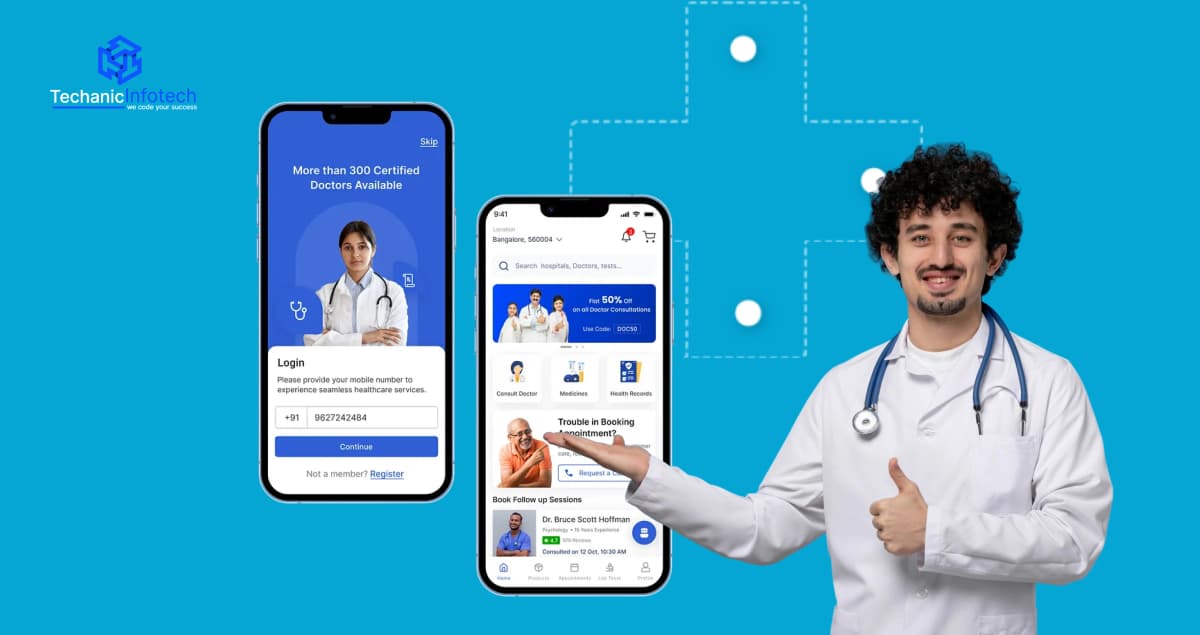
A Practo-like app connects patients and healthcare providers through a secure digital platform that simplifies appointment booking, online consultations, prescriptions, and health record management.
With rising telemedicine adoption and mobile-first healthcare services, such apps are transforming patient engagement and clinical workflows.
From intuitive dashboards to AI-powered doctor recommendations, a Practo-like app enhances convenience, accessibility, and operational efficiency.
This comprehensive guide covers essential features, development processes, cost estimates, monetization strategies, and best practices to build a competitive healthcare marketplace application.
A Practo-like app streamlines healthcare access through doctor discovery, appointment booking, online consultations, digital prescriptions, and secure records.
Following are the key mobile app features list for a Practo-like app.
Patient panel features typically include appointment scheduling, secure messaging, access to medical records, prescription refill requests, billing information, lab results, reminders, telehealth access, and personalized health tracking for improved patient engagement and care coordination.
Patients manage personal details, medical history, insurance information, saved doctors, appointment history, and receive personalized healthcare recommendations securely.
Users can search doctors by specialty, location, experience, consultation fees, availability, gender, language, and ratings.
Patients can view real-time doctor availability, book instant or scheduled appointments, receive confirmations, reminders, reschedule or cancel bookings, and sync appointments with calendar applications seamlessly.
The app enables secure video and chat consultations, allowing patients to connect with doctors remotely, share reports, discuss symptoms, and receive medical advice without visiting clinics physically.
Patients can download, store, and share prescriptions with pharmacies, ensuring easy medication tracking and reducing paperwork.
The Doctor Panel is a centralized dashboard that allows healthcare professionals to manage appointments, patient records, prescriptions, availability, and consultations efficiently while ensuring secure and streamlined clinical operations.
Doctors can update personal details, qualifications, specialization, consultation fees, clinic information, and profile photos.
The panel provides patient details, visit history, consultation notes, and reminders, ensuring organized scheduling, reduced no-shows, and efficient daily workflow management.
The system stores medication history, dosage instructions, and supports downloadable formats, improving accuracy, reducing paperwork, and enhancing patient safety.
The dashboard provides financial insights, performance summaries, and downloadable reports for better financial management decisions.
The Admin Panel is a centralized control system that enables administrators to manage users, doctors, appointments, payments, reports, and platform settings.
It ensures smooth operations, data security, compliance monitoring, and overall system performance across the healthcare application.
Admins can manage user and doctor accounts, verify profiles, update information, activate or suspend access, handle credentials, and monitor activities to ensure platform security, compliance, and smooth operations.
The system provides detailed records, doctor-patient assignments, timestamps, and status updates for improved coordination and operational transparency.
Admins can oversee transactions, track payments, calculate commissions, manage payouts, and monitor pending or completed settlements.
Analytics dashboards provide insights, trends, and downloadable summaries to support strategic planning and data-driven decisions.
Below is a structured overview of the essential mobile app tech stack needed to develop a robust healthcare appointment and management application.
The frontend is responsible for delivering a seamless user experience across web and mobile platforms.
It must be fast, responsive, intuitive, and accessible to patients, doctors, and administrators.
The backend powers the core functionality of the application, handling business logic, authentication, scheduling, notifications, and data processing securely and efficiently.
Microservices architecture, JWT authentication, and secure encryption ensure reliable performance and healthcare data protection compliance.
Databases store and manage patient records, doctor profiles, appointment schedules, prescriptions, and transaction histories with high reliability and security.
NoSQL databases such as MongoDB handle unstructured content and real-time data efficiently.
Cloud infrastructure ensures scalability, uptime reliability, performance optimization, and secure data storage for healthcare applications.
Platforms like AWS, Microsoft Azure, or Google Cloud provide auto-scaling, load balancing, containerization using Docker and Kubernetes, and global CDN distribution.
Third-party services enhance functionality by adding secure payments, communication tools, analytics, and healthcare-specific services.
Integration with payment gateways like Stripe or Razorpay enables secure transactions. SMS and email APIs, such as Twilio, improve notifications.
Developing a healthcare platform like Practo requires a structured, compliance-focused approach.
Each mental health app development step ensures the app is scalable, secure, user-friendly, and capable of handling sensitive medical data efficiently.
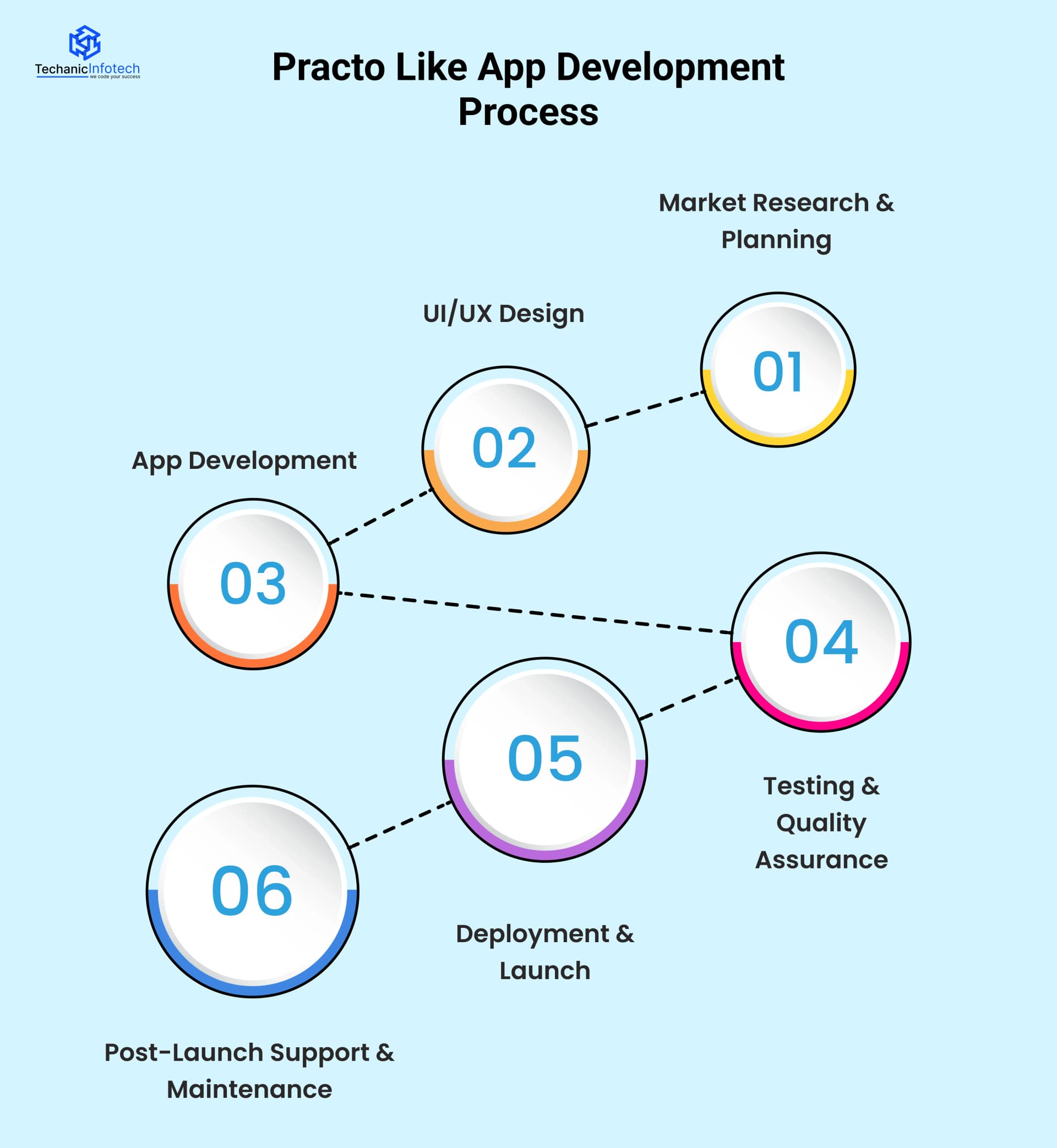
This phase identifies target users, competitors, regulatory requirements, and revenue models.
It involves analyzing healthcare gaps, defining core features like appointment booking and teleconsultation, estimating budgets, creating a project roadmap, and ensuring compliance with healthcare data protection laws.
UI/UX design focuses on creating intuitive navigation for patients and doctors.
Wireframes and prototypes are developed to ensure smooth booking flows, easy profile management, and accessible dashboards.
During AI therapy app development, frontend and backend systems are built and integrated through APIs.
Features such as authentication, appointment scheduling, payment processing, and video consultations are implemented.
Testing ensures the app performs reliably under various conditions. Functional, usability, security, and performance testing are conducted.
QA teams identify bugs, verify compliance standards, test load handling, and ensure seamless performance across devices, operating systems, and network environments.
The application is deployed on cloud infrastructure and published on app stores. Final configurations, server optimizations, and security checks are completed.
Marketing strategies are executed to attract users, while monitoring tools are activated to track performance post-launch.
Continuous mobile app maintenance, updates, and feature enhancements are essential after launch.
Teams fix bugs, improve performance, strengthen security patches, and introduce new features based on user feedback.
Here’s a polished explanation of the mobile app development cost structure for developing a Practo-like app, formatted like your example, with clear points and pricing ranges:
|
Level |
Key Features Included |
Estimated Cost |
|
Basic MVP Development |
• Patient & Doctor Registration/Login • Appointment Booking • Doctor Profiles • Basic Search & Filters • Simple Dashboard (Doctor & Admin) |
$10,000 – $25,000 |
|
Mid-Level Feature Set & AI Integration |
• AI-Assisted Appointment Reminders • Chatbot for Patient Queries • Doctor Performance Dashboard • Teleconsultation (Video/Audio) • Basic Patient Engagement Analytics |
$25,000 – $50,000 |
|
Advanced AI, Customization & Compliance |
• HIPAA/GDPR Compliance • Multi-Role Advanced Dashboards • AI-Powered Insights & Recommendations • Real-Time Notifications • Advanced Search & Deep Analytics |
$50,000 – $90,000+ |
|
Cloud & Infrastructure (Annual) |
• Secure Cloud Hosting • Medical Record Storage • Video Storage (Teleconsultation) • Real-Time AI Processing • High Uptime & Security Monitoring |
$5,000 – $15,000 / year |
|
Maintenance & Updates (Annual) |
• Bug Fixes & Security Patches • OS & Framework Updates • Performance Optimization • Feature Enhancements • AI Model Retraining • Technical Support |
15–20% of Initial Development Cost/year |
Monetizing a healthcare platform like Practo requires diversified revenue streams that balance profitability with user trust.
Below are the most effective monetization strategies for a Practo-like app:
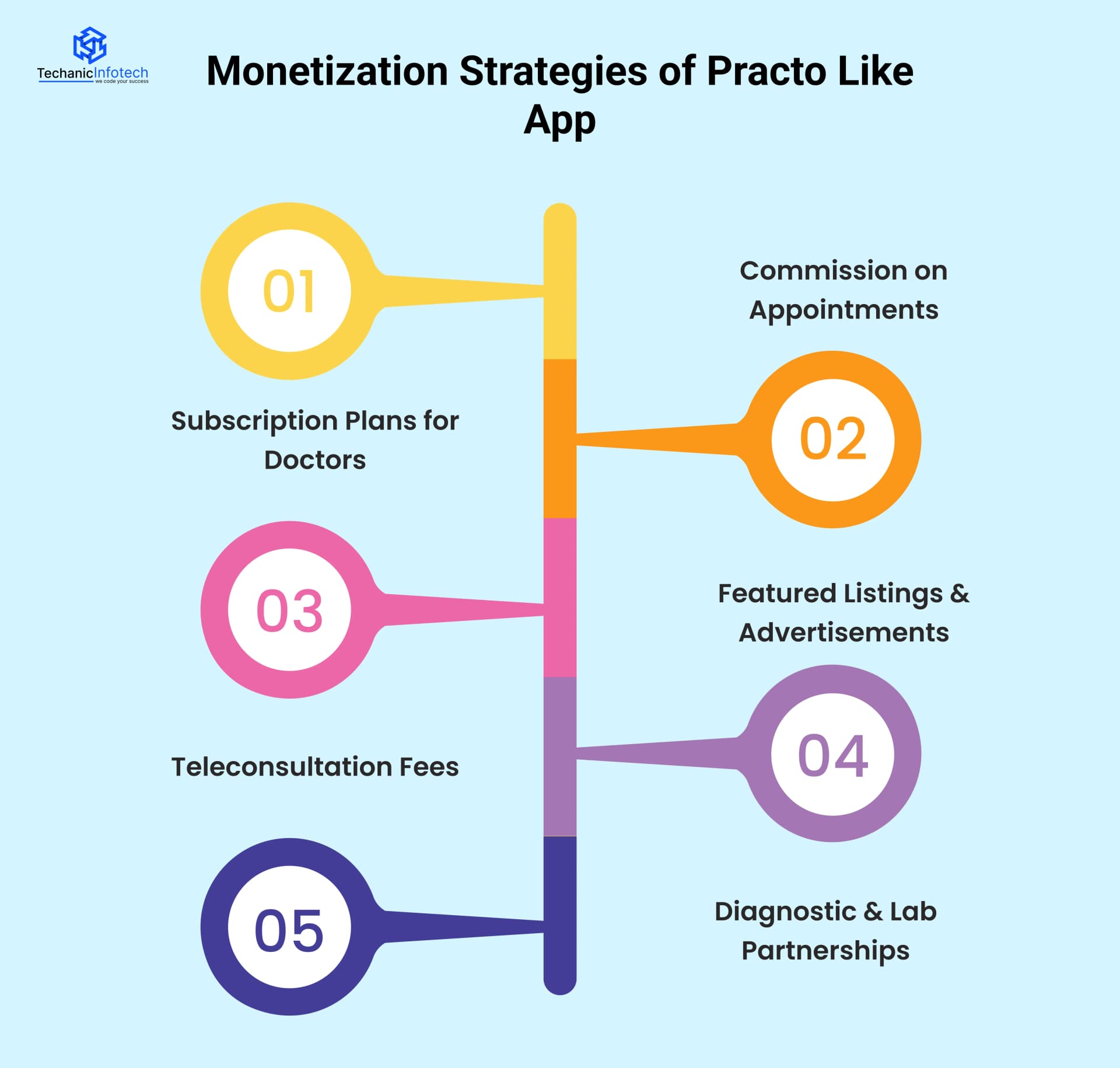
The platform can charge doctors or clinics a percentage fee for every successful appointment booked through the app.
Doctors and hospitals can subscribe to premium plans for enhanced visibility, priority listing, analytics dashboards, and patient management tools.
In-app healthcare advertisements, diagnostic labs, and pharmacy promotions can also generate additional advertising revenue.
Either a percentage is deducted from the consultation fee, or patients pay a convenience charge for using the telemedicine service.
The platform earns a commission for every lab test booked via the app, creating an additional healthcare service revenue stream.
Developing a healthcare app involves technical, regulatory, and operational complexities.
Since platforms like Practo handle sensitive medical data and real-time services, overcoming these challenges is critical for long-term success.
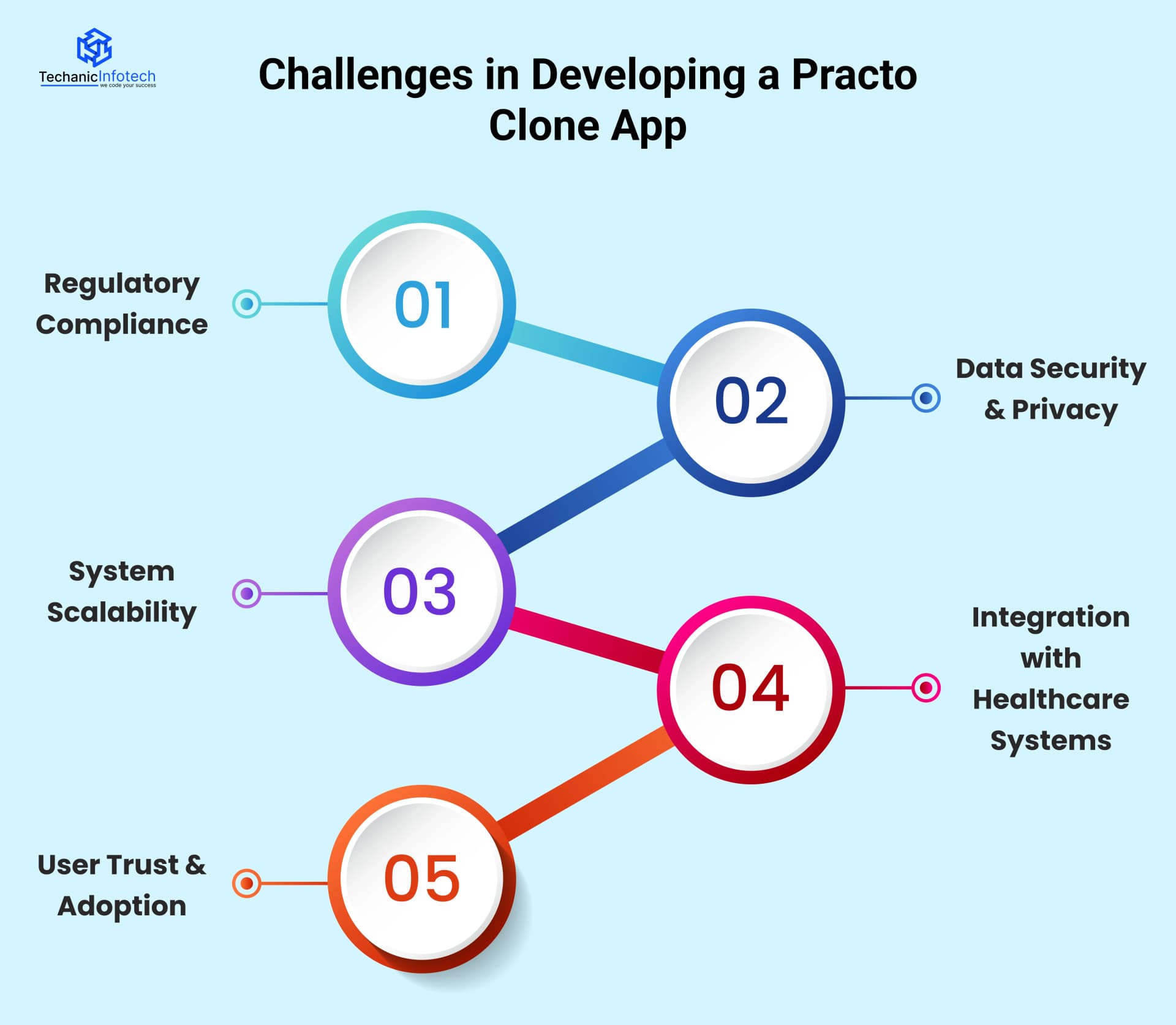
Healthcare apps must comply with strict regulations such as HIPAA, GDPR, and local medical laws.
Ensuring secure storage, encrypted communication, and proper consent management is complex but essential to avoid legal risks and penalties.
Patient health records are highly sensitive, and keeping them secure and private.
Implementing end-to-end encryption, multi-factor authentication, secure APIs, and regular security audits is necessary to prevent breaches, cyberattacks, and unauthorized data access.
Healthcare apps must handle increasing users, appointment bookings, and real-time consultations.
Designing scalable architecture with load balancing and cloud optimization is challenging but necessary to maintain consistent performance.
Integrating with hospital management systems, EHR platforms, pharmacies, and diagnostic labs can be technically complex due to different standards, legacy systems, and interoperability issues.
Building trust among patients and doctors requires intuitive design, transparent pricing, verified profiles, and reliable services.
Low digital literacy in some demographics can also slow adoption rates.
The right team ensures technical excellence, regulatory compliance, scalability, and long-term product success.
Below are the key factors to consider:
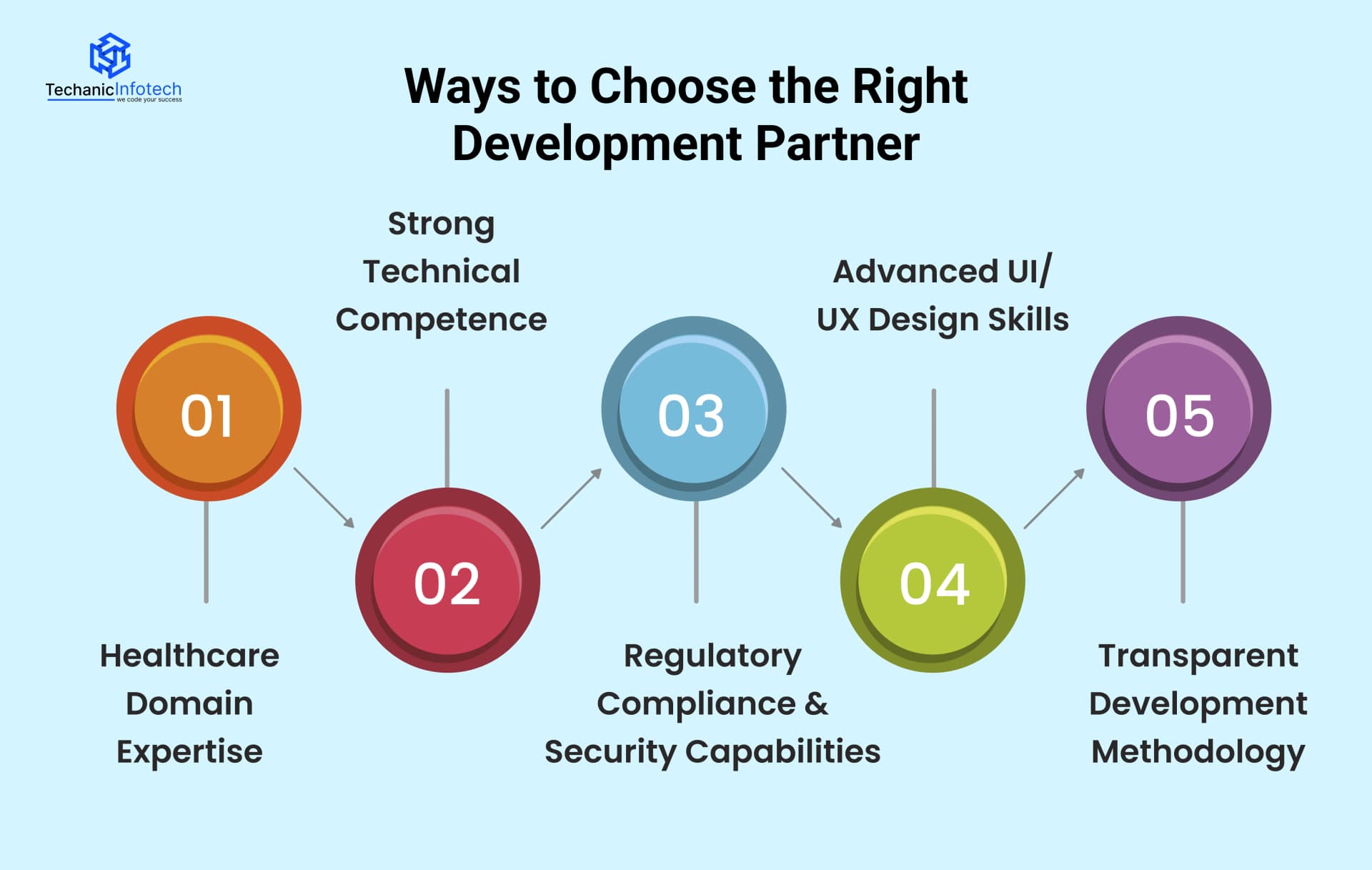
Prioritize a development company with proven experience in healthcare or healthtech solutions.
They should understand medical workflows, teleconsultation systems, EHR integrations, compliance standards (HIPAA/GDPR), and the sensitivity of patient data.
Evaluate their expertise in modern technologies, including frontend frameworks, backend architectures, database systems, and cloud infrastructure.
A reliable partner should recommend scalable microservices architecture, API-first development, secure authentication systems, and performance optimization strategies tailored to healthcare applications.
Ensure the partner implements end-to-end encryption, secure data storage, role-based access control, audit logs, and vulnerability assessments.
Their familiarity with compliance documentation and legal standards is essential to avoid regulatory penalties.
Healthcare applications must be intuitive and accessible for diverse users, including elderly patients and busy medical professionals.
Review their design portfolio to assess usability standards, responsive layouts, accessibility compliance, and their ability to build trust-driven user experiences.
A professional partner provides a clear mobile app development timeline, sprint-based delivery, milestone tracking, documentation, and regular communication to ensure transparency, flexibility, and predictable project outcomes.
Building a Practo-like healthcare app requires strategic planning, regulatory compliance, and a scalable technology foundation.
From appointment booking and telemedicine to AI-powered recommendations and secure health records, every feature must prioritize usability and data protection.
A well-structured development process starting with MVP validation and progressing toward advanced AI and analytics ensures sustainable growth.
Choosing an experienced healthcare app development partner strengthens technical execution and regulatory alignment.
The cost ranges from $10,000 for a basic MVP to $90,000+ for advanced AI-enabled, compliance-ready platforms. Pricing depends on features, integrations, security requirements, and ongoing maintenance needs.
An MVP typically takes 3–5 months, while a fully featured telemedicine platform may require 6–9 months, depending on complexity, compliance requirements, and third-party integrations.
A secure tech stack includes React or Flutter for the frontend, Node.js or Django for the backend, MongoDB or PostgreSQL for the databases, and cloud platforms like AWS for scalability.
Revenue streams include commission on bookings, doctor subscriptions, featured listings, teleconsultation fees, lab partnerships, and in-app healthcare advertisements.
Yes. Compliance with HIPAA, GDPR, and local healthcare laws is essential to protect patient data, ensure legal operations, and build long-term user trust.


Neha Sharma is a tech expert at heart who loves exploring new technologies and turning complex ideas into easy-to-understand content. With a passion for learning and writing, she enjoys sharing insights on emerging tech, digital products, and innovation that help businesses stay ahead.