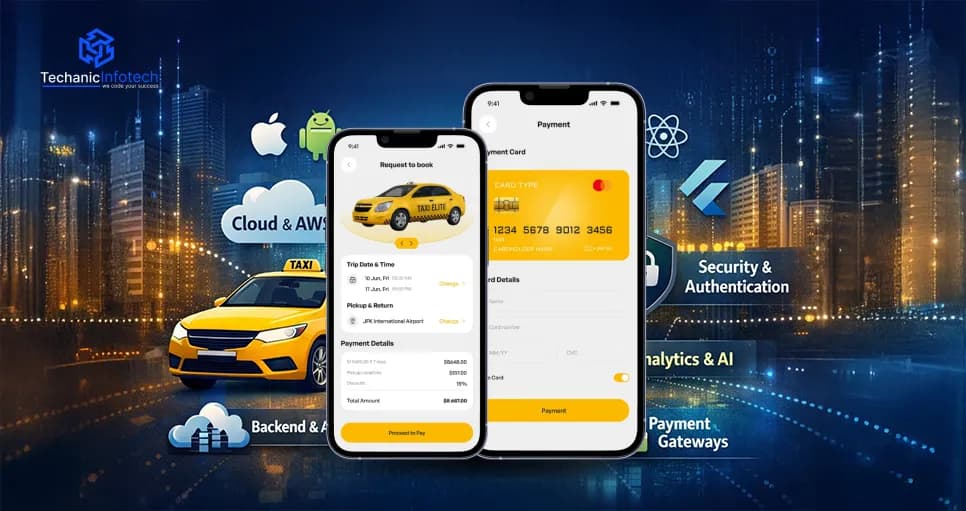
Building a successful ride-hailing platform starts with choosing the right technology foundations.
A well-planned taxi booking app tech stack plays a major role in how smoothly your app performs, how fast it scales, and how securely it handles real-time operations.
From booking rides and tracking drivers to processing payments and managing peak-hour demand, every feature depends on the technologies working behind the scenes. As user expectations grow in 2026, taxi apps' devices.
This is where selecting the right front-end frameworks, backend systems, databases, APIs, and cloud infrastructure becomes critical.
In this guide, we’ll break down the technologies used to build scalable ride apps and explain how the right tech stack supports long-term growth, performance, and user satisfaction.
Ride-hailing and taxi apps continue to reshape urban transport. Backed by a strong taxi app technology stack, investing in 2026 helps businesses capture rising demand and long-term growth in a fast-evolving global market.
The global ride-hailing and taxi market is projected to grow from about $145.8 billion in 2025 to nearly $172.8 billion in 2026, driven by smartphone use and urbanization. This rapid expansion signals strong demand for scalable taxi apps.
More than 70% of urban commuters use online taxi services yearly, thanks to real-time GPS, seamless payments, and mobile convenience. This means a large potential user base for new and improved apps.
Analysts expect the online taxi service market to reach over $160 billion by 2035, with a steady CAGR driven by app innovation and digital mobility preferences. Early investment positions you for long-term gains.
A scalable taxi booking app must deliver speed, convenience, and reliability. The right features ensure smooth user experiences, efficient operations, and the flexibility to handle growing users, drivers, and ride volumes.
User registration is one of the most important taxi booking app development features. A smooth signup process using email, phone numbers, or social logins improves onboarding. Profile management allows users to save preferences, locations, and payment details, boosting personalization and long-term retention.
Real-time tracking is powered by advanced technologies used in taxi booking apps and a reliable taxi booking app tech stack. It lets users track drivers live, view ETAs, and follow routes, improving transparency, reducing cancellations, and enhancing trip accuracy.
A smart booking engine, built on a robust ride-hailing app tech stack, enables instant ride requests and advance scheduling. It efficiently matches riders with nearby drivers, even during peak demand, ensuring reduced wait times and smooth ride allocation.
Seamless payments are a core part of mobile app development for taxi platforms. Supporting cards, wallets, and in-app payments ensures convenience. Secure gateways, automatic fare calculation, and digital receipts help build trust and improve user experience.
This feature manages driver onboarding, document verification, availability status, and performance tracking. A strong driver management system improves service quality, enhances passenger safety, and ensures consistent operations across growing geographic locations.
Push notifications powered by scalable ride-hailing app technologies keep users updated on ride confirmations, driver arrivals, delays, and payments. Real-time alerts improve communication, reduce confusion, and maintain high engagement throughout the ride lifecycle.
An admin panel ties together essential mobile app features such as ride monitoring, driver management, revenue tracking, and analytics. Actionable insights help businesses optimize performance, plan scaling strategies, and make data-driven decisions.
This section serves as a mobile app tech stack guide, helping businesses understand core technologies, choose the right tools, and plan scalable architectures for high-performance taxi booking applications worldwide today.
React Native is a popular choice for building cross-platform taxi apps using a single codebase. It fits well into an on-demand taxi app tech stack by delivering near-native performance, reusable UI components, faster development cycles, and smooth user interactions across both iOS and Android platforms.
Flutter enables visually appealing and high-performance taxi apps using one codebase. It aligns with top taxi booking app trends by supporting rich animations, fast rendering, and consistent UI design. Flutter helps businesses reduce development time while delivering modern, responsive user experiences.
Swift is used for native iOS taxi apps that demand high performance and security. It offers smooth animations, fast load times, and seamless integration with Apple services like Maps, Siri, notifications, and Apple Pay for premium user experiences.
Kotlin is one of the most preferred taxi app frontend technologies for Android development. Its concise syntax improves app stability, reduces errors, and integrates efficiently with GPS, background services, and real-time updates.
These technologies play a key role in taxi booking app development, especially for web apps and admin dashboards. They ensure responsive layouts, smooth animations, and cross-browser compatibility, allowing users and admins to access the platform easily from any device.
Node.js supports real-time features like live ride tracking and instant driver matching. Combined with robust cloud infrastructure for taxi apps, it efficiently handles high traffic, fast API requests, and concurrent users, making it ideal for scalable ride-hailing platforms.
Python plays a key role in AI in taxi app development, supporting dynamic pricing, demand forecasting, and data analytics. Its extensive libraries and scalability make it ideal for intelligent backend logic.
Java is widely used for enterprise-level taxi platforms due to its security, scalability, and multithreading capabilities. It handles complex backend workflows and supports high-volume ride operations reliably.
PHP remains relevant among taxi app backend technologies, especially for admin panels and API development. It offers rapid development, strong database integration, and cost-effective server-side management.
Ruby on Rails is often chosen by startups learning how to create an app like Uber. It enables fast MVP development, built-in security features, clean code structure, and quick deployment, making it ideal for testing and scaling taxi app ideas.
Selecting the right taxi booking app tech stack is a strategic decision that directly impacts performance, scalability, security, and long-term success. A well-chosen stack ensures seamless ride experiences, supports real-time operations, reduces risks, and helps your app scale smoothly with changing market demands.
Before selecting technologies, understand how to design a taxi booking app that matches your business goals. A local taxi service needs a simpler setup, while a multi-city or global platform requires scalable solutions to support growth, user demand, and expanding operations.
A strong taxi booking app architecture ensures your app can handle high traffic, peak-hour bookings, and real-time location updates. Cloud-ready backends, load balancing, and optimized databases help maintain consistent performance as your user base grows.
Your platform choice should align with taxi app monetization models such as commissions, subscriptions, or surge pricing. Native apps offer better performance, while cross-platform frameworks reduce development time and support faster launches without sacrificing core functionality.
Taxi apps manage sensitive user data, live location tracking, and digital payments. Choose technologies that support encrypted data storage, secure APIs, and compliant payment gateways to protect users and meet regulatory requirements across regions.
Technology choices directly impact taxi app development cost and long-term maintenance. Opt for frameworks with strong community support, modular architecture, and easy upgrade paths to reduce expenses and simplify future feature enhancements.
Building a future-ready ride-hailing platform requires the right technology partner with proven expertise.
Build a Scalable Taxi Booking App With Techanic InfoTech focuses on delivering high-performance, secure, and scalable solutions tailored to modern business needs.
As a trusted taxi booking app development company, Techanic InfoTech combines deep technical knowledge with industry best practices to create feature-rich taxi apps that handle real-time bookings, GPS tracking, and seamless payments.
From startups launching their first ride app to enterprises expanding into new markets, the team designs flexible architectures that scale effortlessly with growing demand.
With a strong focus on user experience, security, and long-term reliability, Techanic InfoTech helps businesses turn innovative ideas into successful, revenue-generating taxi booking platforms.
Choosing the right taxi booking app tech stack is the foundation of building a successful and scalable ride-hailing platform.
The technologies you select directly affect app performance, user experience, security, and long-term growth. From frontend frameworks and backend systems to cloud infrastructure and real-time integrations, every component must work together seamlessly.
A well-planned tech stack helps your app handle high traffic, support live tracking, and adapt to evolving user expectations.
As competition increases in 2026, investing in the right technologies ensures faster development, easier maintenance, and future-ready scalability.
By aligning your business goals with the right tech choices, you can build a reliable taxi booking app that stands out, performs consistently and supports sustainable growth in a dynamic digital mobility market.
A taxi booking app tech stack is the combination of frontend, backend, database, APIs, and cloud technologies used to build, run, and scale a ride-hailing application efficiently and securely.
Popular technologies include React Native or Flutter for frontend, Node.js or Python for backend, cloud platforms like AWS, and APIs for maps, payments, and real-time notifications.
Development timelines depend on app complexity, features, and tech stack choice. A basic app may take three to four months, while advanced, scalable solutions require six months or more.
Taxi app development cost varies based on features, platforms, and technologies used. A simple app may start around $20,000, while scalable, enterprise-level apps can exceed $100,000
Yes, with the right taxi booking app tech stack, cloud infrastructure, and scalable architecture, a taxi app can easily handle increased users, drivers, and ride requests without performance issues.


Abhishek Jangid is the CEO of Techanic Infotech, with extensive experience in mobile app and web development. He specializes in helping businesses turn innovative ideas into scalable digital solutions through strategic planning and modern technology.