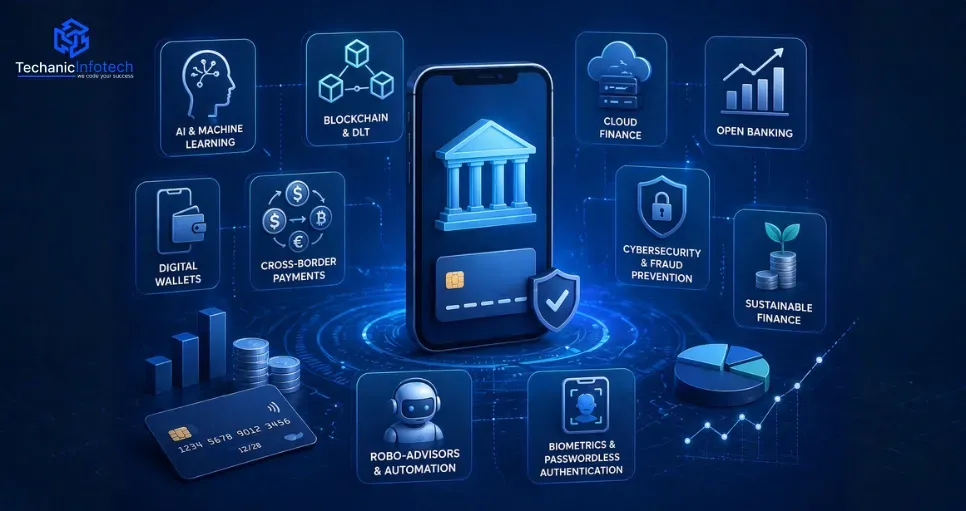
Artificial intelligence and embedded finance are redefining digital banking trends in 2026.
From AI-powered financial assistants to seamless in-app payments, fintech innovation trends are focused on hyper-personalization, automation, and frictionless user experiences.
Blockchain trends in fintech remain strong, powering decentralized finance (DeFi), smart contracts, and secure cross-border payments.
Transparency, immutability, and reduced reliance on intermediaries are shaping the future of fintech industry infrastructure.
Neobanking trends in 2026 highlight the growth of cloud-native platforms, real-time payments, and super app ecosystems. Financial institutions are prioritizing scalable, mobile-first experiences to meet evolving customer expectations.
As fintech transformation strategies accelerate, regulatory compliance and cybersecurity remain critical.
Biometric authentication, AI-driven fraud detection, and RegTech solutions are essential for protecting user data and maintaining trust.
The fintech industry in 2026 is entering a powerful new wave of transformation driven by artificial intelligence, decentralized finance, embedded banking, and hyper-personalized digital experiences.
Financial services are no longer limited to traditional institutions; technology companies, startups, and even non-financial brands are reshaping how consumers interact with money.
From real-time payments to blockchain-powered security, innovation is accelerating at an unprecedented pace.
Regulatory frameworks are evolving alongside rapid digital adoption, creating both challenges and opportunities for businesses.
As competition intensifies, fintech companies must adapt quickly to emerging technologies and shifting market demands to stay relevant in this dynamic and innovation-driven ecosystem.
The global fintech market was valued at USD 394.88 billion in 2025, reflecting the rapid digital transformation of financial services worldwide.
The market is anticipated to grow to USD 460.76 billion in 2026, demonstrating strong year-over-year expansion driven by increasing digital payment adoption and fintech innovation.
By 2034, the fintech market is projected to reach an impressive USD 1,760.18 billion, highlighting substantial long-term growth potential across global economies.
The industry is expected to expand at a robust CAGR of 18.20% throughout the forecast period (2026–2034), indicating sustained momentum and strong investor confidence.
North America led the global fintech landscape in 2025, accounting for a dominant 32.30% market share, supported by advanced financial infrastructure and high technology adoption rates.
Staying updated with eWallet app development trends helps businesses remain competitive, innovative, and aligned with rapidly changing financial technologies and customer expectations in the digital economy.
Following fintech developments enables companies to adapt quickly, improve security, enhance customer experience, and seize new growth opportunities in an evolving financial landscape.
Following emerging trends allows companies to stay ahead of competitors by integrating innovative technologies and improving efficiency for mobile app development services.
Early adoption enhances brand reputation, attracts tech-savvy customers, and ensures long-term sustainability in an increasingly digital financial landscape.
By tracking fintech developments, businesses can align their services with user expectations.
Features like AI-powered chatbots, instant approvals, and real-time payments improve customer satisfaction, loyalty, and retention, which are essential for sustained growth in competitive markets.
Staying updated with fintech trends helps organizations implement advanced security measures such as biometric authentication and blockchain verification.
Proactive compliance reduces legal risks, builds trust with customers, and ensures smooth operations in regulated financial environments.
Emerging fintech technologies like automation and AI streamline internal processes, reduce manual errors, and lower eWallet app development costs.
Efficient systems allow companies to allocate resources strategically and focus on innovation and expansion.
Embedded finance, digital lending, and subscription-based financial tools generate additional revenue channels.
Organizations that monitor trends can identify profitable niches and expand their offerings effectively.
Following fintech advancements enables companies to develop a payment platform like Stripe that serves underbanked and unbanked populations.
Expanding financial inclusion not only supports social impact but also opens untapped markets for growth.
Fintech app development in 2026 is driven by rapid technological advancements, evolving user expectations, and increasing demand for secure, seamless, and personalized digital financial solutions.
Emerging trends are reshaping how financial apps are designed, developed, and delivered, enabling businesses to innovate faster and stay competitive in the dynamic fintech landscape.
Artificial intelligence powers advanced budgeting platforms, predictive financial analytics, and hyper-personalized advisory services.
This significantly elevates user engagement, optimizes financial decision-making, and reduces operational overhead for financial institutions.
Embedded finance seamlessly integrates payments, lending, insurance, and investment services directly into non-financial digital ecosystems.
By embedding financial capabilities within e-commerce and service platforms, businesses create frictionless transaction experiences, enhance customer convenience, and unlock new revenue streams.
Blockchain-powered decentralized finance (DeFi) platforms eliminate traditional intermediaries, enabling secure peer-to-peer financial transactions.
These systems enhance transparency, reduce transaction costs, improve accessibility, and democratize global financial participation through smart contracts and decentralized protocols.
Open banking frameworks facilitate secure and standardized data sharing between financial institutions and third-party providers through APIs.
This interoperability drives innovation, fosters competitive financial ecosystems, and enables highly customized, customer-centric financial solutions.
Advanced biometric authentication in eWallet apps, including fingerprint scanning, facial recognition, and voice authentication, reinforces security infrastructures.
These systems significantly mitigate fraud risks while delivering seamless, frictionless, and highly secure user access experiences.
Instant payment infrastructures enable immediate domestic and cross-border fund transfers.
Real-time processing enhances liquidity management, accelerates transaction cycles, boosts customer satisfaction, and supports the expansion of global digital commerce.
Regulatory Technology (RegTech) leverages automation, AI, and data analytics to streamline compliance management.
It empowers fintech firms to monitor transactions proactively, detect anomalies, mitigate risk exposure, and adapt efficiently to evolving regulatory landscapes.
Blockchain technology ensures immutable record-keeping, cryptographic security, and transparent transaction validation.
It strengthens trust in cross-border payments, smart contracts, digital identity systems, and asset tokenization by safeguarding data integrity.
Buy Now, Pay Later (BNPL) solutions continue to expand across retail and e-commerce sectors.
Flexible installment-based payment models increase consumer purchasing power, enhance checkout conversion rates, and drive merchant revenue growth.
Sustainable fintech platforms integrate ESG analytics, carbon footprint tracking, and ethical investment screening.
These solutions empower environmentally conscious investors, promote responsible financial behavior, and align capital allocation with long-term sustainability goals.
Cloud-native architectures enhance scalability, resilience, data security, and operational agility.
By leveraging cloud computing, fintech firms reduce infrastructure costs to develop an app like PayPal, accelerate deployment cycles, and ensure high system availability.
Financial services are increasingly converging into multifunctional super apps that integrate payments, investments, insurance, messaging, and e-commerce within a unified ecosystem.
This consolidation amplifies user engagement, streamlines digital experiences, and strengthens customer retention.
Adopting new trends requires careful evaluation of business goals, market readiness, technological feasibility, and long-term sustainability to ensure strategic growth and minimize potential risks.
Understanding key factors before implementation helps organizations make informed decisions, allocate resources effectively, and achieve maximum value from emerging innovations.
Ensure that all newly adopted technologies are fully aligned with local, regional, and international financial regulations and industry standards.
This proactive alignment mitigates risks such as legal penalties, reputational harm, operational disruptions, or regulatory investigations.
Adopt and implement emerging technologies within a comprehensive, multi-layered cybersecurity framework.
Incorporate state-of-the-art encryption methods, advanced authentication protocols, continuous system monitoring, real-time threat detection, and strict data privacy policies.
Select technology solutions designed for dynamic, seamless scalability.
Such solutions can handle rapid user growth, surging transaction volumes, and expanding operational demands while preventing system performance bottlenecks.
Scalable systems optimize infrastructure utilization and minimize long-term redevelopment costs, downtime risks, and technical debt.
Conduct a rigorous financial, operational, and strategic evaluation of all prospective technology investments.
Assess implementation costs, ongoing maintenance requirements, resource allocation, and projected revenue generation.
This analysis ensures that every initiative contributes meaningfully to organizational growth, operational efficiency, and overall profitability.
Prioritize technologies and features that enhance usability, simplify workflows, and deliver intuitive, frictionless experiences.
Improving usability drives higher adoption rates, customer satisfaction, loyalty, and retention.
Ensure that all emerging technologies are fully compatible with existing systems, processes, and operational workflows.
This approach maintains a cohesive, interoperable technology ecosystem that supports both current operations and future expansion initiatives.
Not only this, but embedded finance, BNPL services, subscription-based financial tools, and eWallet app monetization strategies are opening new revenue streams.
The fintech industry in 2026 represents a transformative era where technology and finance converge more seamlessly than ever before.
Rapid advancements in AI, blockchain, embedded finance, and cloud computing are reshaping traditional financial models.
Businesses that proactively embrace innovation while maintaining security and regulatory compliance will gain a competitive edge.
At the same time, customer expectations for speed, personalization, and transparency continue to redefine service standards.
By aligning technological investments with long-term objectives, fintech companies can unlock new revenue streams, expand financial inclusion, and build resilient digital ecosystems.
Artificial intelligence and embedded finance are leading trends, enabling personalized financial services and seamless integration of banking features into non-financial platforms.
Yes, blockchain remains essential for secure transactions, smart contracts, and decentralized finance applications across global markets.
Compliance ensures legal operations, builds customer trust, and prevents financial penalties or reputational damage.
Fintech provides digital banking, microloans, and mobile payments to underserved populations, expanding access to essential financial services.
Startups should prioritize security, scalability, user experience, and compliance while adopting innovative technologies like AI and cloud computing.


Abhishek Jangid is the CEO of Techanic Infotech, with extensive experience in mobile app and web development. He specializes in helping businesses turn innovative ideas into scalable digital solutions through strategic planning and modern technology.