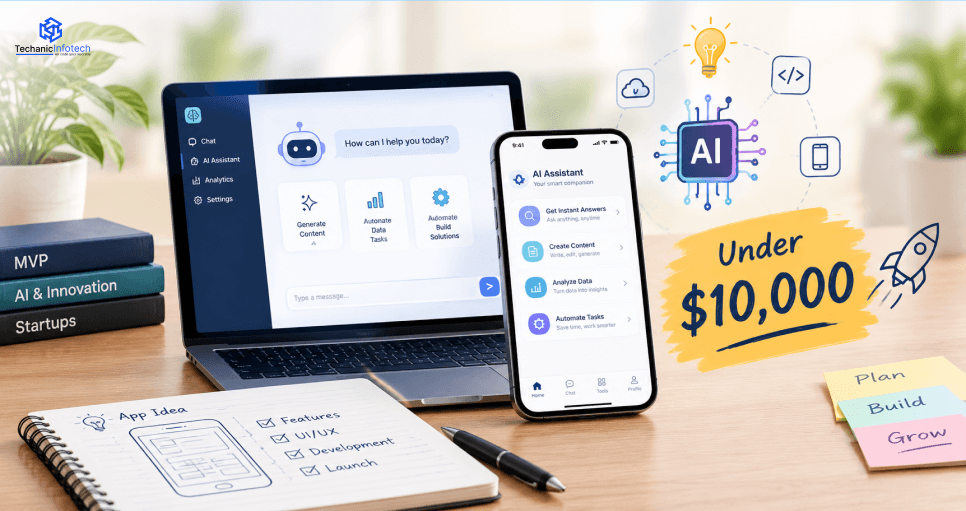
Do you really need a huge budget to build an AI app? Or can you actually get started with under $10,000?
This is one of the most common questions startups ask today. With AI becoming more accessible, the idea of building an app no longer feels out of reach. But the real challenge is understanding what you can realistically build within a limited budget.
The truth is, AI app development under $10,000 is possible, but only if you plan it smartly. You won’t be building a full-scale product, but you can definitely launch a powerful MVP with the right features and tech stack.
In this guide, we’ll break down how to build an AI app under $10,000, what you can build within this budget, and how to make the most of every dollar.
Short answer, yes, but with the right approach.
A lot of startups assume that AI apps require huge budgets, complex infrastructure, and large teams. While that’s true for enterprise-level products, it’s not the case when you’re starting small.
Today, with ready-made APIs, open-source tools, and faster development frameworks, developing an AI app in just $10k is absolutely achievable.
But here’s the reality you need to understand
You won’t be building an AI platform like ChatGPT or a large-scale SaaS product. Instead, you’ll be building a focused MVP (Minimum Viable Product) that solves one specific problem really well.
From our experience, startups can successfully build:
AI chatbot apps for customer support
Simple recommendation engines (e.g., product or content suggestions)
AI-based text or image processing tools
Basic automation apps using AI APIs
AI-powered productivity or utility apps
These fall under low-cost AI app development because they rely on existing AI models instead of building everything from scratch.
To set the right expectations, here’s what usually goes beyond budget:
Custom AI model training from scratch
Large-scale data processing platforms
Highly complex AI systems with multiple integrations
Enterprise-grade AI SaaS platforms
These significantly increase the AI app development cost due to infrastructure, data, and advanced engineering needs.
If your goal is to build an AI app on a budget, focus on:
Solving one clear problem
Using existing AI tools (like APIs)
Launching fast and improving later
From our experience, startups that start small and validate early end up saving more money and building better products.
So yes, you can build an AI app with a low budget, but success depends on how well you plan your features, tech stack, and scope.
Think of $10,000 not as a limitation, but as a starting point to test, learn, and scale smartly.
When planning AI app development under $10,000, the key is to focus on simple, problem-solving apps rather than complex platforms. You’re not building a full-scale AI product, you’re building a smart, focused MVP that delivers value quickly.
From our experience, startups that stay clear about their use case are able to build an AI app on a budget without unnecessary expenses.
Here are the most practical types of AI apps you can build within this budget:
AI chatbots are one of the most cost-effective options. These apps can handle customer queries, automate responses, and improve user engagement.
You can use existing AI APIs to build chatbots for websites, eCommerce platforms, or service businesses. This keeps the AI chatbot app development cost low while delivering high value.
These apps help users generate text, captions, summaries, or basic content using AI.
They are popular among marketers, students, and businesses. Since they rely on pre-built AI models, they fall under low cost AI app development and can be built quickly.
Recommendation engines suggest products, content, or services based on user behavior.
For example, a simple shopping or content app that shows personalized suggestions. These apps are scalable and can be built efficiently within a limited budget.
Apps that process images or text, like OCR (text extraction), basic image recognition, or text classification, are also achievable within $10,000.
They use existing tools and APIs, making them a good option for startups looking for the cheapest way to build an AI app.
These include apps like task assistants, note summarizers, or email reply generators.
They solve everyday problems and are easier to build because they don’t require complex infrastructure. This makes them ideal for AI app development costs for startups.
Automation apps use AI to simplify repetitive tasks like scheduling, sorting data, or managing workflows.
These apps are highly useful for businesses and can be built with minimal resources, making them perfect for startupswith tight budgets.
From our experience, the smartest approach is to build one strong feature instead of multiple weak ones. This helps you stay within budget and still launch a valuable product.
When planning to build an AI app for under $10k, the biggest question is not just what to build, but what features you can realistically afford. The key is to focus on essential features that deliver value without increasing the AI app development cost unnecessarily.
From our experience, startups that prioritize the right mobile app features are able to build an AI app on a budget and still launch a strong product.
These are the must-have features that fit comfortably within a $10K budget:
User Registration & Login: Basic authentication using email, phone, or social login to onboard users securely.
Simple Dashboard/UI: A clean and minimal interface that allows users to easily interact with your app. Avoid complex UI to keep costs low.
AI Feature (Core Functionality): This is the main feature, such as a chatbot, content generator, or recommendation engine, built using existing AI APIs.
Basic Search or Input System: Users should be able to input queries, search content, or interact with the AI easily.
Real-Time Response (Limited): Basic real-time responses using APIs (like chatbot replies or suggestions).
Notifications (Basic): Push or in-app notifications for updates, reminders, or responses.
If you manage your budget smartly, you can include a few additional features:
User Profile Management: Allow users to manage preferences or saved data.
History or Saved Results: Users can view past AI responses or saved content.
Basic Analytics: Track simple user activity and engagement.
Multi-Language Support (Limited): Support for 1–2 additional languages using APIs.
To stay within budget, avoid these features in the initial phase:
Custom AI model development
Advanced personalization using large datasets
Complex dashboards with heavy animations
Multiple third-party integrations
Enterprise-level security systems
These features can quickly increase the AI mobile app development cost beyond $10,000.
From our experience, the best way to control the AI app development cost for startups is:
Build one strong AI feature
Keep everything else simple
Improve after launch
Choosing the right technology stack is one of the biggest factors in controlling your AI app development cost.
If you pick the wrong stack, your budget can easily go beyond $10,000.
But with the right tools, you can build an AI app on a budget without compromising performance.
From our experience, the smartest approach for AI app development under $10K is to use pre-built frameworks, APIs, and scalable tools instead of building everything from scratch.
|
Component |
Technologies |
Why It’s Cost-Effective |
|
Frontend (Mobile App) |
Flutter, React Native |
One codebase for both iOS & Android reduces development cost |
|
Backend Development |
Node.js, Python (FastAPI) |
Fast development, scalable, and widely supported |
|
AI Integration |
OpenAI API, Google AI, Hugging Face APIs |
No need to build AI models from scratch |
|
Database |
Firebase, MongoDB |
Easy to set up and cost-efficient for startups |
|
Cloud & Hosting |
AWS (basic), Google Cloud, Vercel |
Pay-as-you-go pricing helps control cost |
|
Authentication |
Firebase Auth, Auth0 |
Ready-made login systems save time and money |
|
Notifications |
Firebase Cloud Messaging |
Free and easy to integrate |
|
Analytics |
Firebase Analytics |
Helps track users without extra cost |
Cross-platform frameworks reduce development time by up to 40%
AI APIs eliminate the need for expensive model training
Cloud services offer flexible pricing, so you only pay for what you use
Pre-built tools reduce custom development effort
This is exactly how startups achieve low cost AI app development without sacrificing quality.
To stay within budget, avoid:
Building custom AI models
Using multiple complex frameworks
Over-engineering the backend
Heavy infrastructure setup
These can quickly increase the AI mobile app development cost.
If you’re planning how to build an AI app under $10,000, your tech stack should be simple, scalable, and cost-efficient.
From our experience as a trusted AI development company, the right combination of tools can make the difference between a $10K MVP and a $50K project.
Building an AI app on a limited budget may sound challenging, but with the right approach, it’s completely achievable. The key is to stay focused, avoid unnecessary complexity, and make smart technical decisions.
From our experience, startups that follow a structured process can easily manage to create an AI app under $10,000.
Here’s a practical step-by-step process to help you build an AI app on a budget:
Start by identifying one specific problem your app will solve. Avoid trying to build a multi-feature platform in the beginning.
For example, instead of building a full AI platform, focus on something like a chatbot, content generator, or recommendation tool. A clear use case keeps your cost under control and helps you launch faster.
Once your idea is clear, decide what type of AI app you want to build.
Focus on simple and achievable options like chatbots, automation tools, or productivity apps. These are ideal for low cost AI app development because they rely on existing AI solutions instead of complex systems.
List only the essential features required for your app to function.
Your MVP development should include:
User login
Core AI functionality
Simple interface
Basic notifications
Avoid advanced features in the beginning. From our experience, overloading features is the fastest way to increase the AI app development cost for startups.
Choosing the right technology is crucial.
Use cross-platform frameworks like Flutter or React Native to save time and cost. For AI, use APIs like OpenAI or Google AI instead of building models from scratch. This is the cheapest way to build an AI app while maintaining quality.
Keep your design clean and minimal.
Avoid complex animations or heavy graphics. A simple interface not only reduces development time but also improves usability. Good UI/UX design doesn’t have to be expensive, it just needs to be clear and user-friendly.
Instead of building everything at once, divide development into small phases:
Core feature development
AI integration
Basic backend setup
This approach helps you track progress and manage your mobile app development cost more effectively.
Leverage existing tools for features like authentication, notifications, and analytics.
This reduces development effort and helps you stay within budget. Building everything from scratch will significantly increase your cost.
App testing is important, but you don’t need enterprise-level testing for an MVP.
Focus on:
Core functionality
User experience
Basic performance
This ensures your app works smoothly without increasing unnecessary costs.
Once your MVP is ready, launch it as soon as possible.
Early feedback helps you understand what users actually need. This prevents you from spending money on features that don’t add value.
After launch, use real user feedback to improve your app.
Add new features step by step instead of investing everything upfront. From our experience, this is the smartest way to manage AI app development costs for startups while building a scalable product.
When planning to build an app under $10,000, most startups focus only on development. But in reality, several hidden costs can impact your total budget. From our experience, ignoring these can lead to unexpected expenses later.
Here are some commonly overlooked costs:
While AI APIs help reduce initial development cost, they often charge based on usage (per request or token). As your app grows, these costs increase.
AI apps handle data, user inputs, and responses, which require cloud infrastructure.
Even with pay-as-you-go models, hosting can cost anywhere from $50 to $500+ per month depending on usage.
After launch, your app will need regular updates, bug fixes, and performance improvements.
Estimated Cost: 15%–20% of initial development cost annually
This is often ignored when calculating the cost to build an AI app for $10,000.
Tools for analytics, notifications, or authentication may have free tiers initially, but costs increase as your user base grows. These recurring costs can affect your long-term budget.
Publishing your app also involves small but necessary costs:
Apple App Store: $99/year
Google Play Store: $25 (one-time)
These are minor but essential expenses.
Building an app is just the beginning. You’ll need to invest in marketing to attract users.
Estimated Cost: $1,000 – $10,000+
Without marketing, even the best app may struggle to grow.
From our experience, these hidden costs can add 20–30% extra to your total cost. Planning for them early helps avoid budget surprises.
Understanding monetization is important to recover your AI app development cost and turn your idea into a sustainable business. From our experience, the best AI apps use multiple revenue streams instead of relying on just one.
This is one of the most common strategies. Users pay monthly or yearly to access premium features.
For example, advanced AI responses, unlimited usage, or exclusive tools can be part of a paid plan.
Offer a free version with limited features and charge for advanced functionality.
This approach helps attract users while generating revenue from those who need more features. It’s ideal for AI app development under $10,000.
Users pay based on how much they use the AI (e.g., per query or request). This works well for AI tools like content generation or data processing apps.
If your app has a large user base, you can generate revenue through ads. Ads can be shown as banners or sponsored content, creating passive income.
If your AI solution is powerful, you can offer API access to other businesses. This turns your app into a SaaS product and creates a scalable revenue stream.
Some AI apps charge a one-time fee for access. This is simple but less scalable compared to subscription models.
Building an AI app with limited resources is possible, but small mistakes can quickly increase your budget. From our experience, most startups don’t fail because of budget, they fail because of poor planning.
Here are the most common mistakes you should avoid when working on AI app development:
Many startups try to add multiple features from day one. This increases complexity and cost.
Focus on one core feature and build around it. That’s the smartest way to build an AI app on a budget.
Creating your own AI model sounds exciting but is expensive and unnecessary at the early stage. Use existing AI APIs instead. This is the cheapest way to build an AI app without sacrificing performance.
AI tools charge based on usage. If not planned properly, costs can increase quickly as users grow. Always estimate usage early to manage your AI app development cost for startups.
A complex design increases development time and cost. Keep your UI simple and functional. Good usability matters more than fancy design in early stages.
Using heavy or unnecessary technologies can slow development and increase cost. Choose a simple, scalable stack for low cost AI app development.
Jumping into development without clear requirements leads to rework and delays. Plan your features, flow, and budget before starting development.
From our experience, avoiding these mistakes can save up to 30–40% of your total AI mobile app development cost.
Yes, but only if you build it the right way.
A $10K budget is enough to create a solid MVP, but scaling depends on how well you plan your foundation. From our experience, startups that think about scalability early grow faster and spend less later.
Strong Core Feature: Your MVP should solve one problem effectively. This is what attracts early users.
Scalable Tech Stack: Using cloud platforms and modular architecture makes it easier to expand later.
User Feedback Loop: Early users help you understand what to improve before investing more.
Increased API costs as usage grows
Need for better infrastructure and performance
Additional features and integration
These can increase your cost to create an AI app, but they are expected as your app grows.
Building an AI app with a limited budget is no longer impossible. With the right strategy, tools, and planning, AI app development under $10,000 can help startups launch a strong MVP and test their idea in the market. The key is to focus on one core feature, use existing AI APIs, and avoid unnecessary complexity.
From our experience, startups that start small and scale gradually achieve better results while controlling the budget.
Instead of aiming for perfection, aim for validation. Once your idea proves its value, you can invest further and grow your app into a full-scale product.
Yes, you can build an AI app under $10,000 by focusing on an MVP, using existing AI APIs, and limiting features to core functionality instead of complex systems.
You can build chatbots, content generators, automation tools, recommendation systems, and basic productivity apps that rely on pre-built AI models instead of custom development.
The biggest costs usually come from development, AI integration, and backend setup. Poor planning or adding too many features can significantly increase your overall budget.
No, building custom AI models is expensive and requires large datasets and infrastructure. It’s better to use AI APIs to keep development affordable and efficient.
It typically takes around 4 to 10 weeks, depending on the app type, features, and development approach you choose for your MVP.
Cross-platform frameworks like Flutter or React Native, combined with Node.js or Python and AI APIs, are the most cost-effective and scalable options for startups.
You can reduce costs by starting with an MVP, using third-party tools, avoiding complex features, and choosing a cost-effective development team or region.
Yes, costs like API usage, cloud hosting, maintenance, and marketing are often overlooked and can add 20–30% extra to your total budget.
Yes, cross-platform development reduces cost and time by allowing you to build one app for both iOS and Android instead of separate applications.
Yes, if you use a scalable tech stack and focus on a strong core feature, you can expand your app gradually based on user feedback and demand.
Include essential features like user login, core AI functionality, simple UI, and basic notifications. Avoid advanced features until your app is validated in the market.
Yes, with the right monetization strategy and a clear use case, AI apps can become highly profitable as demand for AI solutions continues to grow.


Bharat Sharma is the CTO of Techanic Infotech, bringing deep technical expertise in software architecture, mobile app development, and scalable system design. He leads the engineering team with a strong focus on innovation, performance, and security.