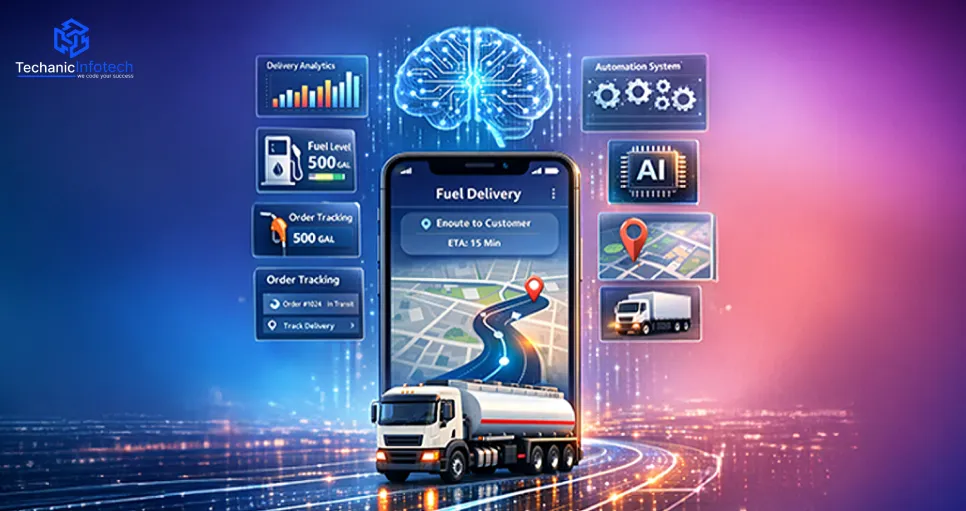
Fuel Delivery App Development
AI in Fuel & Gas Delivery: A Complete Guide for Your Busienss
March 14, 2026
March 14, 2026
Artificial Intelligence (AI) is transforming traditional industries, and the fuel and gas delivery sector is no exception.
Businesses in this industry face constant challenges such as fluctuating demand, complex logistics, rising operational costs, and safety risks.
AI technologies help organizations overcome these challenges by improving efficiency, optimizing delivery routes, predicting demand, and automating key operational processes.
By adopting AI-driven solutions, fuel and gas delivery businesses can streamline operations, reduce costs, improve safety, and gain a strong competitive advantage in a rapidly evolving energy market.
The fuel and gas delivery industry faces operational complexities, safety risks, and fluctuating demand.
Artificial intelligence helps businesses improve efficiency, optimize logistics, and enhance service reliability.
This reduces manual workload and errors, allowing businesses to streamline operations while improving productivity and operational efficiency across fuel and gas delivery networks.
AI-powered route optimization analyzes traffic conditions, delivery locations, and fuel consumption patterns.
This helps businesses select the most efficient routes, reduce transportation time, lower fuel costs, and ensure faster deliveries to customers.
AI analyzes historical sales data, seasonal demand patterns, and market trends to accurately forecast fuel demand.
This enables businesses to plan inventory, prevent shortages, and maintain a consistent supply for customers.
AI-driven systems improve communication and service by providing real-time delivery tracking, automated notifications, and personalized support.
Customers receive faster responses and reliable delivery services, improving overall satisfaction and loyalty.
Fuel and gas transportation involves significant safety risks.
AI systems monitor vehicle performance, driver behavior, and environmental conditions, helping companies identify risks early and ensure safer operations.
Artificial intelligence in fuel and gas logistics refers to the use of advanced technologies such as machine learning, predictive analytics, and automation to improve delivery operations.
AI enables intelligent logistics systems that analyze operational data to optimize delivery schedules, transportation routes, and resource allocation.
This ensures fuel and gas deliveries are completed efficiently while reducing operational delays.
AI analyzes historical consumption data and external factors such as weather and market mobile app development trends to predict future demand.
Businesses can plan fuel distribution more accurately and avoid supply disruptions.
AI systems support automated decision-making by analyzing operational data in real time.
These systems help logistics managers quickly respond to changing conditions, improving efficiency and responsiveness.
AI-powered platforms collect and analyze vehicle performance data, enabling businesses to monitor fuel consumption, mobile app maintenance requirements, and driver performance for better fleet management.
AI technologies integrate with GPS and IoT devices to provide real-time monitoring of fuel deliveries.
Businesses can track vehicles, shipments, and delivery progress for improved operational visibility.
AI offers several benefits for fuel and gas delivery businesses by improving efficiency, reducing AI chatbot development costs, enhancing safety, and enabling data-driven decision-making.
AI automates logistics planning and operational processes, allowing businesses to manage deliveries more efficiently while reducing manual work and improving productivity.
AI-driven optimization reduces fuel consumption, maintenance expenses, and labor costs, helping companies operate more efficiently and increase profitability.
Real-time tracking, automated communication, and AI-powered support systems help businesses deliver faster and more reliable AI app development services to customers.
AI systems monitor vehicle conditions and driver behavior to identify safety risks, helping companies maintain high safety standards in fuel transportation.
AI analyzes operational data to generate insights that help businesses make informed decisions regarding logistics planning and resource allocation.
Several advanced AI technologies support fuel and gas logistics operations, enabling businesses to optimize delivery processes, improve safety management, and enhance decision-making.
Machine learning algorithms help fuel and gas logistics companies accurately predict demand, optimize delivery routes, reduce transportation costs, and improve overall supply chain efficiency and planning.
Internet of Things devices such as sensors and smart meters collect real-time data from vehicles, storage tanks, pipelines, and delivery equipment.
Predictive analytics uses historical records and real-time operational data to forecast fuel demand, anticipate equipment maintenance needs, and identify potential operational risks.
In fuel logistics operations, NLP improves customer support, automates service inquiries, processes delivery requests, and enhances communication between customers, operators, and service teams.
Computer vision technology analyzes images and video feeds from cameras and drones to monitor operational environments.
AI technologies enhance fleet management and fuel distribution by optimizing routes, predicting demand, monitoring vehicles in real time, improving safety, and enabling efficient, cost-effective operations.
This helps reduce travel time, minimize fuel consumption, lower operational costs, and ensure timely fuel deliveries to customers.
Managers can monitor vehicle locations, driver behavior, and delivery progress, enabling faster decision-making, improved coordination, and better control over fuel distribution operations.
This proactive approach reduces unexpected breakdowns, improves vehicle reliability, extends fleet lifespan, and ensures continuous fuel transportation without operational disruptions.
This allows companies to plan distribution schedules efficiently, maintain optimal inventory levels, and avoid shortages or overstocking in fuel supply chains.
By providing alerts and safety insights, AI helps reduce accidents, improve driver performance, and ensure safe transportation of fuel and hazardous materials.
Implementing AI in a fuel and gas delivery under minimum viable product development improves demand prediction, logistics efficiency, equipment reliability, and decision-making.
A structured approach ensures successful adoption and measurable operational benefits.
Identify specific business problems where AI can add value, such as predicting fuel demand, optimizing delivery routes, detecting equipment failures, or improving customer service.
Clear use cases help prioritize investments, align teams, and ensure AI fuel delivery app development solutions directly support operational and business goals.
Build a reliable data system in an artificial intelligence app that collects, stores, and organizes information from sources like delivery records, sensors, vehicle tracking, and customer orders.
Strong data infrastructure ensures accurate inputs for AI models and enables efficient processing, integration, and analysis across business operations.
Create a team combining data scientists, IT specialists, operations managers, logistics experts, and business leaders.
This collaboration ensures AI models address real operational needs, integrate with existing systems, and deliver practical solutions that employees can easily implement and manage.
Use AI and machine learning models to analyze historical sales, seasonal patterns, weather conditions, and regional demand.
Accurate forecasts help companies maintain optimal inventory levels, prevent stock shortages, reduce excess storage costs, and plan fuel deliveries more efficiently.
AI-powered routing systems analyze traffic conditions, delivery schedules, fuel consumption, and customer locations to determine the most efficient routes.
This reduces transportation costs, saves time, lowers fuel consumption, and ensures faster, more reliable deliveries to customers.
AI models analyze equipment and vehicle sensor data to predict potential failures before they occur.
Predictive maintenance helps schedule timely repairs, reduces unexpected breakdowns, extends equipment life, and ensures uninterrupted fuel and gas delivery operations.
In Fuel delivery app development, one should start with a small-scale AI implementation, such as optimizing routes in one region or forecasting demand for a specific product.
A pilot project allows businesses to test models, measure performance, refine strategies, and minimize risks before full deployment.
Maintain accurate, consistent, and clean data while protecting sensitive operational and customer information.
Implement strong cybersecurity measures, access controls, and regular audits to ensure AI systems operate reliably and comply with industry regulations and data protection standards.
In terms of implementing AI in the fuel delivery application, one should consider the mobile app development timeline, which is mostly consumed by facing the challenges that occur in the development process.
While AI offers significant benefits for fuel and gas delivery businesses, companies also face several challenges during adoption.
Addressing these barriers is essential for successful and sustainable AI implementation.
AI systems depend heavily on accurate and well-structured data.
Many fuel and gas companies operate with outdated systems, incomplete records, or fragmented databases, making it difficult to train reliable AI models and integrate them with existing operational platforms.
Implementing AI requires investment in technology infrastructure, software platforms, and skilled personnel.
Businesses may hesitate because the financial returns are not always immediate, and calculating the long-term return on investment can be challenging during early adoption stages.
AI adoption requires data scientists, machine learning engineers, and technical specialists.
Many fuel and gas companies struggle to find professionals with both AI expertise and industry knowledge, which can slow the mobile app development process, deployment, and ongoing management of AI systems.
AI systems connected to logistics networks, sensors, and operational data can become targets for cyberattacks.
Security breaches may disrupt fuel supply chains, compromise sensitive information, or create operational safety risks, making strong cybersecurity practices essential.
Employees and managers may resist adopting AI due to fear of job displacement or lack of understanding about the mobile app tech stack.
Organizational change management, training programs, and clear communication are necessary to build trust and encourage acceptance of AI-driven processes.
Cost considerations to make an artificial intelligence app with implementation that can be divided into three levels. Each level represents increasing investment, capability, and long-term value from AI adoption.
At this stage, companies adopt simple AI tools such as demand forecasting dashboards, basic route optimization software, and cloud-based analytics platforms.
Costs mainly involve software subscriptions, limited data preparation, and basic employee training for using AI-powered decision tools.
This level involves integrating AI with existing logistics, inventory, and delivery systems.
Businesses invest in better data infrastructure, IoT sensors for vehicles and tanks, and hiring data specialists to develop predictive models for demand forecasting and route optimization.
At this stage, companies implement fully advanced AI systems, including predictive maintenance, real-time supply chain optimization, automated decision-making, and advanced analytics.
Mobile app development costs include high-performance computing infrastructure, large data platforms, specialized AI teams, and continuous system improvement.
Artificial Intelligence is rapidly transforming the fuel and gas delivery industry by improving operational efficiency, logistics management, and safety standards.
Through technologies such as machine learning, predictive analytics, and IoT, businesses can better forecast demand, optimize delivery routes, monitor fleet performance, and automate important operational processes.
These capabilities help companies reduce operational costs, improve customer satisfaction, and maintain reliable fuel supply chains.
However, successful AI adoption requires strong data infrastructure, skilled professionals, and careful planning to address challenges such as high implementation costs and cybersecurity risks.
AI in fuel and gas delivery refers to the use of technologies like machine learning, predictive analytics, and automation to improve logistics, demand forecasting, fleet management, and operational decision-making processes.
AI improves efficiency by analyzing traffic data, delivery schedules, and fuel demand patterns to optimize routes, reduce transportation time, minimize fuel consumption, and improve overall delivery planning.
Key benefits include improved operational efficiency, reduced fuel and maintenance costs, better demand forecasting, enhanced safety monitoring, and improved customer service through automated communication and real-time tracking.
AI implementation costs vary depending on the scale of adoption. Businesses can start with basic AI tools at lower costs and gradually invest in advanced systems as operational benefits and returns increase.
Technologies such as machine learning, Internet of Things (IoT) sensors, predictive analytics, natural language processing, and computer vision help analyze data, monitor operations, and improve logistics management in fuel delivery businesses.


Shailendra is a dedicated professional known for his strong client-focused approach and clear understanding of business needs. He brings a thoughtful understanding of client needs and focuses on building long-term relationships through clear communication and quality-driven work. With a blend of strategic thinking, content expertise, and a hands-on approach, Shailendra plays a key role in shaping content that aligns with both business goals and user expectations.