Key Takeaways
AI-powered physiotherapy apps use motion tracking, machine learning, and predictive analytics to deliver personalized, data-driven recovery programs reducing dependency on frequent in-clinic visits.
Technologies like pose estimation and computer vision enable real-time posture correction and exercise monitoring, ensuring safer and more effective home-based rehabilitation.
Machine learning algorithms analyze injury type, performance data, and recovery progress to continuously adapt treatment plans, improving engagement and accelerating healing timelines.
Frameworks such as TensorFlow and PyTorch, along with scalable cloud platforms like Amazon Web Services and Google Cloud, power AI processing, real-time analytics, and secure data management.
AI physiotherapy app development costs range from $10,000 for a basic MVP to $90,000+ for advanced AI-driven platforms, with additional annual maintenance and cloud infrastructure expenses.
AI physiotherapy app development is transforming the rehabilitation industry by combining artificial intelligence with personalized healthcare solutions.
Modern apps leverage technologies like TensorFlow and PyTorch to deliver real-time motion tracking, intelligent feedback, and adaptive recovery plans.
These applications enable patients to perform guided exercises at home while clinicians remotely monitor progress with data-driven insights.
From injury rehabilitation to chronic pain management, these apps reduce dependency on in-clinic visits and improve outcomes through automation and analytics.
As healthcare increasingly adopts smart technologies, AI physiotherapy apps are becoming essential tools for scalable, affordable, and personalized rehabilitation care worldwide.
These Artificial Intelligence enhance clinical accuracy, accelerate rehabilitation, and improve overall patient outcomes.
The following are the points that explain how AI is revolutionizing physiotherapy:
AI-powered systems use computer vision to analyze patient movements in real time, detecting posture errors and incorrect exercise techniques.
This ensures safer rehabilitation sessions, reduces injury risks, and provides immediate corrective feedback without constant physical therapist supervision during home-based therapy programs.
Machine learning algorithms assess patient history, injury type, and recovery progress to generate personalized exercise plans.
These adaptive programs evolve based on performance data, ensuring optimal intensity levels, faster recovery, and a mobile app development timeline, with better adherence to rehabilitation protocols.
AI enables continuous remote tracking of exercise performance, pain levels, and mobility metrics.
Therapists can access dashboards to review progress, adjust treatment plans, and provide guidance virtually, improving accessibility and reducing frequent in-person clinical visits.
Advanced analytics predict recovery timelines and potential setbacks by analyzing historical and real-time patient data.
This helps clinicians intervene early, prevent complications, and design proactive rehabilitation strategies tailored to individual patient needs.
AI-driven reminders, gamification features, and smart notifications motivate patients to complete exercises consistently.
Interactive feedback systems increase adherence, improve accountability, and create an AI app with a more engaging rehabilitation experience compared to traditional physiotherapy methods.
An AI physiotherapy app combines intelligent assessment, personalized exercise plans, real-time motion tracking, and progress analytics to enhance rehabilitation outcomes, patient engagement, and clinical efficiency.
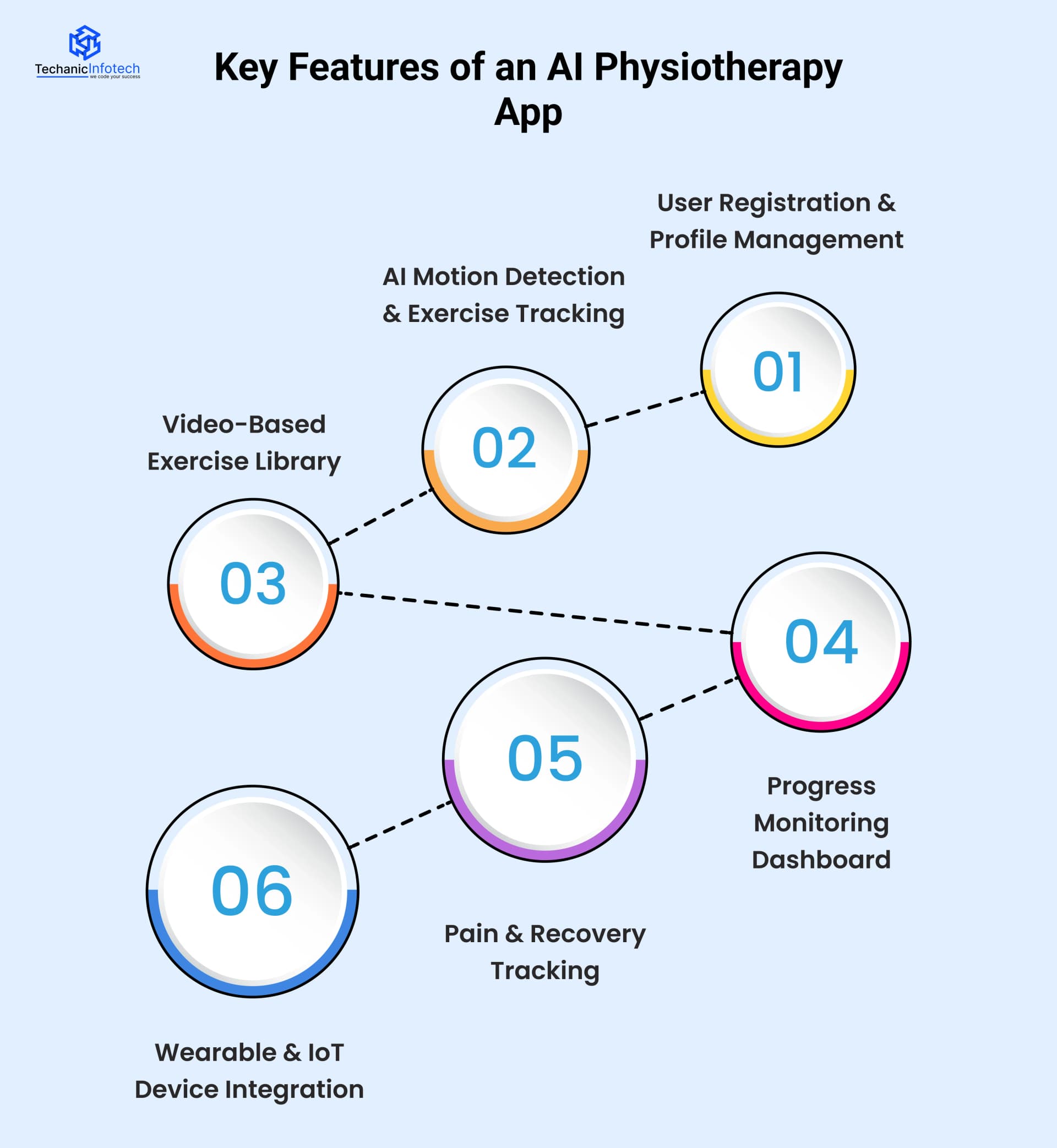
Secure registration allows users to create detailed health profiles, including injury history, medical conditions, and therapy goals.
Role-based access for patients and therapists ensures personalized dashboards, secure data handling, and compliance with healthcare data privacy regulations.
Using pose estimation technologies like MediaPipe and OpenPose, the app tracks body movements through smartphone cameras.
It evaluates posture accuracy, counts repetitions, and provides corrective suggestions in real time.
A comprehensive exercise library includes HD instructional videos categorized by injury type, body part, and difficulty level.
AI recommends relevant videos based on the recovery stage, ensuring patients perform clinically approved exercises safely and effectively.
Interactive dashboards display recovery metrics such as range of motion, exercise consistency, pain scores, and improvement in mobile app development trends.
Visual charts and reports help patients and therapists track milestones, measure effectiveness, and adjust therapy strategies accordingly.
Users can log pain intensity, stiffness levels, and mobility changes daily.
AI analyzes patterns to identify recovery improvements or warning signs, enabling therapists to refine treatment plans and prevent potential setbacks.
Integration with wearables enables the collection of biometric data like heart rate, activity levels, and movement metrics.
IoT connectivity enhances accuracy in monitoring exercises and provides comprehensive health insights beyond camera-based tracking alone.
Advanced AI technologies power modern physiotherapy solutions by enabling intelligent diagnostics, real-time movement analysis, predictive recovery modeling, and personalized treatment planning, transforming traditional rehabilitation into data-driven, highly precise care.
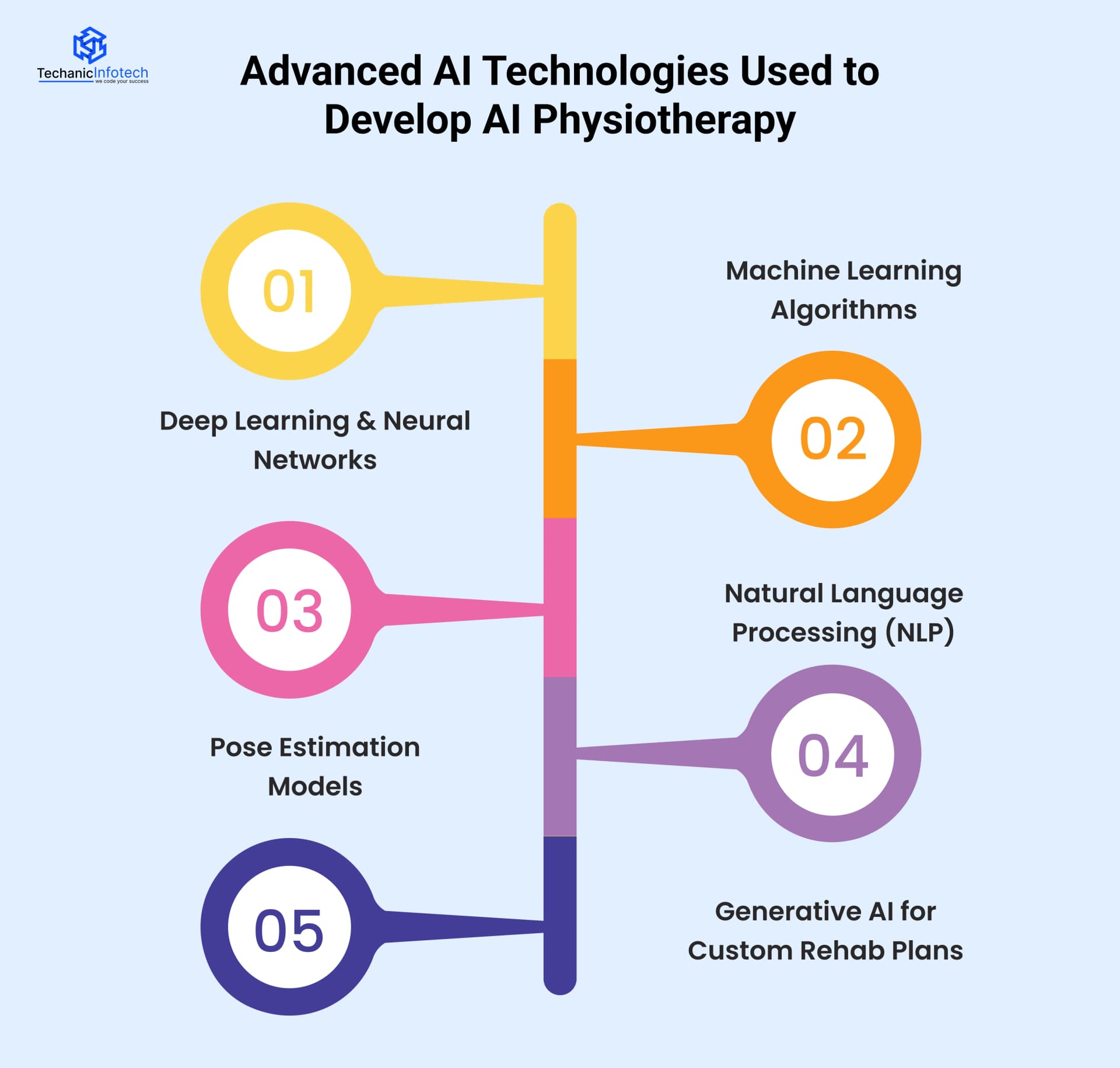
Machine learning models analyze patient data to identify recovery trends, classify movement patterns, and recommend optimized exercise plans.
These algorithms continuously improve accuracy as more data is collected, enhancing predictive capabilities and personalized rehabilitation strategies.
Deep neural networks and the mobile app development process with complex motion data, enabling accurate posture detection and movement classification.
These models handle high-dimensional datasets, improving real-time feedback accuracy and refining exercise recommendations for diverse rehabilitation scenarios.
NLP enables chatbots and virtual assistants to understand patient queries, provide therapy instructions, and generate progress summaries.
It improves communication between users and the application, enhancing accessibility and user experience.
Pose estimation frameworks like MediaPipe and OpenPose detect body joints and skeletal positions through camera input.
These models power real-time motion tracking and posture correction features in physiotherapy applications.
Generative AI systems create dynamic rehabilitation programs tailored to patient conditions and progress.
By analyzing historical outcomes and clinical guidelines, these models design adaptive exercise routines that evolve throughout recovery phases.
Building an AI physiotherapy app requires a robust and scalable mobile app tech stack that supports intelligent analytics, real-time motion tracking, secure data management, and seamless user experience.
The following components form the foundation of effective AI physiotherapy app development:
Cross-platform frameworks like Flutter and React Native enable the development of responsive mobile applications for iOS and Android.
They ensure smooth UI performance, faster mental health app development cycles, and consistent user experiences across devices.
Backend frameworks such as Node.js and Django manage APIs, authentication, and data processing.
They support scalable architectures capable of handling AI computations, secure communications, and high user traffic efficiently.
AI frameworks like TensorFlow and PyTorch facilitate the training, testing, and deployment of motion detection and predictive models.
They provide robust libraries for computer vision, deep learning, and performance optimization.
Cloud platforms such as Amazon Web Services and Google Cloud offer scalable storage, computing resources, and AI services.
They ensure secure data hosting, global accessibility, and seamless integration with machine learning tools.
Databases like MongoDB and PostgreSQL manage structured and unstructured healthcare data.
They ensure secure storage, fast queries, and reliable performance for user records, exercise logs, and analytics reports.
Developing an AI physiotherapy app requires a structured, step-by-step approach to ensure accuracy, compliance, and scalability.
From research and AI model selection to design, AI therapy app development, testing, and deployment, each phase plays a critical role in delivering a reliable and effective rehabilitation solution.
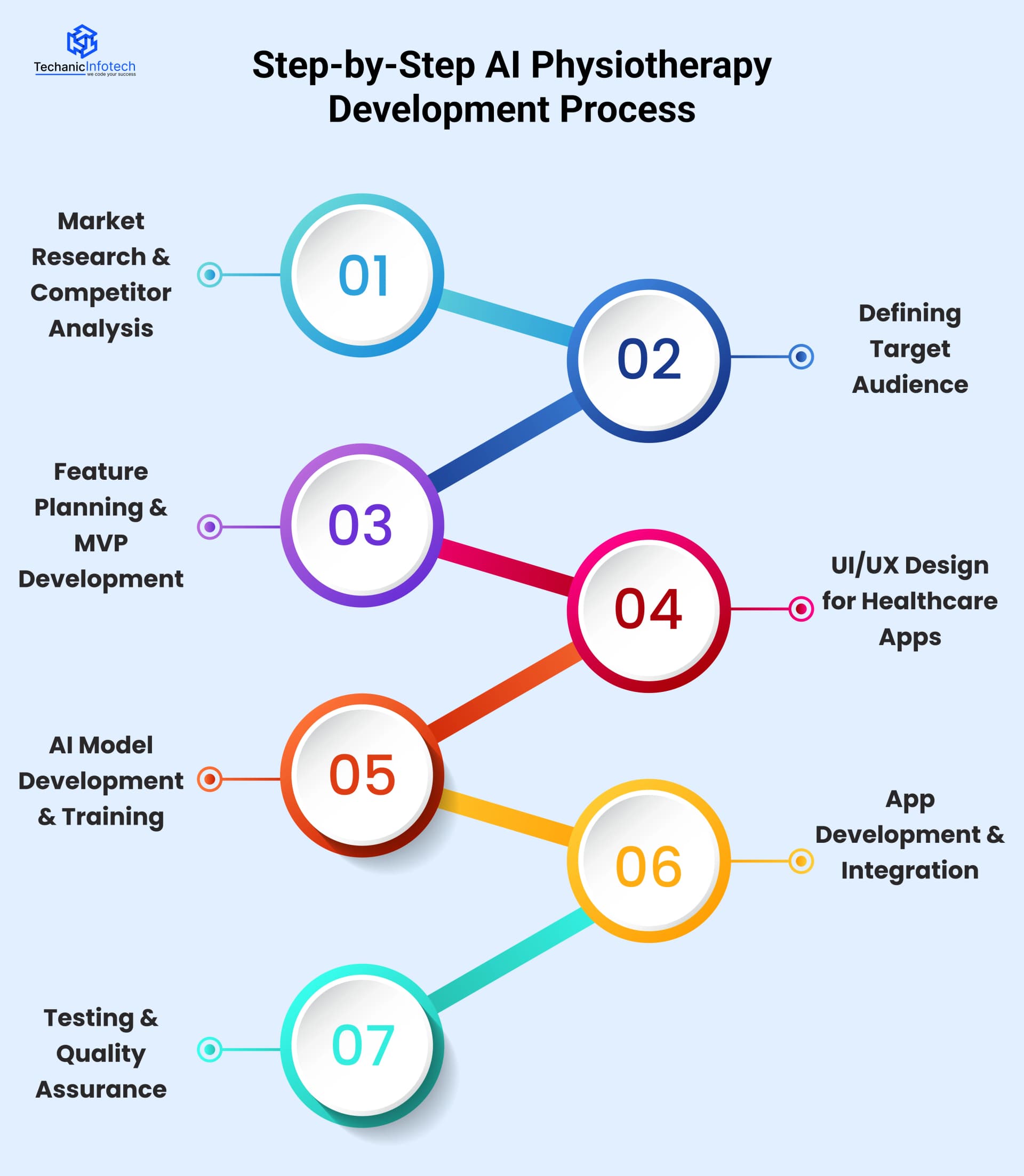
Conduct comprehensive research to analyze target market demand, user pain points, and competitor offerings.
Identify feature gaps, pricing models, and technological trends to define a competitive strategy and unique value proposition.
Segment users based on age, injury types, fitness levels, and rehabilitation needs.
Clear audience definition ensures personalized feature planning, user-friendly interfaces, and effective marketing strategies aligned with patient expectations.
Outline essential features such as motion tracking, dashboards, and consultations.
Develop a Minimum Viable Product (MVP) to test functionality, gather user feedback, and validate the app concept before full-scale minimum viable product development.
Design intuitive interfaces prioritizing accessibility, readability, and ease of navigation.
Healthcare apps require simple layouts, clear instructions, and minimal complexity to support users across different age groups and technical skill levels.
Train AI models using annotated motion datasets to ensure accurate pose detection and performance evaluation.
Continuous testing and fine-tuning enhance reliability and reduce false feedback during real-time therapy sessions.
Integrate frontend, backend, AI modules, and third-party APIs into a cohesive application.
Ensure smooth communication between components to deliver seamless user experiences and real-time performance tracking.
Conduct functional, usability, security, and performance testing to identify bugs and vulnerabilities.
Rigorous QA ensures data protection compliance and smooth app operation across various devices and operating systems.
The mobile app development cost for physiotherapy-like platforms depends on features, AI complexity, integrations, compliance requirements, and platform selection.
From basic MVP solutions to advanced AI-driven systems, budgeting varies based on scalability, customization, and long-term maintenance needs.
|
Level |
Key Features Included |
Estimated Cost |
|
Basic MVP Development |
• User Registration & Login • Structured Video Exercise Library • Progress Tracking • Basic Motion Tracking (Device Cameras/Simple Sensors) |
$10,000 – $25,000 |
|
Mid-Level Feature Set & AI Integration |
• AI-Powered Motion Detection & Correction • Performance Dashboards (Users & Clinicians) • Real-Time Feedback System • Teleconsultation / Video Appointments |
$25,000 – $50,000 |
|
Advanced AI, Customization & Compliance |
• Advanced Algorithm Training • Large Dataset Processing • HIPAA / GDPR Compliance • Multi-Role Dashboards (Patients, Therapists, Admins) • Enterprise-Level Security |
$50,000 – $90,000+ |
|
Cloud & Infrastructure (Annual) |
• Cloud Hosting • Secure Data Storage • Video Storage • Real-Time AI Processing • Data Security & Monitoring |
$5,000 – $15,000 / year |
|
Maintenance & Updates (Annual) |
• Bug Fixes • Security Patches • OS Updates • Performance Optimization • AI Model Improvements • Feature Enhancements • Technical Support |
15–20% of Initial Development Cost per year |
AI physiotherapy app development represents the future of digital rehabilitation by merging intelligent automation with personalized healthcare solutions.
From motion detection and predictive analytics to wearable integrations and teleconsultations, these apps improve accessibility, accuracy, and patient engagement.
While development costs range from $10,000 to $90,000+, the long-term benefits include scalable care delivery, enhanced patient outcomes, and sustainable revenue opportunities.
However, success requires careful planning, regulatory compliance, advanced AI training, and strong technical execution.
Development typically takes 3 to 9 months, depending on features, AI complexity, compliance requirements, and testing phases.
With proper model training and pose estimation technologies, AI tracking can provide highly accurate feedback for guided home exercises.
AI physiotherapy apps can be developed for iOS, Android, and web platforms using cross-platform frameworks.
Wearables are optional but enhance data accuracy by providing additional biometric insights alongside camera-based motion detection.
Yes, compliance with regional healthcare data privacy regulations is essential to protect patient information and avoid legal issues.


Bharat Sharma is the CTO of Techanic Infotech, bringing deep technical expertise in software architecture, mobile app development, and scalable system design. He leads the engineering team with a strong focus on innovation, performance, and security.