Software Development
B2B Procurement Software Development: Types, Features, Cost and Trends
June 16, 2026
June 16, 2026
Key Takeaways
Procurement software reduces approval delays, invoice mistakes, and hidden spending across enterprise purchasing operations.
ERP integrations keep procurement, finance, inventory, and vendor data synced automatically in real time.
AI-powered procurement systems predict supplier risks, automate approvals, and improve purchasing decisions before problems grow.
Custom procurement platforms offer stronger workflow flexibility, security control, and long-term scalability than standard SaaS tools.
Modern procurement automation helps enterprises save costs, improve compliance, and speed up purchase order processing dramatically.
Every spreadsheet-based purchase request, delayed approval, and disconnected ERP entry quietly increases operational costs for enterprises. This is why B2B procurement software development is becoming a major priority for companies looking to control spending, reduce dark purchasing, and automate procurement workflows in 2026.
The shift is happening fast. According to Fortune Business Insights and Mordor Intelligence, the global procurement software market is expected to reach nearly USD 10 billion in 2026 and grow at around 9.7% CAGR over the next few years. Cloud-based procurement systems already dominate the market with more than 67% share, while B2B procurement tools account for nearly 79% of the overall eProcurement industry. This clearly shows that enterprises are investing heavily in scalable digital procurement infrastructure.
In this guide, we will explain how enterprise procurement software works, its core and AI-powered features, procurement workflow automation, ERP integrations, security and compliance requirements, development architecture, implementation costs, and future procurement technology trends shaping modern businesses in 2026.
B2B procurement software is a digital system that helps companies manage how they purchase products, services, raw materials, or business supplies from other businesses. Simple as that. Instead of approvals getting lost in emails or invoices sitting in someone’s inbox for three days because they were “missed somehow,” everything moves through one centralized system.
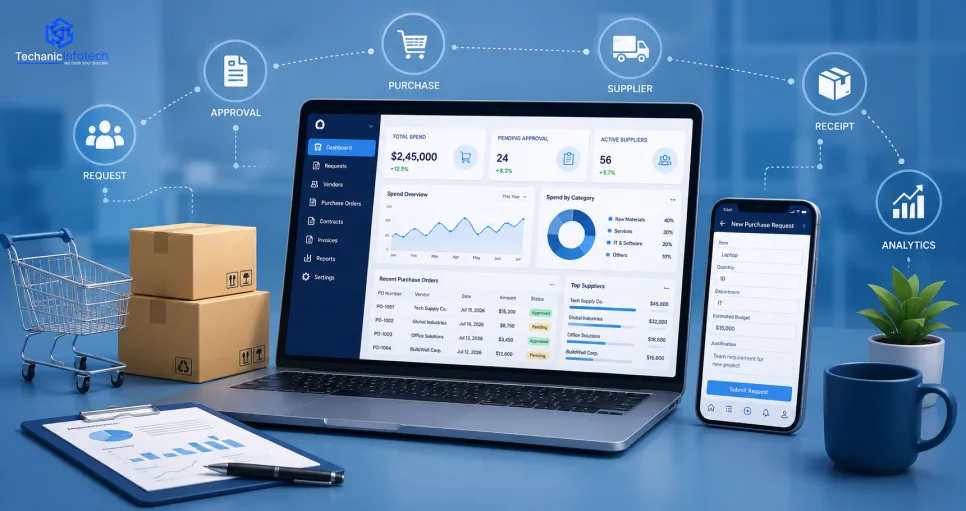
A typical enterprise procurement workflow follows six connected stages. The goal is simple: reduce delays, avoid manual errors, and ensure every purchase complies with company policy without slowing operations.
An employee submits a purchase request inside the procurement platform with product details, quantity, business purpose, and estimated cost before anything can move forward.
The system automatically checks whether the request fits within the department budget and flags unusual or policy-violating purchases early.
Procurement teams can instantly track who requested what, which sounds basic but honestly, that visibility alone solves a surprising number of internal problems.
Instead of forwarding emails manually, the software automatically sends the request to the correct manager based on spend limits, department rules, or purchase category.
Small operational purchases may get approved instantly, while high-value procurement requests move through multi-level approval chains automatically.
This removes approval bottlenecks that usually happen when nobody knows who is supposed to approve the request next.
The system pulls data from approved vendor lists so procurement teams can compare pricing, delivery timelines, vendor performance, and contract terms in one place.
If no vendor exists for a requirement, the platform can generate RFQs (Request for Quotation) to collect supplier bids digitally.
Over time, this creates cleaner vendor management because supplier history, compliance records, and negotiations stay stored inside the system instead of being scattered across inboxes.
Purchase order management software helps enterprises standardize PO creation, approval tracking, and supplier communication.
Once approvals are completed, the procurement software automatically generates the purchase order with vendor details, agreed pricing, taxes, and delivery conditions already filled in.
The PO is shared directly with the supplier without manual document creation or duplicate data entry.
This sounds small, maybe even boring, but automated PO generation cuts down a lot of human mistakes that usually happen during repetitive procurement tasks.
After delivery, the receiving or warehouse team updates the system to confirm that the products or services were actually received.
The platform records delivery quantity, condition, timestamps, and receipt status before payment processing begins.
If delivered items do not match the original order, the procurement team gets alerted immediately instead of discovering the issue weeks later during invoice review.
The procurement system automatically compares the Purchase Order (PO), Goods Receipt (GR), and supplier invoice before approving payment.
If pricing, quantity, or delivery details do not match correctly, the system flags the invoice for manual review instead of processing it automatically.
This process, called three-way invoice matching, helps enterprises prevent duplicate payments, billing errors, and procurement fraud and finance teams save hours of manual verification work because of it.
Enterprise procurement software is usually divided into different categories based on what the business is actually purchasing and how that procurement process works internally.
|
Procurement Software Type |
What It Mainly Handles |
Important Capabilities |
Common Business Use Cases |
|
Direct Procurement Software |
Raw materials and production-critical inventory |
BOM integration, MRP sync, supplier coordination, and inventory tracking |
Manufacturing, automotive, pharma |
|
Indirect Procurement Software |
Office supplies, SaaS tools, MRO assets, operational purchases |
Catalog management, approval workflows, and spend tracking |
Enterprises, retail chains, IT companies |
|
Service Procurement Software |
External services and contract-based workforce |
SOW tracking, milestone management, vendor contracts |
Consulting, logistics, staffing |
|
AI-Powered Procurement Systems |
Intelligent procurement automation and analytics |
Predictive sourcing, anomaly detection, supplier risk analysis |
Large enterprises with complex procurement operations |
Modern procurement software works best when it becomes a connected part of the company’s financial ecosystem. In simple words, every purchase request, invoice, approval, and vendor update should move automatically between systems without manual copying or rechecking. That is what creates a real-time single source of truth across procurement, finance, inventory, and operations.
Many large enterprises use SAP because their entire supply chain already runs on it. Procurement platforms usually integrate with SAP MM (Materials Management) and SAP FI (Financial Accounting) modules.
SAP integration keeps vendor master records synced automatically across procurement and finance systems.
OData APIs, IDocs, and BAPIs help exchange purchase orders, invoices, and inventory updates securely.
Real-time SKU and material code syncing prevents duplicate procurement entries and stock mismatches.
Oracle ERP environments are heavily finance-driven, so procurement integrations mainly focus on budget control and accounting accuracy.
REST APIs and SOAP services connect procurement workflows directly with Oracle financial modules.
Budget validation happens before purchase orders are approved inside the procurement platform.
Approved invoices automatically sync with Oracle General Ledger without manual accounting entries.
Companies already using Microsoft products often prefer Dynamics 365 because procurement, accounting, and operations stay tightly connected.
OData endpoints allow real-time syncing between procurement systems and Dynamics 365 Finance modules.
Vendor invoices and payment records update automatically across procurement and accounting dashboards.
Dual-write mechanisms reduce data duplication between procurement operations and ERP records.
NetSuite is popular among fast-growing businesses because it supports cloud-based financial management without heavy infrastructure requirements.
SuiteTalk REST APIs connect procurement workflows with NetSuite accounting and inventory modules.
Multi-subsidiary procurement transactions can route automatically between departments and business entities.
Automated approval syncing improves visibility across distributed procurement operations.
Mid-sized businesses often use QuickBooks because it keeps accounting simple while supporting basic procurement workflows.
QuickBooks APIs sync purchase orders, invoices, and vendor payment records automatically.
Accounts payable updates happen without manually re-entering procurement transaction data.
Small businesses get procurement visibility without maintaining large enterprise ERP infrastructure.
Here are some of the most common enterprise procurement problems businesses still struggle with and the software fixes that actually solve them.
The Problem: Purchase requests sit inside inboxes for days because approvals depend on manual emails and someone remembering to respond. Production teams usually feel the delay first.
The Solution: Automated approval routing pushes requests directly to the right approver based on department, spend value, and procurement rules. Delayed approvals trigger escalation automatically.
The Problem: Finance teams accidentally process the same invoice twice when invoice records, purchase orders, and delivery confirmations are managed separately. It happens more often than people admit.
The Solution: Three-way invoice matching automatically compares PO records, goods receipts, and invoices before payment approval. Duplicate invoice IDs get flagged instantly.
The Problem: Procurement teams struggle to verify vendor bank details, expired certifications, or suspicious supplier activity when vendor records live across spreadsheets and emails.
The Solution: Centralized vendor management systems track supplier documents, payment changes, and compliance records automatically. Suspicious updates trigger immediate verification alerts.
The Problem: Employees bypass official procurement channels to buy software, tools, or office supplies directly using company cards. Eventually, nobody knows where the money is going.
The Solution: Guided buying portals restrict purchases to approved vendors, catalogs, and spending limits. Unauthorized procurement requests get blocked before payment processing starts.
The Problem: Procurement data inside standalone systems often fails to sync properly with ERP platforms like SAP or Oracle. Finance teams end up reconciling mismatched records manually.
The Solution: Real-time API integrations and event-based syncing keep procurement transactions aligned across ERP, accounting, and inventory systems without duplicate entries.
The Problem: CFOs cannot track real-time spending across departments because procurement data is scattered across tools, vendors, and disconnected reporting systems.
The Solution: Procurement analytics dashboards centralize vendor spend, budget tracking, and purchasing activity into one live reporting environment accessible across teams.
The Problem: Supplier onboarding becomes painfully slow when compliance documents, tax details, and approvals move manually between procurement and finance departments.
The Solution: Digital vendor onboarding workflows automate document collection, approval routing, and verification checks through one centralized procurement portal.
Before procurement development starts, many enterprises first research how to hire a dedicated software development team capable of handling ERP integrations, compliance architecture, and large-scale procurement workflows.
We’ve seen teams spend months designing flashy procurement interfaces while the actual ERP sync logic underneath kept breaking every second day. In enterprise software, the foundation matters more than the screen people click on.
Before writing code, the full Procure-to-Pay (P2P) process needs to be documented carefully. Every approval path, vendor rule, budget limit, and procurement exception must be mapped properly.
Key Inputs: Existing approval flows, ERP structure, procurement cycle reports, and department-level procurement policies.
Engineering Artifact Generated: Workflow maps, procurement gap analysis, approval hierarchy matrix, process timing benchmarks.
This is where the real foundation gets built. Procurement systems handle financial records, invoices, approvals, taxes, currencies, and messy data if the structure is weak.
Most enterprise teams prefer relational databases like PostgreSQL because procurement transactions need ACID-compliant consistency for audit reliability and multi-currency accounting support. This stage also defines APIs, service boundaries, and infrastructure patterns following practical top DevOps principles for scalable deployment stability.
Key Inputs: Data entities, procurement transaction flows, ERP documentation, and infrastructure requirements.
Engineering Artifact Generated: Database schema, API contracts, cloud architecture layout, service communication model.
Supplier management software development usually focuses heavily on vendor onboarding, compliance tracking, and contract visibility. Vendors need their own secure onboarding environment instead of sending compliance documents endlessly over email. Honestly, finance teams waste a shocking amount of time chasing missing vendor paperwork.
The supplier portal usually handles tax forms, certifications, banking information, contract uploads, and approval status tracking with encrypted storage and profile-change validation controls.
Key Inputs: Vendor onboarding process, compliance requirements, and tax documentation standards.
Engineering Artifact Generated: Vendor portal workflows, encrypted supplier database, and approval validation controls.
Many enterprises also require ongoing legacy system maintenance during procurement modernization because older ERP environments often continue running alongside new procurement platforms for years. It constantly exchanges data with ERP systems like SAP, Oracle, Dynamics 365, or NetSuite.
Middleware layers manage bidirectional API communication between procurement workflows and financial systems so invoices, purchase orders, inventory records, and ledger entries remain synchronized in real time. A good mobile app tech stack guide usually talks about APIs casually, but enterprise procurement integrations are far less forgiving.
Key Inputs: ERP API documentation, accounting mappings, and procurement transaction rules.
Engineering Artifact Generated: REST API bindings, webhook pipelines, ERP sync configurations, fallback retry logic.
Approval workflows inside enterprise procurement environments become surprisingly complex once departments, spend thresholds, compliance reviews, and regional policies start overlapping.
A JSON-driven rules engine allows the platform to process dynamic procurement conditions automatically instead of hardcoding every approval path manually into the system.
Key Inputs: Approval matrices, spend thresholds, procurement governance rules.
Engineering Artifact Generated: Dynamic approval engine, escalation logic, and conditional workflow configurations.
Security cannot be treated like a final checklist item added before launch. Procurement systems store supplier contracts, payment records, tax identifiers, and financial approvals, sensitive stuff.
Role-Based Access Control (RBAC), SAML/OIDC Single Sign-On integration, encryption layers, audit logs, and financial field masking are usually implemented during core development itself.
Key Inputs: User hierarchy, compliance requirements, and enterprise identity provider configurations.
Engineering Artifact Generated: RBAC policies, audit trail systems, an encrypted access framework, and SSO integration setup.
Procurement dashboards are operational tools, not decorative charts for board meetings. Teams use them daily to monitor approvals, spending trends, supplier activity, and procurement delays.
Live analytics engines process procurement events continuously so finance leaders can track budget usage, procurement leakage, vendor performance, and purchasing activity without waiting for manual reports.
Key Inputs: Reporting requirements, spend metrics, operational KPIs, and vendor performance indicators.
Engineering Artifact Generated: Live dashboards, analytics pipelines, and procurement reporting engine.
This stage usually decides whether the deployment feels smooth or turns into chaos. Enterprise procurement systems interact with multiple APIs, databases, approval engines, and accounting environments simultaneously.
Teams run User Acceptance Testing (UAT), integration stress testing, ERP fallback validation, and shadow-live deployment scenarios before full rollout. Sometimes companies even run old and new procurement systems together, temporarily awkward, but safer.
Key Inputs: Real procurement datasets, user roles, ERP environments, transaction simulations.
Engineering Artifact Generated: Production-ready procurement platform, rollback plans, and deployment validation reports.
A strange thing happens in growing companies.At the start, procurement feels manageable a few vendors, a few approvals, maybe one finance manager tracking everything in spreadsheets. Then operations expand. Suddenly invoices are everywhere, approvals get delayed, and nobody is fully sure which vendor contract is still active. We’ve seen teams spend entire Fridays just matching invoices manually. It gets messy fast.
That’s why modern procurement platforms are now built in two layers:The operational foundation that keeps purchasing stable every day and the AI layer that quietly predicts problems before finance teams even notice them.
|
Core Feature |
What It Actually Does |
|
Vendor Lifecycle Management |
Stores supplier contracts, tax documents, banking details, and compliance records in one controlled system with expiry alerts. |
|
Approval Workflow Engine |
Automatically routes approvals based on department, purchase value, or spending category without endless email follow-ups. |
|
Purchase Order (PO) Automation |
Converts approved requests into standardized purchase orders with fixed numbering and locked commercial terms. |
|
Three-Way Invoice Matching |
Matches invoices with purchase orders and delivery records before payment gets released to avoid duplicate billing. |
|
Spend Analytics Dashboard |
Gives procurement and finance teams a live view of spending patterns across vendors, departments, and locations. |
|
Audit Trails & Activity Logs |
Records every approval, edit, rejection, and vendor update with timestamps for compliance and internal reviews. |
|
Role-Based Procurement Dashboards |
Shows different views for procurement teams, finance managers, auditors, and executives based on access permissions. |
AI-driven procurement automation software can process low-risk purchasing decisions automatically. Once the system starts collecting clean procurement data this is where things become interesting.
The platform stops behaving like a storage tool and starts acting more like an operational warning system. Quietly watching patterns in the background.
|
Advanced AI Capability |
How It Helps Enterprises |
|
Predictive Purchasing |
Analyzes buying history and supplier lead times to recommend purchases before stock shortages actually happen. |
|
Intelligent Fraud Detection |
Detects suspicious invoice behavior, duplicate billing patterns, and unusual vendor activity before payments are processed. |
|
AI-Based Approval Decisions |
Automatically clears low-risk routine purchases while flagging unusual requests for manual finance review. |
|
Real-Time Vendor Risk Scoring |
Continuously monitors supplier reliability, delayed deliveries, and compliance risks using live operational signals. |
|
AI Spend Forecasting |
Predicts future procurement costs using historical spending, contract renewals, and department-level purchasing trends. |
|
Conversational Procurement Assistant |
Lets employees check PO status or procurement policies using simple natural-language questions instead of complex menus. |
Procurement systems quietly carry some of the company’s most sensitive information, including vendor bank accounts, payment approvals, contract pricing, and tax records.If security breaks here, the damage spreads fast. Really fast sometimes.
SOC 2 Type II Compliance: Continuously monitors infrastructure controls, processing integrity, and access security through independently audited operational compliance frameworks.
ISO/IEC 27001 Standards: Establishes structured information security policies, asset-risk monitoring, and controlled handling of multi-region procurement and supplier data.
GDPR Data Protection Controls: Supports consent tracking, data minimization, and “Right to be Forgotten” workflows for European customer and vendor records.
AES-256 Data Encryption: Encrypts financial records, supplier contracts, and payment details both inside databases and during network transmission.
TLS 1.3 Secure Communication: Protects API traffic, ERP sync requests, and procurement transactions from interception during live data exchange.
Role-Based Access Control (RBAC): Restricts dashboards, invoices, approvals, and supplier records according to employee roles and verified permission levels.
Immutable Audit Trails: Generates timestamped, tamper-resistant logs for every approval, vendor update, payment action, and configuration change.
Single Sign-On (SSO) Authentication: Integrates with corporate identity providers using SAML 2.0 or OIDC to centralize enterprise login security.
Automated Compliance Alerts: Sends warnings before supplier certifications, insurance documents, or regulatory licenses expire inside the procurement workflow.
Secure API Gateway Protection: Filters suspicious API traffic, rate-limits abnormal requests, and blocks unauthorized external system access attempts.
Enterprise procurement software and mobile app development services often include ERP integration, workflow automation, and compliance architecture. Many businesses begin with an MVP in an enterprise approach to validate procurement workflows before scaling into advanced automation and AI-powered procurement operations.
|
Procurement Platform Tier |
Estimated Cost Range (USD) |
Estimated Timeline |
What’s Included |
|
Basic Procurement MVP |
$8,000 – $25,000 |
2 – 3 Months |
Vendor directory, purchase requests, approval workflows, PO management, email alerts, cloud hosting |
|
Standard Enterprise Procurement Platform |
$30,000 – $60,000 |
4 – 6 Months |
ERP integrations, automated invoice matching, RBAC permissions, spend analytics, audit logs |
|
Advanced Multi-Region Procurement System |
$60,000 – $90,000 |
6 – 8 Months |
Multi-entity workflows, supplier portals, custom approval matrices, API orchestration, compliance controls |
|
AI-Powered Enterprise Procurement Ecosystem |
90,000+ |
8 – 10+ Months |
Predictive purchasing, fraud detection, vendor risk scoring, AI approvals, real-time analytics pipelines |
Companies modernizing procurement systems also compare billing software development cost since invoice processing and payment automation are closely connected with procurement operations.
Custom procurement software offers full control, deep ERP integration, and tailored workflows, but it needs a higher upfront cost. SaaS is faster to deploy, cheaper initially, but less flexible and scalable.
For large procurement transformation projects, companies also evaluate dedicated developers vs in house team models to balance long-term scalability, development speed, and infrastructure expertise.
Businesses evaluating enterprise procurement investments often compare implementation budgets with other enterprise solutions, like hotel management software development cost to estimate long-term operational ROI more accurately.
So the real question is not “Which option is cheaper?”It’s this:
|
Comparison Area |
Custom Procurement Software (Build) |
Off-the-Shelf Procurement SaaS (Buy) |
|
Workflow Flexibility |
Built around your exact approval flows, supplier rules, and procurement hierarchy. Nothing feels forced. |
You adapt your process to the software’s predefined workflow structure. |
|
ERP Integration Depth |
Deep SAP, Oracle, Microsoft Dynamics, or NetSuite integrations with custom API mapping. |
Mostly standardized connectors with limited customization flexibility. |
|
Long-Term Cost Structure |
Higher initial development cost, but stable ownership over time. |
Lower setup cost initially, but recurring subscription fees keep increasing. |
|
Vendor Lock-In Risk |
Full ownership of the codebase, infrastructure, and procurement data. |
Migration becomes difficult once years of supplier and transaction data accumulate. |
|
Data Control & Security |
Complete control over encryption policies, audit logs, and hosting environment. |
Sensitive procurement data lives inside a third-party SaaS ecosystem. |
|
Scalability |
Easily customized for multi-country procurement operations and complex approval matrices. |
Scaling often requires expensive enterprise license upgrades. |
|
Deployment Speed |
Usually takes 4–9 months depending on integrations and compliance requirements. |
Can go live within weeks for standard procurement processes. |
|
AI & Automation Control |
Custom AI approvals, predictive purchasing, and vendor risk logic can be tailored internally. |
AI capabilities are limited to what the SaaS vendor already provides. |
|
Compliance Adaptability |
Easier to align with internal audit rules, GDPR, SOC 2, and regional procurement policies. |
Compliance features depend on vendor roadmap and shared infrastructure limitations. |
|
Best Fit For |
Enterprises with complex procurement workflows or legacy ERP ecosystems. |
Businesses needing quick deployment with simpler operational requirements. |
Sometimes I think companies overcomplicate this decision. The answer usually becomes clear once you look at your operations honestly.
Choose a SaaS procurement platform if: Your workflows are fairly standard, your team is small, and you need deployment speed more than deep customization.
Choose custom procurement software if: Your business depends heavily on procurement efficiency, supplier coordination, ERP synchronization, or multi-region financial controls.
A hybrid approach also works surprisingly well: Some enterprises begin with platforms like SAP Ariba or Coupa, then slowly replace rigid modules with custom-built procurement services over time.
And honestly that gradual transition is becoming very common in 2026. Companies want flexibility now. Not just software access.
Procurement systems are changing in a strange way lately.A few years ago the goal was simple: digitize approvals and stop paperwork chaos. Now? Enterprises want procurement platforms that can think ahead a little. Spot risks early. Catch unusual behavior. Even negotiate small decisions automatically.
And honestly, once companies start processing thousands of supplier transactions every month, manual procurement stops scaling properly. You feel the cracks everywhere.
Below are the technology shifts shaping enterprise procurement software in 2026 and beyond.
Procurement platforms are slowly moving from “approval tools” to self-operating systems.
The software watches inventory movement, supplier lead times, seasonal demand spikes, and purchasing history together. If stock levels fall below safe thresholds, the system can automatically raise replenishment requests before teams even notice the shortage. Small repeat purchases especially those are becoming heavily automated now.
Legal contract reviews used to take days. Sometimes weeks if procurement and legal teams kept sending versions back and forth.
Now large language models can scan vendor agreements, pricing clauses, renewal conditions, and compliance terms within minutes. The system highlights risky payment conditions, unusual liability language, or hidden auto-renewal traps that humans often miss during rushed reviews.
Not perfect yet. But surprisingly useful already.
Most supplier problems don’t appear suddenly. There are signals before the damage happens.
Large enterprises operating across the Middle East are increasingly combining procurement automation with enterprise AI services in UAE to improve supplier intelligence, predictive purchasing, and multi-region financial visibility. If a supplier starts showing operational stress, the platform flags the risk early so procurement teams can shift sourcing before operations get affected.
That early warning window matters more than people realize.
Enterprise dashboards can get exhausting. Too many menus. Too many approval screens. Employees forget where things are.
Conversational procurement AI simplifies this through natural-language interactions. Someone can type:
“Check my pending PO approvals.”“Raise a laptop procurement request.”“Which vendor contract expires this month?”
and the system responds instantly inside a chat-style interface without forcing users through complex navigation layers.
Oddly enough, this reduces procurement training time a lot.
This trend is still evolving, but large global enterprises are testing it seriously now.
Blockchain procurement systems create tamper-resistant supplier agreements where payment execution follows predefined rules automatically. Once the platform verifies purchase orders, invoice matches, and delivery confirmations, smart contracts can release payments without manual intervention.
Cross-border procurement teams are watching this space very closely because settlement delays remain a constant headache.
Sometimes procurement systems don’t collapse dramatically. They just slow down quietly until finance teams start chasing invoices on spreadsheets at 11 PM.
This manufacturing group reached that exact point before rebuilding its procurement operations.
Multi-facility manufacturing enterprise operating across India, Germany, and the UAE
Over 11,000 monthly procurement transactions across raw materials and MRO inventory
Legacy approval flow depended on spreadsheets, email routing, and manual SAP data entry
Average purchase order cycle time: 14 days
The duplicate invoice rate reached 0.4% annually
Separate departments followed different procurement rules, which created approval delays and ERP synchronization gaps.Finance teams manually reconciled vendor invoices every weekend just to prevent duplicate supplier payments.
A cloud-native Procure-to-Pay platform was deployed with centralized vendor onboarding, automated three-way invoice matching, and a JSON-driven approval workflow engine.The system also introduced live ERP validation before every PO release.
The backend stack used Node.js, PostgreSQL, and Apache Kafka for resilient event processing under high transaction loads.SAP S/4HANA integration ran through secure OData APIs with SAML 2.0 SSO and AES-256 encryption layers.
Purchase order cycle time dropped from 14 days to under 36 hours within the first 90 days.Duplicate invoice leakage was nearly eliminated, helping the company recover an estimated $340,000 annually in preventable procurement losses.
A growing enterprise cannot keep running on scattered spreadsheets, delayed approvals, and endless email follow-ups forever. At some point, those small operational gaps start turning into real financial leakage duplicate invoices, missed compliance checks, delayed purchasing, and supplier confusion. We’ve seen teams normalize this chaos for years until reporting season exposes everything at once.
A modern cloud-native procurement platform replaces manual dependency with structured workflows, live approvals, and connected financial visibility. But the important part honestly is not just building software. It is understanding how your ERP layers, approval chains, vendors, and internal finance operations actually behave in the real world. That’s where scalable procurement architecture starts making a measurable difference.
B2B procurement software helps companies manage purchasing, approvals, vendors, invoices, and supplier payments through one centralized system instead of scattered spreadsheets, emails, and disconnected ERP entries.
It removes manual approval delays, reduces invoice errors, improves spend visibility, and keeps procurement requests moving automatically between departments without constant follow-ups.
Three-way matching compares the purchase order, goods receipt, and supplier invoice before payment approval to prevent duplicate invoices, billing mistakes, and procurement fraud.
Most enterprise procurement platforms integrate with SAP S/4HANA, Oracle ERP Cloud, Microsoft Dynamics 365, NetSuite, and QuickBooks using APIs and middleware layers.
Custom procurement software development usually starts around $35,000 for MVP systems and can exceed $250,000 for AI-powered enterprise platforms with SAP or Oracle integrations.
Core features usually include vendor management, approval workflows, PO automation, invoice matching, spend analytics, audit trails, and procurement dashboards with RBAC controls.
AI helps predict purchasing needs, detect invoice fraud, automate approvals, monitor supplier risks, and forecast procurement spending before operational problems appear.
Custom software offers better flexibility, deeper ERP integrations, and full data ownership, while SaaS procurement tools are faster to deploy for standard business workflows.
Enterprise procurement systems use AES-256 encryption, RBAC access controls, SSO authentication, audit logs, and compliance standards like GDPR, SOC 2, and ISO 27001.


Abhishek Jangid is the CEO of Techanic Infotech, with extensive experience in mobile app and web development. He specializes in helping businesses turn innovative ideas into scalable digital solutions through strategic planning and modern technology.