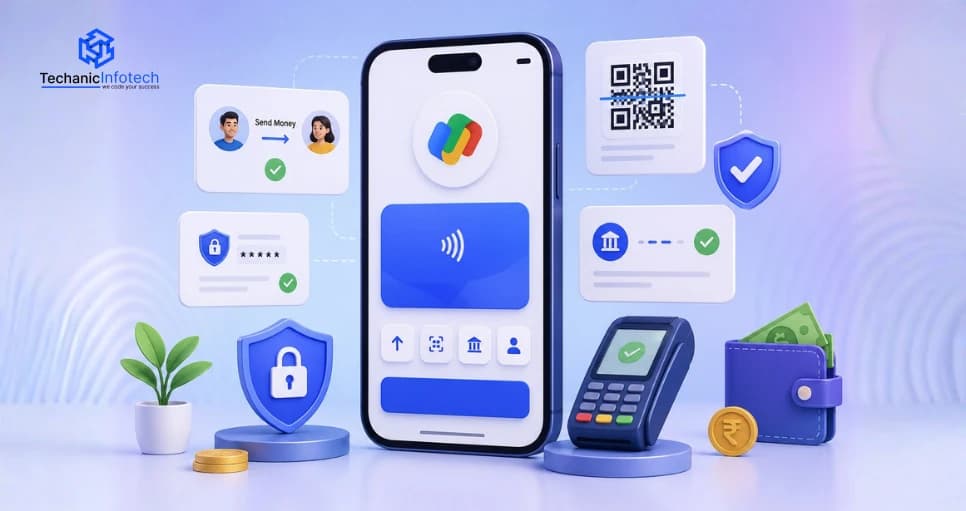
Key Takeaways
The global digital payments industry is growing rapidly, creating strong opportunities for eWallet businesses and fintech startups.
Building an app like Google Pay requires advanced security systems, scalable infrastructure, and seamless payment gateway integrations.
Features such as QR code payments, P2P transfers, biometric authentication, and real-time notifications improve customer engagement and trust.
The cost to create an eWallet app depends on app complexity, security implementation, integrations, UI/UX design, and platform selection.
Cross-platform technologies like Flutter and React Native can help businesses reduce fintech app development costs.
Strong monetization models such as subscriptions, transaction fees, cashback partnerships, and merchant services help generate recurring revenue.
Digital payments are transforming the global financial ecosystem, and mobile wallet applications like Google Pay are becoming an essential part of everyday transactions.
From paying utility bills and transferring money to shopping online and scanning QR codes at stores, users now prefer secure and cashless payment methods because of their speed and convenience.
According to Statista, the global digital payments market is expected to exceed $20 trillion by 2028, driven by rapid smartphone adoption and increasing demand for contactless payments.
As digital transactions continue to rise worldwide, many startups and businesses are planning to create eWallet applications similar to Google Pay.
However, building a successful mobile wallet application requires much more than simple payment functionality.
Businesses must focus on security, scalability, payment gateway integrations, seamless user experience, and compliance with financial regulations to build a reliable payment platform.
In this blog, we’ll explain how to create an app like Google Pay, including key features, development steps, cost factors, monetization strategies, market statistics, and the technologies required to build a secure eWallet application.
Google Pay is one of the most popular digital wallet and online payment platforms that allows users to send money, pay bills, recharge mobile phones, shop online, and make contactless payments directly through smartphones.
The application simplifies digital transactions by enabling users to link bank accounts, debit cards, and credit cards securely.
Google Pay is widely used because of its:
Simple user interface
Fast payment processing
QR code payments
Secure authentication
Real-time transaction tracking
Over the years, Google Pay has evolved into a complete digital payment ecosystem with advanced security systems and seamless integrations.
Businesses planning fintech solutions often work with an experienced eWallet app development company to create scalable and secure mobile payment applications.
The eWallet market is growing rapidly, making mobile wallet applications one of the most profitable fintech business opportunities today.
Let’s understand why businesses are investing in eWallet app development.
Digital payment adoption is increasing rapidly worldwide.
Consumers now prefer fast and cashless transactions for convenience and security.
According to Juniper Research, digital wallet users are expected to exceed 5.2 billion globally by 2026.Source: Juniper Research Digital Wallet Statistics
This growing demand creates excellent opportunities for businesses entering the mobile wallet industry.
Users prefer digital wallets because they simplify everyday payments.
Applications like Google Pay allow users to:
Send money instantly
Pay utility bills
Recharge mobile phones
Shop online
Make QR code payments
Convenience and accessibility significantly improve customer adoption and retention.
Security is one of the biggest reasons users trust mobile wallet applications.
Features such as:
End-to-end encryption
Biometric authentication
Tokenization
Multi-factor authentication
help protect sensitive financial data and improve user confidence.
Businesses focusing on eWallet app security often prioritize advanced fraud prevention and encrypted transaction systems for long-term customer trust.
Additionally, implementing <strong>biometric authentication in ewallet apps</strong> helps improve both security and user convenience in modern fintech applications.
Reward systems, cashback offers, loyalty programs, and referral bonuses help improve customer retention in eWallet applications.
Users are more likely to continue using apps that provide rewards and seamless payment experiences.
Features are one of the most important parts of every successful eWallet application.
The right functionalities improve security, simplify transactions, and enhance customer experience.
Let’s explore the essential features businesses should include.
The app should include a secure and simple onboarding process.
Users should be able to register through:
Phone numbers
Email addresses
Social login
A smooth registration process improves user experience and reduces onboarding friction.
Payment gateway integration is one of the most critical features of an eWallet app.
The application should support:
Debit cards
Credit cards
UPI payments
Bank transfers
QR code transactions
Secure payment integrations improve transaction speed and user trust.
Businesses building scalable fintech products often prioritize secure eWallet API integration to ensure seamless payment processing and real-time transactions.
Users should be able to securely link bank accounts and cards within the app.
This functionality allows seamless money transfers and online transactions.
P2P money transfer functionality enables users to instantly send money to friends and family.
Fast and secure transfers are one of the core features of apps like Google Pay.
Many startups also follow a p2p payment app development guide to improve transaction speed and user experience in fintech applications.
Users prefer apps that simplify daily financial activities.
The app should support:
Electricity bill payments
Water bills
Mobile recharge
DTH recharge
Internet payments
These features increase daily app usage and customer engagement.
QR code payments allow users to make instant transactions at physical stores.
This feature improves convenience for both merchants and customers.
Push notifications keep users informed about:
Successful transactions
Failed payments
Cashback rewards
Security alerts
Promotional offers
Real-time updates improve transparency and customer trust.
Security is extremely important in fintech applications.
The app should include:
Data encryption
Biometric login
OTP verification
Fraud detection
Multi-factor authentication
Strong security systems help businesses protect financial data and prevent fraud.
Modern businesses also focus on scalable and user-friendly ewallet app features to improve engagement and long-term retention.
Developing an eWallet app requires proper planning, market research, and technical execution.
Here’s a step-by-step roadmap to help businesses understand the development process.
Before development begins, businesses should conduct detailed market research.
Analyzing competitors helps identify:
User expectations
Market gaps
Trending fintech features
Customer pain points
Understanding the market landscape helps businesses build competitive payment applications.
Wireframing helps businesses plan application flow and user experience.
Prototypes allow developers to test navigation, design, and usability before development starts.
This stage helps reduce future development errors and improves UI/UX planning.
Selecting the right technology stack is critical for building scalable fintech applications.
The backend infrastructure should support:
Secure transactions
High scalability
Real-time processing
API integrations
Businesses often prioritize scalable architectures while planning fintech solutions.
Choosing the right ewallet app tech stack is extremely important for scalability, security, and long-term app performance.
Many businesses are also adopting wallet as a service for ewallet apps to reduce infrastructure complexity and accelerate development.
This is the core development phase where developers build frontend and backend systems.
The process includes:
UI/UX implementation
Payment gateway integration
Security implementation
API development
Database configuration
Testing is extremely important to ensure smooth performance and eliminate security vulnerabilities.
Businesses planning fintech products often follow a structured eWallet app development timeline to manage development phases efficiently.
Once development and testing are completed, businesses can launch the application.
Marketing strategies may include:
Social media campaigns
Referral programs
Cashback offers
Influencer marketing
App Store Optimization (ASO)
Strong marketing helps improve app visibility and user acquisition.
The cost to create an app like Google Pay depends on multiple factors including features, complexity, security systems, integrations, and platform selection.
On average, eWallet app development cost may range between $15,000 to $150,000+ depending on project requirements and scalability goals.
Here’s a quick cost breakdown:
|
App Type |
Estimated Cost |
|
Basic eWallet App |
$15,000 - $30,000 |
|
Advanced eWallet App |
$30,000 - $60,000 |
|
Enterprise-Level Fintech App |
$60,000 - $150,000+ |
The final cost depends heavily on security implementation, payment gateway integrations, and backend scalability requirements.
The total cost to create an app like Google Pay depends on several important factors including app complexity, security infrastructure, platform selection, integrations, and ongoing maintenance.
Every feature and technical requirement directly impacts the overall development budget.
Let’s understand the major factors affecting eWallet app development cost in detail.
App complexity is one of the biggest factors influencing the overall development cost.
A simple eWallet application with basic functionalities like money transfers, QR payments, and account linking will require a smaller budget.
However, advanced fintech applications with features such as:
AI-based fraud detection
Real-time analytics
Multi-currency support
Smart expense tracking
Loyalty programs
Advanced reporting
require additional development time, backend infrastructure, and security implementation.
The more advanced the app becomes, the higher the development cost will be.
Businesses must decide whether to develop the application for:
Android
iOS
Both platforms
Developing separate native applications for Android and iOS increases the budget because each platform requires separate development efforts.
On the other hand, cross-platform technologies like Flutter and React Native help businesses reduce development costs by using a single codebase for multiple platforms.
Choosing the right platform strategy depends on business goals, target audience, and scalability requirements.
UI/UX design plays a major role in the success of fintech applications.
Users expect digital wallet apps to be:
Clean
Fast
Secure
Easy to navigate
A modern and intuitive interface improves customer trust and retention.
Custom animations, advanced transitions, interactive dashboards, and personalized interfaces increase design complexity and development cost.
Businesses focusing on premium user experience often invest heavily in UI/UX optimization.
Payment gateway integration is one of the most critical parts of eWallet app development.
The app should support multiple payment methods including:
UPI
Debit cards
Credit cards
Bank transfers
QR code payments
Integrating secure and scalable payment systems requires advanced backend development and API integrations.
International payment support and multi-currency functionality may further increase development expenses.
Security is the backbone of every successful fintech application.
Since eWallet apps handle sensitive financial information, businesses must implement advanced security systems such as:
End-to-end encryption
Multi-factor authentication
Tokenization
Fraud detection systems
Biometric verification
Additionally, compliance with regulations like PCI DSS, GDPR, and financial security standards increases development complexity and cost.
However, strong security systems are essential for protecting user data and building long-term customer trust.
The location of your development team significantly affects the total development budget.
Developers in countries like the USA, UK, and Canada generally charge higher hourly rates compared to offshore teams in India, Ukraine, or Southeast Asia.
Here’s a quick comparison of average development costs:
|
Region |
Average Hourly Rate |
|
United States |
$100 – $200/hour |
|
United Kingdom |
$80 – $150/hour |
|
Western Europe |
$70 – $120/hour |
|
India |
$25 – $50/hour |
|
Ukraine |
$30 – $60/hour |
Many businesses choose offshore fintech developers to reduce costs while maintaining development quality.
Development costs do not end after the app launch.
Ongoing maintenance is essential for:
Bug fixing
Security updates
Performance optimization
Server management
Feature enhancements
Compliance updates
On average, annual maintenance costs can range between 15% to 20% of the total development budget.
Regular updates help businesses maintain app stability, improve performance, and enhance user experience over time.
Businesses researching how to build an ewallet app often prioritize long-term maintenance planning for scalability and future growth.
Building a successful eWallet app is not only about providing digital payment functionality businesses also need strong monetization strategies to generate long-term revenue.
Here are some of the most effective monetization models for fintech applications.
Apps can charge small fees for premium transactions, international transfers, and merchant payment services.
Even minimal transaction charges can generate substantial revenue as user volume increases.
Premium subscription plans can offer additional benefits such as:
Higher transfer limits
Faster transactions
Cashback rewards
Advanced financial insights
Priority customer support
Subscription-based revenue models help businesses generate recurring income.
Businesses can partner with brands, merchants, and retailers to provide cashback offers and promotional rewards.
These partnerships improve customer retention while creating additional revenue opportunities.
Fintech apps can generate revenue through carefully optimized in-app advertisements and sponsored promotions.
However, advertisements should not negatively impact user experience.
eWallet applications can offer payment processing and onboarding solutions for merchants and local businesses.
Merchant services create scalable long-term revenue opportunities for fintech platforms.
Businesses researching how ewallet apps make money often combine multiple revenue models to maximize profitability and customer retention.
Implementing advanced eWallet app monetization strategies also helps businesses generate recurring revenue and improve user engagement.
The development cost generally ranges between $15,000 to $150,000+ depending on app complexity, features, security systems, and integrations.
Important features include QR code payments, bill payments, bank account linking, P2P transfers, biometric authentication, and real-time notifications.
An eWallet application may take around 4 to 9 months depending on project complexity and platform requirements.
Security protects sensitive financial data, prevents fraud, and helps businesses maintain customer trust and regulatory compliance.
Technologies like Flutter, React Native, Node.js, Firebase, and secure payment APIs are commonly used for fintech app development.
eWallet apps generate revenue through transaction fees, subscriptions, cashback partnerships, merchant services, and in-app advertising.
QR code payments allow users to make instant contactless transactions by scanning merchant QR codes through smartphones.
Yes, businesses can use cross-platform technologies to build applications for both Android and iOS simultaneously.
Payment gateway integration enables secure, fast, and seamless digital transactions within the application.
Yes, the rapidly growing digital payments industry creates strong opportunities for scalable and profitable fintech businesses worldwide.


Abhishek Jangid is the CEO of Techanic Infotech, with extensive experience in mobile app and web development. He specializes in helping businesses turn innovative ideas into scalable digital solutions through strategic planning and modern technology.