Ecommerce App Development
How to Build an App Like Etsy: Features, Cost & Development Guide?
March 19, 2026
March 19, 2026
What does it really take to build a marketplace like Etsy that people actually trust, use, and keep coming back to?
Online marketplaces have transformed how products are bought and sold, especially for small businesses and independent creators. Platforms like Etsy have shown that you don’t need a physical store to reach a global audience, you just need the right platform.
Today, many businesses are planning to develop an online marketplace app like Etsy to tap into this growing demand. If you are exploring Etsy like app development, having the right strategy, features, and technology is essential.
In this guide, we’ll break everything down in a simple and practical way.
Marketplace apps like Etsy are growing rapidly due to changing consumer behavior, digital adoption, and the rise of independent sellers. Below are some key reasons supported by real data.
Etsy alone connects over 8693 million active buyers worldwide, showing how large the demand is for online marketplaces.
Etsy generated around $2.88 billion in revenue in 2025, proving that marketplace models are highly profitable.
There are over 58 million active sellers on Etsy, many of whom run small or home-based businesses.
Etsy recorded over 459 million visits in a single month (Jan 2026), highlighting massive user engagement.
More users now prefer handmade, unique, and personalized products. In fact, 33% of Etsy transactions include personalized items, showing strong demand for niche marketplaces.
An Etsy-like marketplace may look simple from the outside, but behind the scenes, it involves multiple systems working together to connect buyers and sellers smoothly. If you plan to develop a marketplace like Etsy, understanding this flow is very important.
Here’s a step-by-step explanation of how it works.
The process starts when users sign up on the platform. There are usually two types of users:
Buyers (who purchase products)
Sellers (who list and sell products)
Both create profiles where they manage their activity, orders, and preferences.
Sellers create their online stores by adding product details such as:
Product images
Pricing
Descriptions
Categories
The platform stores this data in the backend and makes it visible to potential buyers. This is a core part of Etsy like website development.
Buyers browse or search for products using filters like category, price, or keywords.The system uses search algorithms to show relevant results based on user behavior and preferences.
Once a buyer selects a product, they place an order and make a payment through integrated payment gateways. The platform securely processes the payment and holds the transaction details.
After the order is placed:
Sellers receive notifications
Buyers get confirmation messages
The system updates order status in real time
This ensures smooth communication between both parties.
Sellers manage shipping, while the platform may integrate tracking systems to keep buyers updated about delivery status.
After delivery, buyers can leave reviews and ratings. This builds trust and helps other users make better decisions.
The admin panel manages the entire system:
User activity
Transactions
Disputes
Platform performance
Behind the scenes, all these steps are powered by strong backend systems, databases, and APIs. This is what makes an online marketplace app like Etsy scalable, efficient, and user-friendly.
Building a marketplace is easy, but making it successful is the real challenge. For Etsy’s marketplace app development to stand out, you need ecommerce app features that create a smooth experience for buyers, sellers, and admins. A balanced platform ensures all three sides work efficiently together.
For users, the app should be simple, fast, and engaging. Key features include the following:
Easy Registration & Login: Quick sign-up using email or social accounts
Advanced Search & Filters: Helps users find products based on category, price, ratings, and preferences
Product Details Page: Clear images, descriptions, pricing, and seller information
Wishlist & Favorites: Users can save items for later
Secure Checkout & Payments: Multiple payment options with safe transactions
Order Tracking: Real-time updates on order status and delivery
Reviews & Ratings: Builds trust and helps users make decisions
A smooth user experience directly improves engagement and repeat purchases in e-commerce app development.
Sellers are the backbone of any marketplace. A strong seller panel ensures they can manage their business easily.
Seller Dashboard: Overview of sales, orders, and performance
Product Management: Add, edit, and manage product listings
Inventory Management: Track stock and availability
Order Management: Handle orders, shipping, and returns
Analytics & Reports: Insights into sales performance and trends
Communication Tools: Chat with buyers directly
From our experience, easy-to-use seller tools increase seller retention and platform growth when you build a marketplace like Etsy.
The admin panel controls the entire marketplace and ensures everything runs smoothly.
User & Seller Management: Manage accounts and permissions
Product Moderation: Approve or remove listings
Payment & Commission Management: Track transactions and platform earnings
Order & Dispute Handling: Manage refunds, returns, and complaints
Analytics Dashboard: Monitor platform performance and growth
Security & Compliance: Ensure safe and secure operations
A successful marketplace is not just about features, it’s about how well these panels work together. When user experience, seller tools, and admin control are balanced, it leads to a scalable and high-performing platform.
Building a marketplace is not just about launching an app on the Play Store, it’s about preparing it to grow smoothly as users, sellers, and transactions increase.
When we work on marketplace app development like Etsy, our focus is always on creating a scalable structure from day one.
We begin by designing a strong system architecture that can handle future growth. Instead of building everything as one large system, we break it into smaller modules, such as
User management
Product listings
Payments
Orders
This modular approach makes it easier to update and scale different parts of the app without affecting the whole system.
Technology plays a big role in scalability. We select tools and frameworks that can handle increasing traffic and data over time.
For example:
Cloud platforms like AWS or Google Cloud
Scalable databases like MongoDB or PostgreSQL
Backend systems that support high performance
This ensures the platform performs well even as the user base grows.
As marketplaces grow, the amount of data increases rapidly. We design databases in a way that allows fast access to product listings, user data, and transactions.
We also optimize:
Search performance
Data indexing
Query speed
This helps maintain a smooth experience even with thousands of products and users.
Users expect fast loading times and smooth navigation. We implement performance optimization techniques such as:
Caching frequently used data
Using content delivery networks (CDNs)
Reducing server load
From our experience, even a small delay can affect user engagement and conversions.
A scalable marketplace should work across multiple platforms, including mobile and web. We design apps that can expand easily to:
iOS and Android apps
Web platforms
Admin dashboards
This ensures consistent experience across all devices.
We always plan ahead for future features like:
AI recommendations
Advanced analytics
Third-party integrations
This avoids major redevelopment later and keeps the Etsy like app development process efficient.
After launch, scalability doesn’t stop. We monitor app performance, user behavior, and system load regularly.
This helps us:
Identify bottlenecks
Improve performance
Add new features smoothly
In our experience, scalability is not a one-time effort, it’s a continuous process. A well-structured foundation ensures that when your platform grows, your app grows with it without performance issues.
Building a successful marketplace requires more than just coding an app, it needs the right strategy, planning, and execution. If you want to develop an online marketplace app like Etsy, you must follow a structured process to ensure scalability, performance, and user satisfaction.
Here’s a detailed step-by-step guide.
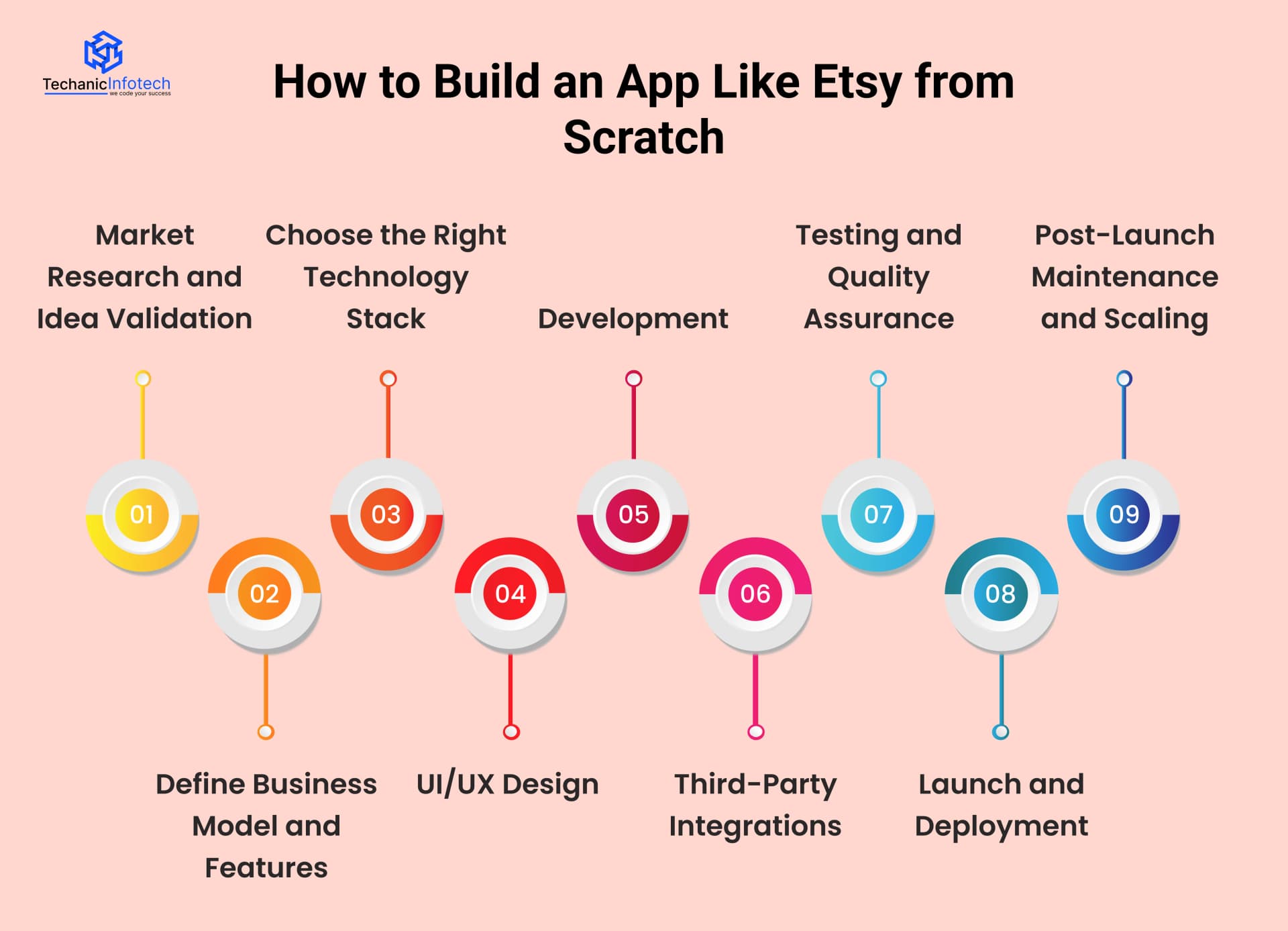
The first step is understanding your market and audience. Before starting development, analyze:
Who are your target users? (buyers and sellers)
What type of marketplace are you building? (handmade, digital products, niche items)
Who are your competitors?
Study platforms like Etsy and identify gaps where you can offer something better. For example, you might focus on a specific niche like eco-friendly products or digital art.
From our experience, niche-focused marketplaces perform better in the early stages than general platforms.
Next, define how your platform will work and generate revenue. Decide:
Commission structure (per sale)
Listing fees
Subscription plans
Premium features
At the same time, finalize core features such as:
User and seller accounts
Product listings
Search and filters
Payment system
Clear planning at this stage helps control the cost of developing an e-commerce app and avoids unnecessary changes later.
The app technology stack plays a crucial role in performance and scalability. You need to choose the right tools for frontend, backend, database, and hosting.
React Native / Flutter
React.js / Angular
Node.js
Django / Ruby on Rails
MongoDB
PostgreSQL / MySQL
AWS (Amazon Web Services)
Google Cloud Platform
Microsoft Azure
Stripe / PayPa
Shipping APIs
Firebase
SSL Encryption
OAuth / JWT Authentication
Design is one of the most important factors in mobile app development. Your app should be:
Simple to navigate
Visually appealing
Easy for both buyers and sellers
Designers create wireframes and prototypes to map out user journeys. A smooth checkout process and clear product pages are essential for conversions. In our experience, better design directly increases user engagement and sales.
This is the core stage where the actual app is built.
Frontend Development: Focuses on user interface and experience
Backend Development: Handles server logic, database, APIs, and transactions
Key features developed include the following:
Product management
User authentication
Payment integration
Order management
Notifications
Strong backend architecture is critical when you build a marketplace like Etsy, as it handles multiple users and transactions simultaneously.
To make your app functional and efficient, integrate essential services such as:
Payment gateways (Stripe, PayPal
Shipping and tracking APIs
Notification services
Analytics tools
These integrations enhance functionality without building everything from scratch.
Before launch, the app must be tested thoroughly. This includes:
Functional testing
Performance testing
Security testing
User experience testing
App testing ensures the app works smoothly and provides a seamless experience. Skipping this step can lead to bugs, poor performance, and user dissatisfaction.
Once testing is complete, the app is ready to launch on platforms like
Apple App Store
Google Play Store
Web platforms
At this stage, you should also focus on marketing strategies like app store optimization and promotions to attract users. A well-planned launch helps you gain early traction.
After launch, continuous improvement is essential. This includes:
Fixing bugs
Adding new features
Improving performance
Monitoring user behavior
From our experience, successful platforms continuously evolve based on user feedback.
To successfully develop a marketplace like Etsy, you need a combination of the right strategy, technology, and user-focused design. Following this step-by-step approach helps reduce risks, control costs, and build a scalable platform.
With proper planning and execution, businesses can create powerful marketplace apps that not only attract users but also sustain long-term growth.
If you plan to develop an online marketplace app like Etsy, understanding both e-commerce app development cost and timeline is important for better planning.
The overall Etsy-like app development cost depends on features, design, and complexity.
On average, a basic marketplace app can cost around $30,000 to $60,000, while a mid-level app may range between $60,000 to $90,000. Advanced platforms with custom features, AI recommendations, and scalability can go beyond $100,000.
In terms of time, it usually takes 3 to 6 months to build a functional app, depending on the scope and team size.
|
App Level |
Features Included |
Avg Cost |
Time Required |
|
Basic App |
User login, product listing, basic search, checkout |
$30,000 – $60,000 |
2 – 3 months |
|
Mid-Level App |
Advanced search, seller dashboard, payments, reviews |
$60,000 – $90,000 |
3 – 5 months |
|
Advanced App |
AI features, analytics, custom UI/UX, scalability |
$100,000+ |
5 – 8 months |
Understanding how Etsy generates revenue is important if you want to develop an online marketplace app like Etsy. The platform follows a simple but highly scalable business model that you can also implement in your own marketplace.
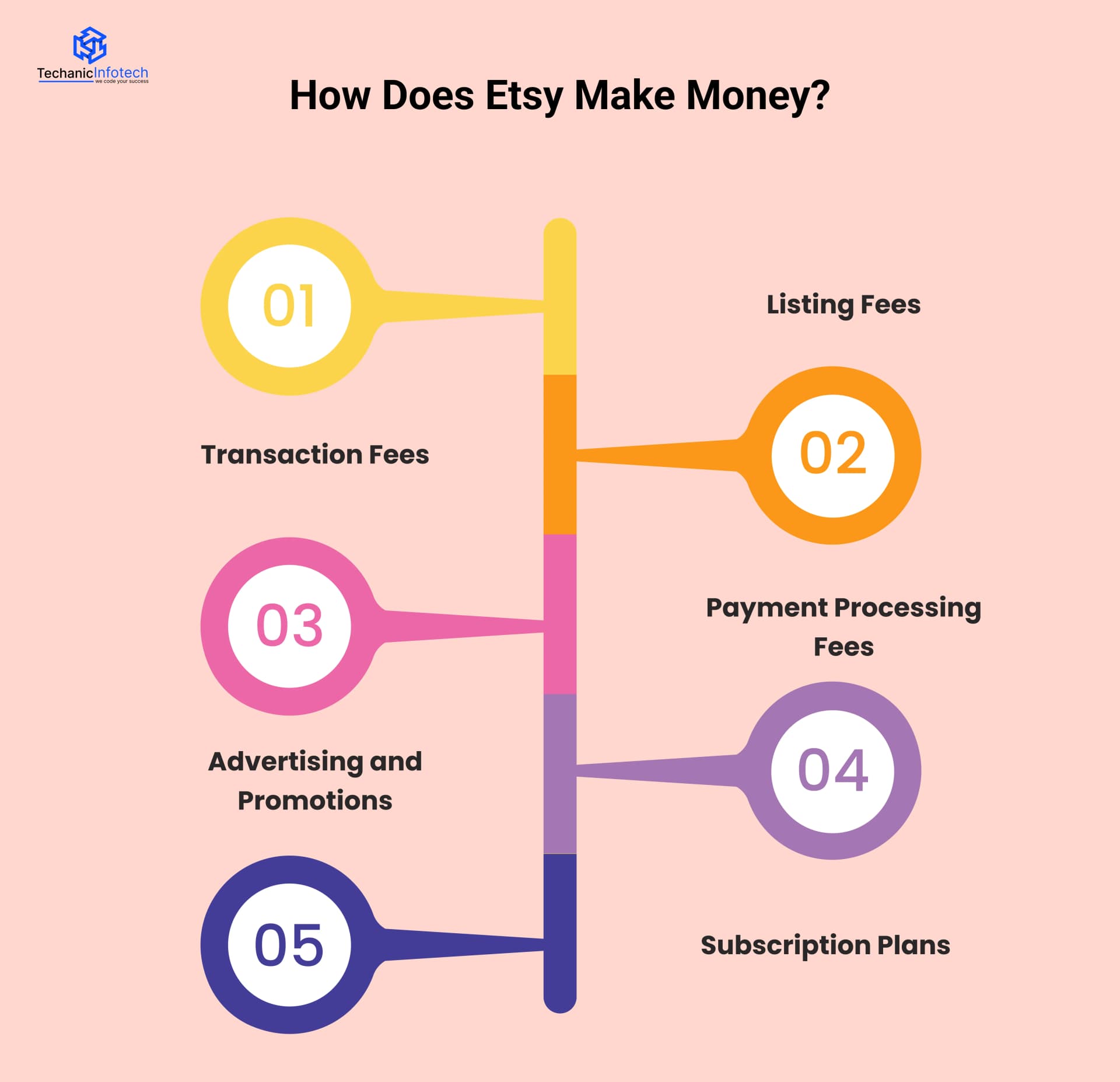
Etsy charges sellers a small fee to list their products on the platform. This ensures that only serious sellers use the platform and also creates a steady income stream. You can apply a similar model when you build a marketplace like Etsy by charging a fixed fee per product listing.
Etsy takes a percentage from every sale made on the platform. This is one of its main revenue sources and grows as the number of transactions increases. In Etsy like app development, adding a commission-based model is one of the most effective ways to generate revenue.
Etsy charges additional fees for handling payments securely. This covers transaction processing and platform maintenance. You can integrate payment gateways and include a small fee for each transaction.
Etsy offers paid advertising options where sellers can promote their products to get more visibility. Featured listings appear higher in search results. This is a great monetization strategy when you develop a marketplace like Etsy, as it benefits both sellers and the platform.
Etsy provides subscription-based services that offer additional tools, customization options, and marketing features to sellers. You can introduce premium plans for sellers to access advanced features and insights.
While working on platforms like Ebarza Marketplace, we gained real, hands-on experience in building and scaling eCommerce and marketplace solutions. Ebarza is a well-known furniture and home décor brand in the UAE, offering a wide range of modern and premium products through its online platform.
From this project, we learned that building a successful marketplace is not just about listing products, it’s about creating a complete ecosystem where users can browse, trust, and purchase easily.
What We Learned
A clean and easy-to-navigate interface plays a major role in conversions. In platforms like Ebarza, users expect smooth browsing, fast loading, and clear product details.
Managing thousands of products, categories, and transactions requires a powerful backend system. We focused on building scalable architecture to handle large data efficiently.
In marketplaces with large inventories, advanced search and filtering systems are essential. This directly impacts how quickly users find what they need.
Most users access marketplace platforms via mobile devices. Optimizing performance and design for mobile significantly improves engagement.
Ebarza operates with a large product catalog and growing user base, which highlights the importance of building scalable systems from the start.
Marketplace apps are evolving quickly as technology and user expectations continue to grow. If you plan to develop an online marketplace app like Etsy, staying updated with future trends is essential to stay competitive.
Below are some key trends shaping the future of marketplace platforms.
Artificial intelligence is transforming how users interact with marketplaces. Apps now use AI to recommend products based on user behavior, preferences, and past purchases. This improves user experience and increases conversion rates.
Users are moving beyond text-based search. Features like voice search and image-based search allow users to find products more easily. This trend is making marketplaces more user-friendly and accessible.
Marketplace apps are integrating with social media platforms, allowing users to discover and purchase products directly through social channels. This helps businesses reach a larger audience and increase sales.
With most users shopping on mobile devices, apps are focusing on mobile-first design and fast-loading experiences. PWAs offer app-like experiences on web browsers, improving accessibility.
Users expect multiple payment options, including digital wallets, buy-now-pay-later (BNPL), and secure checkout systems. This improves trust and makes transactions easier.
Augmented Reality (AR) allows users to visualize products before purchasing, especially in categories like furniture and fashion. This reduces returns and improves buying confidence.
Building a successful marketplace requires more than just an idea, it needs the right strategy, features, and scalable technology.
As the demand for online platforms continues to grow, many businesses are choosing to develop an online marketplace app like Etsy to tap into this opportunity. From understanding core features and development steps to planning cost and future scalability, every stage plays an important role.
With the right approach, businesses can create platforms that not only attract users but also support long-term growth. By focusing on user experience, seller support, and evolving trends, you can build a marketplace that stands out in today’s competitive digital landscape
The cost of developing an online marketplace app like Etsy typically ranges from $30,000 to $120,000+, depending on features, design, and complexity.
It usually takes around 3 to 6 months to build a basic to mid-level app, while advanced platforms may take longer.
Key features include user registration, product listings, search filters, secure payments, seller dashboard, reviews, and admin panel.
Yes, startups can start with an MVP (Minimum Viable Product) and gradually scale by adding more features based on user feedback.
Popular choices include React Native or Flutter for frontend, Node.js or Django for backend, and AWS or Google Cloud for hosting.
It depends on your target audience, but many businesses prefer starting with a web platform and then expanding to mobile apps.


Abhishek Jangid is the CEO of Techanic Infotech, with extensive experience in mobile app and web development. He specializes in helping businesses turn innovative ideas into scalable digital solutions through strategic planning and modern technology.