Fintech App Development
Wealth Management App Development: Features, Costs, and ROI in 2026
June 16, 2026
June 16, 2026
Key Takeaways
Wealth management apps are rapidly evolving into AI-powered financial ecosystems that combine investing, banking, analytics, compliance, and personalized advisory experiences inside a single scalable platform.
Modern wealth management software is no longer just a digital convenience. It has become critical infrastructure for customer retention, operational efficiency, compliance automation, and long-term fintech scalability.
AI, predictive analytics, and behavioral finance models are reshaping how wealth platforms deliver personalized investment guidance, automate financial operations, and improve investor engagement at scale.
Building a scalable wealth management platform now requires far more than frontend development; enterprise architecture, cloud infrastructure, cybersecurity, regulatory compliance, and real-time data systems directly determine product success.
Wealth Management App Development is no longer just a fintech trend. It has become a serious business priority for banks, investment firms, startups, and wealth advisors trying to keep up with changing investor expectations.
Today’s users don’t just want investment dashboards. They expect AI-driven insights, real-time portfolio tracking, personalized financial recommendations, seamless mobile experiences, and banking-level security; all inside a single platform.
That shift is transforming traditional wealth platforms into intelligent financial ecosystems.
At the same time, building a successful wealth management app has become far more complex than most companies expect. Compliance requirements, scalable architecture, AI integration, cybersecurity, and user trust now play a much bigger role than simply launching features quickly.
This guide explores what it really takes to build a secure, scalable, AI-powered wealth management platform in 2026, including features, architecture, tech stack, compliance, development process, and cost considerations.
Global investors increasingly prefer digital-first financial experiences powered by AI, automation, and mobile accessibility. Rising demand for personalized investing, robo advisory systems, and real-time portfolio visibility is pushing banks, startups, and wealth firms to invest heavily in digital wealth infrastructure.
|
Market Segment |
Estimated Value (2026) |
Growth Trend & Drivers |
|
Global Wealth Management Market |
$160.15 Trillion (Total AUM) |
Strong enterprise expansion; traditional wealth rapidly shifting toward digital channels. |
|
Robo Advisory Market |
$18.70 Billion |
Hyper-growth with a 30.8%–31.3% CAGR through 2030; driven by massive retail investor adoption. |
|
AI in FinTech |
$23.05–$36.61 Billion |
Accelerating at a 22.04% CAGR; fueled by predictive finance and generative AI chat solutions. |
|
Mobile Investing Users |
500+ Million Users Globally |
Tech-savvy Gen Z and millennials driving adoption of low-fee mobile investment apps. |
|
Digital Wealth Platforms |
$11.80 Billion |
Growing at a 15.9% CAGR; projected to reach $38.6 Billion by 2034 as legacy banks modernize outdated systems. |
Digital infrastructure metrics and user adoption figures are synthesized using fintech architecture reports from Global Market Insights and AI-driven growth metrics mapped by Fortune Business Insights. Total wealth pools and digital migration dynamics are referenced in alignment with global transactional databases and banking tech tracking from the BCG FinTech Analysis.
Gen Z investors prefer unified platforms combining banking, investing, budgeting, tax planning, and AI-powered financial guidance in one experience.
AI reduces operational workload through automated onboarding, portfolio analysis, fraud detection, customer support, and personalized financial recommendations.
Modern wealth platforms use AI to assist advisors, improve decision-making, and deliver faster, more personalized client experiences at scale.
Regulatory complexity around KYC, AML, audit trails, and reporting is pushing financial firms toward automated digital infrastructure solutions.
High-net-worth investors expect real-time portfolio visibility, family office dashboards, estate planning tools, and seamless multi-device wealth experiences.
Markets like Singapore, Switzerland, UAE, and Hong Kong are rapidly adopting AI-driven digital wealth management ecosystems for premium investors.
A wealth management application is a digital financial platform that helps users manage investments, track portfolios, receive advisory insights, automate financial planning, and optimize wealth growth through AI, analytics, and financial services integrations.
A modern wealth platform is usually a combination of several fintech systems operating together. It is not just an investment tracker.
In most enterprise-grade environments, wealth apps combine: Portfolio management, Financial planning, Banking integrations, AI analytics, Robo advisory, Compliance systems, CRM infrastructure, Payment rails, Tax reporting, Market data infrastructure, and Risk analysis engines.
This is why Wealth Management Software Development often becomes significantly more complex than founders initially expect. Especially once institutional compliance enters the picture.
|
Objective |
Business Impact |
|
Portfolio visibility |
Improves user engagement |
|
AI recommendations |
Increases retention |
|
Goal-based investing |
Encourages recurring deposits |
|
Advisor collaboration |
Strengthens client relationships |
|
Automated compliance |
Reduces operational overhead |
|
Personalized analytics |
Improves portfolio performance insights |
|
Risk management |
Protects users and firms |
Wealth management platforms vary based on target users, advisory models, monetization strategy, and financial products. The most successful platforms align product architecture with investor psychology and long-term retention models.
One of the biggest mistakes fintech founders make is trying to build every feature for every investor type. The strongest products usually dominate one category first.
Robo advisory platforms automate investment recommendations using algorithms, AI models, and risk profiling.
These platforms typically focus on: Automated asset allocation, Portfolio diversification, ETF investing, Rebalancing automation, Goal-based investing, and Tax-loss harvesting.
Retail investors
Younger demographics
Passive investing users
Low-fee investment models
Assets under management (AUM) fees
Subscription plans
Premium analytics
Managed portfolios
These platforms prioritize portfolio tracking, performance analysis, and investment monitoring. Unlike robo advisors, they may not execute trades automatically.
Multi-broker integrations
Asset tracking
Risk exposure analysis
Real-time alerts
Tax reporting
Investment insights
This category overlaps heavily with Investment Portfolio Management App ecosystems.
These platforms focus on holistic financial health. Users can track:
Savings goals
Retirement planning
Insurance coverage
Debt reduction
Budgeting
Cash flow forecasting
Many modern Personal Finance App Development products now integrate investment layers directly into planning workflows.
This model combines:
Human advisors
AI-generated recommendations
Portfolio automation
Real-time communication
Interestingly, hybrid systems often outperform pure robo models in user retention because people still trust human reassurance during volatile markets.
These systems support:
Complex portfolios
Multi-generational wealth
Estate management
Alternative investments
Tax optimization
Private market assets
Cross-border wealth structures
Security and privacy expectations are dramatically higher in this segment.
Digital asset investing has pushed many fintech companies toward hybrid wealth infrastructure.
These apps may include:
Crypto portfolio management
DeFi integrations
NFT tracking
AI-driven volatility analysis
Risk scoring
But compliance complexity rises sharply here. Particularly around AML and jurisdiction-specific regulations.
High-performing wealth apps combine intuitive financial experiences with enterprise-grade security, AI-driven personalization, regulatory automation, and scalable portfolio infrastructure. Features are not just product decisions anymore.
They directly impact: retention, trust, compliance, scalability, monetization, and operational cost And users notice weak product decisions surprisingly fast. Especially in fintech.
The onboarding flow determines whether users trust the platform within the first few minutes. Good onboarding feels invisible. Bad onboarding feels like paperwork. Modern onboarding should include:
Mobile verification
Document upload
Biometric authentication
Dynamic KYC workflows
Risk profiling questionnaires
Bank account linking
Financial goal mapping
KYC systems verify user identities to reduce fraud, comply with financial regulations, and support secure onboarding workflows.
Strong KYC systems combine:
OCR document scanning
Face matching
Liveness detection
Sanctions screening
AML monitoring
Risk scoring
Third-party integrations commonly include:
Plaid
Trulioo
Onfido
Jumio
Alloy
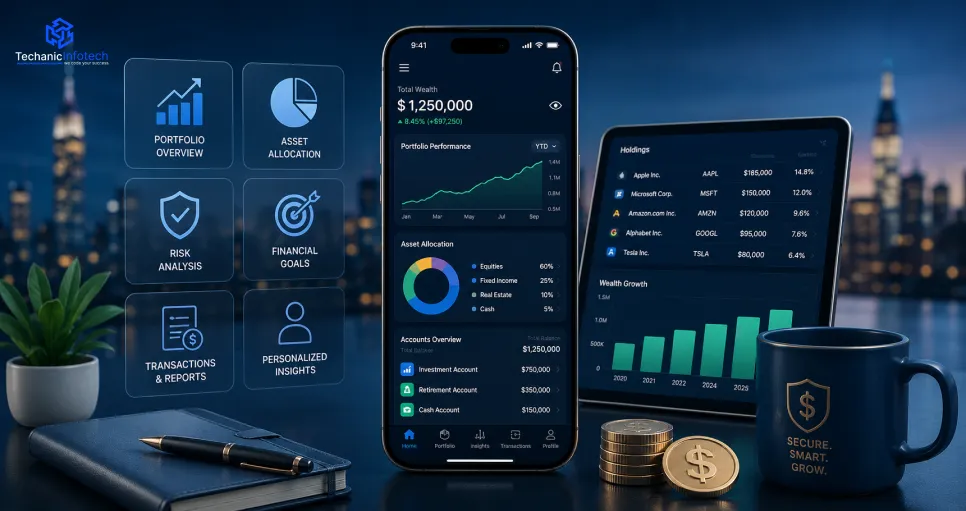
This is the emotional center of the app. Users open wealth apps to answer one question: “How am I doing financially?” A strong dashboard should display:
Asset allocation
Portfolio growth
Historical performance
Risk exposure
Diversification analysis
Market insights
AI-generated summaries
Goal progress
Modern investors respond better to outcomes than raw investment numbers. That means wealth platforms increasingly organize experiences around goals like:
Retirement
Education
Real estate
Travel
Passive income
Family planning
Behavioral finance research consistently shows that emotionally anchored goals improve retention.
This is where modern AI Powered Wealth Management App experiences separate themselves from older fintech products. AI layers may provide:
Portfolio risk predictions
Rebalancing recommendations
Personalized investment suggestions
Spending pattern analysis
Market sentiment interpretation
Tax optimization guidance
But there is an important operational reality here. AI recommendations in finance require explainability. Opaque AI outputs create trust problems. Especially in regulated markets.
Many wealth platforms now integrate budgeting because investing behavior is deeply connected to spending behavior. Integrated cash flow visibility increases:
engagement frequency
recurring investments
financial awareness
Tax visibility is massively underrated in fintech UX. Users hate financial surprises. Strong tax reporting systems should support:
Capital gains summaries
Tax-loss harvesting visibility
Exportable statements
Jurisdiction-specific reports
Multi-currency reporting
Useful notifications improve retention.
Spam destroys it.
Good fintech notifications focus on:
Portfolio milestones
Risk exposure changes
Market volatility alerts
Goal progress
Compliance reminders
Contribution nudges
Advisor-side infrastructure improves client management, compliance operations, relationship visibility, and portfolio servicing efficiency. A surprising number of fintech startups obsess over retail UX while completely neglecting advisor workflows. That becomes painful later.
|
Feature |
Purpose |
Key Capabilities |
|
Advisor CRM |
Centralizes advisor-client relationship management and financial visibility. |
Client profiles, risk scores, portfolio history, communication logs, investment preferences, compliance records |
|
Client Analytics |
Helps advisors identify financial opportunities, risks, and behavioral patterns. |
Churn risk analysis, opportunity gaps, underfunded goals, asset concentration insights, behavioral investment tracking |
|
Compliance Monitoring |
Supports regulatory compliance and audit-ready advisory operations. |
Automated audit logs, communication tracking, trade monitoring, regulatory reporting, suitability analysis |
|
Automated Reporting |
Delivers professional reporting experiences for enterprise and advisory clients. |
Portfolio performance PDFs, AI-generated summaries, white-label branding, real-time analytics exports |
AI-powered fraud systems identify suspicious behavior patterns, transaction anomalies, and account risks before major financial damage occurs. Modern fraud systems use:
Device fingerprinting
Behavioral analysis
Geolocation monitoring
AI anomaly detection
Risk scoring engines
Admin systems should support:
Role-based access
Account restrictions
Verification workflows
Permissions management
Audit visibility
Fintech leaders obsess over operational metrics.
Useful analytics include:
AUM growth
Retention cohorts
Session duration
Portfolio activity
Conversion funnels
Advisor productivity
Audit infrastructure is essential for:
SEC reviews
FINRA audits
Internal investigations
Security tracing
Compliance reporting
And yet many early-stage fintech products still treat audit systems as an afterthought. That usually becomes expensive later.
AI is reshaping digital wealth management through predictive analytics, behavioral finance modeling, conversational assistants, intelligent automation, and personalized investment guidance.
AI in fintech is no longer just chatbot automation.
The most advanced platforms are building financial intelligence layers across the entire customer journey.
AI models can identify:
Risk concentration
Market sensitivity
Portfolio drift
Liquidity concerns
Rebalancing opportunities
Natural language financial interfaces are growing rapidly.
Users increasingly want to ask:
“How exposed am I to tech stocks?”
“Can I retire by 55?”
“Why did my portfolio drop today?”
And receive understandable responses. This changes UX entirely.
One overlooked opportunity in Fintech Wealth Management Solutions is behavioral analysis.
AI systems can detect:
Panic selling behavior
Overtrading
Risk inconsistency
Emotional investing patterns
That insight can improve long-term investor outcomes.
Modern wealth apps increasingly customize:
dashboards
recommendations
investment products
content
communication frequency
based on user behavior.
Some platforms now generate dynamic wealth health scores using:
savings consistency
debt ratios
asset growth
investment diversification
risk stability
This topic deserves far more attention.
Generative AI can produce financially dangerous misinformation if not constrained properly.
Strong fintech AI systems require:
Retrieval-augmented generation
Human validation layers
Compliance review pipelines
Confidence scoring
Guardrail enforcement
Source traceability
Finance cannot tolerate “creative” AI outputs.
Building a wealth management application requires much more than coding screens and connecting APIs. The process involves compliance planning, infrastructure design, security engineering, financial workflow mapping, and continuous operational optimization.
A realistic mobile app development timeline for fintech products depends on compliance approvals, API integrations, AI implementation, and infrastructure complexity.
Here’s how mature fintech teams usually approach it.
The discovery phase builds the strategic foundation of the platform. At this stage, businesses define their target audience, business model, monetization strategy, regulatory exposure, product positioning, and geographic expansion plans.
Teams must answer several important questions early:
Will the platform directly manage user assets?
Will advisory functionality be included?
Which countries will the product launch in first?
Will crypto assets be supported?
Is the platform B2C, B2B, or white-label SaaS?
Strong planning during this phase reduces future development risks and helps avoid expensive pivots later.
This phase focuses on analyzing major wealth management platforms such as Betterment, Wealthfront, Robinhood, INDmoney, Nutmeg, Stash, and eToro.
The goal is not just to study features. Companies should also evaluate onboarding psychology, retention systems, pricing models, AI adoption strategies, revenue streams, and overall user experience patterns. Understanding competitor positioning helps identify market gaps and long-term product opportunities.
In this stage, business ideas are converted into technical execution plans. Teams prepare detailed user stories, technical specifications, compliance workflows, security requirements, and infrastructure dependencies.
Clear documentation at this stage helps development teams avoid confusion during engineering and significantly reduces rework later in the project lifecycle.
Fintech UX is heavily connected to trust and emotional behavior. Even small design mistakes can reduce user confidence in a financial platform.
Modern wealth management apps should focus on: emotional clarity, clean financial data visualization, accessibility, low cognitive load, smooth onboarding experiences, intuitive navigation, and volatility visualization.
Good fintech UX simplifies financial complexity instead of overwhelming users with excessive information.
Architecture decisions directly affect scalability, performance, security, and operational stability.
Poor architectural decisions may not create problems immediately. However, once assets under management (AUM), real-time analytics, and user traffic begin to scale, weak infrastructure can become an operational nightmare.
Modern wealth platforms commonly use cloud-native and microservices-based architectures to support: real-time processing, AI workloads, secure financial transactions, compliance systems, and scalable analytics pipelines. This stage is critical for long-term scalability.
Modern wealth management platforms rely heavily on third-party APIs for financial operations and user experiences.
Common integrations include banking APIs like Plaid and Yodlee, market data providers such as Alpha Vantage and Polygon, trading APIs like Alpaca and Interactive Brokers, KYC providers including Jumio and Trulioo, payment platforms such as Stripe and Adyen, and tax infrastructure solutions like TaxBit.
Beyond selecting providers, teams must also plan for: API rate limits, latency handling, failover systems, data normalization, compliance restrictions, and security standards. Strong API planning reduces operational instability later.
This is the actual product development phase where frontend systems, backend infrastructure, AI functionality, DevOps pipelines, and cloud environments are built.
Typical engineering tasks include: frontend development, backend API engineering, AI implementation, microservices setup, infrastructure automation, and DevOps pipeline creation.
Many founders underestimate how difficult financial edge-case handling becomes in production environments. Common challenges include partial transactions, delayed settlements, market downtime, API inconsistencies, and multi-currency accounting issues.
Building resilient fintech systems requires careful backend planning and extensive validation.
Security cannot be treated as a post-launch feature in fintech products. By the time teams attempt to retrofit security into a platform, architectural vulnerabilities often already exist.
Modern wealth management platforms typically implement: encryption standards, secure authentication systems, multi-factor authentication (MFA), fraud detection mechanisms, audit logging, secure API gateways, and DevSecOps workflows. In financial products, security directly affects user trust and regulatory readiness.
Fintech testing extends far beyond traditional application QA.
Wealth management platforms require extensive testing across: security validation, penetration testing, financial calculation accuracy, load testing, API reliability, AI model validation, regulatory workflow testing, and disaster recovery readiness.
Because financial systems handle sensitive transactions and regulated operations, testing standards are significantly higher than most software categories.
Deployment involves more than simply launching the app into production. Financial systems require continuous monitoring and operational visibility.
A proper deployment strategy should include: CI/CD pipelines, rollback systems, cloud monitoring, observability tools, uptime monitoring, incident response workflows, and infrastructure alerts. Financial downtime can rapidly damage user trust, making monitoring systems essential.
Post-launch optimization often consumes more resources than the initial development process itself.
As platforms scale, businesses must continuously manage increasing user traffic, changing regulations, evolving APIs, infrastructure optimization, cybersecurity improvements, and AI model retraining.
Long-term success in wealth management app development depends on continuous operational improvement, not just product launch.
The ideal fintech tech stack balances scalability, compliance readiness, real-time performance, AI integration capability, and long-term operational efficiency.
Choosing technologies based only on developer familiarity is risky in fintech
Frontend Technologies
|
Layer |
Recommended Technologies |
Why It Matters |
|
Mobile Apps |
Flutter, React Native |
Faster cross-platform delivery |
|
iOS Native |
Swift |
Better Apple ecosystem optimization |
|
Android Native |
Kotlin |
High-performance Android experiences |
|
Web Dashboard |
React.js, Next.js |
Real-time financial dashboards |
|
Layer |
Technologies |
Use Cases |
|
Backend Frameworks |
Node.js, NestJS, Django |
Scalable fintech APIs |
|
Enterprise Systems |
Java Spring Boot |
High-reliability infrastructure |
|
Real-Time Systems |
Go, Rust |
Low-latency processing |
|
Database |
Purpose |
|
PostgreSQL |
Transactional financial data |
|
MongoDB |
Flexible analytics storage |
|
Redis |
Real-time caching |
|
Snowflake |
Enterprise analytics |
|
Category |
Technologies |
|
Machine Learning |
TensorFlow, PyTorch |
|
NLP Systems |
OpenAI APIs, Hugging Face |
|
Data Pipelines |
Apache Kafka |
|
Analytics |
Mixpanel, Amplitude |
|
Cloud Provider |
Benefits |
|
AWS |
Strong fintech ecosystem |
|
Microsoft Azure |
Enterprise banking integrations |
|
Google Cloud |
AI infrastructure strength |
|
Category |
Technologies |
|
Containers |
Docker |
|
Orchestration |
Kubernetes |
|
CI/CD |
GitHub Actions, Jenkins |
|
Monitoring |
Datadog, New Relic |
|
Layer |
Technologies |
|
Authentication |
OAuth 2.0, OpenID Connect |
|
MFA |
Authy, Okta |
|
Encryption |
AES-256, TLS 1.3 |
|
Secrets Management |
HashiCorp Vault |
A related architectural discussion often appears inside broader mobile app tech stack guide strategies because fintech systems rarely operate in isolation anymore.
Enterprise wealth apps require cloud-native, microservices-based architecture capable of handling secure transactions, real-time analytics, AI workloads, and regulatory operations at scale. This is the layer most marketing articles completely ignore. But architecture is where successful fintech businesses quietly separate from fragile ones.
Microservices architecture helps wealth platforms isolate critical financial services like portfolio engines, payments, AI systems, and compliance operations into independently scalable components. This reduces deployment risk, improves uptime, and supports faster fintech innovation.
API gateways act as centralized traffic controllers for enterprise wealth ecosystems by handling authentication, request validation, rate limiting, monitoring, and intelligent routing across banking APIs, investment systems, and third-party financial integrations securely.
Multi-tenant architecture enables banks, advisors, fintech startups, and family offices to operate securely on shared infrastructure while maintaining isolated data environments, customized branding, independent workflows, and scalable operational efficiency.
Event-driven architecture enables wealth platforms to process real-time activities like trade execution, market price updates, fraud alerts, and AI recommendation triggers instantly using streaming technologies such as Apache Kafka and asynchronous messaging systems.
Enterprise AI infrastructure should remain separated from transactional systems to support model scalability, low-latency inference, compliance governance, secure retraining pipelines, and advanced financial intelligence workloads without affecting core operations.
Modern wealth platforms centralize structured and unstructured financial data into cloud-based analytics ecosystems that power predictive modeling, advisor intelligence, customer segmentation, portfolio forecasting, and enterprise-grade investment analytics.
Wealth platforms must combine banking-grade security, regulatory compliance, encryption standards, fraud prevention systems, and audit-ready infrastructure to protect financial data and maintain legal trust.
This section is not optional. Security failures destroy fintech brands faster than almost anything else. Especially in wealth management.
Modern wealth management platforms must comply with multiple financial and data protection regulations depending on their target markets and services.
|
Compliance Framework |
Purpose and Importance |
|
GDPR |
Required for handling European user data, including privacy rights, data consent, portability, and breach notifications. |
|
SEC and FINRA Compliance |
Critical for US investment platforms involving trade monitoring, advisor communications, record retention, and investment suitability. |
|
AML and KYC |
Helps detect suspicious financial activity through transaction monitoring, sanctions screening, and risk scoring systems. |
|
PCI DSS |
Necessary for securely handling payment and card-related financial information. |
|
SOC 2 and ISO 27001 |
Enterprise-grade security certifications increasingly required for fintech partnerships and institutional trust. |
|
RBI and SEBI Regulations |
Important for Indian fintech platforms offering investment, advisory, or regulated financial products. |
Leading wealth management platforms succeed by combining intuitive UX, behavioral finance principles, scalable infrastructure, and retention-focused financial experiences.
|
Platform |
Strategic Positioning |
Key Strengths |
Important Business Lesson |
|
Betterment |
Simplified investing for beginner users through clean financial experiences. |
Automated investing, tax optimization, clean onboarding, goal-focused investing. |
Clarity and simplicity often build more trust than overly complex AI systems. |
|
Wealthfront |
Focused heavily on automation and AI-driven financial intelligence. |
Passive investing, financial automation, cash management, AI recommendations. |
Intelligent automation can significantly improve long-term user engagement and operational scalability. |
|
Robinhood |
Made investing accessible through mobile-first and gamified experiences. |
Strong onboarding, viral growth mechanics, simplified trading UX. |
Rapid growth without strong compliance and infrastructure controls creates serious operational risk. |
|
INDmoney |
Built a broader financial ecosystem beyond traditional investing platforms. |
Investing, insurance, tax planning, budgeting, banking visibility. |
Users increasingly prefer unified financial ecosystems instead of isolated investment-only applications. |
Wealth platforms generate revenue through advisory fees, subscriptions, premium analytics, transaction fees, partnerships, and white-label licensing models. Many fintech founders obsess over acquisition while ignoring monetization architecture. That becomes unsustainable quickly.
Assets Under Management is one of the most widely used wealth monetization models where platforms charge a percentage fee based on total managed investment assets, creating scalable recurring revenue.
Subscription-based monetization is growing rapidly through premium analytics, AI-driven investment insights, advanced tax reporting, and advisor access designed for long-term customer retention.
White-label wealth infrastructure allows banks, credit unions, advisors, and fintech brands to launch investment platforms faster while generating predictable recurring B2B revenue streams.
Transaction-based monetization is commonly used in trading platforms, crypto investing apps, and premium financial products where platforms charge fees per executed transaction.
Wealth platforms increasingly generate revenue through financial product recommendations, lending partnerships, and insurance integrations within broader AI-driven fintech ecosystems.
Wealth management app costs vary based on feature complexity, AI implementation, regulatory scope, infrastructure requirements, and geographic development location.
This is where unrealistic expectations usually appear. Founders often compare fintech pricing to ecommerce apps. That comparison breaks immediately once compliance and security enter the equation.
|
Scope |
Estimated Cost |
|
Basic MVP |
$40,000–$80,000 |
|
Mid-Level Product |
$80,000–$200,000 |
|
Enterprise Platform |
$250,000–$1M+ |
|
AI Capability |
Estimated Additional Cost |
|
AI Chat Assistant |
$15,000–$50,000 |
|
Predictive Analytics |
$25,000–$100,000 |
|
Behavioral AI Models |
$40,000–$150,000 |
|
Recommendation Engines |
$30,000–$120,000 |
Cloud costs grow with:
active users
analytics workloads
AI processing
real-time data streaming
This category is often underestimated. Potential expenses include:
legal consulting
penetration testing
compliance audits
certifications
security tooling
|
Region |
Typical Cost Range |
|
United States |
Highest |
|
United Kingdom |
High |
|
Singapore |
High |
|
Eastern Europe |
Moderate |
|
India |
Cost-efficient scaling |
market data licensing
cloud overages
AI token usage
security tooling
audit preparation
customer support infrastructure
A realistic Wealth Management App Cost estimate should always include post-launch operational scaling.
Most fintech scaling failures come from weak infrastructure planning, poor API architecture, inefficient databases, compliance overload, and fragmented analytics systems. This section rarely appears in competitor content. But it matters deeply.
Real-time wealth platforms process transactions, market feeds, portfolio updates, AI events, and continuous user notifications.
Poor event handling systems can quickly create latency, downtime, synchronization issues, and degraded platform performance.
Monolithic architectures struggle during market volatility, sudden traffic spikes, and large-scale real-time AI processing workloads.
International fintech expansion increases regulatory reporting complexity across taxation, compliance, audit logging, and financial disclosure requirements.
Large-scale AI infrastructure becomes expensive due to LLM integrations, vector databases, personalization systems, and real-time inference workloads.
Disconnected financial data ecosystems weaken analytics quality, AI accuracy, personalization capabilities, and advisor decision-making visibility.
Strong wealth app UX reduces financial anxiety, improves trust, simplifies complexity, and encourages long-term engagement through emotionally intelligent design. Retention in fintech is emotional. People do not abandon wealth apps because charts look slightly outdated. They leave because: trust breaks, complexity increases, anxiety rises, and value feels unclear
Many founders overload dashboards. Users do not want twenty financial widgets. They want clarity.
Aggressive trading-style interfaces are often unsuitable for long-term wealth management platforms because they can increase financial anxiety and impulsive behavior. Calmer, user-focused interfaces generally improve trust, retention, and long-term investment consistency.
Users should experience progress early. Small wins matter.
Users trust AI recommendations more when systems explain:
why recommendations exist
how risks were calculated
what assumptions were used
Cloud-native deployment improves scalability, operational resilience, disaster recovery, and global infrastructure management for fintech ecosystems. Modern wealth systems increasingly use: containerized infrastructure, Kubernetes orchestration, regional cloud deployment, and infrastructure automation.
This improves:
uptime
disaster recovery
latency optimization
Terraform and similar systems help standardize infrastructure deployment.
Financial downtime destroys trust quickly.
Wealth apps require:
backup systems
failover environments
replication strategies
incident response playbooks
Future wealth platforms will become increasingly AI-native, hyper-personalized, embedded within digital banking ecosystems, and driven by predictive financial intelligence. Several shifts are already visible.
Wealth management features are increasingly integrating into banking apps, payroll platforms, ecommerce ecosystems, neobanks, and ai powered loan management software development ecosystems to deliver unified financial experiences. Users now prefer unified financial experiences where investing, saving, spending, and financial planning operate inside one connected ecosystem.
AI-powered wealth platforms are moving toward autonomous financial management by automating savings optimization, tax planning, portfolio rebalancing, and cash flow management. This reduces manual decision-making while improving long-term financial efficiency and personalization.
Voice-driven financial interactions are becoming more common as conversational AI improves. Users increasingly expect natural language experiences that allow them to ask investment, portfolio, and financial planning questions through voice-enabled intelligent assistants.
Next-generation wealth platforms are evolving into intelligent financial operating systems that continuously analyze user behavior, financial goals, risk tolerance, and market conditions to deliver highly personalized financial recommendations and automated decision support.
Choosing the right fintech app development company affects far more than coding quality. A weak technology partner can create compliance risks, security vulnerabilities, scalability issues, and expensive infrastructure problems later.
At Techanic Infotech, we focus on building secure, scalable, and AI-driven fintech ecosystems designed for long-term growth. Our team understands the real operational challenges behind wealth management platforms, including banking integrations, financial compliance, cloud-native architecture, DevSecOps, AI infrastructure, and real-time financial systems.
Unlike generic app development agencies, we approach fintech products with infrastructure-first thinking. Whether you are building a robo-advisory platform, investment ecosystem, or planning to HSBC-inspired digital banking infrastructure, studying how companies build a mobile Banking app Like HSBC helps shape stronger security models, multi-service financial architecture, and enterprise-grade user experiences.
Beyond fintech consulting, our mobile app development services focus on scalable architecture, secure financial infrastructure, AI integrations, and enterprise-grade user experiences.
A serious fintech platform requires more than attractive UI design. It requires a technology partner that understands trust, scalability, compliance, and financial operations from day one.
Wealth management is no longer limited to traditional investing platforms. Users now expect secure, AI-driven, and personalized financial experiences that help them make smarter decisions with confidence.
Modern wealth management apps are combining AI, cloud infrastructure, compliance systems, real-time analytics, and intuitive UX into one connected ecosystem. But technology alone is not enough.
The real challenge is building trust.
Users trust platforms with their savings, investments, retirement plans, and long-term financial goals. That is why successful wealth platforms focus not only on features, but also on security, transparency, scalability, and user experience.
As digital wealth adoption continues to grow across markets like the US, UK, Singapore, UAE, and Switzerland, businesses investing in scalable and secure fintech ecosystems will be better positioned for long-term growth.
This guide covered everything needed to understand modern wealth management app development, including AI integration, architecture, compliance, features, development process, tech stack, security, monetization, and cost planning for next-generation fintech platforms.
A basic wealth management app MVP may cost $10,000–$80,000, while enterprise platforms with AI, compliance systems, analytics, and real-time infrastructure can exceed $500,000. Costs rise significantly due to security, KYC, APIs, and regulatory requirements.
FINRA and SEC compliance requires wealth apps to maintain audit trails, secure records, investor suitability checks, trade monitoring, and transparent disclosures. These regulations help protect investors and ensure financial platforms operate securely and responsibly.
Wealth management apps often achieve ROI within 2–4 years through subscription revenue, AUM fees, and operational automation. AI-driven personalization, automated advisory systems, and higher customer retention also improve long-term profitability.
AI can automate portfolio analysis, reporting, and investment recommendations, but it cannot fully replace human advisors. Investors still value emotional reassurance, trust, and human guidance during major financial decisions or market volatility.
Certified Wealth Manager (CWM) courses are generally open to graduates, finance professionals, bankers, advisors, and investment enthusiasts. Most programs require a bachelor’s degree or relevant financial industry experience for eligibility.
AI-driven personalization improves retention by analyzing user behavior, investment habits, and financial goals to deliver relevant recommendations and timely insights. Personalized experiences increase engagement, trust, and long-term platform usage.
Enterprise wealth platforms require cloud-native infrastructure, microservices, API gateways, encrypted databases, AI processing systems, Kubernetes orchestration, and disaster recovery environments to support scalability, compliance, and real-time financial operations.
Fintech companies automate compliance using AI-based monitoring, digital KYC workflows, audit logging, sanctions screening, and real-time reporting systems. Automation reduces manual effort, improves accuracy, and helps manage regulatory complexity at scale.
Future wealth apps will focus on AI-native ecosystems, predictive analytics, conversational finance, embedded investing, autonomous portfolio management, and hyper-personalized financial experiences powered by real-time data and intelligent automation.


Abhishek Jangid is the CEO of Techanic Infotech, with extensive experience in mobile app and web development. He specializes in helping businesses turn innovative ideas into scalable digital solutions through strategic planning and modern technology.