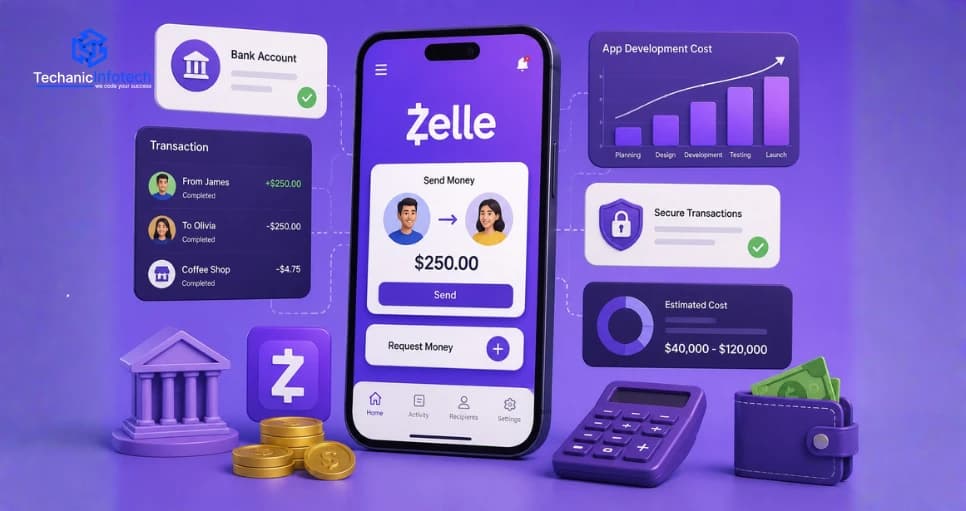
Do you want to make an app like Zelle? Then one of the first questions that may come to your mind is: how much does it cost to develop an app like Zelle?
The answer is not straightforward because building a secure and scalable peer-to-peer payment application requires multiple technologies, integrations, and security systems.
A variety of resources and development efforts go into building an app like Zelle, from payment gateway integrations and backend infrastructure to security compliance and real-time transaction processing.
Every feature and technical component requires proper planning and execution, making the overall development process more complex than a standard mobile application.
However, the biggest advantage is that a well-developed eWallet app can help businesses tap into the rapidly growing digital payments market.
According to Statista, the global digital payments market is expected to exceed $20 trillion by 2028, driven by increasing smartphone usage and growing demand for contactless payments.
As users increasingly prefer instant and secure money transfers, fintech startups and enterprises are heavily investing in peer-to-peer payment applications.
In this blog, we’ll explore the cost to develop an app like Zelle, major development factors, monetization methods, development process, market statistics, and the technologies required to build a secure and scalable fintech application.
Zelle is a peer-to-peer money transfer app that allows users to instantly send money from one bank account to another using a mobile device.
Users can make transactions using:
Mobile numbers
Email addresses
Linked bank accounts
The platform is highly popular because of its:
Real-time transactions
Fast payment processing
Secure money transfers
Simple user interface
Seamless bank integrations
The simplicity and speed of the Zelle platform are so powerful that many users prefer it over traditional third-party payment solutions.
Businesses planning fintech products often work with an experienced eWallet app development company to create scalable and secure payment applications similar to Zelle.
Usually, the cost to develop an app like Zelle ranges between $10,000 to $80,000+ depending on app complexity, security systems, payment integrations, and backend infrastructure.
If you expect features like real-time transfers, fraud prevention systems, and advanced security implementation, the overall budget can increase significantly.
However, building a scalable fintech app opens excellent business opportunities in the rapidly growing digital payments industry.
|
App Type |
Estimated Cost |
Best For |
Key Features |
|
Basic App |
$50,000 – $70,000 |
Startups & MVPs |
User registration, bank linking, money transfers, transaction history, and basic security features |
|
Mid-Size App |
$70,000 – $100,000 |
Growing Businesses |
Real-time payments, push notifications, enhanced UI/UX, payment gateway integration, and multi-factor authentication |
|
Advanced App |
$100,000 – $140,000+ |
Enterprises & Large Fintech Platforms |
AI fraud detection, advanced analytics, multi-bank integrations, enterprise-grade security, and scalable infrastructure |
Several important factors directly impact the total cost to build an app like Zelle.
Let’s understand each factor in detail.
Development time is one of the biggest factors affecting the overall cost to develop an app like Zelle.
The more advanced and feature-rich the application becomes, the more development time it requires.
Features such as:
Real-time payment processing
Secure bank integrations
Fraud detection systems
Multi-factor authentication
Transaction analytics
significantly increase development complexity and effort.
For example, if you want to build a highly scalable fintech application with smooth user experience and enterprise-level security, developers will require additional time for:
Testing
Debugging
API integrations
Security implementation
Performance optimization
Overall, the development timeline for a Zelle-like app generally ranges between 5 to 9+ months depending on app complexity and business requirements.
Businesses often follow a structured ewallet app development timeline to efficiently manage development stages and reduce delays.
|
Development Stage |
Estimated Time |
Factors Affecting Cost & Time |
|
Planning & Research |
2–4 Weeks |
Feature planning, competitor analysis, and fintech market research |
|
UI/UX Design |
4–6 Weeks |
Wireframes, prototypes, and user-friendly interface design |
|
Backend Development |
6–12 Weeks |
Secure infrastructure, database systems, and real-time transaction processing |
|
Frontend Development |
6–8 Weeks |
Mobile interface development for Android and iOS |
|
Integration & Testing |
4–8 Weeks |
API integrations, payment systems, and security testing |
|
Launch Preparation |
2–4 Weeks |
App Store deployment, bug fixes, and optimization |
|
Post-Launch Maintenance |
Ongoing |
Updates, security patches, and performance improvements |
Security is one of the most important aspects of fintech application development.
Since eWallet applications handle sensitive financial information and real-time transactions, businesses must implement advanced security systems to protect user data.
The application should include:
End-to-end encryption
Multi-factor authentication
OTP verification
Tokenization
Fraud detection systems
Device verification
Businesses focusing on best practices for eWallet app security often invest heavily in advanced protection systems and regulatory compliance.
Additionally, fintech applications must comply with standards such as:
PCI DSS
GDPR
Financial security regulations
Data privacy standards
Compliance implementation increases development complexity, testing effort, and overall project cost.
However, investing in strong security infrastructure is essential for protecting transactions and building long-term customer trust.
A robust backend infrastructure is extremely important for handling real-time financial transactions.
Backend systems manage:
Transaction processing
Database communication
User authentication
Payment processing
API integrations
Server scalability
The stronger and more scalable your backend architecture becomes, the higher the development cost.
A poor backend infrastructure can lead to:
Transaction failures
Slow processing
Downtime issues
Security vulnerabilities
Businesses often prioritize scalable eWallet app tech stack solutions to support secure and high-performance transaction processing.
Modern fintech platforms require highly optimized backend systems capable of handling thousands of simultaneous transactions without affecting performance.
Bank and payment gateway integration is one of the most technically challenging parts of fintech app development.
The application must integrate with:
Banking APIs
UPI systems
ACH transfers
Card payment systems
Payment gateways
QR code payment systems
These integrations require advanced backend development and extensive testing to ensure seamless transaction processing.
Businesses often prioritize secure eWallet API integration to support reliable real-time money transfers and smooth financial transactions.
The more banking systems and payment providers you integrate, the more development effort and cost will increase.
This is one of the biggest contributors to the overall cost to develop an app like Zelle.
Platform selection significantly impacts the overall development budget.
Businesses can choose between:
Android app development
iOS app development
Cross-platform development
Developing separate native applications for Android and iOS increases overall costs because each platform requires independent development and testing.
However, cross-platform technologies like:
Flutter
React Native
help businesses reduce development expenses by using a single codebase across multiple platforms.
Choosing the right platform depends on:
Target audience
Business goals
Budget
Scalability requirements
The platform strategy plays an important role in determining the final development cost.
Launching the app is only the beginning.
Regular maintenance and updates are extremely important for ensuring smooth performance and long-term scalability.
Maintenance activities include:
Security updates
Bug fixing
Performance optimization
Compliance updates
Server monitoring
Feature enhancements
Businesses researching how to build an ewallet app often prioritize long-term maintenance planning to support future growth and security improvements.
Annual maintenance costs generally range between 15% to 20% of the total development budget.
Ignoring maintenance can negatively affect security, user experience, and platform performance over time.
User interface and user experience design play a major role in the success of fintech applications.
Users expect payment applications to be:
Fast
Simple
Secure
Easy to navigate
A complicated interface can reduce user engagement and increase app abandonment rates.
Businesses following a strong eWallet app design guide often create more engaging and user-friendly payment applications.
Advanced UI/UX design may include:
Interactive dashboards
Smooth navigation
Custom animations
Personalized user flows
Easy onboarding experiences
Although premium design systems increase development cost, they significantly improve customer satisfaction and retention.
After understanding the cost factors, let’s explore the step-by-step process of building a Zelle-like application.
Before development begins, businesses must clearly define:
App objectives
Core functionalities
Target audience
Security requirements
Monetization strategy
This planning stage helps businesses identify the exact features required for the platform.
Proper planning also reduces future development issues and improves scalability.
User-friendly fintech design is extremely important for improving engagement and customer trust.
Businesses should focus on:
Simple navigation
Fast onboarding
Easy transaction flow
Personalized dashboard experiences
A smooth user experience significantly improves retention and customer satisfaction.
Selecting the right technology stack is essential for building scalable fintech applications.
The infrastructure should support:
Real-time transactions
API integrations
Secure databases
High user traffic
Fraud prevention systems
Many businesses now adopt wallet as a service for ewallet apps to reduce infrastructure complexity and accelerate development speed.
Choosing scalable technologies ensures better long-term performance and security.
Reliable payment gateway integration is extremely important in fintech applications.
The application should support:
Bank transfers
Card payments
UPI payments
Real-time transactions
Payment systems must function smoothly to ensure seamless financial operations and customer trust.
This is the main development stage where frontend and backend systems are developed.
The process includes:
UI development
API integrations
Backend configuration
Security implementation
Database setup
This stage generally consumes the largest portion of the overall development budget because it involves all major technical implementation.
Testing is extremely important in fintech applications.
Businesses must test:
Security vulnerabilities
Payment systems
Transaction speed
User experience
App performance
Fintech applications require extensive testing because even minor security issues can create major financial risks.
Once testing is completed, businesses can launch the app on:
Google Play Store
Apple App Store
Launch preparation includes:
Final optimization
Compliance verification
Marketing campaigns
App Store Optimization
Ongoing support and marketing are extremely important for long-term app growth.
Businesses should invest in:
Performance optimization
User acquisition
Customer support
Security updates
Feature improvements
Strong post-launch strategies help businesses build a scalable and successful fintech platform.
Building a fintech app requires a significant investment, so businesses must also focus on strong monetization strategies.
Businesses researching how ewallet apps make money often combine multiple revenue models to maximize profitability.
Let’s explore some of the most popular monetization methods.
One of the most common monetization methods is charging fees for premium transactions.
For example:
Instant transfers
International payments
Priority transfers
can generate additional revenue.
Users are often willing to pay small fees for faster and more convenient transactions.
Businesses can partner with banks and financial institutions to provide payment infrastructure and fintech services.
These partnerships create long-term revenue opportunities while improving platform credibility.
Merchants accepting payments through the app can be charged transaction commissions.
This revenue model is widely used in fintech and payment applications.
Businesses can offer premium subscription plans with features such as:
Higher transaction limits
Advanced security
Spending analytics
Faster processing
Premium plans help generate recurring revenue.
Fintech applications with large user bases can generate additional revenue through:
Sponsored promotions
In-app advertisements
Partner campaigns
Implementing strong eWallet app monetization strategies helps businesses improve recurring revenue and long-term scalability.
Developing an app like Zelle requires significant investment, advanced security systems, scalable infrastructure, and seamless payment integrations. Depending on app complexity and features, the total development cost may range between $10,000 to $80,000+.
Key factors such as backend infrastructure, bank integrations, platform selection, compliance requirements, UI/UX design, and ongoing maintenance significantly impact the final development budget.
However, as digital payment adoption continues to grow worldwide, investing in a secure and scalable fintech application can create strong long-term business opportunities.
With the right development strategy, scalable technologies, strong security systems, and reliable monetization models, businesses can successfully build high-performing peer-to-peer payment applications that compete effectively in the growing fintech industry.
Developing an app like Zelle typically costs between $10,000 to $80,000+ based on features and complexity.
A Zelle-like app usually takes around 5 to 9 months to develop and launch.
Core features include instant money transfers, bank integration, authentication, notifications, and transaction history.
Technologies like Flutter, React Native, Node.js, AWS, and secure payment APIs are commonly used.
Security protects sensitive financial data and prevents fraud during transactions.
Yes, startups can build a Zelle-like app by starting with an MVP and scaling gradually.
Apps like Zelle earn through transaction fees, subscriptions, and merchant partnerships.
Development cost depends on features, security systems, integrations, platforms, and maintenance requirements.


Abhishek Jangid is the CEO of Techanic Infotech, with extensive experience in mobile app and web development. He specializes in helping businesses turn innovative ideas into scalable digital solutions through strategic planning and modern technology.