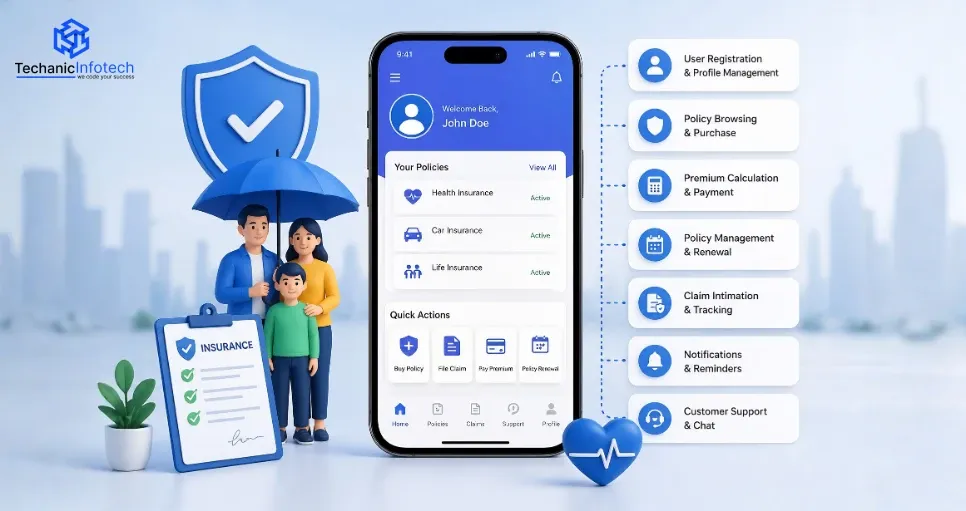
Must-have functionalities include secure login, policy management, premium calculators, online payments, claims submission, document storage, notifications, and in-app support.
AI-powered recommendations, chatbots, real-time claim tracking, telematics integration, fraud detection, voice search, and multi-language support make apps more personalized, secure, and convenient.
A robust admin dashboard allows efficient user management, policy oversight, claims tracking, analytics, notification management, and compliance control, streamlining operations and decision-making.
Multi-factor authentication, encryption, secure payments, and adherence to regulatory standards are critical to protect sensitive customer data and build trust.
App complexity, platform choice, UI/UX design, third-party integrations, and ongoing maintenance influence development cost ($10,000–$90,000+) and timelines (3–9 months).
The insurance industry is rapidly evolving with digital transformation reshaping how customers interact with providers.
Modern users expect convenience, transparency, and instant access to services through mobile platforms.
Insurance apps bridge the gap between insurers and policyholders by offering seamless policy management, quick claims processing, secure payments, and personalized recommendations.
A feature-rich insurance application not only enhances customer experience but also improves operational efficiency for insurers.
From secure login systems to AI-driven policy suggestions, integrating the right functionalities is critical for staying competitive.
Whether you are a startup or an established insurance provider, understanding the must-have features ensures your app delivers value, builds trust, and drives long-term customer engagement in an increasingly digital marketplace.
In 2026, insurance apps are becoming essential as customers demand faster, more convenient, and personalized services.
These apps help insurers streamline operations, improve engagement, and maintain a competitive edge in a digital-first market.
Customers increasingly prefer mobile-first services for convenience and speed. Insurance apps provide instant access to policies, claims, and support.
In 2026 and beyond, businesses without digital platforms risk losing tech-savvy customers who demand seamless experiences.
Insurance apps streamline claim submission, verification, and tracking through automation. This reduces paperwork and manual errors.
Faster claims resolution enhances customer satisfaction and strengthens trust between insurers and policyholders.
Push notifications, personalized offers, and real-time updates keep users actively engaged.
Insurance apps enable continuous interaction, improving retention rates and customer loyalty in competitive insurance markets.
Digital platforms reduce administrative costs by automating processes like underwriting and document verification.
Insurance apps minimize operational expenses while increasing productivity and service efficiency.
Mobile apps collect valuable customer data and usage insights.
Insurers can leverage analytics to personalize services, improve risk assessment, and mobile app design better insurance products.
A robust insurance app differentiates providers in saturated markets.
Advanced features and seamless functionality position insurers as innovative, customer-focused, and future-ready organizations.
An insurance app simplifies managing policies, claims, and payments, giving users quick access to coverage details and instant quotes.
The following are the mobile app features that provide reminders and support, enhancing convenience and overall customer experience.
Secure onboarding with email, phone verification, and multi-factor authentication ensures data protection.
A simple registration process enhances user experience while safeguarding sensitive financial and personal information.
Users should easily view, manage, and update policies within the app.
Centralized dashboards provide clear visibility of coverage details, renewal dates, and premium history.
Customers must be able to purchase new policies and renew existing ones directly through the app.
Automated reminders prevent policy lapses and improve customer retention.
An integrated premium calculator allows users to estimate costs based on coverage preferences and risk factors.
This increases transparency and supports informed purchasing decisions.
Secure payment gateways enable users to pay premiums via credit cards, UPI, net banking, or wallets.
Smooth transactions enhance convenience and trust.
Users can submit claims digitally with the required details and documents.
Real-time tracking ensures transparency and reduces customer anxiety during claim processing.
The app should allow secure uploading and storage of policy documents, ID proofs, and claim forms.
Digital access eliminates paperwork and improves accessibility.
Automated alerts notify users about due payments, claim updates, and policy expirations.
Timely reminders improve engagement and reduce missed deadlines.
Integrated chat support and AI chatbots provide instant assistance for queries and claim guidance.
This improves response time and customer satisfaction.
GPS-enabled locator features help users find nearby agents or branches.
This bridges digital and offline services for enhanced support accessibility.
Advanced features in an insurance app go beyond basics, offering personalized recommendations, AI-powered claim assistance, and real-time policy updates.
These advanced features enhance user engagement, convenience, and overall satisfaction.
AI algorithms analyze user data and preferences to suggest suitable insurance plans. Personalized recommendations improve conversion rates and customer satisfaction.
AI-powered assistants provide 24/7 support, answer FAQs, and guide users through processes. This reduces dependency on manual customer service teams.
Live tracking keeps users informed about claim progress. Transparency reduces stress and enhances overall trust in the insurance provider.
Supporting multiple languages ensures inclusivity and accessibility. It helps insurers expand reach across diverse customer demographics.
Voice-enabled navigation allows users to search policies and services hands-free. It improves accessibility and modernizes the user experience.
Telematics devices and IoT integration enable usage-based insurance models. Real-time data helps insurers assess risk accurately and reward safe behavior.
AI-driven fraud detection systems analyze claim patterns to identify suspicious activities. This reduces financial losses and enhances operational integrity.
The admin panel for insurance providers centralizes management, allowing seamless oversight of policies, claims, and customer data.
It enables providers to track performance, generate reports, manage user access, and ensure smooth operational workflows.
Admins can manage customer profiles, verify documents, and monitor activity. Centralized control improves operational efficiency and data organization.
The admin panel enables creation, modification, and monitoring of policies. Insurers can dynamically update coverage plans and pricing.
Admins track claim status, approvals, and rejections in real time. Automation accelerates claim processing and improves transparency.
Advanced analytics provide insights into user behavior, revenue, and claim mobile app development trends. Data-driven reports support strategic decision-making.
Admins can send alerts, promotional offers, and policy updates. Effective communication enhances engagement and retention.
The panel ensures regulatory compliance, access control, and data protection management. Strong governance safeguards the Insurance app development company and customer data.
Choosing the right Insurance app development partner requires evaluating their industry experience, technical expertise, and portfolio of similar projects.
It's also important to assess their understanding of regulatory compliance, security standards, and their ability to provide ongoing support and updates.
Select a development partner with extensive experience in the insurance domain, including a strong portfolio of successful app deployments.
Domain expertise ensures understanding of industry regulations, workflows, and customer expectations for highly effective solutions.
Ensure the partner demonstrates advanced proficiency in modern mobile app tech stack, such as AI-driven analytics, cloud infrastructure, secure payment integrations, and automation.
Technical expertise guarantees the development of scalable, high-performance, and future-ready insurance applications.
The chosen partner should provide fully scalable and tailored solutions that align with your unique business requirements.
Flexible customization allows integration of specialized features, personalized user experiences, and adaptability to evolving market needs.
Confirm that the partner strictly adheres to global data protection regulations, encryption protocols, and secure coding practices.
Strong security standards protect sensitive customer data, maintain compliance, and build trust in your insurance app.
A reliable development partner offers ongoing mobile app maintenance, technical support, and regular updates.
Continuous post-launch assistance ensures app stability, performance optimization, and seamless feature enhancements over time.
The partner should provide a clear, detailed cost breakdown covering development, integrations, testing, and support.
Transparent pricing prevents unexpected expenses and enables informed budgeting decisions throughout the project lifecycle.
The mobile app development cost depends on factors like app complexity, platform choice (iOS, Android, or both), design requirements, and more.
Additional expenses include backend development, security compliance, testing, and ongoing maintenance.
The overall complexity of an insurance app significantly influences minimum viable product development costs.
Basic applications with limited features may range from $10,000–$25,000, while advanced, feature-rich platforms with AI, automation, and analytics can exceed $90,000 or more.
Choosing between iOS, Android, or cross-platform development directly impacts the total budget.
Building separate native apps for both platforms increases the mobile app development timeline, testing efforts, and maintenance costs compared to a single-platform solution.
A well-crafted, intuitive UI/UX design enhances user engagement but increases overall expenses.
Custom animations, interactive dashboards, personalized interfaces, and extensive user research require additional design hours and specialized expertise, raising development investment.
Integrating third-party services such as payment gateways, banking APIs, CRM systems, AI tools, and analytics platforms adds complexity.
These integrations require secure configuration, licensing fees, and additional development time, increasing the overall Insurance app development cost.
Implementing advanced security measures like end-to-end encryption, multi-factor authentication, and secure cloud hosting requires specialized expertise and rigorous testing.
Ensuring compliance with regulatory standards also demands ongoing audits, significantly increasing development investment.
Post-launch maintenance, bug fixes, performance optimization, feature enhancements, and security updates contribute to long-term costs.
Regular updates ensure smooth functionality, regulatory compliance, and compatibility with new operating system versions.
Insurance mobile apps are no longer optional; they are essential for delivering seamless, secure, and customer-centric services.
By integrating core and advanced features, insurers can improve operational efficiency, enhance engagement, and build long-term trust.
From AI-driven recommendations to real-time claims tracking, technology empowers both customers and providers with transparency and convenience.
However, success depends on choosing the right development strategy, focusing on security, and aligning features with business goals.
Investment in a well-designed insurance app, whether $10,000 or $90,000+, can yield substantial returns through increased customer satisfaction and revenue growth.
As digital adoption accelerates, insurance companies that prioritize innovation and user experience will lead the market and remain competitive in the evolving fintech ecosystem.
Development typically ranges from $10,000 to $90,000+, depending on features, platforms, and complexity.
On average, development takes three to nine months based on scope and integrations.
Yes, with encryption, multi-factor authentication, and compliance protocols, they ensure strong data protection.
Yes, scalable solutions allow small insurers to launch cost-effective mobile applications.
Common technologies include AI, cloud computing, secure APIs, and payment gateway integrations.


Bharat Sharma is the CTO of Techanic Infotech, bringing deep technical expertise in software architecture, mobile app development, and scalable system design. He leads the engineering team with a strong focus on innovation, performance, and security.