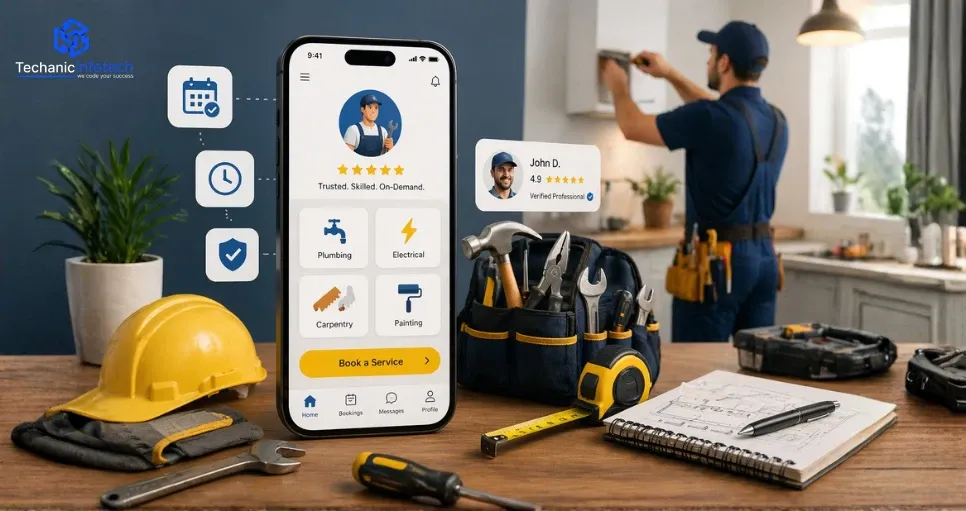
A handyman app is an on-demand service platform that connects customers with verified professionals for home repair and maintenance tasks such as plumbing, carpentry, electrical work, painting, and appliance repair.
It functions similarly to marketplace platforms like TaskRabbit and Thumbtack, where users can book services directly from their smartphones.
The app uses geolocation to match nearby service providers. Secure payment gateways allow online transactions, while real-time notifications keep users updated.
On the service provider side, professionals manage profiles, accept or reject jobs, track earnings, and receive reviews. Admin panels control pricing rules, dispute resolution, and analytics.
Modern handyman apps in 2026 also integrate AI-based recommendations, automated scheduling, and digital invoicing, ensuring convenience, transparency, and efficiency for both customers and service providers.
Handyman apps streamline home services by connecting customers with skilled professionals.
They vary in features, scale, and technology, offering solutions from simple bookings to advanced AI-driven, multi-service platforms.
A single-service handyman app focuses on one niche, such as plumbing or electrical repairs. It allows businesses to specialize and dominate a local market.
This model is easier to manage, requires fewer providers, and ensures high service quality with targeted marketing strategies.
This model offers multiple home services in one platform, similar to Angi. Users can book various services, increasing revenue potential.
It requires advanced filtering, provider management systems, and scalable infrastructure to handle diverse service categories and user traffic.
An aggregator connects independent contractors without employing them directly. The app manages listings, bookings, and payments while professionals remain independent.
This model reduces operational costs and scales faster, making it ideal for startups entering competitive urban markets.
Designed for established service companies, this app supports branded bookings, customer management, and direct communication.
It strengthens brand identity and improves operational efficiency while maintaining full control over pricing, workforce, and service quality.
Customers pay a subscription fee for scheduled inspections and discounted services. It ensures predictable revenue and enhances long-term customer retention.
Built for large property managers or real estate companies, this platform manages bulk service requests, vendor allocation, invoicing, and analytics.
A successful handyman app combines convenience, reliability, and efficiency by offering seamless booking, secure payments, real-time tracking, ratings, and smart mobile app features that enhance user experience for both customers and service providers.
Deliver a seamless and frictionless onboarding experience with quick sign-up options via email, phone number, or social logins.
User profiles should securely store essential information such as saved addresses, booking history, service preferences, and preferred payment methods for faster future transactions.
Empower customers with instant booking capabilities and flexible time-slot selection tailored to their convenience.
Intelligent calendar synchronization prevents scheduling conflicts and optimizes availability management.
Integrate trusted, globally recognized payment gateways such as Stripe and PayPal to ensure secure, encrypted transactions.
Enable automated digital invoicing, transparent refund processing, and escrow protection systems to build confidence and safeguard both customers and service providers.
Implement a transparent and verified review system that empowers customers to make informed decisions.
Authentic feedback builds trust and accountability while motivating service providers to maintain high-quality standards consistently.
Boost engagement with instant notifications for booking confirmations, schedule updates, promotional offers, and service reminders.
Timely, personalized alerts improve user retention, reduce missed appointments, and keep both customers and providers actively connected to the platform.
Equip administrators with a comprehensive dashboard to efficiently manage users, service providers, transactions, disputes, and platform activity.
Integrated analytics and real-time reporting deliver actionable insights into user behavior, revenue trends, and performance metrics, enabling data-driven decisions for optimized pricing, marketing strategies, and sustainable growth.
In 2026, handyman apps are evolving with cutting-edge technologies to offer smarter, faster, and more personalized services.
Advanced features like AI matching, AR diagnostics, and IoT integration are set to redefine convenience and efficiency.
Leverage advanced artificial intelligence to intelligently match customers with the most suitable service professionals based on real-time location, verified expertise, performance ratings, availability, and historical behavior patterns.
Incorporate augmented reality (AR) capabilities that allow customers to share live camera feeds to visually demonstrate issues in real time.
Implement an AI-powered dynamic pricing system that intelligently adjusts service rates based on real-time demand, geographic location, urgency level, seasonal mobile app development trends, and provider availability.
Enable seamless integration with popular voice assistants such as Amazon Alexa, allowing users to book services, check appointment status, receive updates, and manage schedules through simple voice commands.
Utilize blockchain technology to establish secure, tamper-proof smart contracts between customers and service providers.
Integrate with Internet of Things (IoT)–enabled smart home devices to automatically detect maintenance requirements, performance issues, or system malfunctions.
Building a handyman app requires a structured approach to ensure functionality, usability, and scalability.
Following a step-by-step process helps transform your idea into a secure, user-friendly, and market-ready application.
Conduct in-depth market research to evaluate industry demand, customer behavior patterns, emerging trends, and growth opportunities.
Analyze key competitors such as HomeAdvisor to understand their pricing structures, service coverage, strengths, and gaps.
Identify unmet customer needs, pain points, and underserved segments to strategically position your app with a compelling value proposition and clear competitive advantage.
Establish a well-defined monetization strategy by choosing between commission-based, subscription-based, freemium, or hybrid revenue models.
Clearly outline primary and secondary revenue streams, service categories, cost structures, and operational workflows before the mobile app development process begins.
A structured business framework ensures sustainable growth, predictable revenue, and long-term profitability.
Select robust, scalable, and future-ready technologies such as React Native or Flutter for cross-platform development.
Utilize secure and reliable cloud infrastructure to ensure performance, scalability, and data protection.
The backend architecture should support real-time data synchronization, AI-powered features, API integrations, and high user concurrency without compromising speed or stability.
Mobile app design a user-centric interface with clean layouts, seamless navigation, and strategically placed call-to-action elements.
Ensure responsive design across devices while minimizing booking steps to create a frictionless experience.
Incorporate trust-building elements such as verified badges, transparent pricing, ratings, and secure payment indicators to boost user confidence and engagement.
Simultaneously, develop dedicated panels for customers, service providers, and administrators to ensure smooth ecosystem functionality.
Integrate essential features including secure payment gateways, geolocation tracking, booking management APIs, push notifications, and advanced security protocols.
Maintain modular architecture to support future upgrades and feature expansion.
Perform extensive functional, usability, performance, compatibility, and security testing to identify and eliminate potential issues.
Conduct stress testing to ensure scalability under high traffic conditions. Address bugs and vulnerabilities proactively to guarantee a stable, secure, and high-performing application at launch.
Deploy the application across major app stores with optimized App Store Optimization (ASO) strategies to maximize visibility and downloads.
Implement a multi-channel marketing approach including SEO-driven content strategies, targeted social media campaigns, influencer partnerships, paid advertising, and referral programs.
Continuously monitor analytics to refine campaigns and accelerate user acquisition and retention.
In 2026, developing a handyman app requires a modern, scalable, and secure mobile app tech stack.
Choosing the right frontend, backend, database, and cloud solutions ensures high performance, real-time features, and seamless user experiences.
Frontend development ensures a smooth and engaging user experience.
Using cross-platform frameworks like Flutter or React Native allows developers to build a single codebase for both iOS and Android.
Backend minimal viable product development manages data, business logic, and system operations.
Technologies such as Node.js and Django support scalable APIs, real-time features, and secure server-side processing.
Cloud platforms like Amazon Web Services provide scalable hosting, secure storage, and reliable performance.
Features such as auto-scaling, backups, and global content delivery ensure high availability and smooth growth as user demand increases.
Databases like PostgreSQL and MongoDB securely store user data and transactions.
PostgreSQL works well for structured data and complex queries, while MongoDB offers flexible schema design. Choosing the right database improves performance and scalability.
Secure, PCI-compliant payment gateways enable safe transactions between users and providers.
They support card payments, digital wallets, encrypted processing, refunds, and fraud detection, helping build trust and protect financial data.
Strong security measures such as end-to-end encryption, multi-factor authentication, and role-based access control protect user data.
Compliance with regulations like GDPR ensures legal protection and strengthens platform credibility.
The handyman app development cost depends on features, complexity, and technology choices.
Understanding pricing ranges helps businesses plan budgets for MVPs, advanced apps, and enterprise-level solutions.
App development costs vary based on the app’s complexity, features, and scalability requirements.
The table below outlines different development levels, their key features, and estimated costs to help you choose the right option for your needs.
|
Level |
Key Features |
Cost to Develop |
|
Basic MVP |
• Core booking system • Secure payment integration • User registration & login • Profile management • Basic notifications |
$10,000 – $20,000 |
|
Standard App |
• Real-time tracking • Ratings & reviews • Admin dashboard • Enhanced UI/UX • Push notifications |
$20,000 – $40,000 |
|
Advanced App |
• AI-powered recommendations • Advanced analytics • Multi-service marketplace • In-app chat support • Automated workflows |
$40,000 – $60,000 |
|
Enterprise-Level App |
• Custom API/CRM integrations • Scalable cloud infrastructure • Advanced security features • Role-based access control • Business intelligence dashboard |
$60,000 – $90,000+ |
|
Maintenance & Updates (Annual) |
• Bug fixes • Performance optimization • Security updates • Feature enhancements • Technical support |
$5,000 – $15,000 per year |
A Basic Minimum Viable Product typically costs between $10,000 and $20,000 and includes essential features such as core booking functionality, secure payment integration, and user profile management.
A Standard App generally ranges from $20,000 to $40,000 and builds upon the MVP by adding real-time tracking, ratings and reviews, an admin dashboard, and enhanced UI/UX design.
An Advanced App typically has a mobile app development cost range between $40,000 and $60,000 and incorporates AI-powered features, advanced analytics, and multi-service marketplace functionality.
An Enterprise-Level App usually starts at $60,000 and can exceed $90,000 depending on complexity and customization requirements.
Annual maintenance and updates typically range from $5,000 to $15,000, depending on the app’s size and complexity.
Techanic Infotech is the best handyman app development company, having specialisation in building scalable, secure, and AI-powered handyman applications tailored to your business goals.
With expertise in cross-platform development, cloud integration, and modern UI/UX design, the team ensures high-performance solutions aligned with Google’s E-E-A-T and SEO best practices.
From MVP development to enterprise-level platforms, Techanic Infotech provides end-to-end services including strategy consultation, development, testing, deployment, and post-launch support.
Whether you are launching a startup or expanding an existing service marketplace, Techanic Infotech delivers customized solutions that maximize ROI, enhance operational efficiency, and help you dominate the competitive handyman app market in 2026 and beyond.
Building a handyman app in 2026 requires strategic planning, advanced technology integration, and user-centric design.
With growing demand for on-demand home services, investing in a scalable and AI-driven platform offers significant growth potential.
Success depends on choosing the right business model, implementing essential and advanced features, and focusing on security, performance, and customer satisfaction.
From development cost and timeline to monetization and scaling strategies, every step must align with market trends and user expectations.
Development costs range from $10,000 for an MVP to $90,000+ for enterprise-level apps with AI, AR, and advanced integrations.
It typically takes 3–6 months, depending on complexity, features, and customization requirements.
Commission-based and subscription models are most popular, but hybrid models often generate higher long-term revenue.
AI enhances smart matching, pricing, and customer support, making your app more competitive and efficient.
Offer competitive commissions, fast payouts, strong marketing support, and easy onboarding to attract and retain skilled professionals.


Bharat Sharma is the CTO of Techanic Infotech, bringing deep technical expertise in software architecture, mobile app development, and scalable system design. He leads the engineering team with a strong focus on innovation, performance, and security.