Key Takeaways
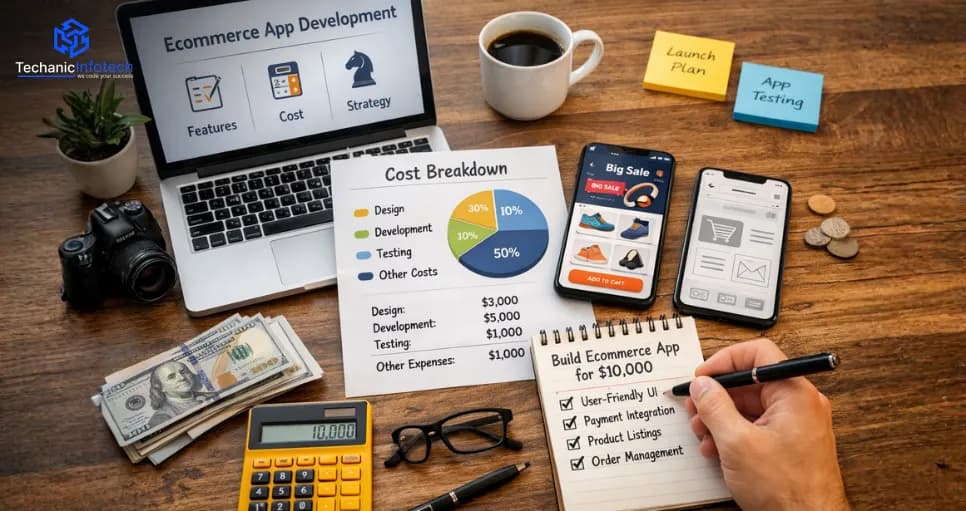
You can build an e-commerce app in $10,000 by focusing on MVP development and essential features instead of full-scale functionality.
The key to controlling the ecommerce app development cost is smart planning, feature prioritization, and choosing the right technology stack.
Using cross-platform development and ready-made integrations helps reduce the cost to build an e-commerce app without compromising quality.
Scaling should be done gradually, start small, validate your idea, and then expand features based on real user needs.
Partnering with an experienced e-commerce app development company can help optimize cost, improve quality, and ensure faster time to market.
Is it really possible to build an ecommerce app for just $10,000 without compromising quality? Many startups and small businesses ask this before starting their journey. The good news is, yes, with the right strategy, it’s achievable.
Understanding the e-commerce app development cost is the first step. Instead of building everything at once, smart businesses focus on MVP development, essential features, and cost-efficient technologies. This approach helps reduce the overall budget while still delivering a functional and user-friendly product.
In this guide, we’ll show you how to build an ecommerce app for $10,000, including features, cost breakdown, and practical strategies to launch and scale successfully.
Building an ecommerce app on a limited budget was difficult a few years ago. But today, with the right approach and modern tools, it’s completely possible to build an ecommerce app for $10,000 without compromising on quality.
Here’s what makes it possible
Instead of building everything at once, businesses focus on launching with essential features like product listing, cart, and checkout. This MVP development reduces initial effort and helps validate the idea quickly.
Modern frameworks allow developers to build apps for both iOS and Android using a single codebase. This saves both time and development cost while maintaining good performance.
Features like payments, login, notifications, and analytics can now be added using existing tools and APIs. This avoids building complex systems from scratch.
Cloud platforms provide flexible backend solutions without heavy upfront investment. You can start small and scale as your app grows.
Careful planning, feature prioritization, and choosing the right team help avoid unnecessary work and reduce overall costs. This is one of the smartest ways to achieve ecommerce app development under $10000.
When you’re trying to build an ecommerce app for $10,000, the key is to focus only on essential features. Instead of adding everything at once, you should prioritize eCommerce app features that deliver real value to users and support basic buying functionality.
Here are the must-have features
A simple and secure login system is essential. Users should be able to sign up using email, phone number, or social accounts. Keep it simple to reduce development time and overall ecommerce app development cost.
Your app should display products in a clean and organized way. Categories and filters help users find what they are looking for quickly. This is the core feature of any ecommerce app and should be designed for easy navigation.
A basic search bar allows users to find products instantly. Even a simple keyword-based search is enough for an MVP. Advanced search can be added later as you scale.
Users should be able to add products to a cart, update quantities, and review their selections before checkout. This is a critical feature that directly impacts conversions.
Integrating a reliable payment gateway is necessary for smooth transactions. Options like cards, wallets, or basic online payments are enough for the initial version. Using ready-made payment APIs helps reduce the cost to build an ecommerce app.
Users should be able to place orders and view their order history. A simple order tracking feature improves user trust and experience.
A basic admin panel allows you to manage products, orders, and users. Keep it simple in the beginning to control the ecommerce app development cost under $10,000.
Building an ecommerce app within a $10,000 budget is possible when you plan every step carefully. Instead of trying to build everything at once, the focus should be on essential features, smart technology choices, and efficient execution.
Here’s a step-by-step breakdown of how your budget is typically distributed.
Every successful app starts with proper planning. This stage includes defining your app idea, target audience, core features, and user flow.
You also decide what to include in your MVP (Minimum Viable Product).
From our experience, businesses that invest time in planning avoid costly changes later. Even with a small budget, this step is crucial to control the overall ecommerce app development cost.
Choosing the right technology stack is one of the smartest ways to control your budget. For a $10K app, it’s important to use cost-efficient and scalable tools.
Frontend: React Native or Flutter (single codebase for iOS & Android)
Backend: Firebase or Node.js (lightweight and scalable)
Database: Firestore or MongoDB
Payment Integration: Stripe, Razorpay, or PayPal
Hosting: AWS, Firebase, or other cloud platforms
Using these technologies reduces development time and keeps the cost to build an ecommerce app within budget. Avoid overcomplicated tech stacks in the beginning, simple and scalable is always better.
UI/UX design is not just about looks, it’s about how users interact with your app. In a $10K budget, the focus is on simple, clean, and functional design rather than complex animations.
Key design elements include:
Home screen layout
Product listing pages
Cart and checkout flow
A well-designed app improves user experience and increases conversions without increasing the cost to build an ecommerce app too much.
Frontend development is what users see and interact with. This includes building screens, navigation, and overall app behavior.
In a budget-friendly app:
Use cross-platform frameworks
Keep UI simple
Avoid heavy animations
This helps reduce development time and keeps the ecommerce app development cost breakdown within limits.
The backend is the core of your app. It handles data, user accounts, product management, and order processing.
For a $10K app:
Use cloud-based backend solutions
Avoid overly complex systems
Focus on scalability for future growth
From our experience, a simple but scalable backend is better than an overbuilt system in the early stage.
When working with a limited budget, the key is to build only what’s necessary. An MVP (Minimum Viable Product) helps you launch faster with essential features and validate your idea in the market.
Must-have features include:
User login/signup
Product catalog
Shopping cart
Payment gateway
Order tracking
From our experience, businesses that focus on MVP first can make low-cost ecommerce app development significant and launch within budget.
Once you start getting users and feedback, you can gradually add new features based on real demand instead of assumptions.
App testing ensures your app works smoothly before launch. This includes:
Bug fixing
Performance testing
Basic security checks
Skipping this step can lead to poor user experience and higher costs later.
This stage includes:
App store submission
Basic setup and configuration
Launch support
It’s a small part of the budget but essential for going live successfully.
After launching an e-commerce mobile app, your app will need the following:
Minor updates
Performance improvements
Bug fixes
Even in a low-budget project, keeping some amount reserved for post-launch is important.
Choosing the right development approach is crucial when you want to build an ecommerce app in $10,000. Native and cross-platform development differ significantly in cost, time, and scalability.
Here’s a detailed comparison to help you decide
|
Factor |
Native Development |
Cross-Platform Development |
|
Development Cost |
$20,000 – $60,000+ (per platform) |
$5,000 – $15,000 (single codebase) |
|
Fits $10K Budget? |
Not feasible (too expensive) |
Yes, ideal for budget apps |
|
Platforms Covered |
Separate apps for iOS & Android |
Single app for both platforms |
|
Development Time |
4–8 months (per platform) |
2–4 months (faster launch) |
|
Codebase |
Separate codebases |
Single shared codebase |
|
Performance |
Excellent (optimized for each platform) |
Good (sufficient for most ecommerce apps) |
|
UI/UX Experience |
Best (platform-specific design) |
Good (slight limitations) |
|
Maintenance Cost |
High (two apps to maintain) |
Low (single codebase updates) |
|
Scalability |
High (ideal for complex apps) |
Moderate to high |
|
Best For |
Large-scale apps with high budget |
Startups, MVPs, and budget-friendly apps |
Key Insight
Native development offers top performance but exceeds a $10K budget.
Cross-platform is the best choice if you want to reduce ecommerce app development cost and launch faster.
From our experience, most startups begin with cross-platform and later move to native as they scale.
Let’s make this practical. If you have a budget of $10,000, what kind of e-commerce app can you actually build? The answer is a clean, functional MVP that is ready to launch and start generating revenue.
Imagine you’re building a fashion ecommerce app for a startup brand. Instead of trying to compete with large platforms, you focus on essential features that help users browse and purchase products.
With a $10K budget, your app can have:
User registration and login (email/social login)
Product listing with categories (e.g., men, women, accessories)
Basic search functionality
Product detail pages with images and pricing
Shopping cart and checkout
Payment integration (Stripe or similar)
Order history for users
A simple admin panel to manage products and orders
These features are enough to create a complete buying experience without increasing the ecommerce app development cost unnecessarily.
To stay within budget, the app is developed using:
Cross-platform technology (one codebase for iOS & Android)
Ready-made APIs for payments and authentication
Cloud backend (like Firebase) instead of custom infrastructure
This approach reduces the cost to build an ecommerce app while keeping the app scalable for future updates.
To stay within $10,000, you avoid advanced features like:
AI-based product recommendations
Advanced analytics dashboards
Multi-vendor marketplace functionality
Complex loyalty programs
These can be added later once your app starts generating revenue.
From our experience, apps built this way can:
Launch within 2–3 months
Start acquiring early users
Generate initial sales
Provide real user feedback
This helps businesses improve the product step by step instead of investing heavily upfront.
Launching your app is just the beginning. The real growth starts after you go live. If you’ve built your app with a $10K budget, scaling it the right way helps you turn a basic MVP into a strong and profitable ecommerce platform.
Before making any changes, it’s important to understand how users are interacting with your app.
Look at which products are getting the most attention, where users drop off during the journey, and which features are used the most. From our experience, scaling based on real data helps you make smarter decisions and avoid unnecessary development costs.
Instead of adding multiple features at once, focus on improving your app step by step. Start by introducing features like wishlists, product recommendations, reviews, and notifications based on user needs.
This phased approach helps you manage the cost to build an ecommerce app while improving user experience over time.
As your user base grows, your app must handle increased traffic smoothly. Optimizing loading speed, improving backend performance, and upgrading hosting when required are essential steps. A faster app not only improves user experience but also increases conversions.
If your app is available on only one platform, consider expanding to others. Launching on iOS, Android, or even a web version helps you reach a larger audience and grow your business faster. This step is important for long-term scalability.
Once you have a steady user base, focus on improving your revenue model. You can introduce subscriptions, premium features, or loyalty programs to increase user spending and overall profitability.
Building an ecommerce app on a budget requires smart planning. However, many businesses unknowingly make mistakes that increase the overall mobile app development cost.
Here are some common mistakes and how you can avoid them
One of the biggest mistakes is trying to build a fully loaded app from day one. Adding advanced features like AI recommendations, multiple payment options, or complex dashboards increases both time and cost.
How to avoid it: Start with an MVP and focus only on essential features. You can always add advanced functionality later based on user feedback.
Jumping into development without clear goals often leads to confusion, rework, and delays. This directly increases the cost to build an ecommerce app.
How to avoid it: Spend time defining your features, user flow, and business goals before development starts. A clear roadmap saves both time and money.
Using overly complex or unsuitable technologies can increase development time and maintenance costs, especially when implementing compliance features like transaction screening.
How to avoid it: Choose simple, scalable, and cost-effective technologies that match your project needs. From our experience, a lightweight tech stack works best for budget-friendly apps.
Many businesses underestimate the importance of design and either skip it or redo it later. This leads to poor user experience and additional redesign costs.
How to avoid it: Invest in a simple, user-friendly design from the beginning. A clean UI improves conversions and reduces future changes.
Building an app without considering future growth can lead to expensive upgrades later. As your user base grows, your app may struggle to handle traffic.
How to avoid it: Use scalable architecture and cloud solutions from the start. This helps you expand without significantly increasing the ecommerce app development cost breakdown.
Startups today are increasingly choosing low-cost solutions and working with a reliable ecommerce app development company to launch faster and reduce risk.
Here’s why this approach is becoming popular
Startups operate with limited budgets, so investing heavily in the beginning can be risky.
A low-cost approach allows them to launch quickly, test their idea, and make improvements based on real user feedback. This strategy helps avoid unnecessary spending and improves decision-making.
The ecommerce industry is growing rapidly, making it attractive for startups. The global ecommerce app market is expected to reach $3.48 trillion in 2026.
This growth encourages startups to enter the market quickly using budget-friendly solutions instead of waiting for large investments.
Mobile commerce is dominating the market, with 57% of global e-commerce sales happening through mobile devices. Apps also drive higher engagement, with users spending significantly more time compared to websites
Low-cost development allows startups to build an MVP first and scale later. Instead of building a full product, they focus on core features and expand based on user demand.
Many ecommerce app development companies follow this approach to help startups manage costs while building scalable products.
Startups need to manage cash flow carefully. A low-cost ecommerce app helps them allocate budget to other areas like marketing and user acquisition. This balanced approach improves ROI and ensures sustainable growth without overspending on development.
Building an ecommerce app within a $10,000 budget is not only possible but also a smart strategy for startups and growing businesses. The key is to focus on essential features, choose the right technology, and follow an MVP-first approach.
From our experience, businesses that start small and scale gradually are more likely to succeed than those that invest heavily upfront without validation.
By understanding the ecommerce app development cost breakdown, prioritizing features, and working with the company, you can launch a functional app and grow it over time.
With the right planning and execution, a budget-friendly ecommerce app can become a scalable and profitable digital business.
Yes, it is possible to build an ecommerce app for $10,000 by focusing on essential features and using an MVP approach. Advanced features can be added later as your business grows.
You can include core features like user login, product listing, search, cart, payment integration, and order tracking. These are enough to launch a functional app.
A basic ecommerce app can be developed in 2 to 3 months, depending on features and the development approach.
The ecommerce app development cost can range from $10,000 to $100,000+, depending on complexity, features, and platform.
You can reduce the cost to build an ecommerce app by using cross-platform development, prioritizing essential features, and integrating ready-made APIs.
Yes, cross-platform development is ideal for budget projects as it uses a single codebase, reducing both time and cost.
Yes, a basic admin panel is important to manage products, orders, and users, even in a low-cost ecommerce app.
Technologies like React Native, Flutter, Firebase, and Node.js are commonly used for low cost ecommerce app development.
Yes, you can start with a basic version and gradually add advanced features as your user base grows.
Yes, working with an experienced ecommerce app development company ensures better quality, faster delivery, and cost optimization.
Hidden costs include maintenance, hosting, third-party APIs, updates, and marketing expenses after launch.
A $10K app is a great starting point. With proper scaling, updates, and strategy, it can grow into a successful and profitable platform.


Abhishek Jangid is the CEO of Techanic Infotech, with extensive experience in mobile app and web development. He specializes in helping businesses turn innovative ideas into scalable digital solutions through strategic planning and modern technology.