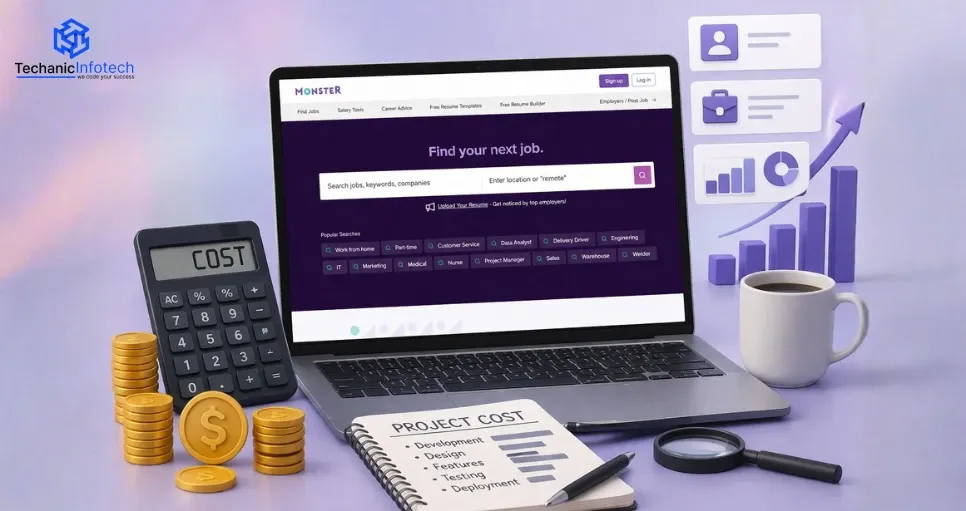
Job Portal App Development
Cost to Build a Job Portal Like Monster: Complete Pricing Guide for 2026
April 8, 2026
April 8, 2026
Key Takeaways
Building a job portal like Monster typically costs between $10,000 and $90,000+, depending on features, scalability, integrations, and whether you develop a basic MVP or an advanced AI-powered platform.
Core features such as job posting, resume uploads, advanced search filters, dashboards, and messaging are essential to ensure smooth interaction between employers and job seekers.
The technology stack including front-end, back-end, database, and cloud infrastructure—directly impacts performance, scalability, security, and long-term maintenance costs of the job portal.
Development time ranges from 2–3 months for basic platforms to 6–9 months for advanced portals with AI matching, analytics, and third-party integrations.
Ongoing costs like maintenance, hosting, updates, and marketing are crucial and can range from $5,000 to $20,000 annually to ensure growth and platform stability.
Monetization strategies such as job posting fees, subscriptions, featured listings, and resume database access help generate consistent revenue and improve long-term business sustainability.
Building a job portal like Monster requires strategic planning, advanced technology, and a scalable infrastructure.
The total cost depends on features, design complexity, integrations, and development location.
A basic job board with limited functionality may cost significantly less than a fully featured platform with AI-powered job matching, resume parsing, and analytics dashboards.
Development expenses typically include UI/UX design, front-end and back-end development, database setup, third-party integrations, testing, deployment, and ongoing maintenance.
Businesses must also consider cloud hosting, security compliance, and post-launch marketing.
On average, the cost to build a job portal like Monster ranges between $10,000 and $90,000+, depending on customization, scalability requirements, and the level.
Proper planning and choosing an experienced development partner can optimize costs while ensuring long-term growth and performance.
The global job board software market was valued at USD 504.52 million in 2024 and is projected to reach USD 875.98 million by 2032 with a 7.14 % CAGR (2026–2032).
Job board software has evolved into advanced recruitment platforms with AI, predictive analytics, and automated workflows.
There’s strong adoption of cloud-based SaaS solutions and AI/machine learning for smarter candidate matching and resume parsing.
More than 55 % of job seekers use mobile devices, making mobile-friendly interfaces essential.
Growth in remote work and the gig economy is reshaping job board requirements and features.
A job portal like Monster delivers a bridge between job seekers and employers.
In terms of making an app like this, one should consider job portal app features that make the application more effective.
This feature allows job seekers and employers to create accounts using email, phone, or social login.
Candidates can add education, skills, certifications, and work experience. Employers can showcase company details and branding elements.
Secure authentication and profile management ensure personalized and seamless user experiences.
Advanced search functionality helps candidates find jobs using keywords, location, salary range, industry, and experience level. Smart filters enhance user experience by narrowing results instantly.
Geo-location and AI-powered suggestions further refine results, increasing application relevance and engagement rates.
Users can upload resumes in multiple formats or create one using the built-in resume builder tools. Resume parsing extracts skills and qualifications automatically.
Templates, formatting options, and keyword optimization improve applicant visibility and enhance hiring chances significantly.
Employers access a centralized dashboard to manage job listings, review applications, shortlist candidates, and track hiring progress.
Analytics tools provide insights into application rates and job performance. The dashboard improves hiring efficiency and decision-making through real-time data.
Employers can create, edit, and manage job listings with detailed descriptions, requirements, and salary information.
Automated expiration dates and renewal options simplify listing management. Paid promotions and featured job placements can increase visibility and attract qualified candidates.
AI-powered matching algorithms analyze candidate profiles and job descriptions to recommend relevant opportunities.
Skill-based filtering, semantic search, and automated ranking improve recruitment efficiency.
This feature reduces manual screening and enhances the quality of matches.
In-app messaging enables direct communication between employers and candidates.
Real-time notifications inform users about application status, new job postings, and interview requests.
Push notifications and email alerts increase engagement and reduce response delays.
The admin panel controls platform operations, user management, job approvals, and analytics monitoring.
Admins can manage subscriptions, moderate content, and oversee payments. Security tools and reporting dashboards ensure smooth platform governance and regulatory compliance.
A well-planned tech stack is essential for building a scalable, secure, and SEO-optimized job portal with the help of a reliable job portal development company.
Choosing the right combination of frontend, backend, database, and cloud technologies ensures performance, reliability, and strong search visibility.
React, Angular, or Vue.js enable dynamic, responsive interfaces. HTML5, CSS3, and JavaScript frameworks create a job portal like Indeed with seamless user experiences across devices.
Mobile responsiveness ensures accessibility and improved engagement for job seekers and recruiters.
Node.js, Django, Ruby on Rails, or Laravel handle server-side logic and data processing.
These technologies ensure scalability, secure authentication, and smooth API integrations for job searches and resume parsing.
MySQL, PostgreSQL, or MongoDB store user data, job listings, and applications securely.
Cloud-based database hosting ensures reliability, data backup, and scalability to support high user traffic.
AWS, Google Cloud, or Azure provide scalable infrastructure, load balancing, and storage.
Cloud hosting ensures high availability, performance optimization, and disaster recovery capabilities.
Elasticsearch enables fast job searches. AI-based resume parsing and recommendation engines enhance the accuracy of job-candidate matching and personalization.
SSL encryption, OAuth authentication, and secure payment gateways such as Stripe or PayPal ensure secure transactions and data protection compliance.
Building the app like Monster involves costs for job portal app design, development, database setup, hosting, security, and many more.
The following is the table that shows the development cost estimation of a job portal app like Monster.
|
Level / Stage |
Key Features |
Estimated Cost |
|
Basic |
User registration, job posting, resume uploads, and keyword search |
$10,000 – $20,000 |
|
Intermediate |
Employer dashboards, payment gateways, advanced filters, structured job data, improved UI/UX |
$20,000 – $45,000 |
|
Advanced |
AI-based recommendations, ATS integration, multi-language support, API connections, cloud scalability |
$45,000 – $90,000 |
|
Maintenance |
Performance optimization, security updates, bug fixes, database management, SEO audits |
$5,000 – $15,000 per year |
|
Post Launch |
SEO campaigns, content marketing, paid ads, CRO optimization, analytics improvements |
$5,000 – $20,000 per year |
A basic job portal typically costs between $10,000 and $20,000, covering essential features like user registration, job posting, resume uploads, and keyword search.
It uses pre-built templates and standard security protocols.
This level suits startups validating ideas while ensuring mobile responsiveness, fast loading speeds, and foundational SEO setup for indexing.
An intermediate job portal usually ranges from $20,000 to $45,000, depending on customization and integrations.
It includes employer dashboards, payment gateways, advanced filters, structured job data markup, and improved UI/UX.
The infrastructure supports moderate traffic, stronger security practices, analytics tracking, and optimized site architecture aligned with Google indexing guidelines.
An advanced job portal costs approximately $45,000 to $90,000, depending on scale and automation needs.
It includes AI-based recommendations, ATS integration, multi-language capability, API connections, and cloud-native scalability.
Enterprise-grade security, structured data compliance, high-performance hosting, and technical SEO optimization ensure strong authority, trustworthiness, and global reach.
Annual maintenance generally costs $5,000 to $15,000, depending on complexity and traffic volume.
This includes performance optimization, security updates, bug fixes, database management, and SEO audits.
Ongoing monitoring improves uptime, protects sensitive user data, and ensures compliance with evolving search engine algorithms and data regulations.
Post-launch investment typically ranges from $5,000 to $20,000, focusing on SEO campaigns, content marketing, paid ads, CRO optimization, and analytics improvements.
Continuous performance testing, structured data validation, and backlink development strengthen domain authority, improve rankings, and align the app with platform guidelines.
Cost estimates by AI-powered job portal development steps help businesses understand budget allocation for each phase, including planning, design, development, testing, and deployment.
Meanwhile, the cost estimation ensures transparent investment planning and efficient resource management throughout the project lifecycle.
The following table shows the cost estimation of developing job portals like Monster
|
Development Phase |
Key Features / Tasks |
Estimated Cost |
|
UI/UX Design |
Wireframes, prototypes, user research, and responsive layouts |
$2,000 – $5,000 |
|
Front-End Development |
Interactive UI, semantic code, mobile-first optimization, schema-ready layouts |
$2,000 – $6,000 |
|
Back-End Development |
Server logic, database architecture, authentication, API integration, security protocols |
$3,000 – $10,000 |
|
Testing & QA |
Functional testing, security checks, performance audits, and device compatibility |
$1,000 – $4,000 |
|
Project Management |
Sprint planning, documentation, milestone tracking, and coordination |
$1,000 – $3,000 |
|
Deployment & Hosting |
SSL, CDN, cloud hosting, backups, and uptime monitoring |
$1,000 – $4,000 annually |
UI/UX design generally requires $2,000 to $5,000 within a structured $10,000+ job portal development budget. This includes wireframes, prototypes, user research, and responsive layouts.
A well-designed interface enhances accessibility, reduces bounce rates, improves crawlability through structured navigation, and supports long-term engagement and search performance.
Front-end development typically costs $2,000 to $6,000, depending on interactivity and responsiveness requirements.
Clean, semantic code improves Core Web Vitals and ensures mobile-first optimization.
Proper heading structures, schema-ready layouts, and fast-loading components enhance indexing efficiency and user experience.
Back-end development may require $3,000 to $10,000, depending on system complexity.
It includes server logic, database architecture, authentication, API integrations, and security protocols.
Optimized queries, caching mechanisms, and scalable infrastructure improve reliability, data protection, and performance under growing traffic demands.
Testing and quality assurance for mobile app development cost $1,000 to $4,000, covering functional testing, security checks, performance audits, and device compatibility validation.
Thorough QA reduces technical errors, improves page speed stability, ensures structured data accuracy, and strengthens trust signals essential for search engine credibility.
Project management typically ranges from $1,000 to $3,000, depending on timeline and team size.
It includes sprint planning, documentation, milestone tracking, and coordination.
Structured workflows reduce delays, prevent scope creep, and ensure the final product aligns with business objectives and SEO best practices.
Deployment and hosting generally require $1,000 to $4,000 annually, depending on server capacity and traffic.
This includes SSL configuration, CDN setup, cloud hosting, backups, and uptime monitoring.
Reliable hosting improves loading speed, security, and crawl consistency critical for ranking and long-term scalability.
Development cost depends on platform complexity, feature set, technology stack, third-party integrations, customization level, FlexJobs's app development team location, and many more.
The following is the list of factors that directly affect the cost of developing a job portal like Monster.
The broader the feature set, the higher the investment. Basic portals cost less, while AI matching, ATS modules, multilingual support, and automation increase development hours.
Feature complexity directly impacts infrastructure needs, testing requirements, compliance standards, and long-term SEO architecture.
Choosing modern, scalable technologies can increase upfront cost to build a job portal, but reduce long-term maintenance risks.
Open-source frameworks lower licensing fees, while enterprise systems add reliability but increase expenses.
Cloud infrastructure, database type, and integration capabilities significantly influence performance and operational sustainability.
Custom research-based design increases cost but enhances credibility and engagement.
Accessibility compliance, mobile-first structure, optimized navigation, and fast-loading assets improve search visibility.
A professionally designed interface builds trust, strengthens brand authority, and supports higher conversion rates.
Costs vary based on geographic location and expertise level. Teams in North America and Western Europe often charge higher rates than those in Asia or Eastern Europe.
Experienced developers ensure secure architecture, SEO-friendly coding practices, and scalable system design.
Integrating payment gateways, CRM systems, email automation, analytics tools, and ATS platforms increases cost due to API development and security validation.
Each integration requires testing, compliance checks, and performance optimization to maintain reliability and search performance.
Ongoing updates, feature improvements, and security enhancements require recurring budgets.
Regular SEO audits, content refreshes, database optimization, and infrastructure scaling ensure consistent growth.
Continuous improvement strengthens user trust, protects rankings, and prevents costly technical failures.
Job portals connect employers with talent and generate revenue through diverse monetization models.
These include job posting fees, subscriptions, advertising, resume database access, and premium services for recruiters and job seekers.
Employers pay a fixed fee to publish a single job listing for a specific duration.
This is one of the most common revenue models used by platforms like Indeed.
It works well for companies with occasional hiring needs and ensures predictable revenue per listing for the portal.
Companies pay a recurring monthly or annual fee to post multiple jobs, access candidate databases, and use advanced hiring tools.
Platforms like LinkedIn offer tiered recruitment subscriptions.
This model ensures steady, predictable revenue and encourages long-term client relationships.
Instead of paying per listing, employers pay for each qualified application received.
This performance-based model reduces risk for recruiters and increases accountability for the portal.
Portals like ZipRecruiter leverage performance-based pricing, making it attractive for small and medium-sized businesses.
Employers can pay extra to highlight job postings at the top of search results or on the homepage.
Similar to promoted listings on Monster, this boosts visibility and applicant flow. It provides an additional upselling opportunity beyond standard job posting fees.
Job portals can charge recruiters for access to a searchable database of candidate resumes. Companies pay to unlock contact details or download resumes.
Platforms such as Naukri.com generate significant revenue from resume database subscriptions, especially in competitive hiring markets.
Job portals can sell banner ads, company profile pages, or branded employer campaigns.
Large platforms like Glassdoor monetize through employer branding packages that showcase company culture, reviews, and job openings.
This model attracts companies looking to strengthen their talent acquisition brand.
Building a job portal typically takes three to six months, depending on features, technology stack, customization level, and integrations.
Mobile app development time varies based on team size, complexity, testing requirements, and scalability goals.
A simple job portal with essential features like job posting, resume uploads, search filters, and user registration typically takes 2–3 months.
This includes UI/UX design, backend development, testing, and deployment. Ideal for startups launching an MVP with limited features and minimal third-party integrations.
A mid-level job portal with advanced search, employer dashboards, payment integration, and email notifications usually requires 3–6 months.
Additional features like applicant tracking systems (ATS), admin panels, and analytics increase development time but offer better scalability and user experience.
A large-scale job portal similar to Indeed or LinkedIn may take 6–9 months or more.
Features like AI-based recommendations, real-time messaging, video interviews, and high-security infrastructure significantly extend development timelines.
Development time increases based on custom requirements such as multilingual support, geolocation-based job matching, or integration with HR tools.
The more personalized the workflow and automation, the longer the design, development, and testing phases will take.
A skilled and experienced development team can speed up the process.
A dedicated team of developers, designers, and testers working full-time may complete the project faster compared to freelancers or part-time contributors handling multiple projects simultaneously.
Security testing, GDPR compliance, and performance optimization can extend timelines.
Ensuring data protection, secure payment gateways, and scalability requires multiple app testing phases before launch, especially if targeting global users.
Building a job portal like Monster requires careful planning, technical expertise, and a scalable infrastructure strategy.
The total investment varies based on features, integrations, AI capabilities, and security requirements.
While a basic platform can launch within a moderate budget, advanced portals with automation and intelligent matching require higher investment but offer long-term competitive advantages.
Focusing on user experience, mobile responsiveness, structured data, and SEO optimization ensures better visibility and sustainable growth.
Additionally, choosing the right development partner significantly impacts project efficiency, security compliance, and future scalability.
With proper monetization strategies and ongoing optimization, a well-built job portal can become a highly profitable digital recruitment platform in today’s expanding global employment market.
Cost for developing a job portal like Monster usually ranges from $10,000 to $90,000+ that may fluctuate as per the complexity of the app, whether it's basic, intermediate, or advanced level, including maintenance cost.
Developing a job portal app typically takes 3–6 months for a basic version and 6–12 months for advanced features like AI matching, messaging, and integrations, depending on complexity and team size.
Essential features include user registration, profile creation, resume upload, job posting, advanced search filters, application tracking, messaging, notifications, employer dashboards, admin panel, and secure payment integration for premium listings.
Yes, AI significantly improves job portals by enabling smart job-candidate matching, resume screening, skill analysis, chatbots, salary prediction, fraud detection, and personalized recommendations, enhancing hiring efficiency and user experience.
Reduce costs by starting with an MVP, using cross-platform frameworks, leveraging cloud services, integrating third-party APIs, outsourcing strategically, reusing open-source tools, and prioritizing essential features before scaling functionality.
A complete pricing breakdown includes UI/UX design, front-end and back-end development, database setup, API integrations, testing, deployment, and maintenance costs.
You can estimate costs by dividing the project into phases such as design, development, testing, deployment, and post-launch maintenance, each with its own budget allocation.
AI features like resume parsing, job recommendations, and chatbots increase development costs but significantly improve user experience and hiring efficiency.
Choose a company based on experience, portfolio, technology expertise, client reviews, scalability approach, and post-launch support services.


Bharat Sharma is the CTO of Techanic Infotech, bringing deep technical expertise in software architecture, mobile app development, and scalable system design. He leads the engineering team with a strong focus on innovation, performance, and security.